](https://deep-paper.org/en/paper/2410.18393/images/cover.png)
When the next global health crisis hits, the first warning signs likely won’t appear in an official government report or a World Health Organization press release. Instead, they will appear in a tweet, a Weibo post, or a status update, buried within the noise of billions of social media interactions.
Social media acts as a real-time sensor for societal trends, including public health. However, there is a significant language barrier in our current automated monitoring systems. Most existing Artificial Intelligence (AI) tools designed to track epidemics focus almost exclusively on English. But viruses do not respect borders, and they certainly don’t wait for translation. An outbreak starting in a rural region of a non-English-speaking country might be discussed intensely in the local language weeks before it hits English news feeds.
This brings us to a groundbreaking paper titled SPEED++, which introduces a multilingual framework designed to bridge this gap. The researchers have developed a system that can extract detailed epidemic information across dozens of languages—even those it wasn’t explicitly trained on—potentially buying policymakers weeks of critical preparation time.
The Problem: Beyond English and Beyond Keywords
Early attempts at using social media for disease detection were relatively simple. They mostly relied on counting keywords (like “flu” or “fever”) or simple binary classification (is this tweet about an epidemic: yes/no?).
While useful, these methods lack nuance. Knowing that people are talking about “sickness” isn’t enough. To understand an unfolding crisis, epidemiologists need specific details:
- Who is infected?
- What are the symptoms?
- Where is it happening?
- How are people trying to cure it?
This is where Event Extraction (EE) comes in. EE goes beyond simple detection; it identifies specific “triggers” (words indicating an event happened) and “arguments” (the details surrounding that event).
However, previous works like the original SPEED framework were limited to English. The new SPEED++ framework tackles two massive challenges simultaneously:
- Multilinguality: Detecting events in languages like Hindi, Spanish, and Japanese without needing massive annotated datasets for each one.
- Granularity: Moving from simple detection to Event Argument Extraction (EAE), which pulls out detailed roles like “victim,” “location,” and “prevention method.”
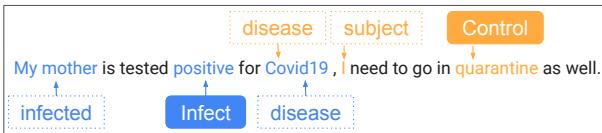
As shown in Figure 2 above, the difference is clear. A simple system sees a sentence about COVID-19. SPEED++ sees a structured web of information: a Subject (I), a Disease (Covid-19), an Infect event (tested positive), and a Control event (quarantine).
Building the Foundation: The Ontology and Dataset
To teach an AI how to understand epidemics, you first have to define what an epidemic looks like in data. The researchers created a comprehensive Ontology—a structured map of concepts.
They defined 7 Event Types (such as Infect, Spread, Symptom, Cure) and associated them with 20 Argument Roles.
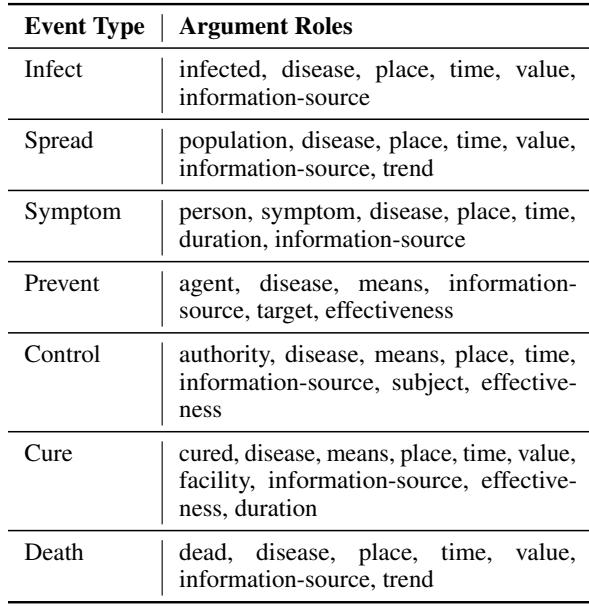
As detailed in Table 1, this ontology allows the system to be incredibly specific. It doesn’t just look for “death”; it looks for the Death event and extracts the specific Disease, Place, and Count (Value) associated with it.
The Data Bottleneck
Creating a dataset to train this kind of model is expensive. It requires bilingual experts to manually read thousands of tweets and label every specific argument. It is infeasible to do this for every language on Earth.
To overcome this, the researchers created the SPEED++ Dataset. They focused on four diverse languages—English, Spanish, Hindi, and Japanese—and four different diseases—COVID-19, Monkeypox, Zika, and Dengue.
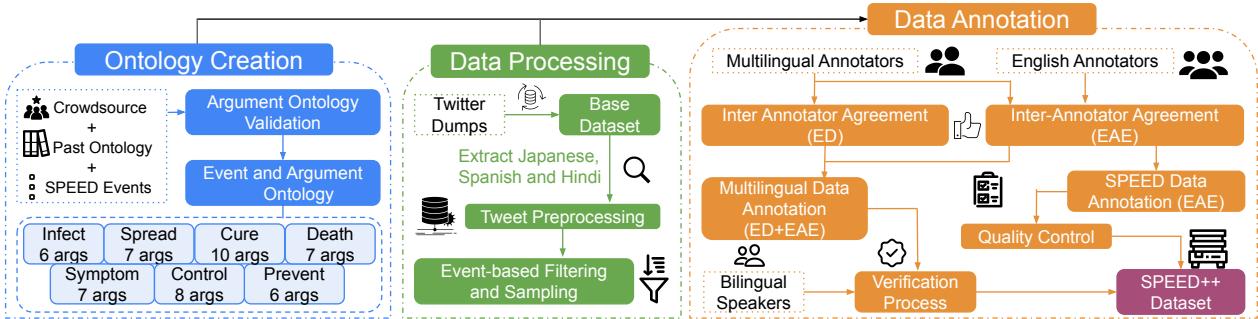
Figure 3 illustrates this rigorous pipeline. They started with raw Twitter dumps, filtered them using keywords and seed sentences, and employed human experts to annotate the data. This resulted in a high-quality dataset of over 5,000 tweets. However, 5,000 tweets aren’t enough to cover the whole world. This is where the modeling innovation comes in.
The Core Method: Zero-Shot Cross-Lingual Transfer
The most impressive aspect of SPEED++ is its ability to perform Zero-Shot Cross-Lingual Transfer.
In machine learning, “Zero-Shot” means the model can perform a task it hasn’t explicitly seen during training. In this context, the researchers trained their model only on English COVID-19 data. They then asked the model to find epidemic events for different diseases (like Monkeypox) in different languages (like Hindi or Japanese).
How is this possible?
The researchers utilized a powerful combination of techniques:
- Multilingual Pre-training: They used base models (like XLM-RoBERTa) that have already “read” text in hundreds of languages. These models understand that the concept of “virus” in English is semantically similar to “virus” in Spanish or “病毒” in Chinese, even if the words look different.
- TagPrime: This is the specific architecture used for extracting the events. It treats the extraction process as a sequence labeling task.
- CLaP (Contextual Label Projection): To further bridge the language gap, they used a data augmentation technique. They took the English training data and “projected” it into other languages to create pseudo-training data. This gives the model a “rough draft” of what the target language looks like before it even sees real data.
Putting it to the Test
The researchers compared SPEED++ against several baselines, including a keyword-based system, a standard epidemiological tool (COVIDKB), and even GPT-3.5-turbo.
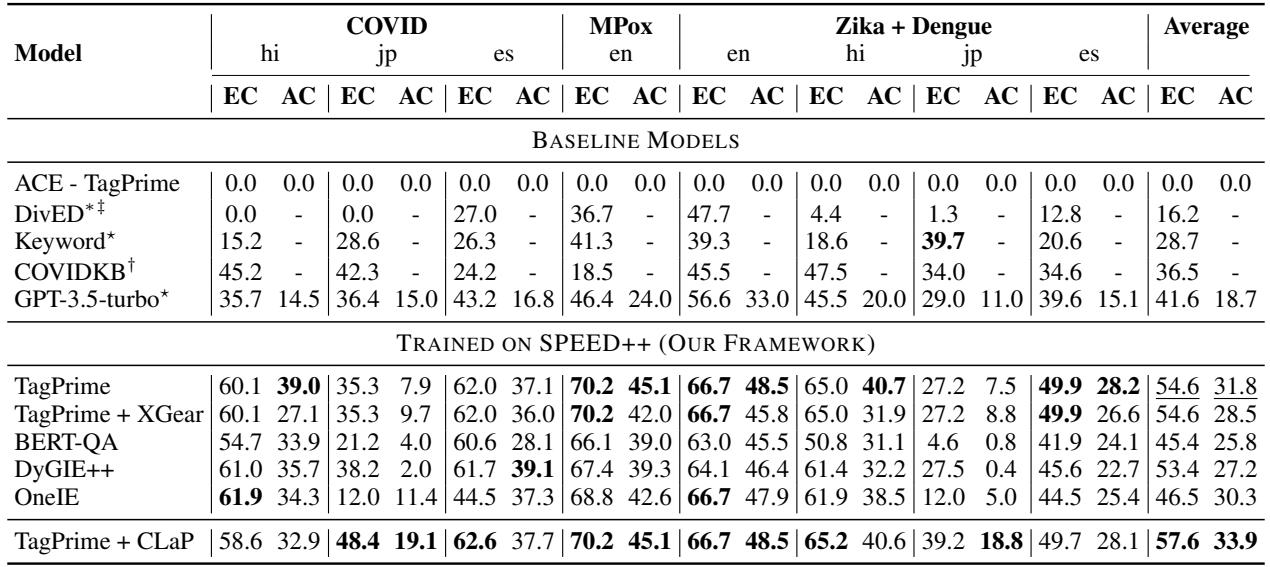
The results, shown in Table 5, were decisive. The TagPrime + CLaP model (the bottom row) consistently outperformed the baselines. While GPT-3.5 is a powerful generalist, it struggled with the specific structured extraction required here, especially in non-English languages. The SPEED++ framework achieved significantly higher F1 scores (a measure of accuracy), proving that specialized, architecturally sound models are still superior to general LLMs for this type of detailed extraction task.
Real-World Impact: Predicting the Past
To prove the utility of their framework, the authors conducted a fascinating “historical” experiment. They applied their model—which was trained on English data—to Chinese Weibo posts from December 2019 and January 2020. This was the critical window when COVID-19 was emerging in Wuhan, but before it was declared a global pandemic.
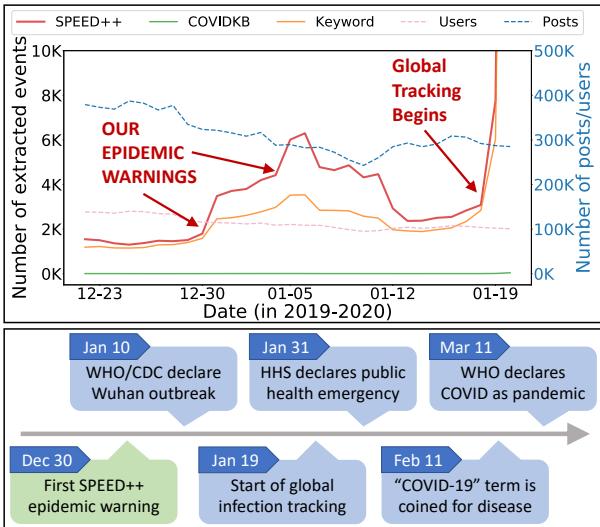
Figure 1 tells a compelling story.
- The Red Line (SPEED++): Look at the sharp spike in extracted events around December 30, 2019.
- The Bottom Timeline: This warning signal appears three weeks before global infection tracking officially began (Jan 19) and months before the WHO declared a pandemic.
The model successfully identified the surge in “pneumonia of unknown origin” discussions in Chinese, purely based on its training on English COVID concepts. This suggests that had SPEED++ been active and monitoring global feeds in 2019, it could have provided an early warning signal that official channels missed.
Global Scale and Misinformation Detection
The utility of SPEED++ isn’t limited to a single language. To demonstrate scale, the researchers ran the model on a snapshot of Twitter data covering 65 languages across 117 countries.
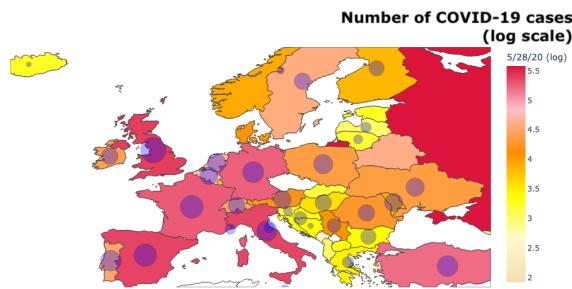
The map in Figure 6 shows the correlation between the events extracted by the model (blue dots) and the actual reported COVID cases (red shading). The strong alignment confirms that the model works globally, accurately reflecting the severity of the pandemic in different regions without needing language-specific tuning for each country.
Digging into the Details
Because SPEED++ extracts arguments (details), it can summarize what people are saying. This is incredibly useful for two things:
- Symptom Tracking: Identifying new symptoms as they emerge in public discourse.
- Misinformation Detection: Identifying dangerous or fake “cures” circulating in communities.
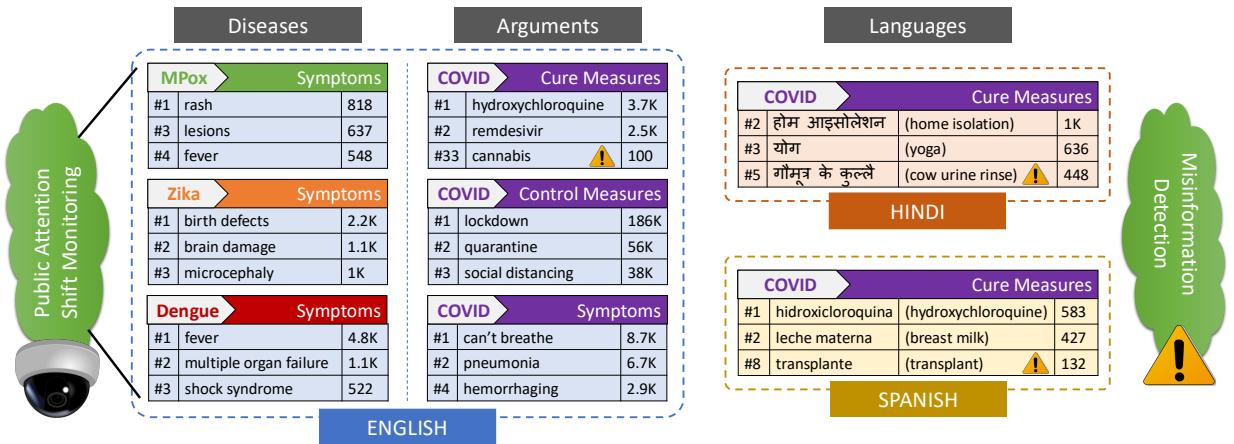
Figure 7 displays an “Information Bulletin” generated by the system.
- Left Column (Symptoms): It correctly identifies “rash” and “lesions” for Monkeypox, and “microcephaly” for Zika.
- Right Column (Misinformation): In the Hindi and Spanish sections for COVID-19, the model extracted “cow urine” and “breast milk” as discussed cure measures.
By flagging these unverified medical claims automatically, health organizations could rapidly identify misinformation trends and issue targeted corrections in the appropriate languages.
Conclusion
The SPEED++ framework represents a significant leap forward in digital epidemiology. By combining rigorous dataset creation with advanced zero-shot cross-lingual modeling, the researchers have built a tool that listens to the world, not just the English-speaking parts of it.
The implications are profound:
- Earlier Warnings: Detecting outbreaks weeks before official data catches up.
- Better Intelligence: Understanding symptoms and behaviors on the ground.
- Combating Infodemics: Tracking misinformation at scale.
While no AI can predict the future with perfect certainty, SPEED++ proves that the signals for the next pandemic will likely be visible on social media long before they reach a breathless news headline—provided we are listening in the right languages.