](https://deep-paper.org/en/paper/2410.19218/images/cover.png)
If you have ever conducted a literature review, you know the frustration. You type a query into a search engine describing a specific methodology or a complex theoretical intersection—say, “learning to win by reading manuals in a Monte-Carlo framework”—and the results are disappointing. You get papers about “reading comprehension” or generic “manuals,” missing the core scientific intent completely.
The problem isn’t that the search engine is broken; it’s that it relies on dense retrieval models that often prioritize surface-level textual similarity over deep academic concept matching.
In this post, we will explore TaxoIndex, a novel framework proposed by researchers from the University of Illinois at Urbana Champaign and Yonsei University. This method fundamentally changes how machines understand research papers by building a “semantic index” guided by academic taxonomies. It allows models to “think” in terms of concepts—like Reinforcement Learning or Monte Carlo methods—rather than just matching words.
The Problem with Current Search
Modern search engines use Dense Retrieval. They encode your query and the documents into dense vectors (lists of numbers) using Pre-trained Language Models (PLMs) like BERT. The relevance is calculated by measuring how close these vectors are in vector space.
While this works wonders for general web search, it struggles with the nuances of academia. An academic query often encompasses multiple high-level concepts (topics) and low-level details (phrases) that general language models don’t fully grasp.
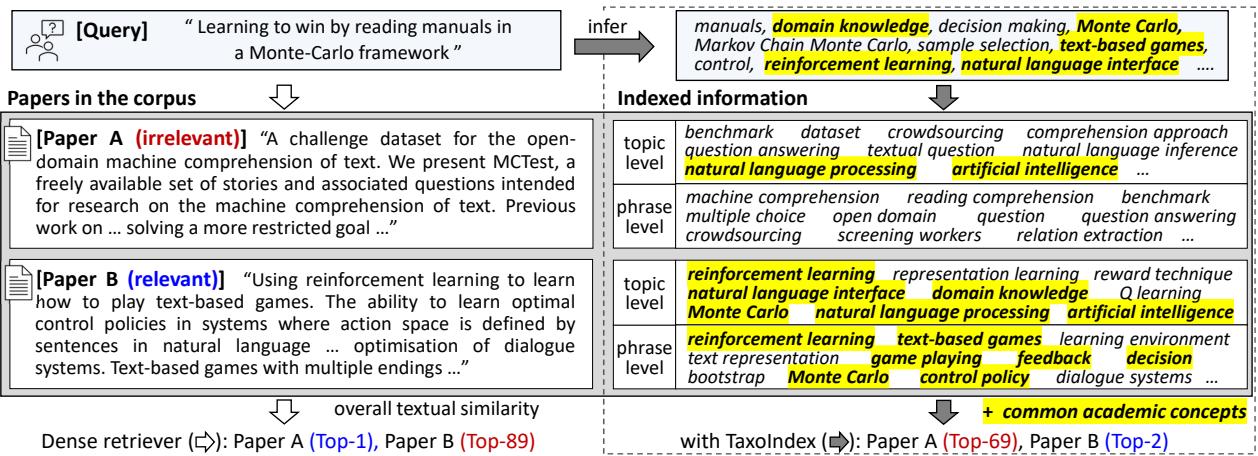
As shown in Figure 1, for the query “Learning to win by reading manuals…”, a standard dense retriever (left) retrieves “Paper A.” Why? Because Paper A talks about “comprehension of text” and “solving a goal.” The words match, but the science doesn’t. The user wants Reinforcement Learning, but they got QA Benchmarks.
TaxoIndex (right) correctly identifies the underlying concepts: Reinforcement Learning, Decision Making, and Text-based Games. It retrieves “Paper B,” which is scientifically relevant despite having different surface text.
The Solution: Taxonomy-Guided Semantic Indexing
The core insight of TaxoIndex is simple yet powerful: To find relevant papers, we must index them based on the academic concepts they contain, not just the words they use.
The authors propose a framework that represents every paper at two levels of granularity:
- Core Topics: Broad categories (e.g., “Natural Language Processing”).
- Indicative Phrases: Specific, fine-grained details (e.g., “Q-learning”).
Crucially, this process is guided by an Academic Taxonomy—a hierarchical tree of knowledge (like the one from Microsoft Academic).
Step 1: Constructing the Index
How do we transform a raw PDF into a structured semantic entry? The researchers devised a two-step construction strategy illustrated below.

1. Core Topic Identification
The system uses a massive academic taxonomy (a tree structure of topics). For a given paper, it traverses this tree top-down.
- It calculates the similarity between the document and topic nodes.
- It recursively visits the most similar child nodes (e.g., going from Computer Science \(\rightarrow\) Machine Learning \(\rightarrow\) Reinforcement Learning).
- Finally, a Large Language Model (LLM) filters these candidates to select the most accurate “Core Topics.”
2. Indicative Phrase Extraction
Topics are often too broad. To capture the specific “flavor” of a paper, TaxoIndex extracts Indicative Phrases. It doesn’t just grab frequent words; it scores phrases based on:
- Distinctiveness: Is this phrase specific to this paper compared to other papers in the same topic?
- Integrity: Is the phrase a complete, meaningful concept?
The result is a Forward Index (as seen in Figure 2) where every document is mapped to a set of topics and phrases.
The Core Method: Index-Grounded Fine-Tuning
Having an index is great, but how do we use it to improve the search model? We cannot simply paste these topics into the text during a live search because we don’t know the topics of a user’s query beforehand.
Instead, the researchers use Index Learning. They train an add-on module to predict the indexed topics and phrases from the input text. This forces the model to learn the underlying academic concepts.
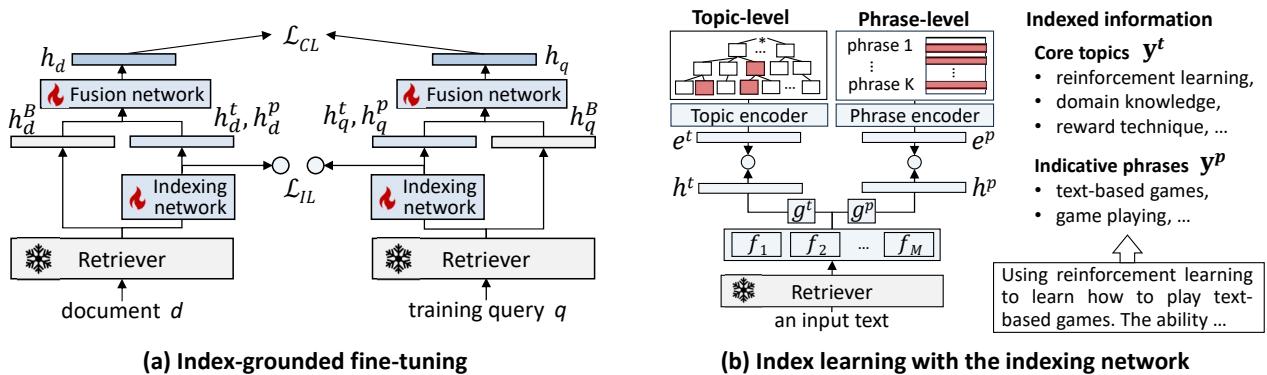
The architecture, shown in Figure 3, consists of two main networks that sit on top of a frozen backbone retriever (like SPECTER or Contriever).
1. The Indexing Network
This network’s job is to extract semantic information from the document embedding (\(\mathbf{h}_d^B\)). It uses a Multi-gate Mixture of Experts (MMoE). This is a fancy way of saying it has several neural network “experts” and a gating mechanism that decides which experts to listen to when predicting a topic versus predicting a phrase.
The mathematical formulation for extracting these features is:

Here, \(f_m\) are the expert networks, and \(w^t\) and \(w^p\) are the weights assigned by the gating network. This shared structure allows the model to learn features that benefit both topic and phrase prediction simultaneously.
The Loss Function: To ensure the network actually learns useful concepts, it is trained to minimize the following loss function:
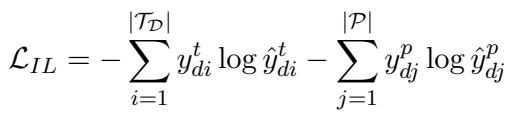
Simply put, this equation checks if the model correctly predicted the assigned Core Topics (\(y^t\)) and Indicative Phrases (\(y^p\)). If the model guesses wrong, it gets penalized.
2. The Fusion Network
Once the Indexing Network has extracted the topic (\(\mathbf{h}^t\)) and phrase (\(\mathbf{h}^p\)) representations, they are combined into a single “Index Embedding” (\(\mathbf{h}^I\)).
This Index Embedding is then fused with the original backbone embedding (\(\mathbf{h}^B\)) to create the final representation used for search:

Notice the \(\alpha \cdot w_d\) term. This is an input-adaptive weight. The model learns to trust the index more or less depending on the specific document. If the backbone is confused, the weight \(w_d\) increases, allowing the semantic index to guide the representation.
Training the Retriever
The entire system is trained using Contrastive Learning. The goal is to maximize the similarity between a query (\(\mathbf{h}_q\)) and a relevant document (\(\mathbf{h}_{d^+}\)) while minimizing similarity to irrelevant documents (\(\mathbf{h}_{d^-}\)).

The TaxoIndex framework adds a clever twist to finding “irrelevant” documents (negatives) for training. Instead of just picking random papers, it uses Core Topic-aware Negative Mining. It finds papers that share the same topic but are lexically different, or vice versa, forcing the model to distinguish between subtle conceptual differences.
Experiments and Results
The researchers tested TaxoIndex on two challenging datasets: CSFCube and DORIS-MAE. These datasets represent real-world scenarios where users (or experts) search for papers based on abstract needs rather than exact titles.
1. Overall Performance
The results were compelling. TaxoIndex significantly outperformed standard methods.
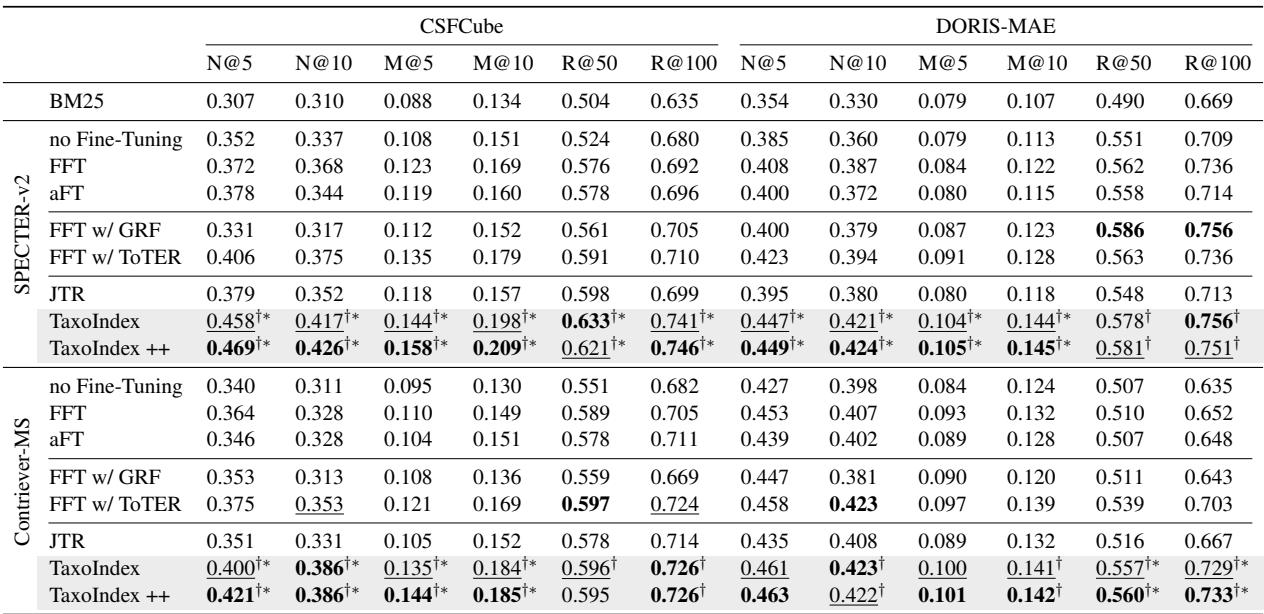
In Table 1, compare TaxoIndex against FFT (Full Fine-Tuning). Even though TaxoIndex only updates a small add-on module (keeping the massive backbone frozen), it achieves much higher Normalized Discounted Cumulative Gain (NDCG) and Recall scores. This proves that explicitly modeling topics and phrases is more effective than just blindly fine-tuning on data.
2. Efficiency with Limited Data
One of the biggest challenges in specialized fields (like Bio-engineering or Quantum Physics) is the lack of labeled training data. TaxoIndex shines here.
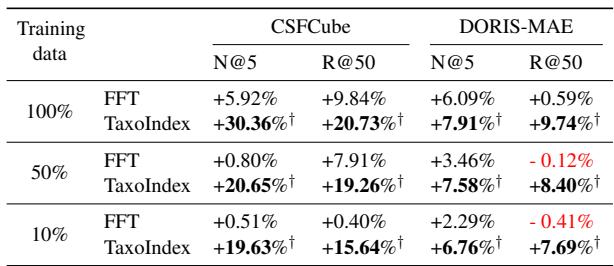
Table 2 shows what happens when training data is cut to 50% or even 10%. Standard Fine-Tuning (FFT) barely improves over the base model, sometimes even getting worse. TaxoIndex, however, maintains robust improvement. Because the model is learning from the structure of the taxonomy (Index Learning), it doesn’t need as many query-document pairs to learn what “relevance” looks like.
3. Handling Difficult Queries
The researchers also analyzed “Difficult Queries”—those with high lexical mismatch (the query uses different words than the paper) or high concept diversity.
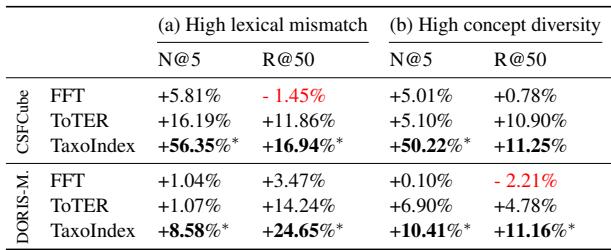
As seen in Table 3, standard methods (FFT) struggle with high lexical mismatch, showing negative improvement in some cases. TaxoIndex thrives here (+56.35% improvement on CSFCube), effectively bridging the gap between the user’s language and the paper’s terminology.
4. Ablation Study: Do we need both Topics and Phrases?
Is the complex two-level index really necessary? The ablation study confirms that it is.
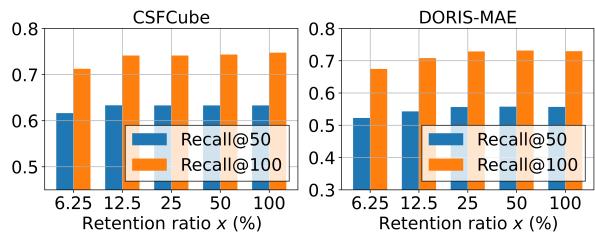
Table 4 (left) shows that removing either the topic level or the phrase level drops performance. They are complementary: topics give the broad context, while phrases provide the specific details.
Figure 4 (right) highlights an interesting efficiency capability: Document Filtering. By filtering documents based on predicted topics, the system can ignore 75% of the corpus and still achieve retrieval results comparable to searching the whole database. This has massive implications for search speed in large-scale systems.
Robustness to Taxonomy Quality
You might wonder, “What if the taxonomy is incomplete or outdated?”
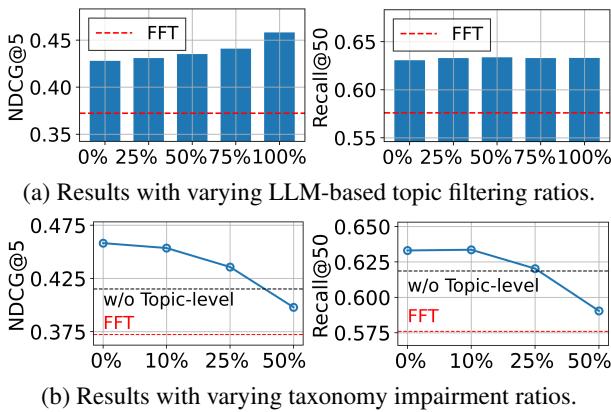
Figure 5 demonstrates that even if 50% of the taxonomy nodes are randomly removed (pruned), TaxoIndex still outperforms the baseline (FFT). The model is resilient because the Indicative Phrases (extracted directly from text) compensate for missing topics in the hierarchy.
Conclusion
TaxoIndex represents a significant step forward in academic information retrieval. By moving beyond surface-level text matching and incorporating structured knowledge—Core Topics and Indicative Phrases—it bridges the semantic gap between a user’s intent and a paper’s content.
Key takeaways for students and researchers:
- Structure Matters: Integrating external knowledge (like taxonomies) can guide neural networks to learn more meaningful representations.
- Granularity is Key: Representing data at multiple levels (broad topics vs. specific phrases) provides a more complete semantic picture.
- Index Learning: Teaching a model to predict metadata is a powerful self-supervised signal that works well even when labeled training data is scarce.
As academic literature continues to grow exponentially, tools like TaxoIndex will be essential for helping us find the needle in the haystack—or in this case, the specific Reinforcement Learning strategy in a sea of AI papers.