](https://deep-paper.org/en/paper/2410.20763/images/cover.png)
Have you ever tried to read a research paper from a field you aren’t familiar with? Maybe you are a computer scientist trying to parse a biology paper, or a sociologist reading about quantum mechanics. You likely encountered a sentence where you understood the grammar, but a specific term—like “arbitrary-precision arithmetic” or “hyperaemia”—stopped you in your tracks.
When this happens, you might open a new tab and search for the definition. But standard definitions can be dry, disconnected from the text, or just as confusing as the original term.
This brings us to a fascinating area of Natural Language Processing (NLP) research: Targeted Concept Simplification.
In this post, we will deep-dive into a paper titled “Evaluating LLMs for Targeted Concept Simplification for Domain-Specific Texts” by researchers from the University of Michigan and Google DeepMind. We will explore how Large Language Models (LLMs) can be used not just to “dumb down” text, but to intelligently explain difficult concepts in context, helping adult readers learn while they read.
The Problem: It’s Not About Reading Level, It’s About Context
For years, text simplification research focused on lowering the reading grade level of a text—making sentences shorter and words simpler. This works well for children or language learners. However, skilled adult readers face a different challenge. They don’t need short sentences; they need domain knowledge.
When an expert reader struggles with a new domain, the issue is usually a “knowledge gap” regarding specific technical concepts.
The authors of this paper began with a preliminary study to confirm this. They asked human annotators to read definitions from various academic domains and identify what made them difficult.
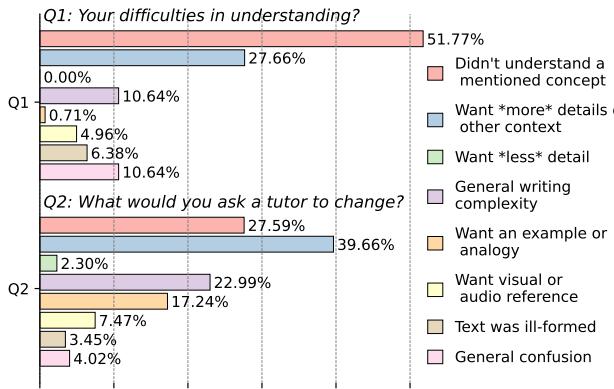
As shown in Figure 2 above, the results were revealing. The majority of difficulties (over 51%) stemmed specifically from not understanding a mentioned concept.
Crucially, look at the bottom chart (Q2). When asked what they wanted a tutor to change, the most popular request (nearly 40%) was for more detailed explanations, followed by examples or analogies. Only a small fraction wanted less detail. This contradicts the traditional “simplification” approach of cutting content. Readers don’t want the text to be empty; they want the difficult concepts elaborated upon so they can build a mental model of the subject.
The Task: Targeted Concept Simplification
Based on these insights, the researchers introduced a new task: Targeted Concept Simplification.
The goal isn’t to rewrite the whole document to be simple (which often removes nuance). The goal is to identify a specific “difficult concept” within a sentence and rewrite the sentence to make that specific concept clear, without losing the original meaning.
The researchers proposed three main strategies for handling a difficult concept:
- Lexical Simplification: Replacing the complex term with a simpler synonym.
- Definition: Appending a dictionary definition.
- Explanation: Rewriting the sentence to contextually explain the concept.
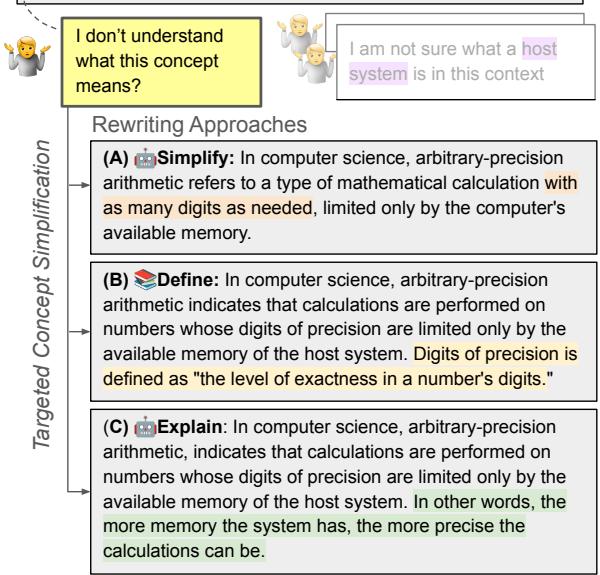
Figure 1 illustrates these strategies perfectly. In the original text, the concept “digits of precision” is a blocker.
- Approach (a) simplifies it to “as many digits as needed.” It’s easy to read but loses the technical specificity.
- Approach (b) pastes a definition. It helps, but it breaks the flow.
- Approach (c) explains it in context, linking the concept of precision to memory usage. This is the “gold standard” the researchers were aiming for.
The Dataset: WIKIDOMAINS
To train and evaluate models on this task, the researchers needed high-quality data. Existing datasets were too narrow, often focusing only on medical text or general science.
They introduced WIKIDOMAINS, a curated dataset of 22,000 definitions spanning 13 different academic domains, derived from Wikipedia.
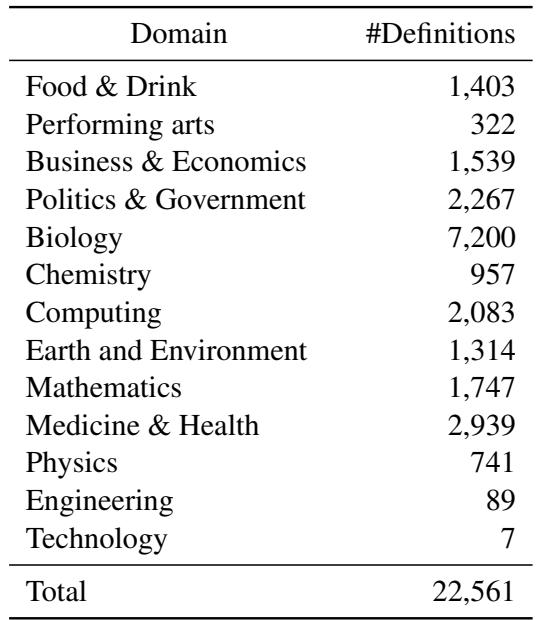
As you can see in Table 1, the dataset covers a wide spectrum of human knowledge, from Biology and Computing to Economics and Performing Arts.
Identifying the “Difficult Concept”
How did the researchers decide which word in a sentence was the “difficult” one without manually annotating 22,000 sentences? They used a clever heuristic based on domain specificity.
The idea is simple: A difficult concept is likely a term that appears frequently in its specific domain (e.g., Physics) but rarely in general text. They calculated a score for candidate concepts using this equation:

Here, the numerator counts how many articles in the specific domain (\(\mathcal{D}_t\)) contain the concept \(c\). The denominator counts how many articles across all of Wikipedia (\(\mathcal{D}_{all}\)) contain it. A high ratio indicates a highly specialized term (jargon).
The Experiments
The researchers evaluated several state-of-the-art LLMs (at the time of the paper) to see how well they could perform this task.
The Models:
- Open Source: Falcon-40b, BLOOM-170b (using 8-bit quantization).
- Commercial: GPT-4, PaLM-2.
- Baseline: A simple dictionary look-up method (appending a definition from Wikidata/WordNet).
The Prompts: They tested two distinct prompting strategies to mirror the user needs identified earlier:
- Simplify: “Rewrite the definition simplifying the concept: [concept].”
- Explain: “Rewrite the definition integrating an explanation for the concept: [concept].”
Evaluation Metrics
Evaluating text generation is notoriously difficult. The team used a mix of human and automated metrics.
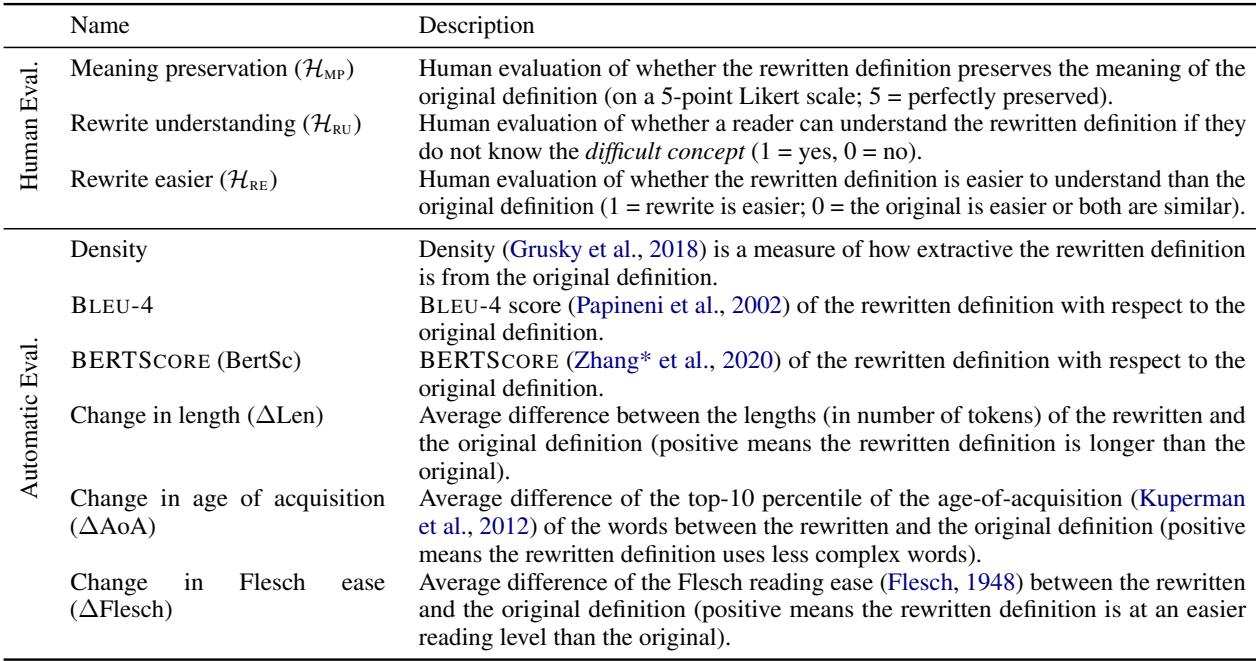
Table 3 details the metrics. The most critical are the human evaluations:
- Meaning Preservation (\(\mathcal{H}_{MP}\)): Did we lose the original fact?
- Rewrite Understanding (\(\mathcal{H}_{RU}\)): Could a layperson understand this without knowing the difficult term beforehand?
- Rewrite Easier (\(\mathcal{H}_{RE}\)): Is this actually easier than the original?
Results: What We Learned
The results offered a nuanced view of current LLM capabilities.
1. No Single Model is Perfect
Below, Table 4 shows the human evaluation scores.
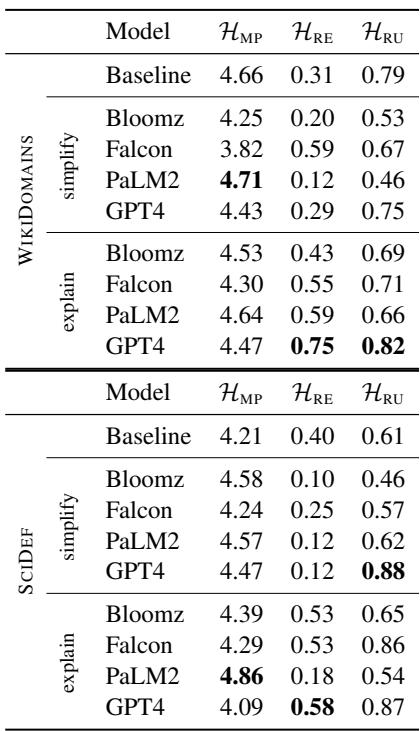
GPT-4 generally performed best, particularly in making the text easier (\(\mathcal{H}_{RE}\)) and understandable (\(\mathcal{H}_{RU}\)). However, note that PaLM-2 scored highest on Meaning Preservation. This highlights a classic trade-off in simplification: the more you simplify to make something “easy,” the higher the risk of drifting away from the precise, original meaning.
Surprisingly, the Baseline (dictionary look-up) was competitive on Meaning Preservation but scored poorly on “Easier to Understand.” This makes sense—accurate technical definitions are precise but often dense.
2. Explanation beats Simplification
One of the paper’s most important findings is that how you prompt matters.
The researchers compared the “Simplify” prompt against the “Explain” prompt.
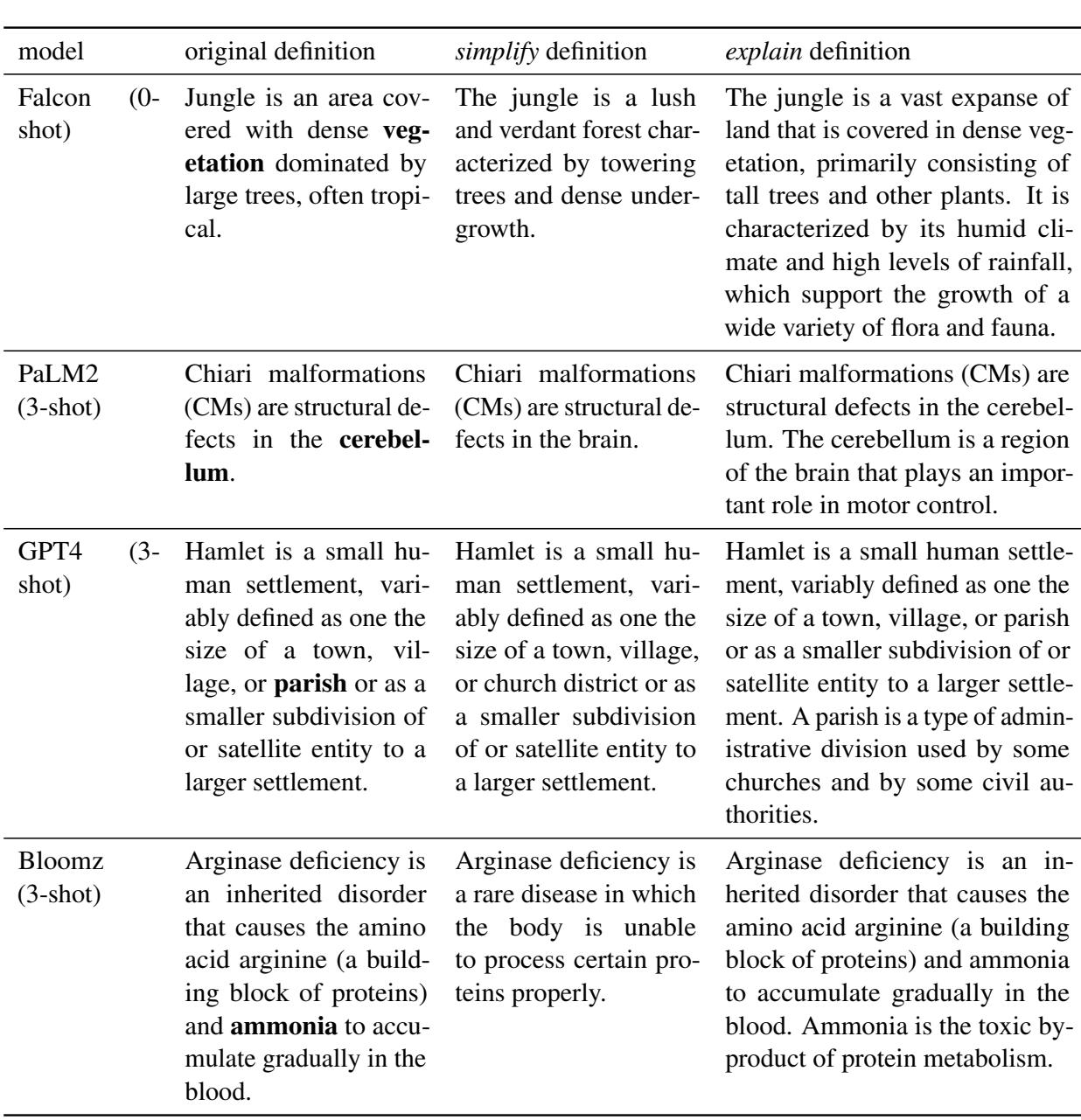
Look at the examples in Table 17.
- In the PaLM2 example (second row), the “Simplify” prompt changes “cerebellum” to “brain.” This is a massive loss of information! It’s too simple.
- The “Explain” prompt keeps “cerebellum” but adds context: “The cerebellum is a region of the brain that plays an important role in motor control.”
This qualitative observation is backed by data. The researchers found that human judges significantly preferred the Explain strategy for facilitating understanding. This confirms the initial user study: adults want more context, not just simpler words.
3. The Failure of Automated Metrics
For students and researchers, this is perhaps the most critical takeaway: Don’t trust standard automated metrics for this task.
The researchers calculated correlations between automated metrics (like BLEU, BERTScore, and Readability scores) and human judgments.
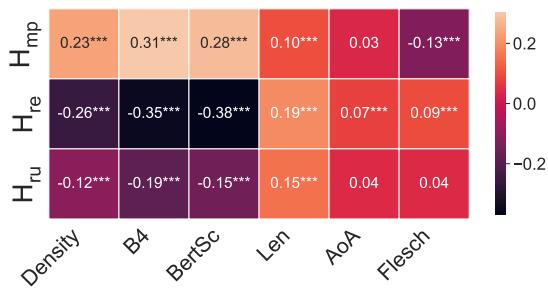
Figure 3 is a heatmap of these correlations.
- Dark/Orange/Red implies low or negative correlation.
- Yellow implies positive correlation.
Notice how Meaning Preservation (\(\mathcal{H}_{MP}\)) has some decent correlation with BERTScore (semantic similarity). This is expected.
However, look at Rewrite Easier (\(\mathcal{H}_{RE}\)) and Rewrite Understanding (\(\mathcal{H}_{RU}\)). The correlations are almost non-existent or very weak. Standard “readability” metrics (like Flesch-Kincaid) or n-gram overlap metrics (BLEU) cannot accurately measure if a concept has been effectively explained. A sentence can be short and simple (high readability score) but completely fail to explain the concept (low understanding).
Qualitative Failures
It is helpful to look at where models fail. The researchers highlighted cases where models either hallucinated, over-simplified, or did nothing.
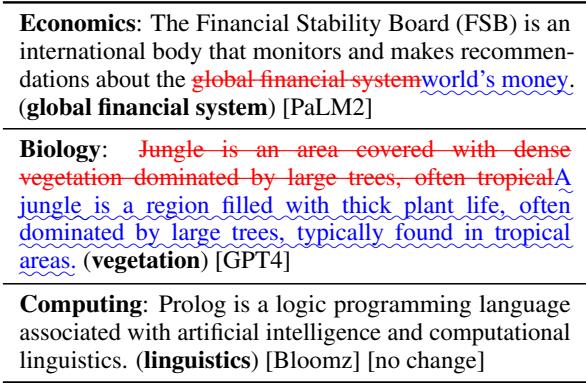
In Table 7 (bottom half of the image above), we see:
- Economics (PaLM2): The model replaces “global financial system” with “world’s money.” This is an oversimplification that sounds childish and loses nuance.
- Biology (GPT4): The model rewrites the definition of “Jungle” to sound like a children’s book (“place filled with a lot of plants”), losing the specific ecological distinction of “dense vegetation dominated by large trees.”
- Computing (Bloomz): The model makes no changes at all, failing the task entirely.
Conclusion & Implications
This research highlights a pivotal shift in how we should think about AI reading assistants.
- Context is King: For domain-specific texts, replacing jargon with simple words is often the wrong approach. It strips away the education. The better approach is elaborative simplification—adding definitions and context into the flow of the text.
- Evaluation Gap: We desperately need better automated metrics that assess explanation quality rather than just text similarity or syllable count.
- Personalization: The “difficulty” of a concept depends on the reader. A biologist reading a physics paper needs different help than a historian reading the same paper.
The WIKIDOMAINS dataset provided by this paper serves as a new benchmark for researchers to tackle these problems. As LLMs continue to evolve, the goal is to move from “Explain Like I’m 5” to “Explain Like I’m an Intelligent Adult Who Just Doesn’t Know This Specific Term.”
This post summarized the research paper “Evaluating LLMs for Targeted Concept Simplification for Domain-Specific Texts.”