](https://deep-paper.org/en/paper/2410.21155/images/cover.png)
Introduction
We are living through an explosion of scientific literature. Every day, hundreds of new papers are published in fields like Artificial Intelligence (AI) and Machine Learning (ML), introducing new tasks, proposing novel methods, and evaluating them on various datasets. Keeping up with this torrent of information is nearly impossible for a human researcher.
This is where Scientific Information Extraction (SciIE) comes in. The goal of SciIE is to turn unstructured text—the PDFs you read—into structured knowledge. By extracting entities (like BERT or ImageNet) and the relations between them (like BERT is-evaluated-on SQuAD), we can build Knowledge Graphs that power recommendation systems, academic search engines, and even automated question-answering bots.
However, there is a bottleneck. Most existing datasets used to train these systems rely heavily on abstracts. While abstracts are concise, they miss the rich, fine-grained details hidden in the body of a paper. An abstract might say “We improved performance,” but the experimental section tells you exactly which hyperparameters were used or which specific sub-tasks were benchmarked.
In this post, we will dive deep into a research paper that tackles this problem head-on: SciER. The authors introduce a new, manually annotated dataset based on full-text scientific publications. They also propose and benchmark sophisticated methods, including Large Language Models (LLMs) with specialized prompting techniques, to extract this complex information.
The Problem with Abstracts
To understand why SciER is necessary, we first need to look at the limitations of the current landscape.
Traditional SciIE tasks usually involve two steps:
- Named Entity Recognition (NER): Identifying key terms (e.g., recognizing “ResNet-50” as a Method).
- Relation Extraction (RE): Determining how those terms interact (e.g., “ResNet-50” is-used-for “Image Classification”).
Popular benchmarks like SciERC have served the community well, but they are limited to abstracts. Abstracts are summaries; they are marketing pitches for the paper. They often lack the specific implementation details, hyperparameter settings, and nuanced comparisons found in the introduction, method, and experiment sections.
Furthermore, existing datasets often use generic relation types. Knowing that Method A is “Used-for” Task B is helpful, but knowing that Method A is “Trained-with” Dataset C and “Evaluated-with” Dataset D is significantly more valuable for a researcher trying to reproduce results.
Introducing SciER: A Full-Text Dataset
The core contribution of this paper is the SciER dataset. The researchers collected 106 scientific articles from Papers with Code, covering diverse AI topics including NLP, Computer Vision, and AI for Science.
Unlike previous attempts that used distant supervision (weak automated labeling), SciER is manually annotated by experts. This ensures high quality and precision.
The Scope of Annotation
The dataset focuses on three primary entity types that are central to empirical AI research:
- METHOD: Algorithms, models, and architectures (e.g., CNN, Transformer).
- TASK: The problem being solved (e.g., Sentiment Analysis, Object Detection).
- DATASET: The data used for training or testing (e.g., COCO, MNIST).
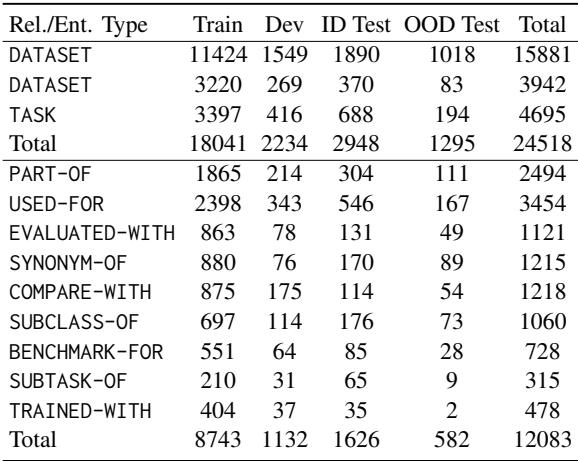
While the entity list is concise, the sheer volume of annotations is massive. As shown in the statistics table below, SciER contains over 24,000 entities and 12,000 relations. This is significantly larger than previous datasets like SciERC, especially regarding the density of relations per document.
A Fine-Grained Relation System
The most exciting aspect of SciER is its relation typology. The authors didn’t just want to know if entities were related; they wanted to know how. They developed a tag set of nine fine-grained relations.
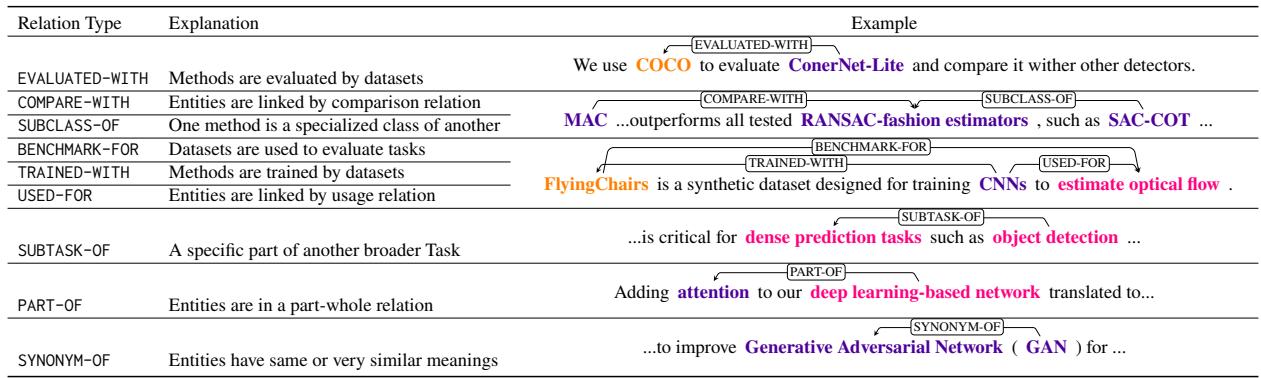
As illustrated in Table 2 above, these relations capture the lifecycle of a machine learning experiment:
- Hierarchical Relations:
SubClass-OfandSubTask-Ofallow for the construction of taxonomies (e.g., CNN is a subclass of Deep Learning). - Experimental Relations:
Trained-With,Evaluated-With, andBenchmark-Fordistinguish between training data and testing benchmarks—a distinction often lost in abstract-only extraction. - Comparative Relations:
Compare-Withcaptures when a paper contrasts its method against a baseline.
This granularity allows for much more sophisticated downstream applications. For instance, a system trained on SciER could answer complex queries like, “Find all methods for Image Segmentation that were trained on Cityscapes but evaluated on a different dataset.”
Methodology: How to Extract the Knowledge
Creating the dataset is step one. Step two is building models that can actually perform the extraction. The authors set up three distinct tasks to evaluate performance:
- NER: Given a sentence, find the entities and classify them.
- RE: Given a sentence and two entities, predict the relation between them.
- ERE (Entity and Relation Extraction): The “Holy Grail” task—given raw text, extract all triplets (Subject, Relation, Object) from scratch.

Figure 1 (top) shows a sample annotation where a sentence contains a Method and a Task linked by a relation. The table (bottom) breaks down the input/output differences between the three tasks.
To benchmark SciER, the authors compared two distinct approaches: Supervised Learning and Large Language Models (LLMs) via In-Context Learning.
Approach 1: Supervised Baselines
The authors employed state-of-the-art (SOTA) supervised models, including:
- PURE: A pipeline approach that encodes entities and relations separately.
- PL-Marker: A method that uses clever packing strategies to understand the boundaries of entities better.
- HGERE: A joint model using hypergraph neural networks to extract everything at once.
These models require training on the SciER training set. They generally act as the “upper bound” for performance in this study because they are specialized for this exact task.
Approach 2: LLM-based In-Context Learning (The Core Method)
The most instructive part of the methodology is how the researchers adapted general-purpose LLMs (like GPT-3.5, Llama-3, and Qwen2) for this specialized scientific task. They didn’t fine-tune the LLMs; instead, they used Retrieval-Augmented In-Context Learning.
The Architecture
The architecture, visualized below, relies on constructing a highly specific prompt for every test sentence.

Here is the step-by-step breakdown of their LLM framework:
- Retriever: When the system receives a test sentence (\(x_{test}\)), it searches the training set for the most similar sentences.
- Demonstrations (\(D\)): The top \(k\) similar sentences (and their correct labels) are retrieved to serve as “few-shot” examples. This shows the LLM exactly what is expected in a similar context.
- Prompt Design (\(I\)): The prompt is composed of:
- Instruction: A clear definition of the task.
- Guidelines: Specific definitions of the entities and relations (e.g., defining exactly what constitutes a “Method”).
- Demonstrations: The retrieved examples.
- Input: The target sentence.
The “HTML Tag” Innovation
A common problem with using LLMs for extraction is that they are “chatty.” If you ask them to extract entities, they might rephrase the entity or output a list that is hard to map back to the original text position.
To solve this, the authors forced the LLM to act as a text annotator. They instructed the model to rewrite the input sentence but insert HTML tags around the entities (e.g., <span class="Method">CNN</span>). This simple constraint significantly improved the model’s ability to identify exact text boundaries, which is crucial for scoring well on NER metrics.
Pipeline vs. Joint Modeling
The authors tested two strategies for LLMs:
- Joint ERE: Asking the LLM to do everything at once (find entities and relations in one pass).
- Pipeline: First asking the LLM to find entities (NER), and then, in a separate prompt, asking it to determine the relationship between the found entities (RE).
Experiments and Results
The authors conducted extensive experiments, testing on both an In-Distribution (ID) test set (papers similar to the training data) and an Out-of-Distribution (OOD) test set (papers from different years or sub-fields).
1. Supervised Models vs. LLMs
The results showed a clear hierarchy. The specialized supervised models (like HGERE and PL-Marker) outperformed the LLMs significantly.
- Best Supervised (HGERE): ~61% F1 score on the full ERE task.
- Best LLM (Qwen2-72b): ~41% F1 score on the full ERE task.
This highlights that while LLMs are powerful generalists, specialized models trained on high-quality data (like SciER) still reign supreme for precise information extraction tasks.
2. The “Pipeline” Surprise
In the world of deep learning, “joint” models (doing everything at once) are usually preferred because they can share information between tasks. However, for LLMs, the authors found the opposite.
Pipeline modeling significantly outperformed Joint modeling. By breaking the problem down—“First, find the methods. Okay, now how does this method relate to that task?"—the LLMs made fewer errors. The joint approach often overwhelmed the model, leading to lower recall.
3. The Power of Prompt Engineering (Ablation Study)
One of the most valuable takeaways for students is the impact of “Prompt Engineering.” The authors didn’t just ask “Extract relations.” They added detailed guidelines and HTML tag constraints.
Does this extra effort matter?
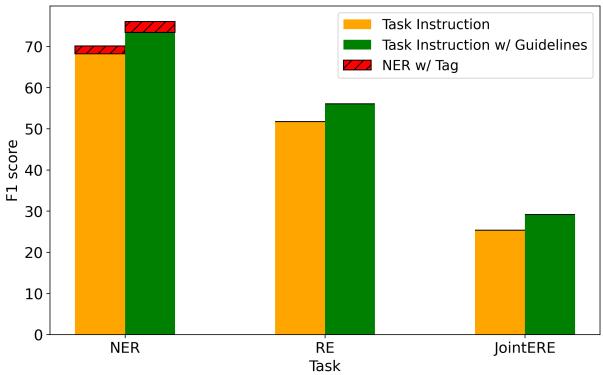
Figure 3 shows the ablation study results.
- Orange Bars: Basic instructions.
- Green Bars: Instructions + Detailed Guidelines.
- Red Striped: Adding the HTML Tag constraint (for NER).
The jump in performance is stark. Adding guidelines improved performance across all tasks. For NER, adding the HTML tag constraint pushed the F1 score even higher. This proves that how you ask the LLM is just as important as which LLM you use.
4. How Much Data Do We Need?
Finally, the researchers investigated how the size of the training set affects performance. This is crucial because annotating full-text papers is expensive.
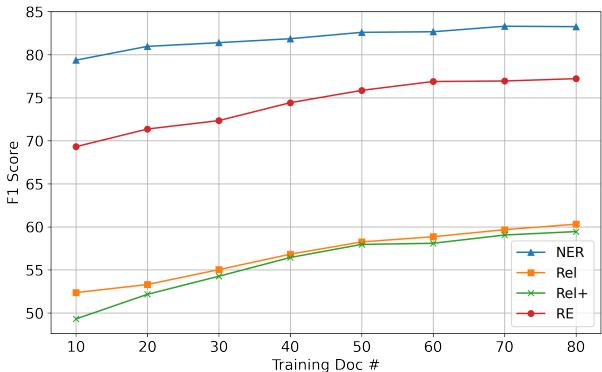
Figure 4 reveals an interesting trend.
- NER (Blue Line): Performance rises quickly and then plateaus. You don’t need a massive dataset to teach a model what a “Dataset” looks like.
- Relation Extraction (Orange/Green Lines): These lines continue to climb steadily as more documents are added.
This suggests that understanding the complex relationships between scientific concepts requires significantly more data than simply recognizing the concepts themselves.
Conclusion & Implications
The SciER dataset represents a significant step forward for Scientific Information Extraction. By moving beyond abstracts and embracing the complexity of full-text documents, it offers a more realistic benchmark for how AI can assist researchers.
For students and practitioners, this paper offers several key takeaways:
- Context Matters: Real-world information extraction requires looking at the full document, not just the summary.
- Taxonomy Matters: The shift to 9 fine-grained relation types (like Trained-With) turns a simple graph into a rich knowledge base.
- LLM Strategy: If you are using LLMs for extraction, consider a pipeline approach (break it down) and use constrained generation (like HTML tags) to improve precision.
While supervised models currently hold the crown, the rapid evolution of LLMs combined with datasets like SciER suggests a future where our AI assistants won’t just find papers for us—they’ll read, understand, and synthesize them, accelerating the pace of scientific discovery.