](https://deep-paper.org/en/paper/2410.21485/images/cover.png)
Introduction
Imagine you are using a real-time speech translation app to converse with a local while traveling abroad. You speak into your phone, and it spits out a translation. But here is the critical question: How do you know if the translation is accurate if you don’t speak the target language?
This is the domain of Quality Estimation (QE). In the world of Machine Translation (MT), QE is the task of predicting the quality of a translation given only the source and the output—without access to a “correct” reference translation. It serves as a confidence score, letting users know if they should trust the AI or ask for a clarification.
Historically, QE has focused almost exclusively on text. However, the rapid rise of speech technologies—like OpenAI’s Whisper or Meta’s SeamlessM4T—has brought Speech Translation (ST) into the spotlight. The problem? Evaluating the quality of translated speech is significantly harder than evaluating text.
In this post, we dive into a fascinating paper titled “SpeechQE: Estimating the Quality of Direct Speech Translation.” The researchers identify a major flaw in how we currently judge speech translation and propose a novel, End-to-End (E2E) solution that leverages the power of Large Language Models (LLMs) to listen, not just read.
Background: The Problem with the Pipeline
To understand why this paper is significant, we first need to look at how translation quality is currently measured.
In a traditional Text Quality Estimation (Text-QE) setup, a model looks at a source sentence (e.g., in Spanish) and a translated hypothesis (e.g., in English) and predicts a quality score.
\[ q = \mathrm { t e x t - Q E } ( t , h ) \]However, Speech Translation adds a layer of complexity because the source is audio, not text. The current industry standard for estimating the quality of speech translation is a “Cascaded” approach. It works like a pipeline:
- ASR (Automatic Speech Recognition): An AI transcribes the source audio into text.
- Text-QE: A standard QE model compares the transcribed text to the translation.
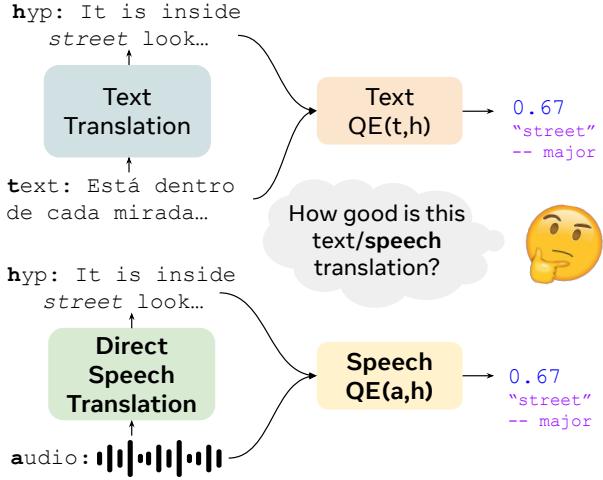
As shown in Figure 1, there is a distinct difference between the two workflows. The top path represents the standard text-based evaluation. The bottom path represents SpeechQE, where the system must evaluate a direct translation from audio.
The Flaw in the Cascade
The researchers argue that relying on a cascade (ASR followed by Text-QE) is fundamentally flawed for two reasons:
- Inefficiency: Modern “Direct ST” models translate audio straight to text without an intermediate transcription step. Running a separate ASR engine just to check quality adds unnecessary computational cost and latency.
- Error Propagation (The “Telephone Game”): If the ASR system mishears the audio, it passes incorrect text to the QE system. The QE system, trusting the transcript, might penalize a correct translation or approve a hallucination because it doesn’t know what was actually said.
The authors formally define the cascaded approach as:
\[ q _ { c a s } = \mathrm { t e x t - Q E } ( A S R ( a ) , h ) \]Here, the quality score \(q_{cas}\) depends on the output of the ASR system. If \(ASR(a)\) is wrong, the entire estimation fails.
The Solution: End-to-End SpeechQE
The core contribution of this paper is the proposal of an End-to-End (E2E) SpeechQE system. Instead of transcribing the audio first, why not build a model that can “listen” to the source audio and “read” the translation simultaneously to judge its quality?
The goal is to model the following function directly:
\[ q = S p e e c h Q E ( a , h ) \]Here, the system takes the raw audio (\(a\)) and the translation hypothesis (\(h\)) to produce a score (\(q\)).
Architecture: Integrating Speech into LLMs
Building a model from scratch that understands both complex audio features and the nuances of translation quality is computationally expensive. To solve this, the researchers utilized a “connected” architecture that leverages existing pre-trained giants.
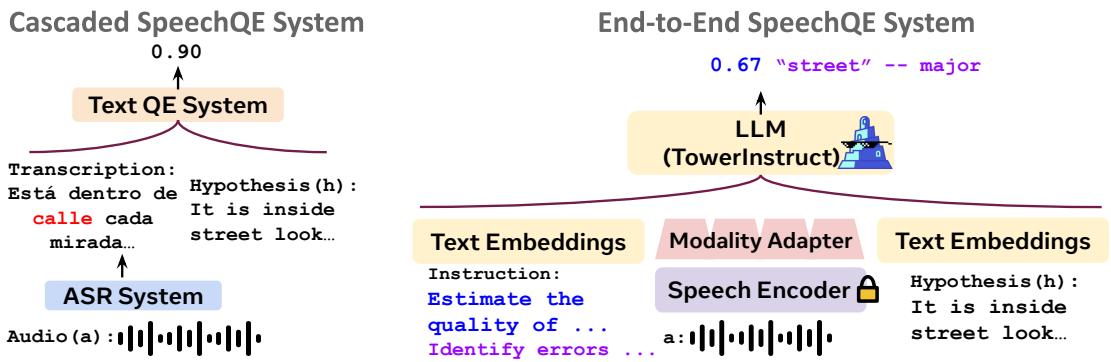
Figure 2 provides a clear comparison of the two architectures.
- Left (Cascaded): You can see the disjointed nature of the system. The audio must first pass through an ASR block to become text before the QE system can even look at it.
- Right (End-to-End): This is the proposed solution. It fuses the modalities.
The E2E architecture consists of three main components:
- Speech Encoder: They use Whisper (specifically
whisper-large-v2), a robust model known for its high-quality audio feature extraction. This component acts as the “ears” of the system. - Modality Adapter: This is the bridge. LLMs understand text tokens, not audio waves. The adapter compresses the audio features and projects them into the same embedding space as the text. This allows the LLM to “see” the audio as if it were a sequence of vectors.
- Text-LLM (The Brain): They use TowerInstruct-7B, a language model fine-tuned for translation tasks. This acts as the “brain,” analyzing the semantic alignment between the audio embeddings and the text translation.
Training Strategy
Training this beast requires a clever approach. You cannot simply throw data at it and hope for the best. The researchers used a two-phase training strategy:
- Phase 1 (Alignment): They train the Modality Adapter using ASR and Speech Translation (ST) tasks. The goal here isn’t to perfect translation, but to teach the adapter how to map speech sounds to the LLM’s internal representation of language.
- Phase 2 (Task Learning): They introduce the SpeechQE task. Here, they use LoRA (Low-Rank Adaptation) to fine-tune the LLM efficiently while keeping the heavy speech encoder frozen.
Because human-labeled quality data is scarce and expensive, the researchers used “silver labels.” They took a large speech translation dataset (CoVoST2), generated translations using various systems, and scored them using high-performance metrics like xCOMET.
\[ m = m e t r i c ( h , r ) \mathrm { o r } m = m e t r i c ( t , h , r ) \]They essentially taught their E2E model to predict what an advanced metric (like xCOMET) would score the translation, but without needing the reference text (\(r\)) that metrics usually require.
Experimental Setup
To prove their E2E model works, the researchers constructed a comprehensive benchmark.
The Data
They utilized CoVoST2, a massive speech translation corpus. They didn’t just test on one system; they generated translations using seven different direct ST models, ranging from small versions of Whisper to large SeamlessM4T models. This ensured the QE system was tested against a wide variety of translation errors and quality levels.
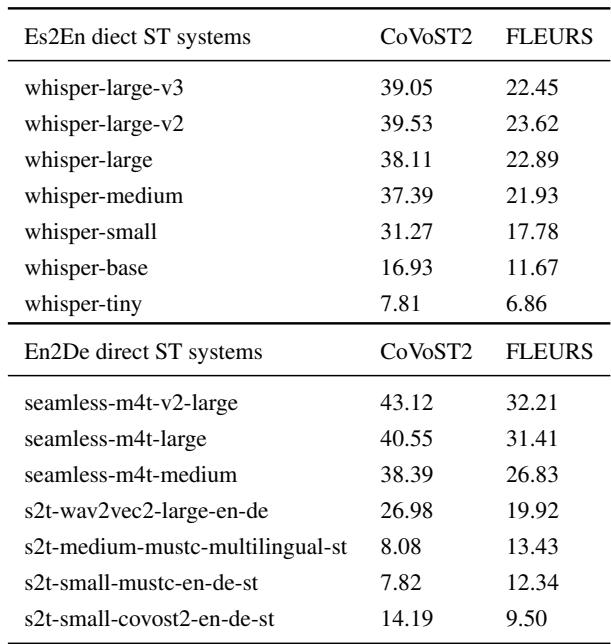
Table 2 shows the diversity of the models used to generate hypotheses. Note the massive difference in quality (BLEU scores) between whisper-tiny (7.81 BLEU) and seamless-m4t-v2-large (43.12 BLEU). A good QE system must be able to distinguish between these high-quality and low-quality outputs.
The Prompt
Since the core of the system is an instruction-tuned LLM, the input format is crucial. The model is fed a prompt that combines the audio embeddings and the text hypothesis.
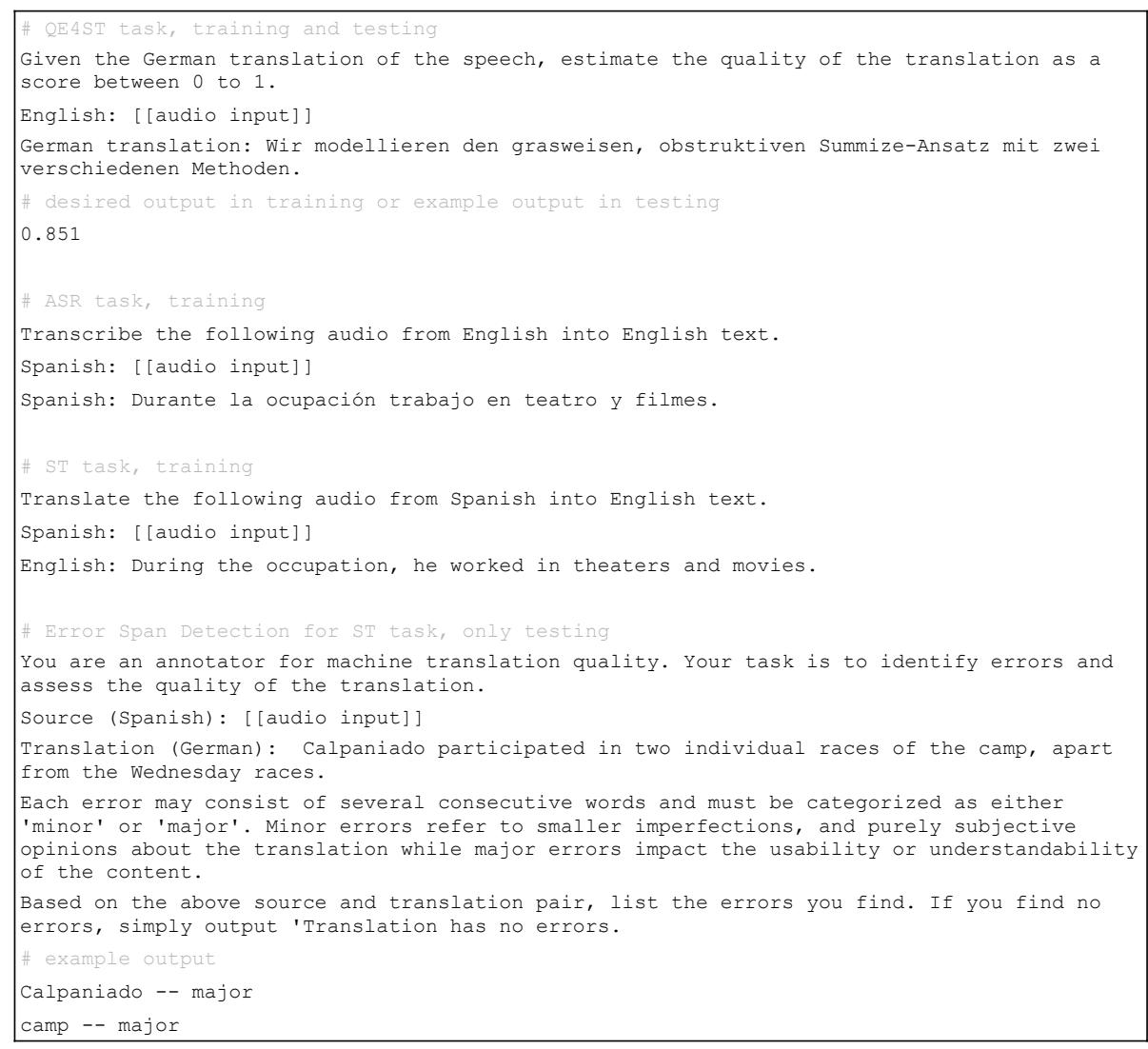
As seen in Figure 3, the prompt explicitly asks the model to “estimate the quality of the translation as a score between 0 to 1.” This natural language interface allows the model to leverage its pre-trained reasoning capabilities.
Results: Does E2E Beat the Cascade?
The results of the experiments were compelling and highlighted the limitations of the traditional cascaded approach.
1. Correlation with Metrics
The primary metric for success is the Spearman correlation (\(\rho\)). This measures how well the system’s predicted score ranks translations compared to the “ground truth” (in this case, the xCOMET or MetricX scores).
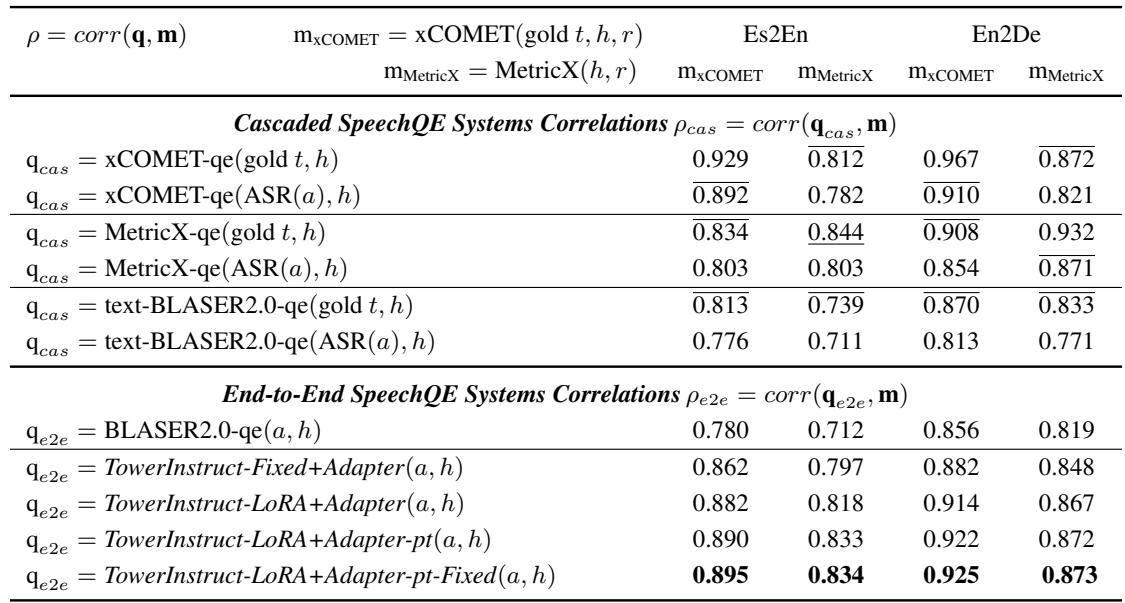
Table 3 presents the main results. Here is the breakdown:
- Cascaded Systems (Top rows): These use
whisper-large-v3(a state-of-the-art ASR) followed by a Text-QE model. They perform decently (e.g., 0.892 correlation for Es2En). - E2E Systems (Bottom rows): The best E2E configuration (
TowerInstruct-LoRA+Adapter-pt-Fixed) achieves a correlation of 0.895.
Key Finding: The E2E system outperforms the Cascaded system, even when the Cascade uses the best available ASR model. Perhaps most shockingly, in some configurations (like En2De MetricX), the E2E model even rivals or beats cascaded systems that use Gold Transcriptions (perfect text). This suggests that the E2E model picks up on prosodic or acoustic cues in the speech that a text transcript simply loses.
2. Correlation with Human Judgment
Automatic metrics are useful, but do they reflect what humans think? The researchers tested their models against the IWSLT23-ACL dataset, which contains human Direct Assessment (DA) scores.

Table 4 shows that the E2E SpeechQE model correlates better with human judgment (0.509) compared to the best ASR-Cascaded system (0.503). While the margins are slim, this consistency across both metric-based and human-based evaluations solidifies the E2E approach’s validity.
3. Zero-Shot Error Span Detection
A single score (e.g., “0.6/1.0”) is helpful, but developers and users often want to know where the mistake happened. This is called Error Span Detection (ESD).
The researchers tested if their E2E model could identify specific errors without being explicitly trained on ESD data (Zero-Shot).

Table 6 shows that while Cascaded systems generally still have an edge here (likely due to the strong text-processing capabilities of the underlying Text-QE models), the E2E model performs respectably. It demonstrates that the transfer of knowledge from the text LLM to the speech domain is working.
Qualitative Analysis: Why the Cascade Fails
The numbers tell us the E2E model is better, but why? The paper provides a qualitative example that perfectly illustrates the “Telephone Game” problem mentioned earlier.

Let’s break down the example in Table 7:
- The Scenario: A Spanish audio clip mentions a person named “Carpanedo” participating in a “campeonato” (championship).
- The Translation Hypothesis: The translator outputs: “Calpaniado participated in two individual races of the camp…”
- Error 1: Name hallucination (“Calpaniado”).
- Error 2: Mistranslation (“camp” instead of “championship”).
- The Cascaded System:
- The ASR hears the audio and incorrectly transcribes: “Calpaniado… campamento…”
- The Text-QE looks at the ASR transcript (“campamento”) and the Translation (“camp”). It thinks, “Campamento translates to Camp. Perfect match!”
- Result: It gives a high quality score (0.932), completely missing the error because the ASR misled it.
- The E2E System:
- It listens to the raw audio. It likely detects the acoustic features of “Carpanedo” and “campeonato.”
- It sees the translation says “camp.”
- Result: It realizes the mismatch and assigns a low quality score (0.497), correctly identifying the major errors.
This example is the “smoking gun” for why SpeechQE needs to be end-to-end. By removing the ASR middleman, the model becomes robust to transcription errors that would otherwise hide translation mistakes.
Conclusion and Implications
The research presented in SpeechQE challenges the prevailing reliance on cascaded systems for evaluating speech translation. By successfully integrating a speech encoder with a Large Language Model, the authors demonstrated that End-to-End systems are not only more efficient but also more accurate at estimating quality.
Key Takeaways
- Modality Matters: Treating speech as just “text waiting to be transcribed” ignores vital information. E2E models capture nuance that ASR discards.
- Robustness: E2E models are immune to the “error propagation” that plagues cascaded systems. If the ASR makes a mistake, the cascaded QE makes a mistake. The E2E model, however, verifies against the source audio directly.
- Future Potential: The success of the E2E model on Zero-Shot tasks suggests that as Multimodal LLMs improve, their ability to perform fine-grained analysis (like error span detection) on speech will likely surpass text-only models.
This paper suggests that as we move toward a world of seamless, real-time speech translation (like the “Universal Translator” of sci-fi), the systems judging that translation must listen as well as they read. SpeechQE is a significant step in that direction.