](https://deep-paper.org/en/paper/2410.22239/images/cover.png)
Introduction
Imagine a student who consistently scores 95% on history exams. On the surface, they appear to be a master of the subject. However, a closer look reveals a strange pattern: they answer every single question about the 19th Century correctly, but fail every single question related to the Industrial Revolution. This student doesn’t just have a knowledge gap; they have a systematic bias.
Machine learning models, particularly text classifiers, behave in much the same way. We often judge them by their aggregate accuracy metrics. If a sentiment analysis model achieves 92% accuracy, it is deemed ready for deployment. Yet, hidden within that remaining 8% error rate are often “systematic errors”—clusters of failures triggered by specific sentence structures, topics, or annotation artifacts in the training data.
Identifying these sub-populations where models underperform is the “debugging” phase of modern AI development. Traditionally, this required domain experts to manually sift through thousands of error logs or guess keywords that might be causing the issue.
But what if we could ask an AI to debug another AI?
In this post, we explore DISCERN, a novel framework introduced by researchers from UNC Chapel Hill. DISCERN treats model errors not just as data points, but as a language problem. By utilizing Large Language Models (LLMs) to generate precise, natural language explanations of why a classifier is failing, DISCERN creates a feedback loop that not only identifies bugs but helps fix them automatically.
The Problem: Opaque Errors in High-Performing Models
Despite the revolution in Natural Language Processing (NLP), models like BERT or RoBERTa are prone to learning “spurious correlations.” For example, a classifier might learn that the presence of the word “not” always implies negative sentiment, failing to account for phrases like “not bad at all.” Alternatively, a news classifier might accurately categorize sports and politics but consistently confuse “Science” with “Technology” when the articles discuss legal regulations.
Previous attempts to solve this involved Slice Discovery. This is the process of grouping error examples (clustering) and trying to label them.
- Manual Inspection: A human reads the errors. This is slow and unscalable.
- Keyword Extraction: Algorithms find common words in the error group (e.g., “internet,” “regulation”). This is often too vague. Knowing that the model fails on “internet” doesn’t tell you how or why.
The researchers behind DISCERN argue that we need more than keywords; we need explanations. We need a system that can say: “The model fails when classifying news articles that discuss legal and regulatory challenges in the technology sector.”
This level of specificity allows for targeted data generation to retrain and heal the model.
The Solution: DISCERN Framework
DISCERN stands for a framework that interprets systematic biases using language explanations. The core philosophy is that LLMs (like GPT-4 or Mistral) are excellent at pattern recognition and articulation. However, LLMs are also prone to hallucination or being too general.
To solve this, DISCERN implements an interactive loop between two different LLMs: an Explainer and an Evaluator.
The Architecture
The framework operates in four distinct stages. Let’s break down the architecture shown below.
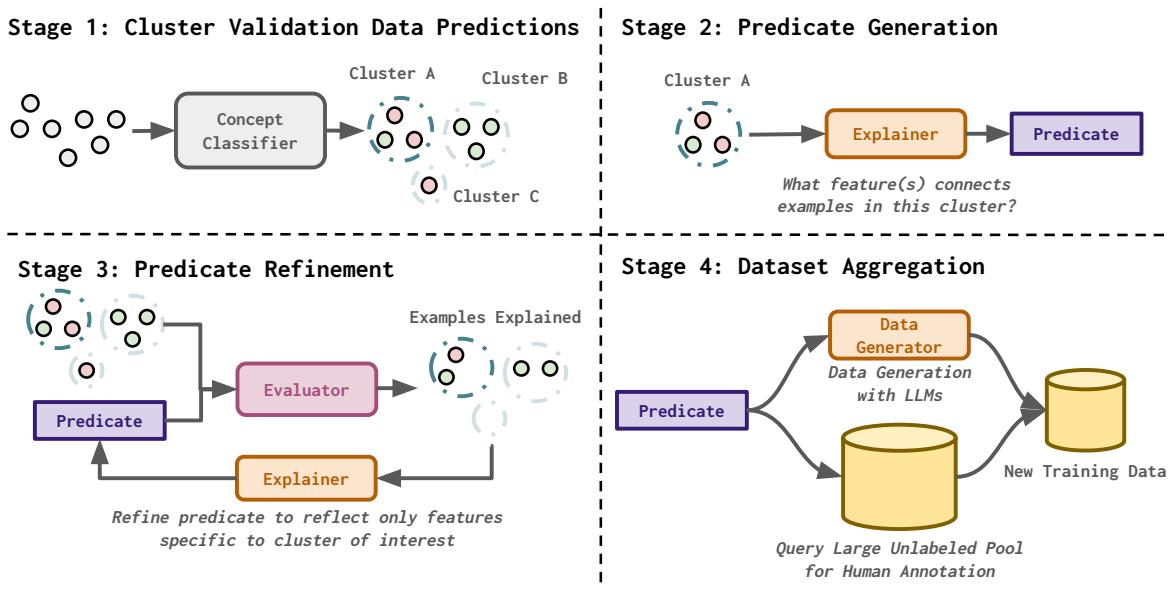
Stage 1: Clustering Validation Set Examples First, the system needs to find the errors. It takes a validation dataset (data the model hasn’t trained on) and identifies where the classifier’s predictions were wrong. Instead of looking at these errors in isolation, DISCERN groups them. It uses agglomerative clustering on the sentence embeddings. This groups the errors based on semantic meaning. If the model is failing on questions about “historical dates” and “movie trivia,” the clustering step should ideally separate these into two distinct error groups (Cluster A and Cluster B).
Stage 2: Predicate Generation (The Explainer) Once a cluster of errors is isolated, DISCERN asks an “Explainer LLM” (e.g., GPT-3.5) to look at the examples and generate a predicate—a logical statement or description that explains what these examples have in common.
- Input: A list of failed sentences.
- Prompt: “What feature connects examples in this cluster?”
- Output: A draft description (e.g., “These are sentences about computers.”).
Stage 3: Predicate Refinement (The Feedback Loop) This is the most critical innovation of DISCERN. A raw description from an LLM is often too broad. “Sentences about computers” might apply to the error cluster, but it might also apply to thousands of examples the model classified correctly. If we use a broad description to fix the model, we might break the parts that are working.
To fix this, DISCERN introduces an Evaluator LLM (e.g., Mixtral). The Evaluator acts as a harsh critic.
- It takes the generated predicate.
- It checks it against the Error Cluster (Target).
- It checks it against Other Clusters (Non-Target).
If the description applies to too many non-target examples, the Evaluator sends feedback to the Explainer: “Your description is too broad. It captures examples from Cluster B. Refine it to be more specific to Cluster A.”
This loop continues iteratively until the description is precise—meaning it covers the errors but excludes the non-errors.
Stage 4: Model Refinement Once the system has a precise text description of the bug (e.g., “News articles debating legal regulations in the tech sector”), it takes action.
- Synthetic Generation: An LLM generates hundreds of new training examples that match this specific description.
- Active Learning: The system scans a pool of unlabeled data to find real-world examples matching the description.
These new examples are added to the training set, and the classifier is retrained to close the gap.
The Power of Refinement
Why is the interactive loop in Stage 3 so important? The paper demonstrates that without refinement, explanations are often “right for the wrong reasons.”
Consider an example from the AGNews dataset. The classifier was failing on a specific cluster of tech news.
- Without Refinement (DISCERN-F): The LLM described the cluster as: “Sci/Tech news articles discuss legal and regulatory challenges in internet and technology sectors.”
- With Refinement (DISCERN): After the feedback loop, the description became: “Legal and regulatory issues in the internet and technology sectors are debated in various news articles.”
It seems like a subtle difference, but the inclusion of the concept of “debate” was the key semantic feature the classifier was missing. The refined description allows for the generation of training data that specifically targets controversial or debated regulatory topics, rather than just dry legal reporting.
Experimental Setup
To validate this framework, the researchers tested DISCERN on three standard text-classification datasets:
- TREC: Classifying questions into types (e.g., “When,” “Who,” “Number”).
- AG News: Classifying news articles into categories (World, Sports, Business, Sci/Tech).
- COVID Tweets: Sentiment analysis on tweets related to the pandemic.
They used two distinct classifiers to prove the method works regardless of the underlying model: DistilBERT and RoBERTa.
They compared DISCERN against several baselines:
- No Description (Naive Augmentation): Just generating more data that “looks like” the error examples, without understanding the semantic link.
- DISCERN-F: Generating a description without the iterative refinement loop.
- Keyword-based methods: Using algorithms to find keywords rather than sentences.
Key Results
The results provide compelling evidence that language explanations are a superior way to debug models compared to raw data or keywords.
1. Synthetic Data Augmentation
The primary metric was accuracy improvement. Can we fix the bug by generating synthetic data based on the DISCERN description?
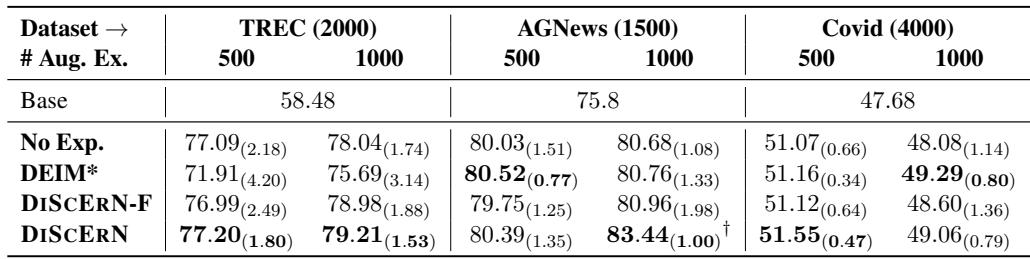
As shown in the table above, DISCERN achieves the highest accuracy across almost all configurations. Notably, on the AGNews dataset with 1000 augmented examples, DISCERN reaches 83.44% accuracy, significantly outperforming the naive approach (80.68%) and the unrefined description approach (80.96%).
This confirms that the quality of the prompt used to generate synthetic data matters. A precise description leads to higher-quality synthetic training data, which leads to a better classifier.
2. Reducing Misclassification Rates
The improvements are even more drastic when we look specifically at the clusters where the model was originally failing. The goal, after all, is to fix specific bugs.
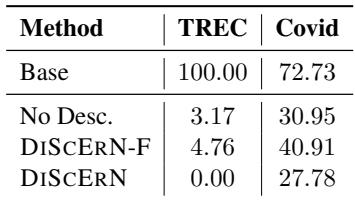
The table above illustrates the median misclassification rates for the problematic clusters.
- On TREC, the error rate dropped to 0.00%. DISCERN effectively solved the systematic error completely.
- On Covid, the error rate dropped from a baseline of ~73% down to 27.78%, significantly lower than the baselines.
This indicates that DISCERN is highly effective at “patching” specific holes in a model’s knowledge.
3. Active Learning
Synthetic data is great, but real data is often better. In the “Active Learning” experiments, the researchers used the generated descriptions to hunt for real, unlabeled examples in the wild that matched the error profile.
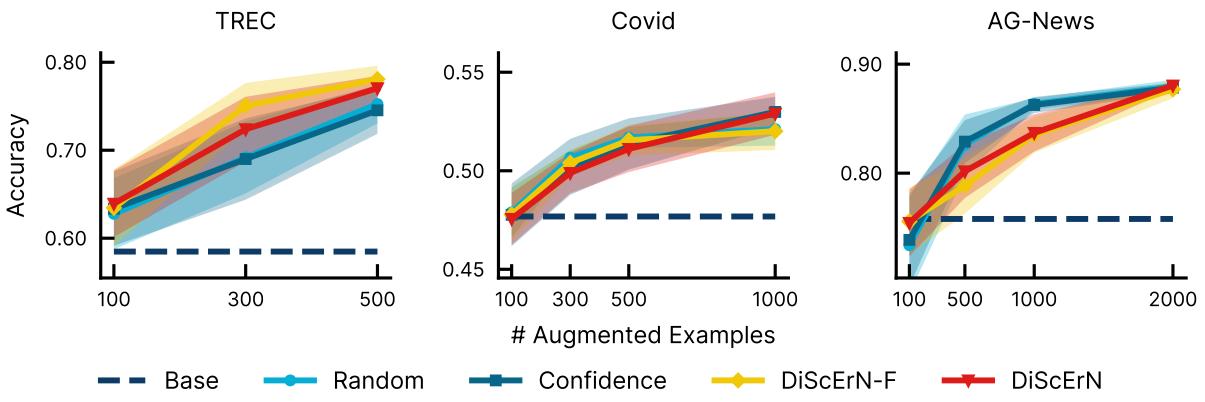
The graph above tracks classifier accuracy as more human-annotated examples are added. The red line (DISCERN) consistently trends higher than the blue line (No Description/Random). This proves that DISCERN helps annotators find the most valuable data to label. Instead of labeling random tweets, you label only the tweets that match the description of the model’s blind spot.
4. Human Interpretability
One of the secondary goals of DISCERN is to make AI more understandable to humans. If a developer is trying to fix a model, they need to understand the bug.
The researchers conducted a user study where participants were shown either raw examples of errors or the DISCERN description. They were then asked to predict if a new example belonged to that error cluster.
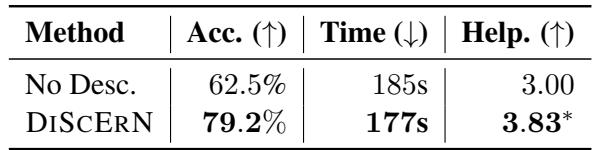
The results were clear: users were 25% more effective (79.2% vs 62.5%) at identifying biased instances when they had the DISCERN language explanation. They also completed the task faster and rated the descriptions as more helpful. This suggests that DISCERN is a powerful tool for human-in-the-loop debugging.
Why Model Choice Matters
The framework relies on LLMs to generate and evaluate the descriptions. Does the choice of LLM matter?
The researchers performed ablations (tests removing or changing parts of the system) to find out.
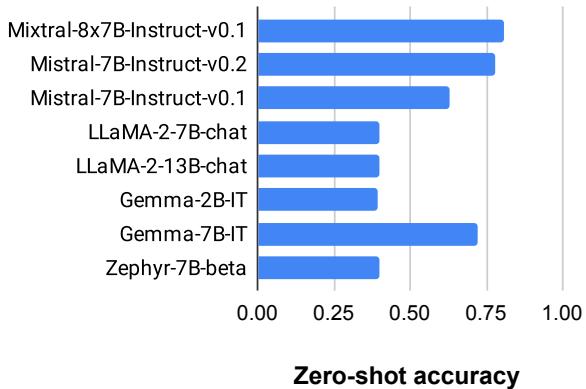
For the Evaluator role (Stage 3), they found that Mixtral-8x7B-Instruct (a high-performing open-source model) aligned best with ground-truth judgments, even outperforming some other popular models. This is crucial for accessibility, as it shows the framework can run effectively using open-weights models.
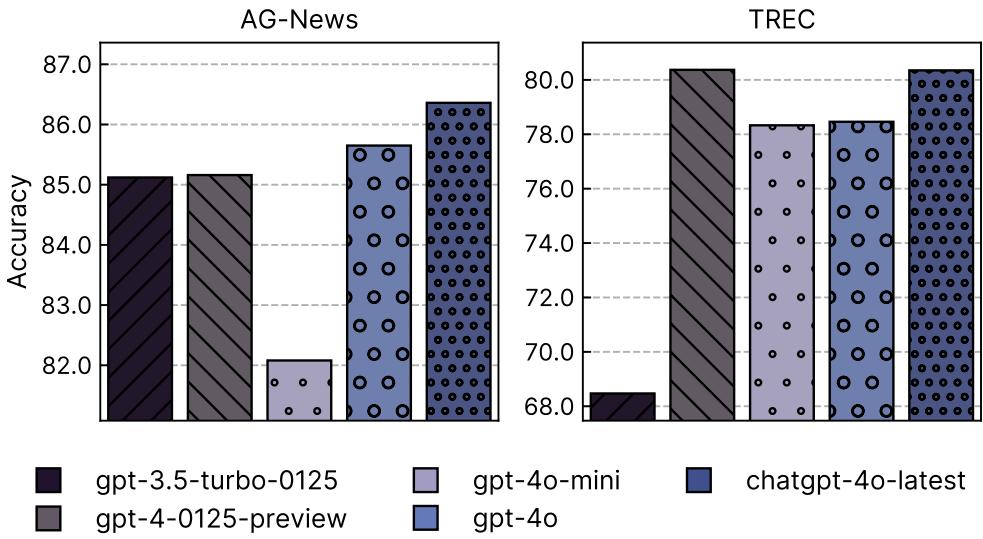
For the Explainer role, the trend is clear: smarter models yield better debugging. As shown above, upgrading from GPT-3.5 to GPT-4o or ChatGPT-4o-latest resulted in better classifier accuracy. This suggests that as LLMs continue to improve, the DISCERN framework will automatically become more effective without any architectural changes.
Conclusion
The DISCERN framework represents a shift in how we approach machine learning reliability. Instead of treating errors as statistical anomalies to be smoothed over, it treats them as concepts to be understood and described.
By leveraging the reasoning capabilities of Large Language Models, DISCERN turns the opaque, high-dimensional problem of “classifier bias” into a transparent, natural language problem.
- It creates precise definitions of where models fail.
- It automates the fix through synthetic data generation or targeted active learning.
- It empowers developers by providing readable explanations of bugs.
As AI systems become more integrated into critical decision-making processes, the ability to “debug” them effectively is paramount. DISCERN offers a blueprint for self-correcting AI systems that can identify their own blind spots and articulate exactly what they need to learn next to fix them.