](https://deep-paper.org/en/paper/2410.22360/images/cover.png)
If you are a student or a researcher, you are likely familiar with the overwhelming sensation of staring at a mountain of papers. The number of scientific publications is growing exponentially. Staying abreast of a field doesn’t just mean reading; it means synthesizing. You have to read dozens of papers, identify common themes, compare methodologies, and contrast results.
The gold standard for this synthesis is the Literature Review Table. These are the structured grids found in survey papers where rows represent specific publications and columns represent “aspects” (like Model Architecture, Dataset Size, or Evaluation Metric). Creating these tables is one of the most laborious tasks in academia. It requires not just extracting data, but identifying the schema—the set of aspects that make for a meaningful comparison.
Can Large Language Models (LMs) automate this? Can we throw a stack of PDFs at an AI and get a perfect review table back?
A recent paper titled “ARXIVDIGESTABLES: Synthesizing Scientific Literature into Tables using Language Models” tackles this exact problem. The researchers introduce a new framework, a massive dataset, and a novel evaluation metric to determine if AI is ready to be your research assistant.
The Anatomy of the Problem
To understand the solution, we first need to formalize the task. Generating a literature review table isn’t just about summarization; it’s about structured synthesis.
As illustrated in the schematic below, the process involves taking a set of unstructured input papers (1) and transforming them into a structured format. This requires two distinct cognitive leaps:
- Schema Generation (2): Deciding what to compare. The model must look at the papers and realize that “Learning Rate” or “Dataset” are relevant columns (aspects) for this specific set of documents.
- Value Generation (3): Extracting the specific data point for each paper corresponding to those columns.
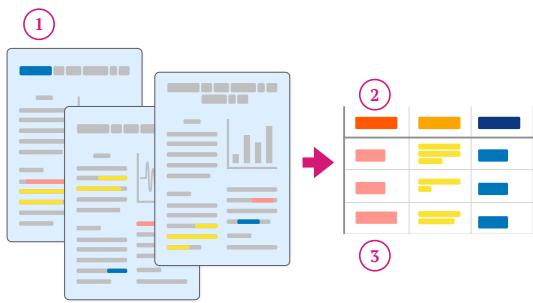
While recent advances in “document-grounded question answering” have solved parts of value generation (e.g., “What is the accuracy of Model X?”), the Schema Generation part remains under-explored. How does a model know which columns are interesting? This is the core challenge the authors address.
Challenge 1: The Data Gap
You cannot train or evaluate models on a task if you don’t have good data. Before this study, there was no large-scale, high-quality dataset of literature review tables linked to their source papers. Existing datasets often focused on numeric results tables or didn’t link back to the full text of the cited papers.
To solve this, the authors built ARXIVDIGESTABLES. They scraped 16 years of ArXiv papers (from 2007 to 2023) to extract real-world literature review tables. This wasn’t a simple copy-paste job; it required a massive filtering pipeline to ensure quality.
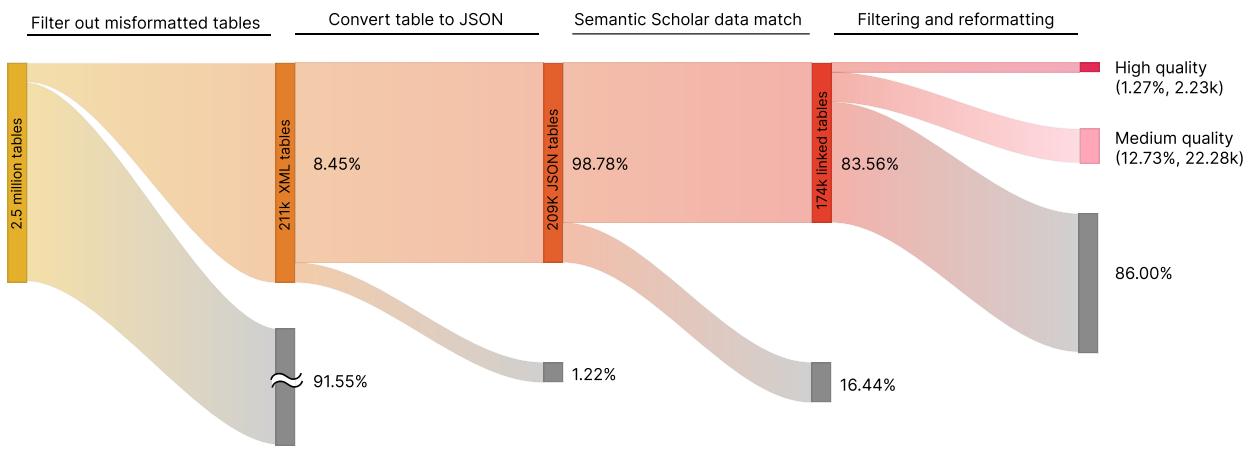
As shown in the pipeline above, the process started with 2.5 million tables. Through rigorous filtering, they narrowed this down to 2,228 high-quality tables. The criteria were strict:
- Ecological Validity: The tables had to be real syntheses created by scientists, not artificial annotations.
- Structure: They had to follow the Row=Paper, Column=Aspect format.
- Grounding: Every row had to link to an accessible full-text paper, and the table had to have associated captions and in-text references.
This dataset provides the “ground truth” needed to see if an AI can recreate what human researchers have painstakingly built.
The Framework: Decomposing Generation
How do you prompt a model to build a table? The researchers experimented with two approaches:
- Joint Generation: Asking the model to generate the schema and the values all at once.
- Decomposed Generation: Breaking the task into two steps—first generating the columns (schema), and then filling in the cells (values).
The decomposed approach proved to be the more robust method, allowing for more control and the integration of specific contexts.
The Role of Context
A major finding of the paper is that models need “hints” to generate good schemas. Just feeding the model the abstracts of the papers often isn’t enough to tell it why you are comparing them.
The researchers tested several “Context Conditions” to steer the model:
- Baseline: Just the paper titles and abstracts.
- Generated Caption: Using a separate LM call to write a hypothetical caption for the table, then generating the table based on that.
- Gold Caption: Feeding the model the actual caption the human author wrote.
- In-Text References: Including the sentences from the survey paper that describe the table (e.g., “Table 1 compares the datasets used in recent VQA studies…”).
- Few-Shot Examples: Showing the model other examples of literature review tables.
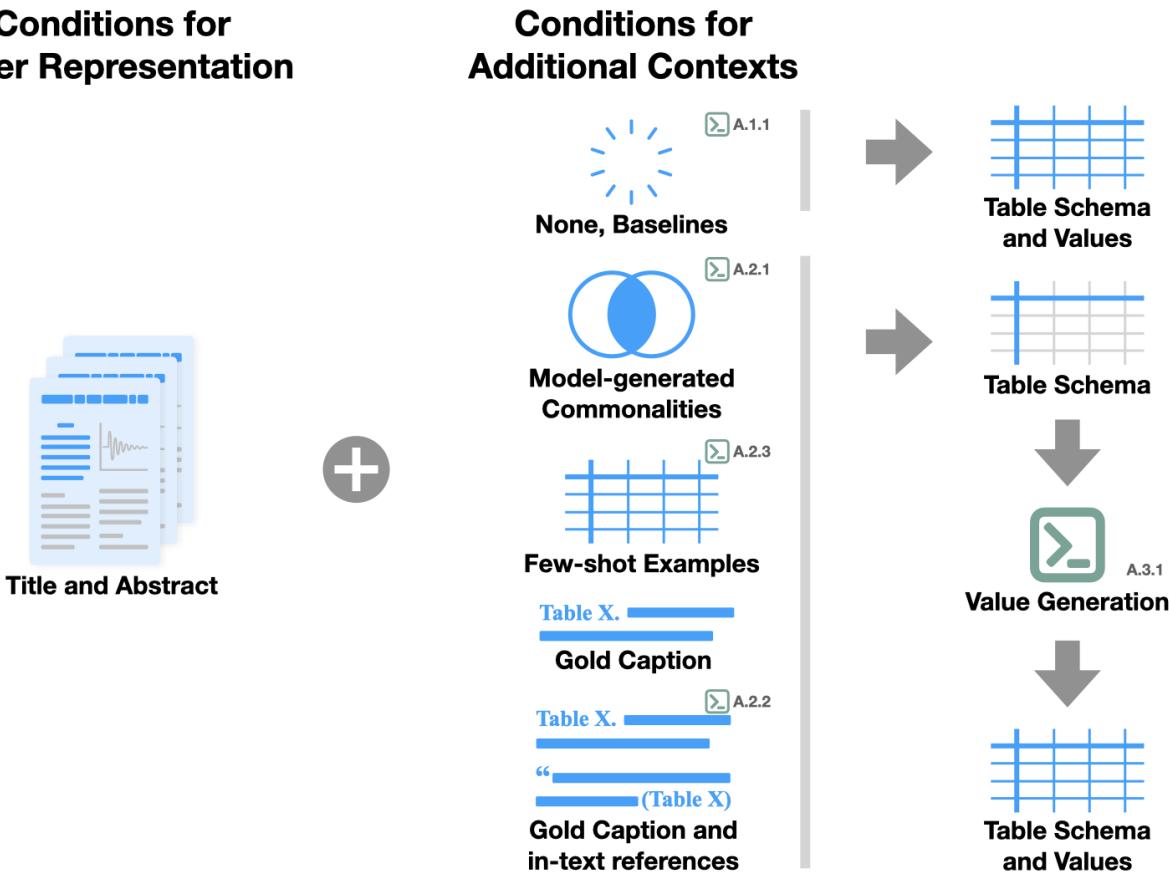
This diagram visualizes the flow. On the left, we have the paper representations. On the right, we see the different levels of “Additional Context” being injected into the prompt. The most complex path (Gold Caption and in-text references) gives the model the specific framing the human author had in mind.
Challenge 2: The Evaluation Crisis
Suppose the model generates a table. How do we know if it’s good?
This is harder than it sounds. In standard machine learning tasks, we check for exact matches. But in language, the same concept can have many names.
Look at the comparison below. The top table is the Original Reference (created by a human). The bottom is the Model Generated table.
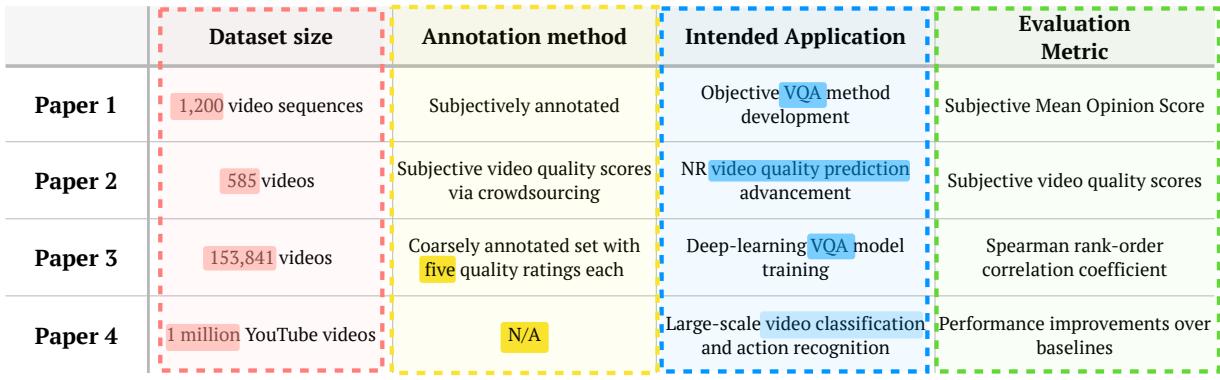
Notice the blue column. The human labeled it “Task”. The model labeled it “Intended Application”. If we used a standard “Exact Match” metric, the model would get a score of 0. But a human reader knows these are effectively the same thing. Furthermore, the model generated a green column called “Evaluation Metric”. The human didn’t include this, but does that make the model wrong? It might still be a useful column.
Introducing DECONTEXTEVAL
To solve the “Task” vs. “Intended Application” problem, the authors developed an automatic evaluation metric called DECONTEXTEVAL.
This metric attempts to align the generated columns with the reference columns using a two-step process:
- Featurization (Decontextualization): Column names are often brief and ambiguous (e.g., “Size”). The system uses an LM to expand the column name into a full description based on the values in the table (e.g., “Size” becomes “The number of video clips contained in the dataset”).
- Scoring: The system then uses Sentence Transformers to calculate the semantic similarity between the expanded description of the generated column and the reference column.
They calibrated this metric against human judgment to find the sweet spot between being too strict (Exact Match) and too hallucination-prone (asking a standard LLM if they match).
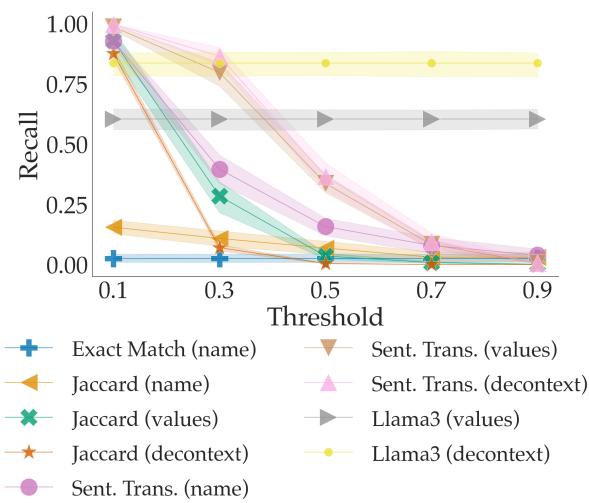
This graph shows why they chose their specific method. The Exact Match (blue) line is at the bottom—it’s too harsh. The Llama 3 (red) line is at the top—it’s too generous and hallucinates matches. The Sentence Transformers (green) line represents the best balance (trade-off) between precision and recall, matching human intuition most closely.
Experimental Results
So, how well do current LLMs (like GPT-3.5 and Mixtral) perform at this task?
1. Schema Reconstruction: Can AI guess the columns?
The researchers measured “Recall”—what percentage of the human-authored columns did the AI successfully recreate?
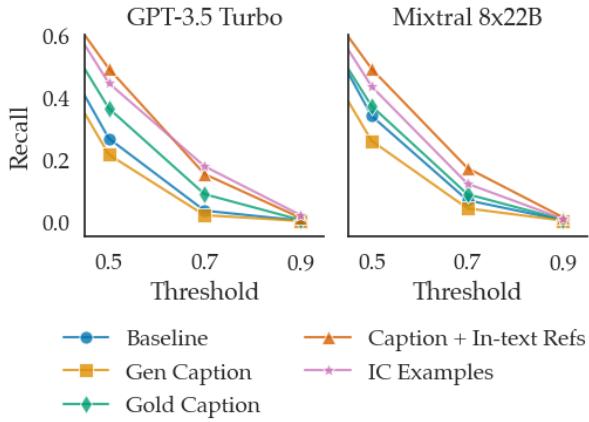
The results in Figure 5 reveal two key insights:
- Context is King: The lines for “Caption + In-text Refs” (orange) are significantly higher than the “Baseline” (blue). If you tell the model why you are making the table (via caption/text), it does a much better job of picking the right columns.
- The Ceiling: Even with the best context, recall tops out around 40-50% at strict thresholds. The models are not perfectly reproducing human tables.
2. The “Novelty” Factor: When AI diverges, is it wrong?
Since the models failed to reconstruct about half of the human columns, the researchers asked a follow-up question: Are the “extra” columns the model created actually bad?
They conducted a human evaluation where experts rated the columns generated by the AI that did not match the reference table. They rated them on Usefulness, Specificity, and Insightfulness.
The results were surprising. The “Novel” (unmatched) columns were rated as equally useful and sometimes even more specific than the human-authored columns. This suggests that the low recall score isn’t just a failure of the model; it’s a reflection of the open-ended nature of the task. There are many valid ways to compare papers, and the AI often found valid angles that the original authors simply chose not to include.
3. Value Accuracy: Can AI fill the cells?
Finally, once the columns are decided, can the model accurately extract the data?
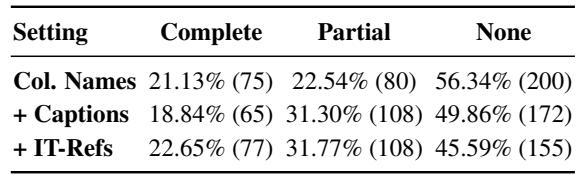
The automated metrics (shown in the graph) show a decline in accuracy as we demand higher similarity thresholds. However, looking at Table 4 (Human Assessment), we see a more nuanced picture.
- Exact Matches: Occur about 20% of the time.
- Partial Matches: Occur about 30% of the time.
A “Partial Match” is often acceptable in a research context. For example, if the human wrote “CNNs” and the model wrote “Convolutional Neural Networks,” that is a match in utility, even if lexically distinct. However, the high number of “None” matches (approx 45-50%) indicates that accurate information extraction from scientific texts remains a difficult challenge for current models.
Conclusion and Implications
The ARXIVDIGESTABLES paper takes a significant step toward automated literature review. It provides the community with a much-needed benchmark dataset and a robust way to evaluate generated tables.
The key takeaways for students and researchers are:
- AI as a Synthesizer: Large Language Models are capable of identifying meaningful aspects for comparing papers, especially when given context about the goal of the review.
- Beyond Reconstruction: We shouldn’t judge AI solely on its ability to copy a human. The “novel” schemas generated by AI can offer unique, specific, and useful perspectives that a human reviewer might overlook.
- The “Human in the Loop”: With value generation accuracy hovering around 50% for high-quality matches, these systems are not yet ready to run autonomously. They are best viewed as “scaffolding” tools—drafting a table structure and filling in initial guesses that a human expert must verify.
This research paves the way for tools that could one day read a hundred papers for you and present a perfectly organized dashboard of comparisons, letting you focus on the insights rather than the data entry.