](https://deep-paper.org/en/paper/2410.23132/images/cover.png)
In the fast-paced world of Deep Learning, we often look for the “next big thing”—a new Transformer architecture, a complex loss function, or a revolutionary optimizer. However, sometimes the most significant breakthroughs come not from inventing something entirely new, but from taking a simple, powerful idea and engineering it to perfection.
This is exactly what the authors of the paper “Revisiting MAE pre-training for 3D medical image segmentation” have achieved. They took the concept of Masked Autoencoders (MAEs)—a technique that has dominated natural language processing and computer vision—and rigorously adapted it for 3D medical imaging.
The result? A model nicknamed Spark3D (S3D) that doesn’t just nudge the state-of-the-art forward; it leaps over it.
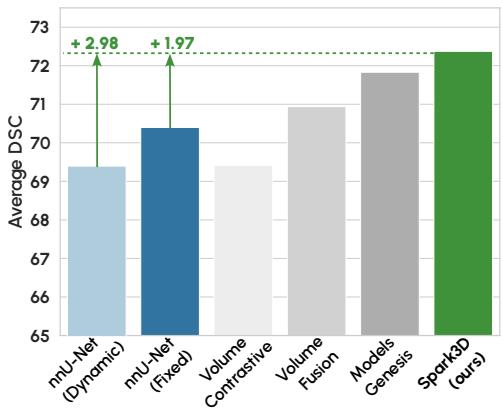
As shown in Figure 1, Spark3D achieves a massive improvement of nearly 3 Dice Similarity Coefficient (DSC) points over the strong nnU-Net baseline. If you work in medical image segmentation, you know that gaining even 0.5 DSC on a well-tuned baseline is a struggle. Gaining 3 points is a paradigm shift.
In this blog post, we will tear down this paper to understand why previous attempts at Self-Supervised Learning (SSL) in medicine failed, how Spark3D fixes these pitfalls, and the specific engineering choices that make it work.
The Context: The Broken Promise of SSL in Medicine
To understand why this paper is important, we first need to understand the problem. Medical imaging suffers from a “data hunger” crisis. We have millions of scans sitting in hospital archives (unlabeled data), but only a tiny fraction are annotated by experts (labeled data) because it is expensive and time-consuming.
Self-Supervised Learning (SSL) promises a solution: pre-train a model on the millions of unlabeled images to learn the “structure” of the human body, then fine-tune it on the small labeled dataset.
While this has worked wonders in fields like Natural Language Processing (think GPT) and 2D Computer Vision, it has largely failed to gain traction in 3D medical imaging. Most practitioners still prefer training from scratch. The authors argue that this failure stems from three specific pitfalls.
The Three Pitfalls of Medical SSL
The researchers identified three major flaws in how the medical AI community has approached SSL so far:
- Pitfall 1 (P1): Data Starvation. Most “large-scale” pre-training in medical papers uses fewer than 10,000 volumes. In the world of deep learning, this is barely a warm-up.
- Pitfall 2 (P2): The Transformer Obsession. There is a trend to use Transformers (like ViT or Swin) because they are popular in 2D vision. However, in 3D medical segmentation, Convolutional Neural Networks (CNNs)—specifically the U-Net—are still the undisputed kings. Pre-training a Transformer doesn’t help if the underlying architecture is inferior for the task.
- Pitfall 3 (P3): Insufficient Evaluation. Many papers test on the same dataset they trained on, or use weak baselines to make their method look better.
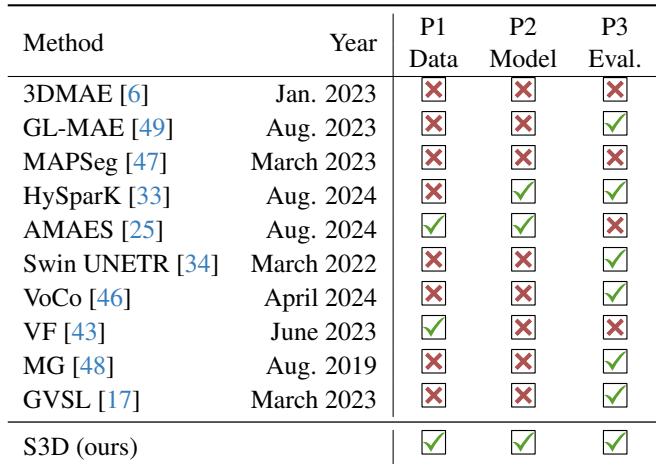
Table 1 summarizes this bleak landscape. Notice how previous state-of-the-art methods like Swin UNETR or VoCo fall into multiple pitfalls. Spark3D (S3D) is designed explicitly to avoid all three.
The Core Method: Designing Spark3D
The authors didn’t invent a new mathematical theory. Instead, they revisited the Masked Autoencoder (MAE) and optimized it for 3D CNNs.
The concept of an MAE is simple:
- Take an image.
- Mask out (hide) a large portion of it (e.g., 75%).
- Ask the neural network to reconstruct the missing parts.
If the network can reconstruct a brain tumor from a partial image, it must have learned a deep understanding of brain anatomy. The challenge is making this work for 3D CNNs.
1. Solving the Data Problem (Addressing P1)
You cannot learn robust features from a handful of scans. The authors curated a massive proprietary dataset to ensure the model sees enough variety.
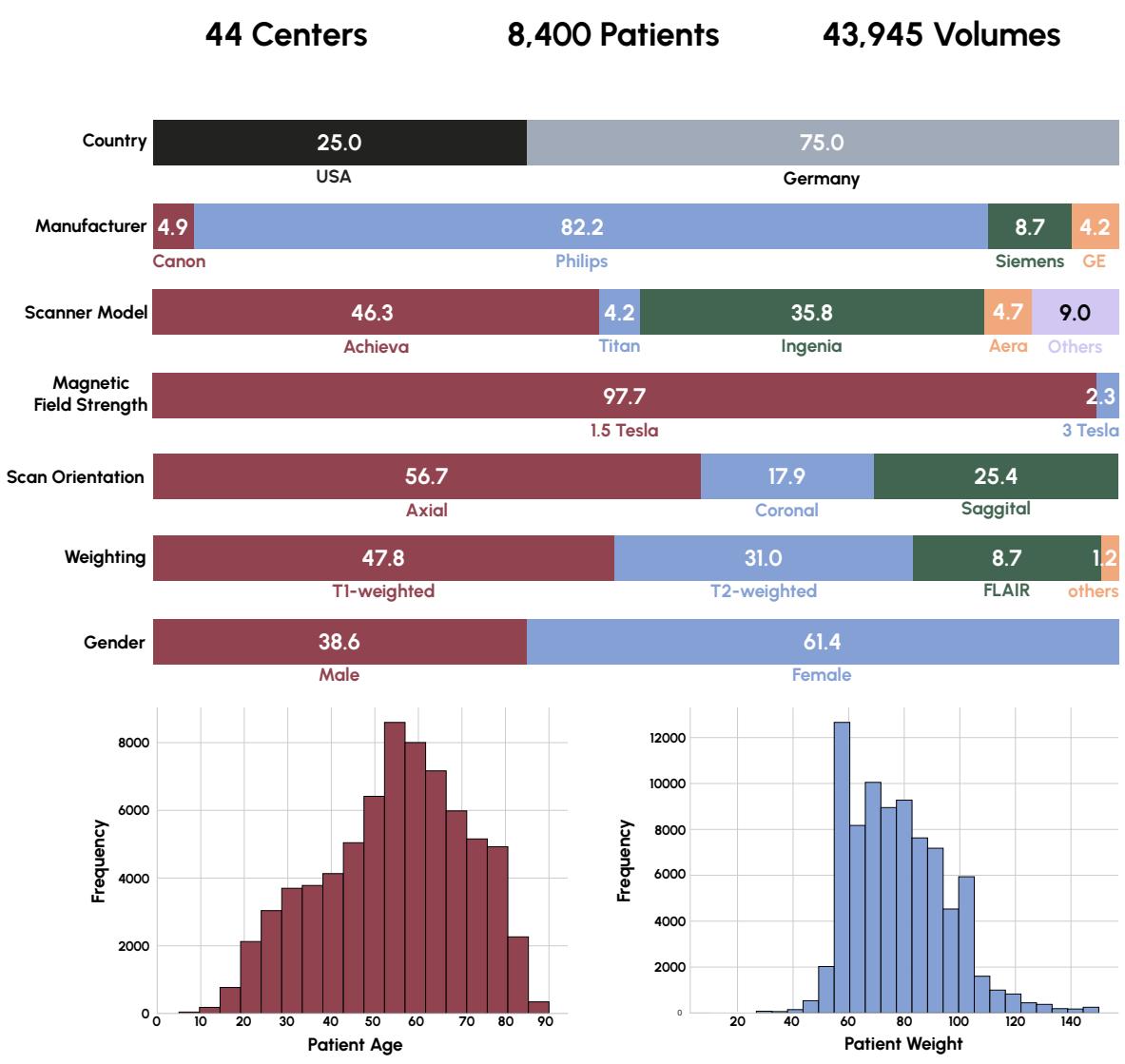
Figure 3 illustrates the scale of this data. It includes nearly 44,000 MRI volumes from 44 different centers. Crucially, it covers various scanner manufacturers (Philips, Siemens, GE) and modalities (T1, T2, FLAIR). This diversity prevents the model from overfitting to the “style” of a specific hospital’s MRI machine.
2. Back to Basics: The Architecture (Addressing P2)
Instead of using a trendy Transformer, the authors used a Residual Encoder U-Net (ResEnc U-Net). This is a CNN-based architecture that has been proven to be state-of-the-art for 3D segmentation. By choosing a strong backbone, they ensure that any performance gains come from the pre-training method, not just from switching architectures.
3. Adapting MAE for CNNs: The “Sparsification” Strategy
Here lies the technical innovation. Transformers handle masked data easily—they just drop the “tokens” corresponding to masked areas. CNNs, however, rely on a rigid grid. If you just zero out pixels, standard convolutions struggle because the distribution of values changes drastically (sparse inputs lead to statistical shifts).
To fix this, the authors employed a Sparse CNN approach adapted from computer vision literature (specifically ConvNeXt V2 and SparK). They introduced three key components:
- Sparse Convolutions & Normalization: The network treats masked regions as “empty” rather than just “black pixels.” The normalization layers are adjusted so they don’t get thrown off by the missing data.
- Mask Token: Before the decoder tries to reconstruct the image, the missing spots are filled with a learnable “Mask Token.” This gives the decoder a placeholder to work with.
- Densification Convolution: A special convolutional layer is added to smooth out the transition from sparse features to dense features before decoding.
The authors performed an ablation study to see which of these mattered most.
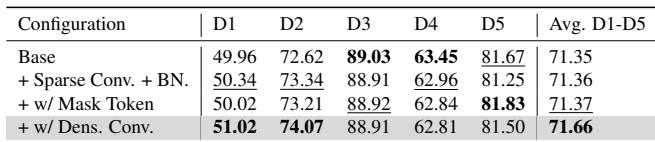
Looking at Table 2(a), you can see that adding these components step-by-step improves performance. The jump from the “Base” model to the model with “Densification Conv” helps push the Average DSC up.
Table 2(b) answers another critical question: How much of the image should we hide? Surprisingly, hiding 60% to 75% of the image works best. If you make it too easy (masking only 30%), the model doesn’t learn much. The authors settled on a Dynamic Masking Ratio, where the masking percentage changes randomly between 60% and 90% during training. This keeps the model on its toes.
4. The Fine-Tuning Recipe
Pre-training is only half the battle. How you transfer those learned weights to your specific task (Fine-Tuning) is equally important. The authors asked: Should we freeze the encoder? Should we warm up the learning rate?
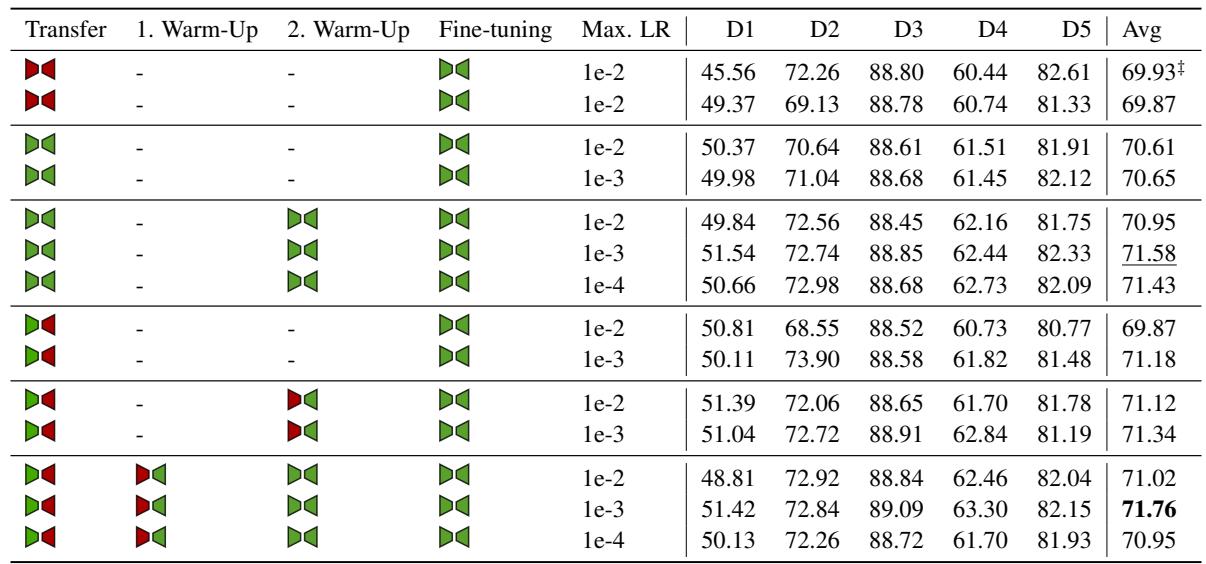
Table 3 reveals the optimal “recipe” (indicated by the Green Bow Ties):
- Warm-up is essential: You must ramp up the learning rate slowly for both the encoder and decoder.
- Don’t freeze the encoder: Unlike some NLP approaches, freezing the encoder hurts performance in medical imaging. The features need to adapt to the specific downstream task.
- Lower Learning Rate: Using a slightly lower learning rate (1e-3) during fine-tuning yielded the best stability.
Experiments & Results: The “Spark” in Spark3D
To address Pitfall 3 (Insufficient Evaluation), the authors set up a massive validation framework. They used 5 datasets for development and 8 completely separate test datasets to evaluate the final model. These test datasets covered everything from brain tumors (BraTS) to stroke lesions (ISLES) and anatomical structures (Hippocampus).
Beating the Baselines
The comparison included strong SSL methods like Models Genesis (MG), Volume Fusion (VF), and VoCo. It also included the toughest competitor of all: a standard nnU-Net trained from scratch (denoted as No (Dyn) and No (Fix)).
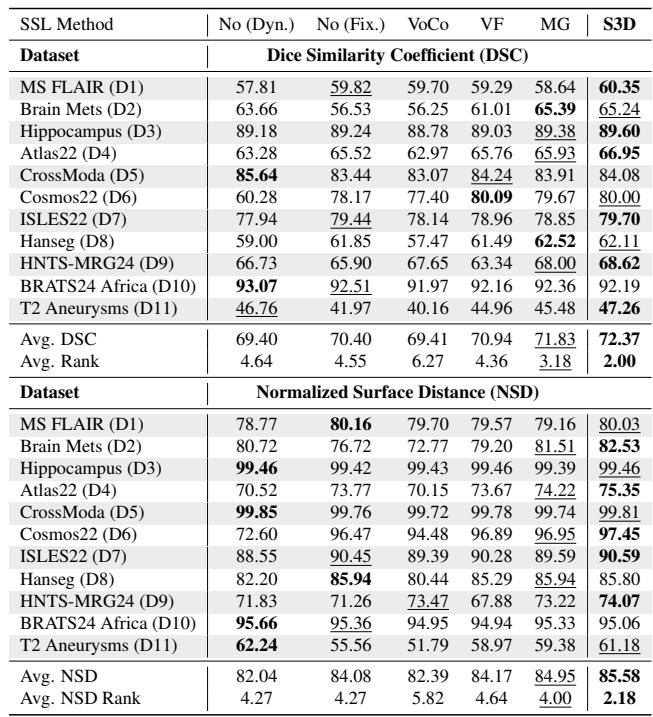
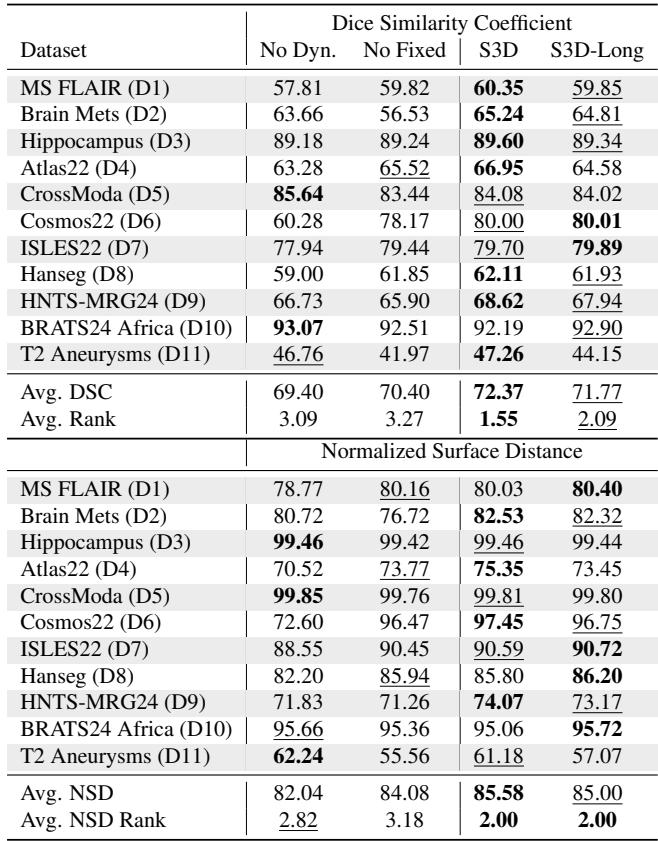
Table 4 is the centerpiece of the results. Here is what we see:
- Consistency: S3D (the far-right column) achieves the highest DSC in almost every dataset.
- Magnitude: In difficult tasks like “Brain Mets (D2)”, S3D beats the standard nnU-Net (
No Dyn) by nearly 1.6 DSC points. In the aggregated average, it wins by 3 points. - Surface Distance: The lower table shows Normalized Surface Distance (NSD), a metric that measures how physically close the predicted boundaries are to the truth. S3D dominates here as well, achieving an average NSD of 85.58 vs. 82.04 for the baseline.
Ranking Stability
Averages can be misleading if a method wins big on one dataset but fails on another. To prove S3D is robust, the authors analyzed the “Rank” of each method across all datasets.
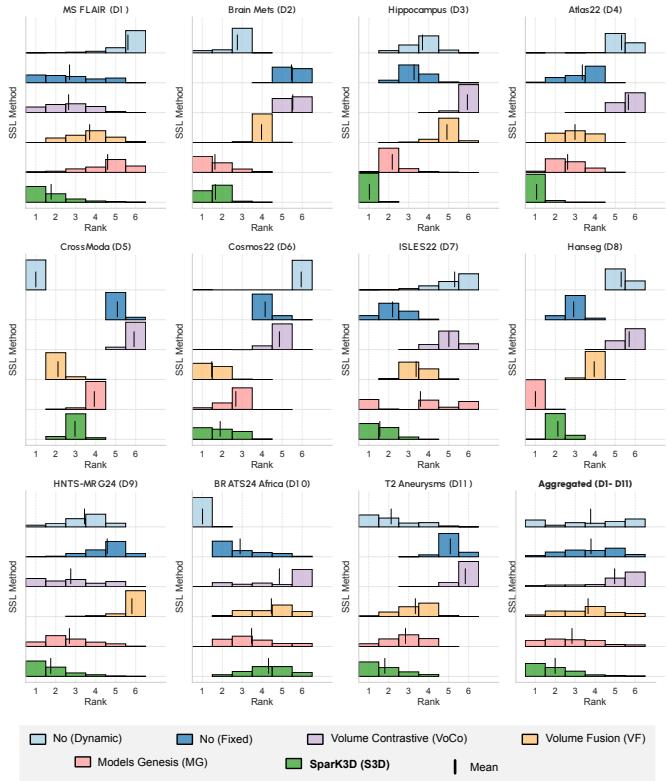
Figure 2 visualizes this ranking. The Green Box (S3D) is consistently at the top (Rank 1 or 2) across almost all datasets. In contrast, other methods like VoCo (Purple) or Volume Fusion (Orange) fluctuate wildly—performing well on some tasks and poorly on others. This reliability is crucial for clinical adoption; doctors need a model that works everywhere, not just on specific pathologies.
The “Low-Data” Miracle
The promise of SSL is that it should help when you don’t have many labels. The authors tested this by training S3D on extremely small subsets of data—as few as 10 to 40 images.
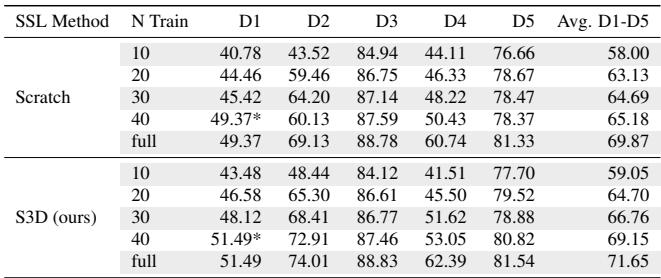
Table 6 presents a stunning finding. Look at the row for 40 images. The pre-trained S3D model trained on only 40 scans achieves a Dice score (Avg 69.15) that is statistically indistinguishable from a model trained from scratch on the full dataset (Avg 69.87).
This implies that if you have S3D pre-training, you can achieve state-of-the-art results with a fraction of the annotation effort. For a hospital, this means saving hundreds of hours of radiologist time.
Generalization: Does it work outside the brain?
S3D was trained on Brain MRI. A skeptic might ask: “Does this learned knowledge transfer to other parts of the body or other modalities like CT?”
The authors tested this by applying their Brain-MRI-pretrained model to the BTCV dataset, which consists of Abdominal CT scans.
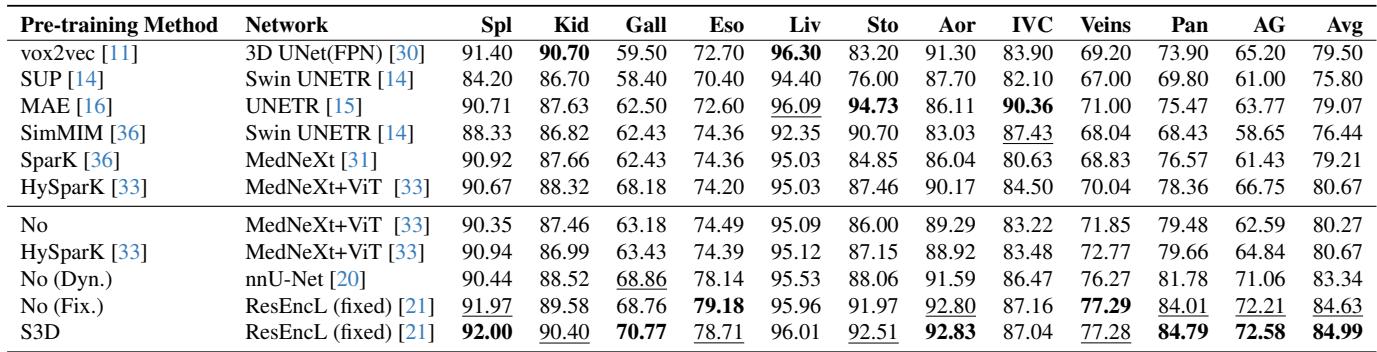
Table 11 shows something counter-intuitive. S3D (bottom row) outperforms methods that were actually pre-trained on CT data (like HySparK). Even though the model had never seen a stomach or a liver during pre-training, the fundamental understanding of 3D spatial structures, edges, and textures learned from the brain transferred effectively to the abdomen.
Ablation Studies: What didn’t work?
Part of rigorous science is reporting what doesn’t help. The authors explored scaling up the pre-training time significantly.
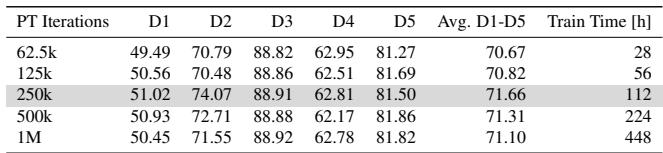
As shown in Table 7 and Table 12, training for longer (1 million steps vs. 250k steps) or increasing batch sizes did not improve performance. In fact, performance slightly degraded. This suggests that the model converges to a robust representation relatively quickly, and further training might lead to overfitting the pre-training task (reconstruction) at the expense of general features.
Conclusion and Implications
The paper “Revisiting MAE pre-training for 3D medical image segmentation” serves as a masterclass in modern deep learning research. It moves away from the “novelty trap” of inventing complex new modules and focuses on the “rigor gap”—fixing data, architecture, and evaluation.
Key Takeaways for Students and Practitioners:
- Architecture Matters: Don’t blindly apply Transformers just because they work in NLP. In 3D medical imaging, well-tuned CNNs (like ResEnc U-Net) are formidable.
- Scale Matters: Pre-training on 40k images creates a fundamentally different model than pre-training on 2k images.
- Simplicity Wins: The MAE objective is incredibly simple—reconstruct the masked image. Yet, when engineered correctly with sparse convolutions, it outperforms complex contrastive learning frameworks.
- Label Efficiency: With methods like S3D, the barrier to entry for creating medical AI tools is lowered. You no longer need thousands of labeled scans; forty might be enough.
Spark3D sets a new standard for open science in medical AI. By providing a pre-trained checkpoint that generalizes this well, the authors have given the community a powerful tool to accelerate research across detecting tumors, treating strokes, and mapping the human brain.