](https://deep-paper.org/en/paper/2410.23780/images/cover.png)
Imagine you are driving down a busy urban street. You see a lane marked with a solid white line, but overhead, a blue sign indicates “Bus Lane: 7:00-9:00, 17:00-19:00.” You glance at the clock; it’s 10:30 AM. You confidently merge into the lane.
This decision-making process—perceiving the geometry of the road, reading a sign, understanding the temporal rule, and associating that rule with a specific lane—is second nature to humans. For autonomous vehicles (AVs), however, it is a surprisingly complex challenge.
While modern self-driving systems are excellent at detecting where the road is (geometry) and how lanes connect (connectivity), they often struggle with the “traffic regulation layer”—the abstract rules governing those lanes. Most systems rely on pre-built, offline High-Definition (HD) maps for this data. But what happens when the map is outdated? Or when a temporary sign appears?
In this post, we will dive deep into a new research paper titled “Driving by the Rules”. The researchers propose a novel benchmark and method called MapDR to solve the missing link in online HD mapping: integrating traffic sign regulations directly into vectorized maps in real-time.
The Missing Layer in Online Mapping
To understand the problem, we first need to look at how AVs perceive the world. High-Definition maps are typically composed of three distinct layers:
- Geometric Layer: The physical layout (dividers, centerlines, boundaries).
- Connectivity Layer: How lanes connect (path planning, topology).
- Traffic Regulation Layer: The rules associated with those lanes (speed limits, HOV restrictions, bus-only times).
Current trends in autonomous driving are moving toward “Online HD Map Construction”—building the map in real-time using onboard sensors rather than relying on stale offline data. State-of-the-art methods like MapTR have mastered the first two layers. They can draw the road vectors beautifully. However, they completely ignore the third layer.
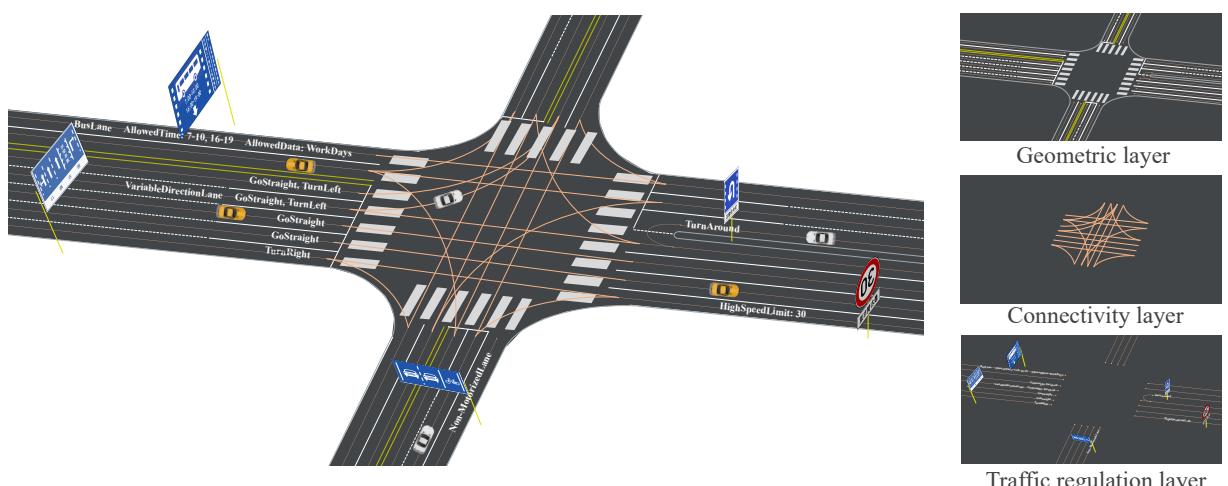
As shown in Figure 1, existing methods construct the geometry and connectivity but leave the regulation layer blank. This is dangerous. If an AV sees a lane but doesn’t know it’s a “tide lane” (reversible direction) or a “bus lane,” it cannot drive safely.
The goal of this research is to bridge this gap. The researchers aim to automate the process of not just reading a sign, but associating specific rules with specific vectorized lanes in the local map.
Defining the Challenge: MapDR
The researchers formalized this problem into a new task called MapDR (Map Driving Rules). The objective isn’t just “detect a sign”; it is a two-step reasoning process:
- Rule Extraction: Understanding the complex semantics of a traffic sign (images and text) and converting them into structured data.
- Rule-Lane Correspondence: Determining exactly which lane(s) in the 3D space those rules apply to.
This mimics human cognition. First, we read; then, we map the information to the physical world.
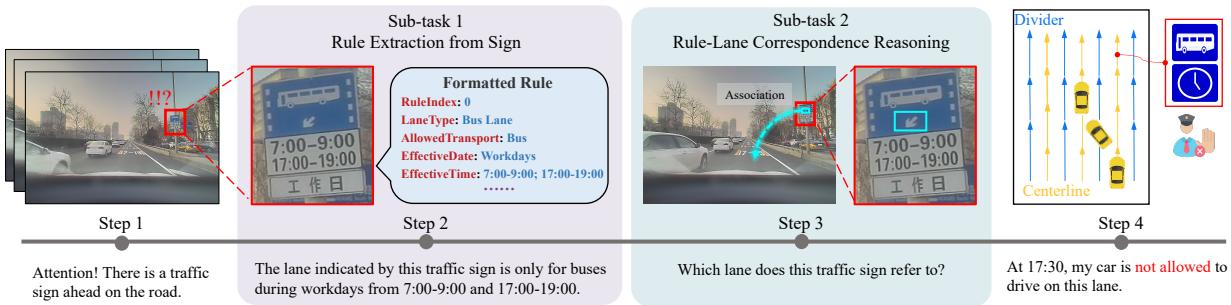
As illustrated in Figure 2, the system must take a raw video feed, extract structured rules (e.g., “Bus Lane,” “Allowed: Bus,” “Time: 7-9”), and then link that rule to the specific centerline vector of the correct lane. If the system fails at either step—misreading the time or picking the wrong lane—the driving decision will be wrong.
Structured Rule Representation
One of the key contributions of this paper is how they format these rules. A simple label like “Speed Limit Sign” isn’t enough for a computer to plan a path. The system needs actionable data.
The authors propose a {key: value} pair format. A single sign might contain multiple rules. For example, a sign might say “Left Turn Only” for one lane and “Straight Only” for another.
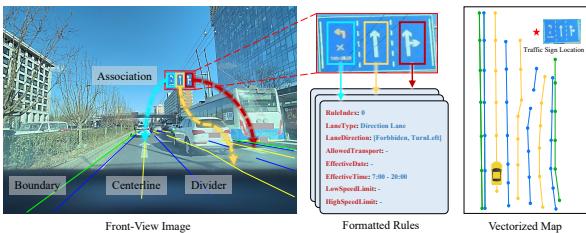
Figure 3 shows this annotation in action. Notice how the traffic sign is parsed into a JSON-like structure defining LaneType, EffectiveTime, and AllowedTransport. Crucially, these rules are connected via directed lines to the specific lane vectors (centerlines) on the map.
The Dataset: A New Benchmark
Because no existing dataset combined vectorized HD maps with detailed, lane-level rule annotations, the researchers built their own.
MapDR is the first dataset of its kind, collected across major cities in China (Beijing, Shanghai, Guangzhou). It features:
- 10,000+ video clips of traffic scenes.
- 18,000+ annotated driving rules.
- Diversity: It covers bus lanes, tidal flow lanes, high-occupancy vehicle (HOV) lanes, and complex intersections.
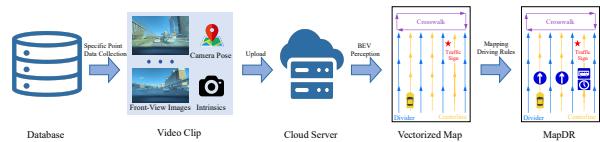
The production pipeline (Figure 5) involves collecting raw sensor data, generating the base vectorized map using cloud servers, and then meticulously annotating the rules and their relationships to the lanes. This provides the ground truth needed to train AI models to perform this task automatically.
The Solution: A Modular Approach
How do we teach a neural network to do this? The paper proposes a modular architecture that splits the problem into the two sub-tasks defined earlier: perceiving the sign and mapping it to the road.
They introduce two specialized encoders:
- VLE (Vision-Language Encoder): To understand the sign.
- MEE (Map Element Encoder): To understand the road vectors.
Let’s break down the architecture.
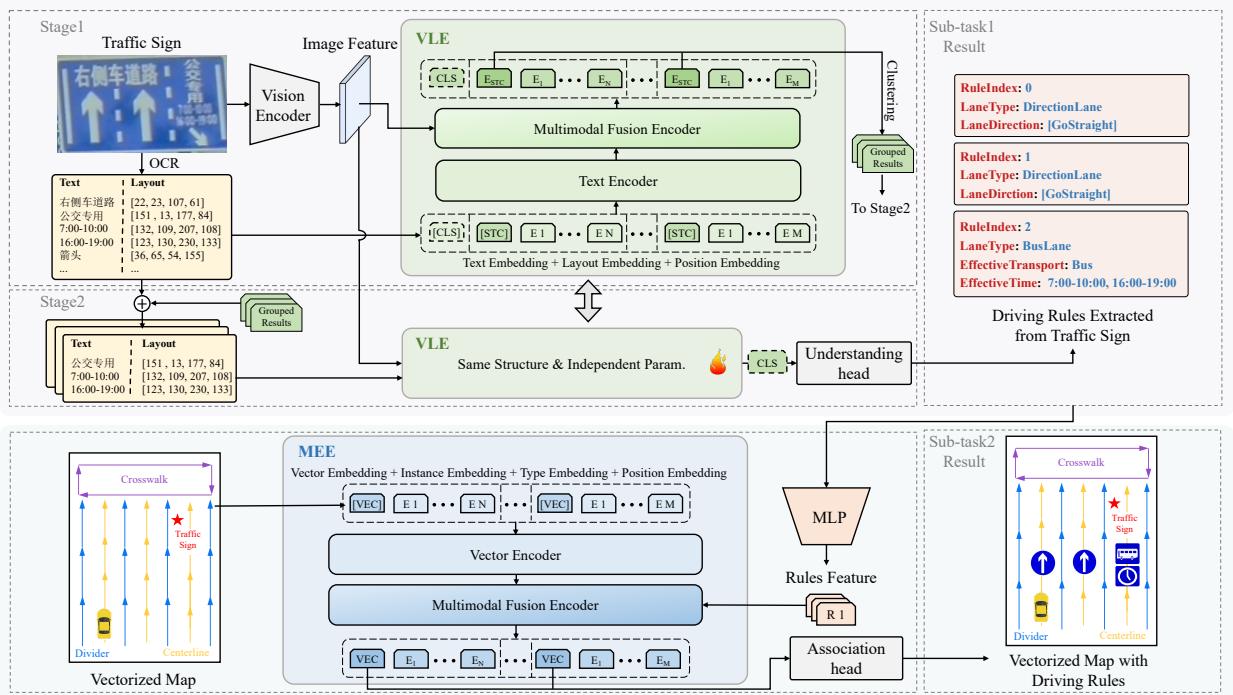
1. Vision-Language Encoder (VLE)
The VLE is responsible for Rule Extraction. Traffic signs are multimodal—they contain visual symbols (arrows, icons) and text.
- Input: The system takes the image and performs OCR (Optical Character Recognition) to get the text and layout.
- Processing: It uses a BERT-based text encoder and a ViT (Vision Transformer) image encoder. A cross-attention module fuses these features.
- Clustering: Since one sign board might have multiple rules (e.g., different times for different lanes), the VLE clusters the text and symbols into groups, where each group represents one specific rule.
2. Map Element Encoder (MEE)
This is the most innovative part of the architecture. Standard neural networks are good at images, but vectorized maps are just lists of point coordinates. How do you feed a list of 3D points into a neural network effectively?
The MEE treats map vectors similarly to how Large Language Models (LLMs) treat words in a sentence.
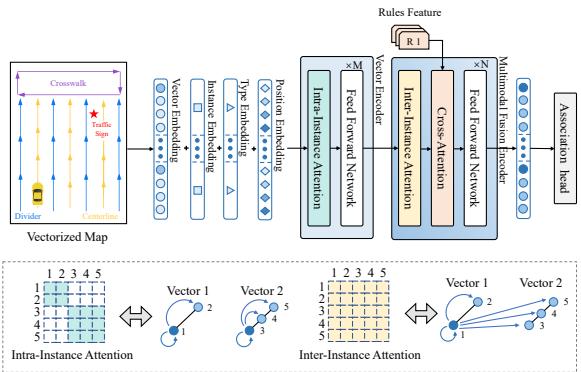
As shown in Figure 7, the MEE uses a Transformer architecture:
- Vector Embeddings: Each lane is a sequence of points. These points are embedded into a feature vector.
- Type & Instance Embeddings: The model is told what type of line it is (divider vs. centerline) and which specific instance it belongs to.
- Hierarchical Attention:
- Intra-Instance Attention: The model looks at points within a single lane to understand its shape.
- Inter-Instance Attention: The model looks at relationships between different lanes (e.g., a lane next to a divider).
3. The Handshake: Reasoning
Finally, the system fuses the output of the VLE (the extracted rule) with the output of the MEE (the map vectors). A final classification head (the “Association Head” in Figure 6) decides, for every pair of Rule + Lane: “Does this rule apply to this lane?”
The Alternative: End-to-End LLMs
The modular approach described above is highly specialized. But we live in the era of Generative AI. Could a Multimodal Large Language Model (MLLM) like GPT-4 or Qwen-VL solve this in one go?
The researchers explored this by building RuleVLM, an end-to-end model.
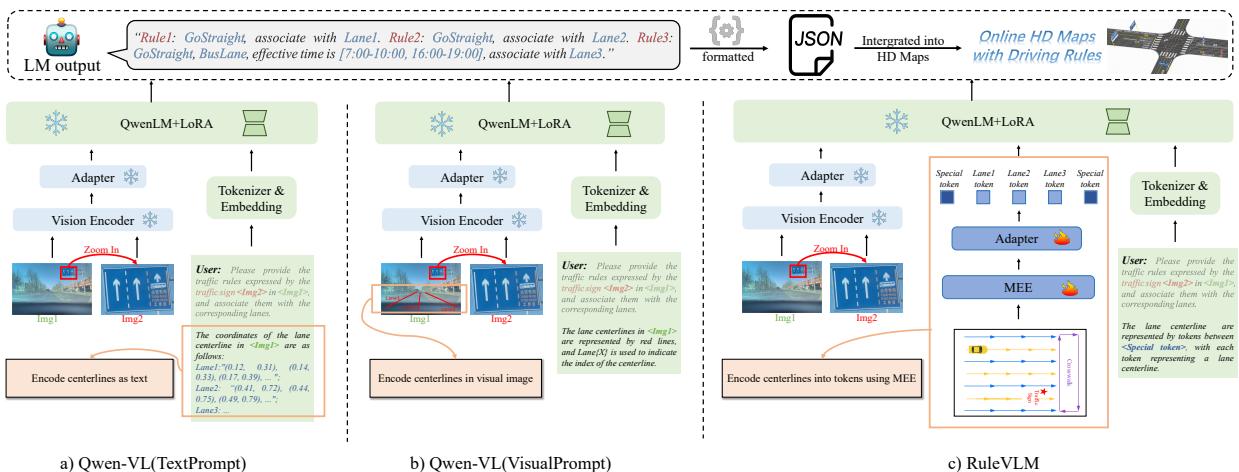
They tested three ways to feed map data into an LLM (Figure 8):
- Text Prompt: Converting lane coordinates into text strings. (e.g., “Lane 1 is at coordinates x,y…”).
- Problem: LLMs are notoriously bad at spatial reasoning from raw coordinate numbers. It also creates massive text prompts.
- Visual Prompt: Drawing the lane lines onto the image so the LLM can “see” them.
- Result: Better, but still relies on the LLM’s visual acuity to distinguish overlapping lines in complex intersections.
- RuleVLM (The Authors’ Method): They injected the MEE (Map Element Encoder) directly into the LLM. Instead of converting vectors to text or pixels, they convert them to “soft tokens”—vectors that the LLM can process as if they were a foreign language it understands.
Experiments and Results
So, what works better? The specialized modular approach or the giant brain of the LLM?
The researchers evaluated the models using Precision, Recall, and F1 Score for both sub-tasks (extracting rules and reasoning correspondence).
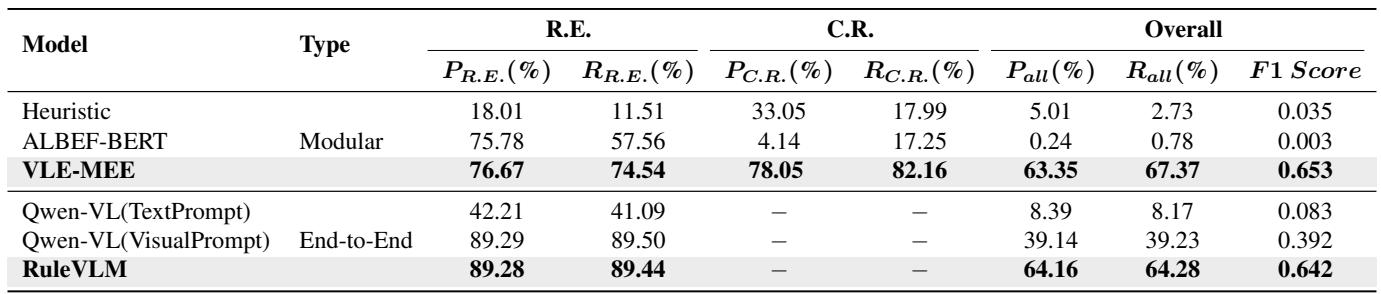
Table 2 reveals the key findings:
- Heuristics don’t work: Simple rule-based matching (e.g., “assign the sign to the nearest lane”) failed miserably (F1 Score: 0.035). Traffic scenes are too messy for simple distance rules.
- Text Prompts fail: The end-to-end model using text coordinates (Qwen-VL TextPrompt) also struggled (F1 Score: 0.083), confirming that LLMs cannot easily “imagine” geometry from coordinate numbers.
- Visual Prompts help: Drawing lines on the image (VisualPrompt) improved performance significantly (F1 Score: 0.392).
- MEE is King: The modular approach (VLE-MEE) achieved the highest score (F1 Score: 0.653). The specialized encoder for map vectors allows for much more precise reasoning than generic visual or textual features.
- RuleVLM is close: The end-to-end model utilizing the MEE adapter performed comparably to the modular approach (F1 Score: 0.642), showing that LLMs can do this task if given the right data representation.
Why is this hard?
The difficulty varies by lane type. Bus lanes are often distinct and easy to identify. However, “Tidal Flow” lanes (lanes that change direction based on the time of day) are notoriously difficult because they rely on understanding complex time tables and variable geometry.
Conclusion: Toward “Rule-Compliant” AVs
The MapDR paper highlights a critical gap in the autonomous driving stack. We have conquered the ability to detect where the road is, but we are just beginning to teach cars to understand the “law” of the road in real-time.
The introduction of the MapDR benchmark provides the data needed to train future systems. Furthermore, the success of the Map Element Encoder (MEE) demonstrates that treating map vectors as a distinct modality—separate from images or text—is essential for high-performance spatial reasoning.
As these systems improve, we move closer to a future where autonomous vehicles don’t just follow a pre-recorded path, but actively read, interpret, and obey the dynamic rules of the road, just like a conscientious human driver.
Key Takeaways
- Traffic Regulation Layer: Online maps must include rules, not just geometry.
- MapDR: A new massive dataset for linking signs to lanes.
- MEE: A transformer-based method for encoding road vectors effectively.
- Future: Hybrid models combining specialized encoders (like MEE) with the reasoning power of LLMs (like RuleVLM) seem to be the most promising path forward.