](https://deep-paper.org/en/paper/2411.01176/images/cover.png)
If you have ever stared at a terminal window during a security incident, you know that the command line is the battlefield of modern cybersecurity. For attackers, the command line interface (CLI) is the ultimate tool for execution, persistence, and privilege escalation. For defenders, it is a crime scene full of fingerprints.
However, there is a significant problem in how we analyze these fingerprints. Attackers are masters of disguise. They can rewrite the same malicious logic in a dozen different ways—changing argument orders, using aliases, or obfuscating strings—to evade detection systems that rely on simple pattern matching or signature detection.
In the world of Natural Language Processing (NLP), we solved a similar problem years ago using embeddings—converting text into vectors where “dog” and “puppy” are mathematically close. But applying this to the rigid, syntactically unique world of command lines has been a struggle.
Today, we are diving deep into a fascinating paper titled “CmdCaliper: A Semantic-Aware Command-Line Embedding Model and Dataset for Security Research.” This research introduces a novel way to teach AI to understand what a command means, not just what it looks like. We will explore how the researchers used Large Language Models (LLMs) to synthesize a massive training dataset and how they built a model that outperforms state-of-the-art sentence embeddings with a fraction of the parameters.
The Core Problem: Syntax vs. Semantics
To understand why this research is necessary, we first need to look at the limitation of current security tools. Traditional detection relies heavily on signatures. If an attacker runs mimikatz.exe, the system flags it. But if they rename it to notepad.exe and pass specific flags that achieve the same result, a signature-based system might miss it.
This is the difference between syntax (the specific characters used) and semantics (the intent or action performed).
In natural language, we use models like BERT or GPT to capture semantics. However, command lines are not natural language. They have strict grammars, flags, file paths, and argument structures that confuse standard language models.
- Natural Language: “The quick brown fox jumps over the lazy dog.”
- Command Line:
schtasks /create /tn "TaskName" /tr "C:\program.exe" /sc daily /st 00:00
The researchers behind CmdCaliper set out to build an embedding model specifically for this domain. Their goal was to map command lines into a vector space where commands with similar intents are clustered together, regardless of how they are written.
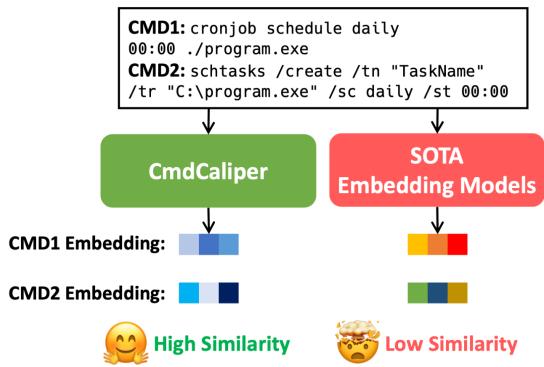
As shown in Figure 1, a standard State-of-the-Art (SOTA) embedding model might look at two different commands and see “Low Similarity” because the words don’t match. CmdCaliper, however, recognizes that both commands are scheduling a daily task and assigns them “High Similarity.”
The Data Bottleneck: Introducing CyPHER
The biggest hurdle in training a command-line AI is data. Unlike English text, which is abundant on the internet, pairs of “semantically similar” command lines do not exist in the wild. You can’t just scrape the web for a dataset where someone lists 28,000 ways to execute the same hack with slight variations. Furthermore, real-world command line logs are often sensitive, proprietary, and riddled with privacy concerns.
To solve this, the researchers created CyPHER (CyCraft’s Paired Command-Lines Harnessed for Embedding Research). It is the first dataset of its kind, and the way they built it is a masterclass in using Generative AI for data synthesis.
The CyPHER Construction Pipeline
Instead of manually writing thousands of commands, the team utilized a “Self-Instruct” mechanism powered by a pool of LLMs.
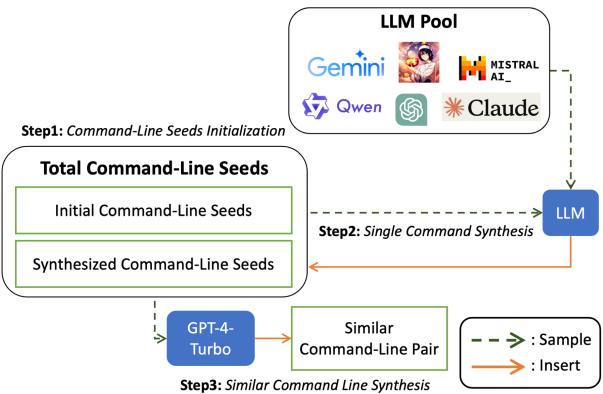
As illustrated in Figure 2, the pipeline consists of three clever stages:
- Initial Seeds Collection: They started with over 2,000 diverse real-world command lines sourced from red-team exercises, documentation, and GitHub. These served as the genetic material for the dataset.
- Single Command Synthesis (The LLM Pool): To ensure the dataset wasn’t biased toward the writing style of a single AI, they used a pool of different models (Gemini, Mistral, Qwen, Claude, etc.). They fed the seed commands to these LLMs and asked them to generate new, valid command lines. This expanded the dataset to tens of thousands of unique entries.
- Similar Command Synthesis: This is the critical step. For every unique command, they instructed GPT-4-Turbo to generate a semantically similar pair. The prompt explicitly asked for commands that share the same purpose but differ in appearance (e.g., different argument order, obfuscation, or using different executables to achieve the same goal).
Validating the Data
You might wonder: “Is synthetic data actually good?” If the AI just changes one character, the dataset isn’t useful. The researchers analyzed this using ROUGE-L scores, a metric that measures text overlap.
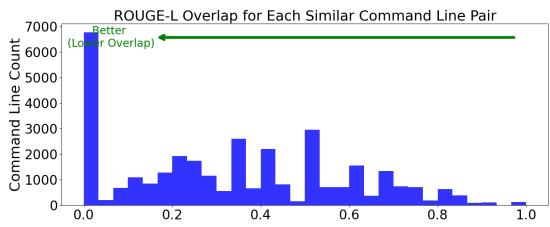
Figure 4 shows the distribution of overlap scores for the generated pairs. The distribution is heavily skewed toward zero. This is excellent news. It means the “similar” commands look very different textually (low overlap) but, based on the generation prompt, we know they are semantically identical. This is exactly the kind of hard-to-learn data a model needs to become robust.
Note: For the testing set, the researchers did NOT use synthetic data. To ensure a fair evaluation, they used real-world malicious command lines from the Splunk Attack Data repository, ensuring the model was tested on actual attacks it hadn’t seen during training.
The Model: How CmdCaliper Works
With the CyPHER dataset in hand, the team moved on to training CmdCaliper.
The model is based on a contrastive learning framework. The idea is to take a pre-trained sentence embedding model (specifically GTE, or General Text Embeddings) and fine-tune it using the pairs from CyPHER.
Contrastive Learning and InfoNCE
The training process uses a “Siamese” network structure. You feed the model two command lines:
- Anchor: The original command.
- Positive: The semantically similar command generated by the LLM.
The model also looks at “In-batch Negatives”—other random commands in the same training batch that are not related to the anchor.
The objective is to minimize the distance between the Anchor and the Positive while maximizing the distance between the Anchor and the Negatives. The mathematical engine driving this is the InfoNCE Loss function:
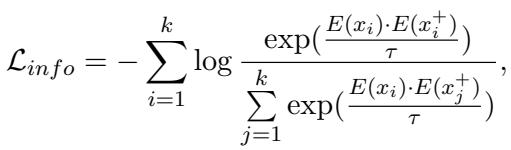
While the equation looks complex, the intuition is straightforward:
- The numerator (top part) represents the similarity score of the matching pair (\(x_i\) and \(x_i^+\)). We want this to be high.
- The denominator (bottom part) is the sum of similarities of the anchor with all other samples (negatives). We want this to be low relative to the numerator.
- \(\tau\) (tau) is a temperature parameter that controls how sharp the probability distribution is.
By iteratively adjusting the model’s weights to minimize this loss, CmdCaliper learns to ignore the superficial syntax of a command line and focus on its underlying intent.
Experiments and Results
Does it work? The researchers pitted CmdCaliper against several state-of-the-art (SOTA) text embedding models, including OpenAI’s text-embedding-ada (indirectly compared via benchmarks), BERT, and the original GTE models.
They trained three versions of CmdCaliper: Small (30M parameters), Base (110M parameters), and Large (335M parameters).
1. Retrieval Performance
The first test was a retrieval task. Given a command, can the model find its semantically similar pair hidden in a list of distractions?
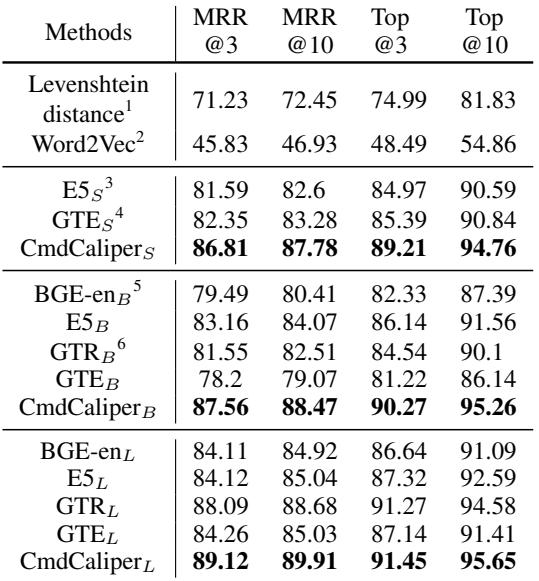
Table 4 reveals a stunning result. Look at the CmdCaliperS (Small) row. With only 0.03 billion parameters, it achieves an MRR@3 score (a ranking metric) of 86.81.
Compare that to E5L (a large SOTA model with 0.34 billion parameters), which scores 84.12.
Key Takeaway: The smallest version of CmdCaliper outperforms generic models that are 10 times larger. This proves that domain-specific fine-tuning is far more efficient than simply throwing more parameters at the problem. A massive English-language model doesn’t understand PowerShell as well as a tiny model trained specifically on PowerShell.
2. Malicious Command Detection
The ultimate test for security research is detection. Can the model distinguish between safe administrative tasks and malicious attacks?
The researchers used the Atomic Red Team dataset, which maps commands to MITRE ATT&CK techniques. They treated detection as a retrieval task: if a new command embeds close to known malicious commands in the vector space, it is likely malicious.
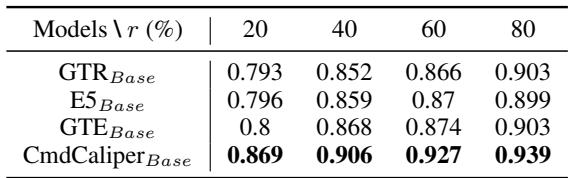
Table 5 shows the Area Under the Curve (AUC) scores. CmdCaliper-Base consistently outperforms the base versions of GTR, E5, and GTE.
Notice the column “r = 20”. This represents a “few-shot” scenario where the model only has 20% of the malicious data available as a reference. Here, CmdCaliper’s lead is most pronounced (0.869 vs 0.800 for GTEBase). This suggests that CmdCaliper generalizes much better; it doesn’t need to see every variation of an attack to recognize the malicious intent.
Why This Matters
The implications of CmdCaliper extend beyond just a slightly better detection rate. This paper highlights three major shifts in security research:
- Semantic Security: We are moving away from exact-match signatures (which are brittle) toward semantic understanding. An attacker can change
invoke-mimikatztoinv-mimi, but if the embedding model knows they both mean “dump credentials,” the attack is caught. - Synthetic Data Viability: The CyPHER dataset proves that we don’t always need to compromise user privacy to build great security tools. A pipeline of diverse LLMs can hallucinate realistic, high-quality training data that yields real-world results.
- Efficiency: You don’t need a GPU farm to run effective security AI. By specializing the model, a 30-million parameter network can beat a general-purpose giant. This allows for deployment on edge devices and endpoints where resources are limited.
Conclusion
CmdCaliper represents a significant step forward in applying Deep Learning to cybersecurity. By treating command lines as a unique language with its own semantics, and by leveraging the generative power of LLMs to solve the data scarcity problem, the researchers have created a tool that is both powerful and efficient.
For students and researchers entering this field, the takeaway is clear: applying generic NLP tools to specialized domains is a good start, but curating domain-specific data and objectives (like the CyPHER dataset and contrastive loss) is where the real breakthroughs happen.
The full dataset and model weights have been open-sourced, paving the way for future innovations in automated threat hunting and incident response. The “language” of hackers is complex, but tools like CmdCaliper are finally helping computers translate it.