](https://deep-paper.org/en/paper/2411.02063/images/cover.png)
Introduction: The Efficiency Dilemma
In the world of Large Language Models (LLMs), size has become synonymous with intelligence. From GPT-3 to Llama 3, the trend has been clear: scaling up parameters leads to better performance. However, this “bigger is better” philosophy comes with a massive price tag. Training these behemoths requires astronomical computational resources, vast amounts of energy, and significant time.
Researchers have long sought ways to break this dependency. We know that techniques like LoRA (Low-Rank Adaptation) work wonders for fine-tuning—allowing us to adapt massive models using very few trainable parameters. This naturally leads to a burning question: If low-rank methods work so well for fine-tuning, why can’t we use them to pre-train the model from scratch?
Ideally, we could design a model that is inherently low-rank, reducing the number of parameters (and thus the computational load) from day one. However, previous attempts to do this have largely failed. Directly applying low-rank decomposition to the entire network during pre-training usually results in a “dumber” model that struggles to learn effectively.
A recent paper, Scalable Efficient Training of Large Language Models with Low-dimensional Projected Attention, offers a breakthrough solution. The researchers discovered that low-rank pre-training isn’t inherently flawed; we were just applying it to the wrong places. By targeting specific components of the Transformer architecture, they introduced a method called Low-dimensional Projected Attention (LPA). This approach not only speeds up training by over 12% but, surprisingly, can actually outperform standard Transformers.
In this post, we will dissect how LPA works, why previous attempts failed, and the scalability implications for the future of AI.
Background: The Low-Rank Intuition
To understand LPA, we first need to understand the concept of low-rank decomposition.
Inside a neural network, layers are essentially massive matrices of numbers (weights). When we say a matrix has “full rank,” we mean that every row and column creates a unique dimension of information. However, researchers have found that deep learning models often have “low intrinsic rank.” This means that even though the matrix is huge, the actual information it processes lives in a much smaller subspace.
The LoRA Connection
You might be familiar with LoRA, a popular fine-tuning method. LoRA freezes the massive pre-trained weights and adds two tiny matrices, \(A\) and \(B\), to represent changes. If the original weight matrix is \(1000 \times 1000\) (1 million parameters), LoRA might approximate the update using a \(1000 \times 8\) matrix and an \(8 \times 1000\) matrix (\(16,000\) parameters). The variable \(r\) (in this case, 8) is the rank.
The logic is simple: \(A \times B\) produces a matrix of the same size as the original, but it is formed by a “bottleneck” of size \(r\).
The Pre-training Challenge
If this bottleneck saves memory during fine-tuning, why not build the model with these bottlenecks permanently installed?
Historical attempts to replace standard dense layers with low-rank modules (\(W = W_A \times W_B\)) across the entire Transformer during pre-training have resulted in performance degradation. The models simply couldn’t capture the complexity of the data. The researchers behind LPA realized that the Transformer architecture isn’t a monolith; it has two distinct parts with very different jobs: the Attention Mechanism and the Feed-Forward Network (FFN).
Their key insight? Location matters.
Core Method: Low-dimensional Projected Attention (LPA)
The core innovation of this paper is the discovery that Attention layers are highly tolerant of low-rank decomposition, while FFN layers are not.
Based on this, they propose the LPA architecture. In this setup, the standard weight matrices in the Attention mechanism are replaced by low-dimensional modules, while the FFN layers are left largely alone (or treated differently).
Visualizing the Architecture
Let’s look at how LPA restructures the standard Transformer block.

As shown in Figure 1, the input \(x\) enters the attention mechanism. In a standard Transformer, the Query (\(Q\)), Key (\(K\)), and Value (\(V\)) are generated by multiplying \(x\) by large square matrices (\(W_Q, W_K, W_V\)).
In LPA, these large matrices are replaced by pairs of smaller matrices. Notice the “Low Dimensional Space” highlighted in the diagram. The input is first projected down into a smaller dimension (the bottleneck), and then projected up to the target dimension. This happens for \(Q\), \(K\), \(V\), and the Output projection (\(O\)).
The Mathematics of LPA
Let’s look at the math to see exactly where the parameters are saved.
Standard Attention: In a standard Transformer, the attention output \(z\) is calculated using full-rank matrices.

Here, \(W_Q, W_K, W_V, W_O\) are large, parameter-heavy matrices.
LPA Attention: In LPA, each of these matrices is decomposed. For example, \(W_Q\) becomes \(W_{Q1} \times W_{Q2}\).
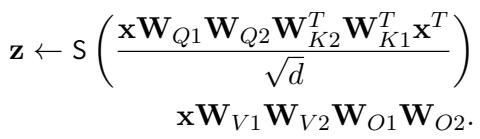
Because the inner dimension connecting \(W_{Q1}\) and \(W_{Q2}\) is small (rank \(r\)), the total number of parameters drops significantly. If the input dimension is \(d_{in}\) and the rank is \(r\), the complexity drops from \(d_{in}^2\) to \(2 \cdot d_{in} \cdot r\). Since \(r\) is usually much smaller than \(d_{in}\), the savings are massive.
Why Not Compress the FFN?
You might ask, “If this works for Attention, why not do it for the Feed-Forward Network (FFN) too?” The FFN usually contains the bulk of a model’s parameters, so compressing it would yield even bigger savings.
The researchers tested this hypothesis rigorously. They compared applying low-rank modules to:
- Low Attn: Only the Attention layers (The LPA method).
- Low FFN: Only the FFN layers.
- Low All: Both Attention and FFN layers.
The results were telling. Applying low-rank modules to the FFN layers (or all layers) consistently hurt the model’s perplexity (a measure of how confused the model is—lower is better). However, applying it only to the Attention layer often resulted in performance better than the original standard Transformer.
Why the difference? The authors provide a compelling theoretical explanation based on how these layers process data.
1. The FFN processes tokens independently. The FFN layer applies a non-linear transformation to each token individually. It projects the token into a high-dimensional space to disentangle features before compressing them back down.


If we force the FFN to pass through a low-dimensional bottleneck (as shown in the second equation above), we cripple its ability to map individual tokens into that necessary high-dimensional feature space.
2. Attention processes relationships. The Attention layer is fundamentally different. It computes relationships between tokens.

As shown in the equation above (specifically Lemma 1 in the paper), the output \(z_i\) depends on the interaction between \(x_i\) and all other tokens. The softmax function normalizes these relationships into probability scores. The researchers argue that this relationship-mapping is less sensitive to the absolute dimensionality of the vector space. The “Low-dimensional Projected Attention” acts as a two-step projection that captures the necessary relationships without needing the full parameter count of a dense matrix.
Experiments & Results
Theoretical elegance is nice, but does it actually work in practice? The researchers conducted extensive experiments, scaling their method up to 3 billion parameters.
1. Pre-training Performance (Perplexity)
The primary metric for LLM pre-training is perplexity on held-out test data. The authors compared LPA against two baselines:
- Transformer (Same-Dim): A standard model with the same hidden size (but more parameters).
- Transformer (Same-Param): A standard model scaled down to have the same number of parameters as the LPA model.
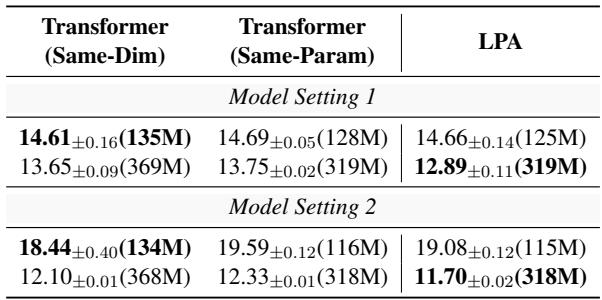
Table 3 shows the results on 130M and 370M parameter models.
- Observation: The LPA model consistently outperforms the “Same-Param” Transformer.
- Key Finding: In the 370M scale, LPA even outperforms the “Same-Dim” Transformer (12.89 vs 13.65), despite having fewer parameters. This suggests that the low-rank structure in Attention might act as a beneficial regularization, preventing overfitting or focusing the model on the most important features.
2. Scalability: The 3 Billion Parameter Test
The true test of any efficiency method is scalability. Methods that work on small models often break when scaled up. The authors trained a 2.43B parameter LPA model and compared it against a 3.23B standard Transformer.
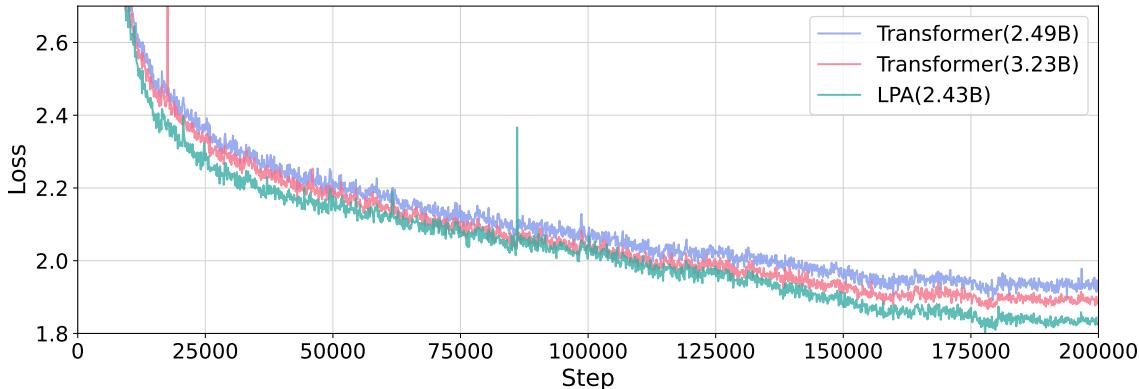
The training loss curves in Figure 2 are striking. The teal line (LPA) consistently maintains a lower loss than the blue line (Same-Param Transformer) and effectively matches or beats the red line (Same-Dim Transformer).
This confirms that LPA is scalable. It allows us to train a model that performs like a 3.2B parameter model while only having the computational footprint of a 2.4B parameter model.
3. Efficiency Gains
What does this mean for actual training time? Because LPA reduces the number of floating-point operations (FLOPs), it translates directly to wall-clock speedups.
The paper reports that for the 3B scale model, LPA saves approximately 12.4% in training time and reduces GPU memory consumption. While this might seem modest, when training runs costs millions of dollars, a 12% reduction is massive. Furthermore, the model creates a smaller checkpoint, saving storage.
4. Downstream Tasks
Low perplexity doesn’t always mean a smarter model. To ensure the model actually understands language, the researchers tested it on the GLUE benchmark, which includes tasks like sentiment analysis and question answering.

As seen in Table 5, the LPA model achieves a higher average score (70.72) compared to the standard Transformer (67.47). This validates that the parameter reduction in the Attention layer does not compromise the model’s ability to reason or understand context; in fact, it seems to enhance it.
5. Sensitivity to Rank (\(r\))
A critical hyperparameter in this method is \(r\)—the size of the bottleneck. If \(r\) is too small, information is lost. If \(r\) is too big, we don’t save any parameters.
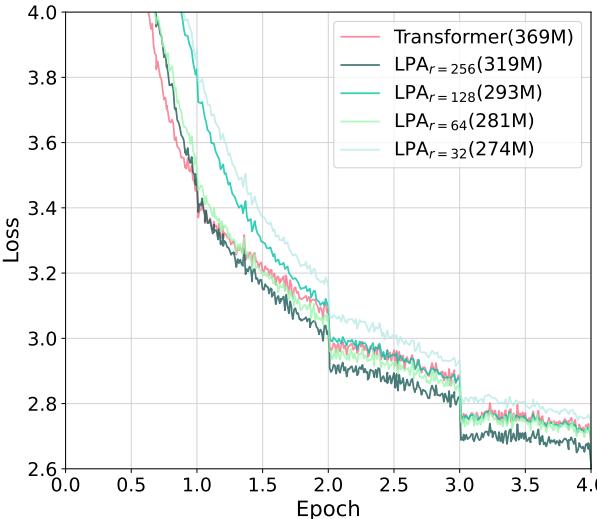
Figure 3 illustrates the training loss for different values of \(r\).
- Robustness: The model is surprisingly robust. Even reducing \(r\) to 64 or 128 (darker lines) results in performance better than the baseline Transformer.
- Limit: Performance only degrades significantly when \(r\) drops to 32, suggesting there is a lower limit to how much we can compress the Attention mechanism.
6. Allocating the Surplus
Since LPA saves parameters, the researchers asked: “What if we re-invest these saved parameters elsewhere?”
They tried adding parameters back by increasing the FFN size or adding more layers. However, the most effective strategy was increasing the attention dimension (output size). By keeping the low-rank structure but making the projected space slightly wider, they achieved the best balance of efficiency and performance.
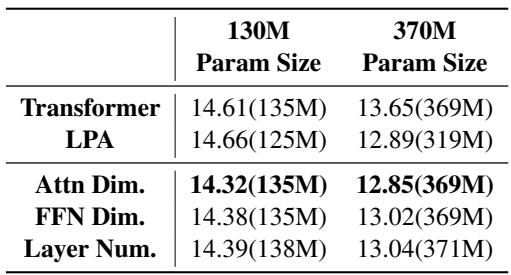
Table 8 shows that the “Attn Dim.” strategy (reallocating parameters to attention width) yields the lowest perplexity (12.85), further proving that the Attention layer is the most efficient place to optimize.
Conclusion & Implications
The research presented in Scalable Efficient Training of Large Language Models with Low-dimensional Projected Attention challenges the assumption that pre-training requires full-rank dense matrices.
Key Takeaways:
- Precision is Key: Low-rank pre-training fails when applied blindly. It works when targeted specifically at the Attention layers.
- LPA Architecture: By replacing standard attention matrices with low-dimensional (\(W_A, W_B\)) modules, LPA reduces parameter count and computational cost.
- Superior Performance: LPA doesn’t just match standard Transformers; it often outperforms them on both perplexity and downstream tasks.
- Scalable: The method holds up at the multi-billion parameter scale, offering a viable path for training larger models more cheaply.
This work opens exciting doors for the democratization of LLMs. By reducing the hardware barrier for pre-training effective models, LPA suggests that we haven’t yet hit the ceiling of architectural efficiency. As we look toward the future, combining LPA with other efficiency techniques (like quantization or sparse attention) could lead to a new generation of powerful, lightweight AI models.