](https://deep-paper.org/en/paper/2411.03550/images/cover.png)
Introduction: The Invisible Rhythm of Communication
Imagine you are trying to explain a complex concept to a friend. You don’t just blurting out a random string of high-density keywords. Instead, you pace yourself. You mix complicated terms with simpler explanations; you structure your sentences so that the listener can predict where you are going. This instinctive pacing is what linguists call Information Distribution.
In our native language, we do this naturally. We smooth out the “bumps” in conversation to make sure we are understood. But what happens when we write in a language we are still learning? Do we lose this rhythm? Do we overwhelm the reader, or do we play it too safe?
A fascinating research paper, “Learning to Write Rationally: How Information Is Distributed in Non-Native Speakers’ Essays” by Zixin Tang and Janet G. van Hell, dives deep into this question. By analyzing thousands of essays from the TOEFL exam using advanced computational linguistics, the researchers uncovered surprising patterns about how Second Language (L2) learners manage information.
Whether you are a linguistics student, a data scientist interested in NLP, or simply someone who has struggled to write an essay in a foreign language, this study offers a unique computational window into the human mind.
Background: The “Rational” Writer
Before we dissect the experiment, we need to understand the theory behind “rational” writing. The core premise is that human communication is optimized for efficiency. We want to transmit the most information possible without exceeding the receiver’s processing capacity.
To quantify this, the researchers rely on Information Theory, specifically three key metrics derived from Claude Shannon’s foundational work in the 1940s:
- Surprisal: How unexpected is a word given the context?
- Entropy: How uncertain are we about what the next word will be?
- Uniform Information Density (UID): How evenly is information spread across the sentence?
The Hypothesis
The researchers posited that as language learners become more proficient, their writing doesn’t just get “better” grammatically—it changes mathematically. They hypothesized that advanced learners would display information distribution patterns that more closely resemble native speakers. Specifically, they looked for evidence of the UID Hypothesis: the idea that humans prefer to avoid sudden spikes or drops in information density.
Core Method: Measuring Thoughts with Math
To analyze these abstract concepts, the authors took a “Big Data” approach. They utilized the TOEFL11 corpus, a massive dataset containing 11,000 essays written by non-native English speakers from 11 different native language (L1) backgrounds (such as Arabic, Chinese, German, and Spanish). They compared these against essays written by native English speakers from the ICNALE corpus.
But how do you measure “surprise” or “uncertainty”? The researchers used GPT-2, a pre-trained Large Language Model (LLM). Because GPT-2 is trained on a vast amount of internet text, it has essentially “learned” the probability distribution of standard English. By feeding the student essays into GPT-2, the researchers could calculate exactly how predictable (or unpredictable) each student’s word choices were compared to a standard English model.
Let’s break down the three metrics they calculated for every essay.
1. Surprisal: The Measure of Information
Surprisal tells us how much information a word carries based on its context. A word that is highly predictable (like “birthday” after “Happy…”) carries very little information and low surprisal. A word that is unexpected carries high information and high surprisal.
The formula used is:

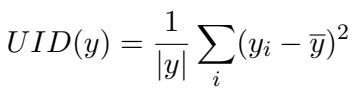
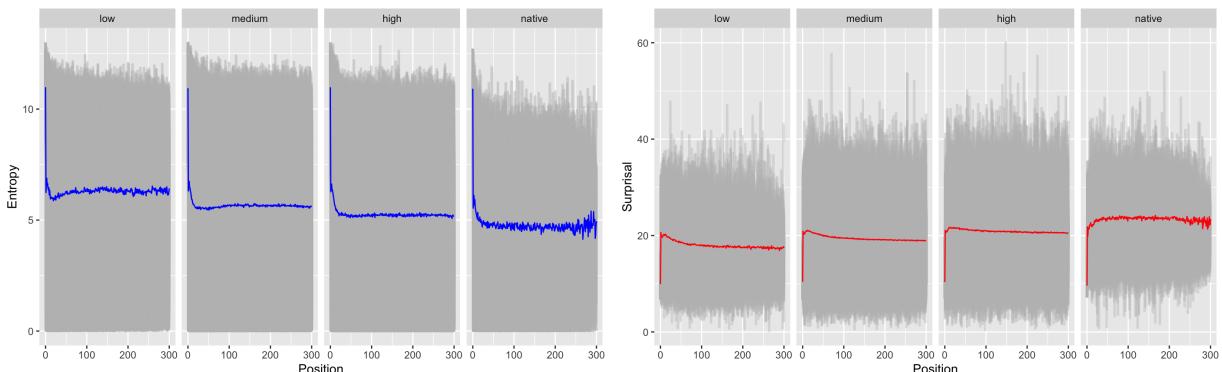
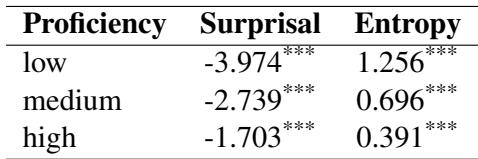
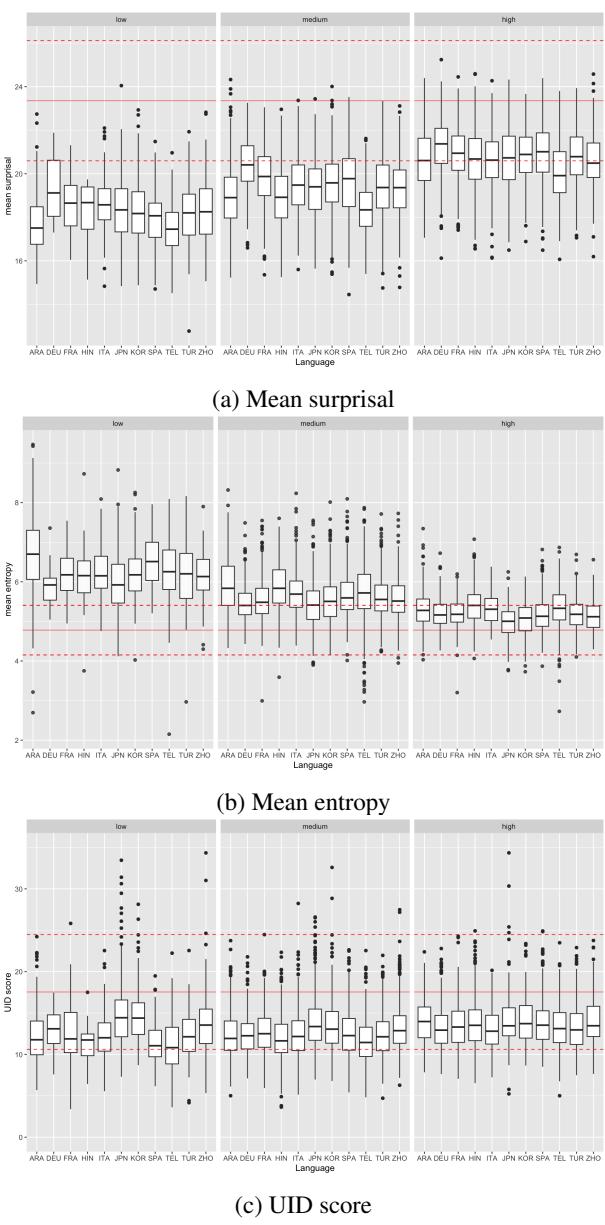
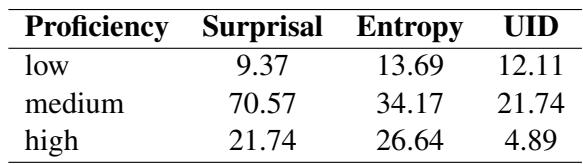
Here, \(p(w_i | C_{t Why it matters: Learners often stick to very common, predictable words (low surprisal). The researchers wanted to see if higher proficiency leads to the use of more informative, “surprising” words. While surprisal looks at the specific word chosen, Entropy looks at the context before the word appears. It measures the “expected surprise.” If a sentence structure allows for only one possible next word, entropy is low (certainty). If the next word could be almost anything, entropy is high (uncertainty). This formula sums the probabilities of all possible words in the vocabulary. Why it matters: Native speakers usually maintain a manageable level of entropy. If entropy is too high, the reader gets lost. If it’s too low, the writing is repetitive and robotic. This is perhaps the most critical metric in the study. UID measures the variance of surprisal. In this equation, a score of 0 represents perfectly even distribution. The higher the score, the “bumpier” the information flow. According to the UID hypothesis, good writers unconsciously strive to keep this score low to facilitate smooth communication. The researchers grouped the L2 essays into “Low,” “Medium,” and “High” proficiency based on their TOEFL scores and compared them against native speakers. The results painted a nuanced picture of language acquisition. When analyzing how information changes throughout the course of an essay, a clear trend emerged. As shown in Figure 1 below, look at the top row (Entropy). The blue line (Low proficiency) shows higher uncertainty at the start. As proficiency increases (moving to High and Native), the entropy stabilizes. More importantly, look at the bottom row (Surprisal). The Native speakers (far right) maintain a consistent level of surprisal. Low-proficiency speakers (far left) tend to produce content with lower surprisal—meaning they play it safe with predictable words. The statistical analysis confirmed this visual trend. The researchers found that as proficiency increases, the gap between learners and native speakers shrinks. The table below (Table 1) shows the \(\beta\) values from their linear mixed-effects models. Notice the stars (***) indicating statistical significance. The negative values for surprisal indicate that compared to native speakers (the reference level), learners have lower surprisal, but this difference gets smaller (closer to 0) as they move from Low to High proficiency. The takeaway: Higher proficiency allows learners to pack more information into their sentences (higher surprisal) while simultaneously reducing the chaotic uncertainty of what comes next (lower entropy). They become more efficient communicators. Here is where the study uncovered something unexpected. While Surprisal and Entropy changed drastically as students learned more English, the UID score (the smoothness of information) remained surprisingly stable across all groups. Take a look at the boxplots in Figure 2. This suggests that distributing information evenly is not a language-specific skill—it is a universal human cognitive mechanism. Even meaningful beginners who struggle with vocabulary and grammar naturally try to space out their information to make themselves understood. They might use simpler words, but they still adhere to the “rhythm” of rational communication. Does your native language affect how you write in English? The study says yes. The researchers performed an ANOVA analysis to see if the L1 background (e.g., being a native German speaker vs. a native Chinese speaker) influenced these metrics. As seen in Table 2, the F-scores are significant for all metrics. However, notice the UID column. The F-scores are generally lower for UID than for Surprisal or Entropy, particularly in the High proficiency group. This reinforces the previous finding: while your native language strongly dictates which words you choose (Surprisal) and how you structure your grammar (Entropy), the drive to smooth out information (UID) is a more fundamental constraint that varies less across different language backgrounds. The findings of Tang and van Hell provide a computational framework for understanding “fluency.” This research bridges the gap between psycholinguistics and artificial intelligence. By using GPT-2 not to generate text, but to measure it, the authors provided a quantitative look at the L2 learning curve. The implications extend beyond just theory. Imagine automated writing tutors that don’t just correct your grammar but analyze your information flow. A tool could tell a student, “Your sentence is grammatically correct, but the entropy is too high—the reader can’t predict where you’re going,” or “Your writing is too predictable (low surprisal); try using more precise vocabulary.” As we continue to live in an increasingly multilingual world, understanding these “hidden” mathematical structures of language helps us appreciate the complexity of the bilingual mind. We all strive to be rational writers—balancing clarity with depth—regardless of the language we are using.2. Entropy: The Measure of Uncertainty

3. Uniform Information Density (UID): The Measure of Smoothness
Experiments & Results: The Proficiency Effect
Finding 1: Proficiency Looks Like “Native” Complexity
Finding 2: The Universal Nature of UID
Finding 3: The Influence of Native Language (L1)
Discussion: What Does This Mean for Language Learning?
Conclusion and Future Implications