](https://deep-paper.org/en/paper/2411.03745/images/cover.png)
Simulator HC: How to “Cheat” at Math with AI to Solve Complex Geometric Vision Problems
If you have ever dabbled in 3D computer vision—building systems for Structure-from-Motion (SfM), Visual SLAM, or camera calibration—you know that at the bottom of every cool visualization lies a bedrock of nasty mathematics. Specifically, we often have to solve systems of polynomial equations.
For decades, the field has relied on purely algebraic methods to solve these equations. While elegant, these methods struggle when problems get too complex, involving high degrees or many variables. They become computationally heavy and numerically unstable.
But what if we could combine the “rough guess” capabilities of Deep Learning with the “precise refinement” of algebraic geometry?
In this post, we are doing a deep dive into the research paper “Simulator HC: Regression-based Online Simulation of Starting Problem-Solution Pairs for Homotopy Continuation in Geometric Vision.” This paper proposes a fascinating hybrid approach: use a neural network to guess an answer, “simulate” a fake problem that fits that answer perfectly, and then use a mathematical technique called Homotopy Continuation to morph that fake problem into the real one, carrying the solution along with it.
It is a clever workaround that achieves state-of-the-art efficiency. Let’s break down how it works.
1. The Problem: The “Polynomial Trap”
To understand why this paper is significant, we first need to understand the headache of geometric vision.
Many geometric problems (like figuring out where a camera is located based on 3D points) can be written as polynomial equations. For example:
- PnP (Perspective-n-Point): Given 3D points and 2D projections, find the camera pose.
- Relative Pose: Given two images, find how the camera moved between them.
The Old Way: Gröbner Bases
Traditionally, we solve these using Gröbner bases. You can think of a Gröbner basis solver as a “pre-compiled elimination recipe.” Researchers derive a specific template for a specific problem (like the famous 5-point algorithm).
However, this approach hits a wall. As problems get harder (e.g., generalized cameras, rolling shutters, or solving for scale), the “elimination template” grows exponentially. It becomes a massive matrix that is slow to compute and prone to crashing due to numerical precision errors.
The Alternative: Homotopy Continuation (HC)
In recent years, researchers have turned to Homotopy Continuation (HC). HC is a numerical method that feels a bit like magic.
Here is the intuition:
- You have a Target System \(F(x)=0\) that you want to solve (hard).
- You construct a Start System \(G(x)=0\) that looks similar but is trivial to solve (easy).
- You create a continuous path (a homotopy) that slowly morphs \(G(x)\) into \(F(x)\).
- You track the roots (solutions) as they move along this path.
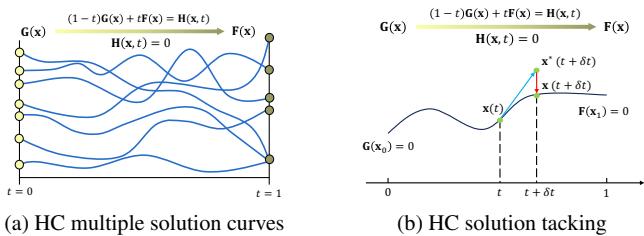
As shown in Figure 2(a) above, traditional HC tracks all possible solution curves (the blue lines) from the start to the finish.
The Catch: A complex polynomial system might have hundreds or thousands of theoretical solutions in the complex domain. Standard HC has to track all of them just to find the few “real” solutions that make physical sense. This is computationally expensive (slow) and wasteful.
2. The Core Innovation: Simulator HC
The authors of this paper asked a critical question: Why track 100 paths when we only care about one?
If we knew roughly where the solution was, we could pick a starting point close to it and just track that single path. This is where Simulator HC comes in. It introduces a three-stage pipeline:
- Regression: A Neural Network estimates a rough solution.
- Online Simulation: We generate a synthetic “Start Problem” that fits this rough solution perfectly.
- Homotopy Continuation: We track one single path from the synthetic problem to the real problem.
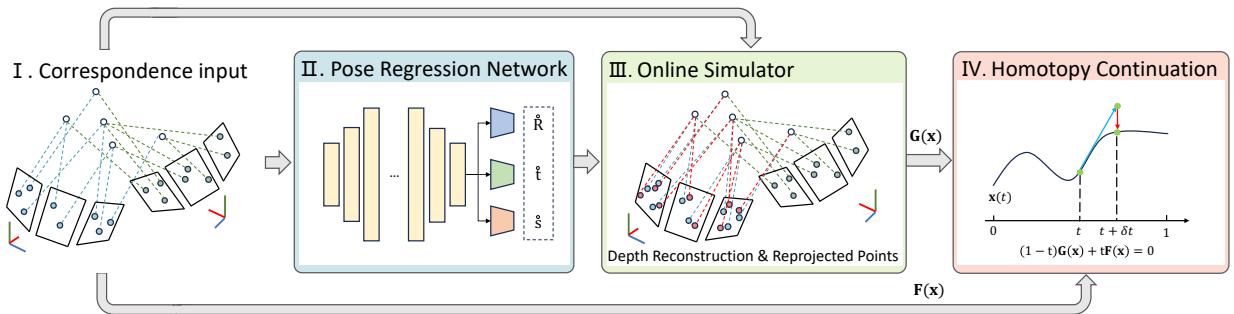
Let’s look at each stage in detail.
Stage I: The Regression Network
First, we need a guess. The researchers train a standard Convolutional Neural Network (CNN) that takes geometric correspondences (point pairs) as input and outputs a camera pose (rotation and translation).
This network doesn’t need to be perfect. In fact, neural networks are notoriously bad at getting “exact” solutions required for high-precision vision. But they are great at getting close. The network acts as a general function approximator, providing a warm start.
Stage II: The Online Simulator (The Clever Bit)
This is the most novel part of the paper.
Suppose the network looks at a real image and guesses a camera pose \(\hat{R}, \hat{t}\). This guess is likely slightly wrong, meaning if you plug it into the real equations, they won’t equal zero.
Instead of forcing the guess to fit the real problem, the researchers change the problem to fit the guess.
They effectively ask: “If this guessed pose were actually 100% correct, what would the 2D image points look like?” They then project the 3D points using the guessed pose to create new, synthetic 2D points.
Now we have a perfectly consistent pair:
- Solution: The Network’s Guess.
- Problem: The Synthetic 2D points.
This forms our Start System \(G(x)\). We know the solution to \(G(x)\) is exactly the network’s output.
Stage III: Single-Path Homotopy Continuation
Now we simply morph the Synthetic 2D points back into the Real 2D points.
Mathematically, the homotopy function \(H(x,t)\) is defined as a linear interpolation between the Start System \(G(x)\) and the Target System \(F(x)\):

Here, \(t\) goes from 0 to 1.
- At \(t=0\), we are at the Simulated Problem (Solution is known).
- At \(t=1\), we are at the Real Problem (Solution is unknown).
Because our regression guess was likely close to the real answer, the path from \(t=0\) to \(t=1\) is usually short and well-behaved. We don’t need to track 100 paths; we just track this one specific curve depicted in Figure 2(b) (from the earlier image).
How is the path tracked?
The tracking uses a “Prediction-Correction” method. It involves solving differential equations. The curve \(x(t)\) is defined by the differential equation:

To move along the path, the solver takes a small step \(\delta t\) (Euler prediction):
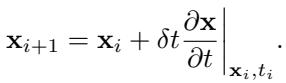
Because this linear step drifts slightly off the curve, a Newton-Gauss correction step pulls it back onto the path:

By repeating this prediction-correction cycle, the solver “slides” the solution from the fake problem to the real one.
3. Application 1: Generalized PnP
The authors first test this on the Generalized Perspective-n-Point (GPnP) problem. This involves finding the pose of a multi-camera system relative to known 3D points.
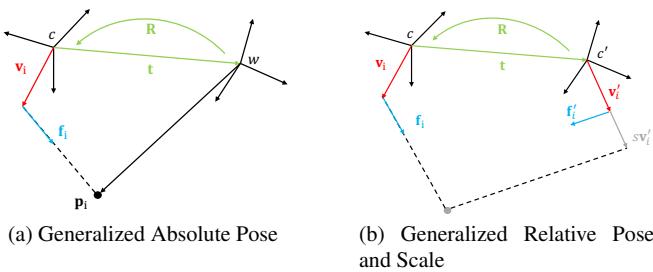
As seen in the left side of Figure 3, we have a world point \(p_i\), a ray origin \(v_i\), and a ray direction \(f_i\). The geometric constraint is:

The algorithm works as follows:
- Regress: The network predicts rotation \(R\) and translation \(t\).
- Simulate: Compute synthetic image rays \(\hat{f}_i\) that line up perfectly with the predicted \(R, t\).
- Solve: Use HC to morph \(\hat{f}_i\) back to the measured \(f_i\).
This serves as a proof of concept. Since GPnP is relatively simple (it can be solved efficiently with traditional methods), the Simulator HC achieves 100% success rate, matching the traditional solvers but offering a new way to initialize.
4. Application 2: Generalized Relative Pose and Scale (GRPS)
The real power of Simulator HC shines in “hard” problems where traditional solvers struggle. The authors tackle the Generalized Relative Pose and Scale problem.
Imagine you have two clusters of cameras (like two passing autonomous cars, or a multi-camera rig moving through a room). You want to figure out how they moved relative to each other. Because these are “generalized” cameras (non-central), you can actually solve for the metric scale of the translation, which is usually impossible with a single standard camera.
However, this is a minimal problem with 140 solutions.
- Traditional Gröbner basis solvers need to manipulate a \(144 \times 284\) matrix.
- Standard HC would need to track 140 paths.
The Geometry of GRPS
The setup involves rays from two different views intersecting in 3D space, accounting for a scale factor \(s\):

By eliminating the unknown depths (\(\alpha\)), the authors derive a constraint involving only the poses and scale:

The Simulator Strategy for GRPS
The regression network now predicts Rotation, Translation, and Scale. To create the “Start Problem,” the simulator needs to generate consistent correspondences.
- Take the predicted \(R, t, s\).
- Solve for the “fake” depths using linear least squares:

- Generate the “fake” image rays \(\hat{f}_i\):

Now, the HC solver tracks the solution from this simulated setup to the real measurements.
5. Experiments & Results
How does this hybrid “Simulate-and-Solve” approach compare to the heavyweights?
Speed and Efficiency
The results are striking. Because Simulator HC only tracks one path, it is vastly faster than standard HC methods that track everyone.
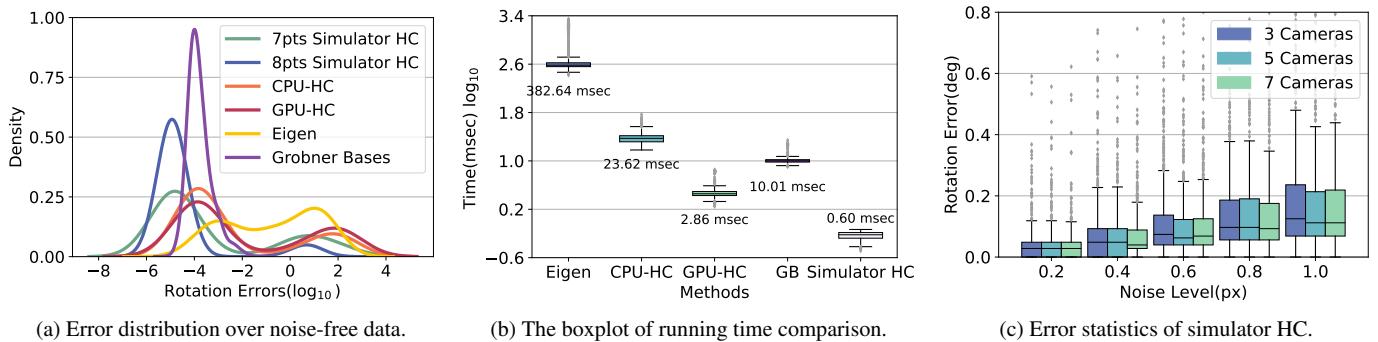
Look at Figure 4b (center):
- CPU-HC / GPU-HC: These track all 140 solutions. They are slow (orange/maroon).
- Gröbner Bases (GB): The traditional algebraic method (purple). It is slow because of the massive matrix operations.
- Simulator HC (Green): It is exponentially faster, running in ~0.06 ms on a CPU. It is about 17x faster than the Gröbner Bases solver.
Success Rate and Stability
Speed is useless if the answer is wrong. Figure 4a (left) shows the error distribution.
- The Gröbner Bases (purple) is the most precise (narrowest spike at 0 error), which is expected for an exact algebraic solver.
- Simulator HC (green/blue) has a slightly wider error spread but still maintains a very high success rate (over 96% when using 8 points).
- Importantly, the pure regressor (just the neural network) would have a huge error spread. The HC step successfully tightens that loose guess into a precise solution.
Robustness in RANSAC
In the real world, visual data is full of “outliers” (bad matches). Solvers are wrapped in a loop called RANSAC to filter these out.
The authors integrated Simulator HC into RANSAC and compared it to Gröbner Bases.
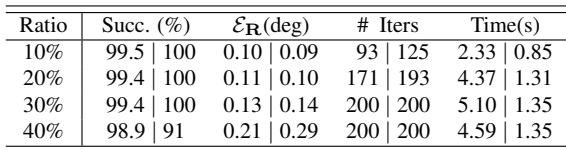
As shown in Table 2, Simulator HC maintains a high success rate even with 40% outliers, but completes the task significantly faster than the traditional method. This makes it highly practical for real-time applications like autonomous driving or AR/VR.
6. Conclusion and Key Takeaways
The paper Simulator HC presents a paradigm shift in how we approach geometric vision. Instead of viewing Deep Learning and Algebraic Geometry as competitors, it treats them as teammates.
- Deep Learning provides the intuition: a fast, approximate guess of where the solution lies.
- Algebraic Geometry (HC) provides the precision: a rigorous mathematical path to refine that guess into an exact root.
- The Bridge: The “Online Simulator” connects the two by creating a synthetic reality where the Neural Network’s guess is the absolute truth, providing a valid starting point for the math to take over.
This method transforms “hard” problems (like GRPS with 140 solutions) into manageable “single-path” tracking tasks. For students and researchers in Computer Vision, this highlights an exciting trend: the future isn’t just “more layers” in a neural network, but integrating those networks into established mathematical frameworks to solve problems faster and more reliably than ever before.