](https://deep-paper.org/en/paper/2411.04424/images/cover.png)
Judging the Judges: How Bayesian Statistics Fixes LLM Evaluation
If you have played with ChatGPT, Claude, or Llama, you know that evaluating these models is tricky. Unlike a math test, there is no single “correct” answer for writing a poem, summarizing a news article, or chatting about philosophy.
For a long time, the gold standard was human evaluation. You would generate two responses and ask a human, “Which one is better?” But human evaluation is slow, expensive, and not scalable. This led to the rise of LLM-as-a-judge: using a strong model (like GPT-4) to evaluate weaker models. It’s fast, cheap, and scales infinitely.
But there is a catch. LLM judges are not perfect. They have biases—they might prefer longer answers, they might have a “position bias” (preferring the first answer shown), or they might just get confused.
If your judge is biased, your leaderboard is wrong.
In a fascinating paper titled “Bayesian Calibration of Win Rate Estimation with LLM Evaluators,” researchers from Yale University tackle this problem head-on. They demonstrate that simply counting how many times a model “wins” according to an LLM judge is statistically flawed. Instead, they propose a rigorous statistical framework—using Bayesian inference—to “calibrate” these judges, getting us closer to the truth without needing thousands of hours of human labor.
In this deep dive, we will unpack the math behind their discovery, explain why the “observed win rate” is a lie, and walk through the Bayesian methods they developed to fix it.
The Problem: The Illusion of the Win Rate
Let’s set the stage. You are comparing two AI models: Model A and Model B. You want to know which one is better at writing stories.
You generate 1,000 stories from Model A and 1,000 from Model B. You feed pairs of these stories to an evaluator (let’s say, GPT-4) and ask: “Which story is better?” The evaluator picks Model A 70% of the time. You conclude that Model A has a 70% win rate.
This number—70%—is what the researchers call the Observed Win Rate. It seems straightforward, but it is often misleading. The observed win rate is only equal to the true win rate if the judge is 100% perfect. If the judge makes mistakes (which it does), that 70% is a mixture of the true signal and the judge’s error noise.
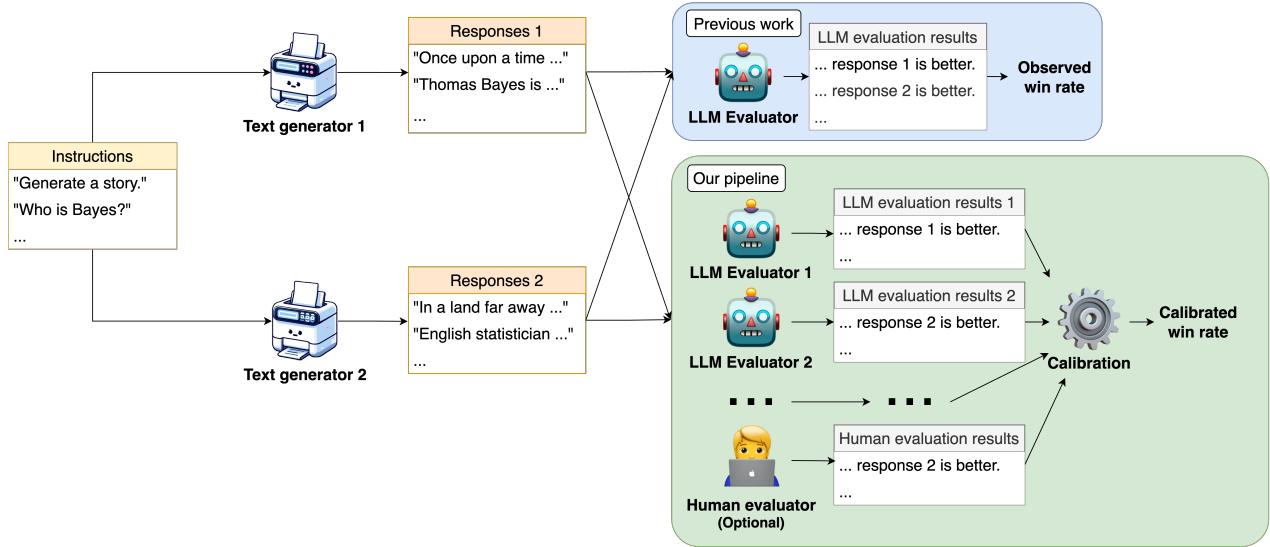
The researchers propose a new pipeline to correct this. As illustrated below, the standard approach (left) takes the observed win rate at face value. Their proposed pipeline (right) treats the LLM evaluation as just one piece of evidence, combines it with optional human insights, and runs it through a calibration engine.
Defining the “True” Win Rate
To solve this mathematically, we first need to define our terms rigorously. What are we actually trying to measure?
We are looking for the True Win Rate, denoted as \(p\). This is the probability that an average human expert would prefer Model A over Model B.

In this equation:
- \(G_0\) and \(G_1\) are the two models (generators).
- \(H\) is the human decision function (returning 0 if Model A wins).
- \(p\) is the probability that the Human prefers Model A.
The “Observed” Win Rate
Next, we have the Observed Win Rate, denoted as \(k_e\). This is the probability that your LLM evaluator (\(e\)) picks Model A.

Here, \(T_e\) is the LLM judge’s decision. If the LLM judge were identical to the human judge, then \(k_e\) would equal \(p\). But they are not.
The Discrepancy
The core contribution of the paper begins with a statistical reality check. The researchers utilize the Law of Total Probability to show exactly how the observed win rate is constructed.
The observed win rate \(k_e\) is composed of two scenarios:
- True Positive: The Human thinks Model A wins, and the LLM agrees.
- False Positive: The Human thinks Model B wins, but the LLM wrongly picks Model A.
To quantify this, they define two accuracy metrics for the judge:
- \(q_0^e\): The probability the judge is right when Model A is the true winner.
- \(q_1^e\): The probability the judge is right when Model B is the true winner.
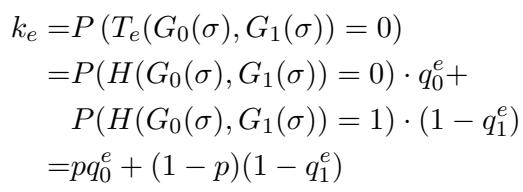
Look closely at that last line: \(k_e = p q_0^e + (1-p)(1-q_1^e)\).
This equation is the “smoking gun.” It proves that the observed win rate \(k_e\) is a distorted version of the true win rate \(p\).
- If \(p\) (true quality) goes up, \(k_e\) (observed score) changes.
- But if \(q_0\) or \(q_1\) (judge’s bias) changes, \(k_e\) also changes.
If your LLM judge is biased towards Model A (high \(q_0\), low \(q_1\)), your observed win rate will be inflated. Calculating the difference between the observed and true win rate gives us the “estimation error”:
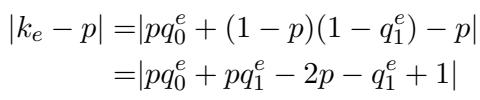
The goal of this research is to solve for \(p\). We can observe \(k_e\) (by running the evaluation), but we don’t know \(p\), \(q_0\), or \(q_1\). This is an algebra problem with too many unknowns.
The Solution: Bayesian Calibration
Since we cannot solve this equation directly without knowing the judge’s accuracy, the authors turn to Bayesian Inference.
Bayesian statistics allows us to deal with uncertainty. Instead of assuming we know the exact accuracy of the judge, we treat accuracy as a probability distribution. We start with a “prior” belief (e.g., “The judge is probably better than random guessing”) and update that belief as we see data.
The paper proposes two distinct methods to recover the true win rate \(p\).
Method 1: Bayesian Win Rate Sampling (BWRS)
The first method is a direct algebraic inversion coupled with sampling. If we look back at the equation linking \(k_e\) and \(p\), we can mathematically rearrange it to solve for \(p\):
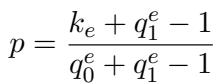
The algorithm works like this:
- Estimate the Judge’s Accuracy (\(q_0, q_1\)): We need a small sample of ground truth—cases where we have both Human and LLM labels. Using this sample, we don’t just calculate a single number for accuracy; we generate a distribution (specifically, a Beta distribution) representing the likely range of the judge’s accuracy.
- Estimate Observed Win Rate (\(k_e\)): We also generate a distribution for the observed win rate based on the full dataset.
- Monte Carlo Sampling: We draw thousands of random samples from these distributions. For every sample of \(k_e, q_0, q_1\), we plug them into the equation above to calculate a potential value for \(p\).
- Aggregation: After doing this thousands of times, we get a distribution of likely values for the True Win Rate \(p\). We can then take the mean or the mode of this distribution as our final answer.
This method is powerful because it gives us confidence intervals. It acknowledges that we aren’t 100% sure about the judge’s accuracy and propagates that uncertainty into the final score.
Method 2: Bayesian Dawid-Skene
The second method adapts a classic algorithm from 1979 called the Dawid-Skene model. Originally designed to aggregate answers from unreliable crowd-workers (like on Amazon Mechanical Turk), it is perfect for aggregating answers from imperfect LLM judges.
The intuition is this: Imagine you have three judges. Judge A and B usually agree, but Judge C always disagrees. The model infers that A and B are likely correct and C is likely confused. It simultaneously figures out:
- What the “True” label is (Win or Loss).
- How reliable each judge is.
The researchers modernized this by making it Bayesian. Instead of just finding the most likely values (Maximum Likelihood Estimation), they sample from the full posterior distribution.
This model is more robust than BWRS because it can handle multiple LLM evaluators looking at the same data, pooling their insights to find the truth.
The Role of Priors: Where does the “Truth” come from?
Both methods work best if we have some idea of how good the judge is. The authors explore three settings for this “Prior Knowledge”:
- No Prior: We assume nothing. We essentially guess that the judge is likely better than a coin flip (\(>50\%\) accuracy) but otherwise know nothing. The Dawid-Skene model is surprisingly good at figuring things out even here.
- In-Distribution Prior: We have a small “validation set” where humans have actually labeled the data. We use this to calibrate our beliefs about the judge’s accuracy before running the full evaluation.
- Out-of-Distribution (OOD) Prior: This is the most practical scenario. Suppose you want to evaluate a new Story Generation model. You don’t have human labels for this model, but you do have human labels for an old Story Generation model. You assume the judge’s behavior will be similar across similar tasks and use the old data to calibrate the judge for the new task.
Mathematical initialization of these priors can get complex. For the OOD setting, the authors use the counts of agreements and disagreements from the external dataset to shape the Beta distributions for the new task:

This formula essentially says: “Base your initial belief about the judge’s accuracy (\(q_0\)) on how well they performed on the old dataset (\(s_0\) correct judgments out of \(n_0\) total).”
Experiments and Results
The researchers validated these methods on six datasets covering story generation (HANNA, OpenMEVA), summarization (SummEval), and instruction following (LLMBar, MT-Bench, LLMEval).
Are LLM Judges Actually Biased?
First, they checked the raw accuracy of standard judges (like GPT-3.5 and Gemini). The results in Table 1 confirm why calibration is necessary.
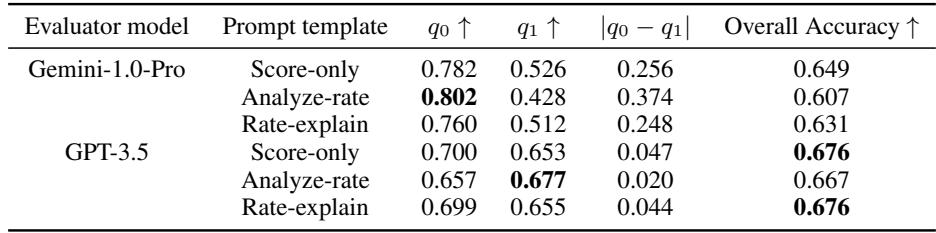
Notice the column \(q_0 - q_1\). Ideally, this should be zero—the judge should be equally good at identifying a win regardless of which model is better. However, for Gemini-1.0-Pro using the “Analyze-rate” prompt, there is a 0.374 (37.4%) difference! This evaluator is massively biased depending on the ground truth. If you used this judge without calibration, your win rates would be skewed.
Does Calibration Reduce Error?
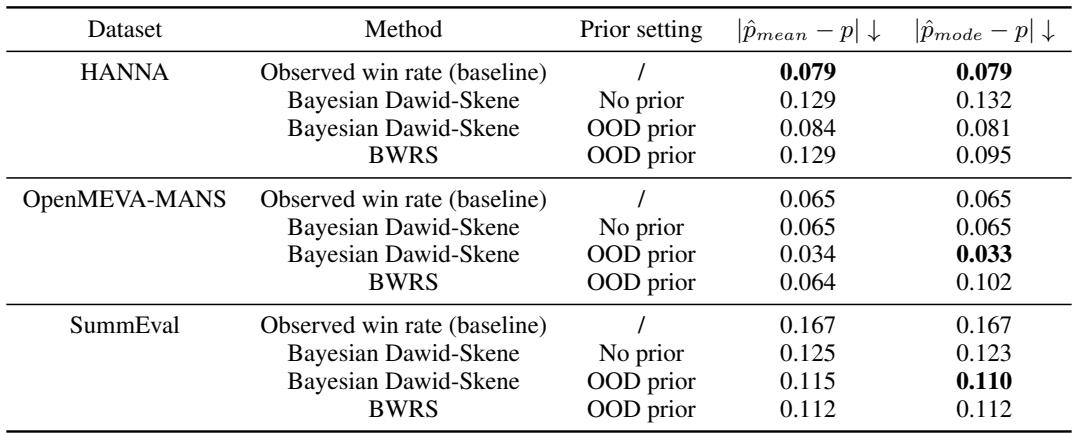
The primary metric for success is the Estimation Error: the difference between the estimated win rate and the actual human win rate (\(|\hat{p} - p|\)). A lower number is better.
Table 2 shows the results for the Story and Summarization datasets.
Key takeaways from the results:
- Baseline (Observed Win Rate): The error rates are quite high (e.g., 0.167 on SummEval).
- Bayesian Dawid-Skene (OOD Prior): This is the winner. By using prior knowledge from a different dataset, the error drops significantly (e.g., from 0.167 to 0.110 on SummEval).
- Even “No Prior” helps: Even if you have zero human data, applying the Bayesian Dawid-Skene model often yields a better estimate than the raw win rate, because the model effectively “votes” multiple evaluators against each other to cancel out noise.
Instruction Following Datasets
They also tested on popular benchmarks like MT-Bench and LLMBar. Here, they used the “No Prior” setting because there wasn’t a suitable external dataset.
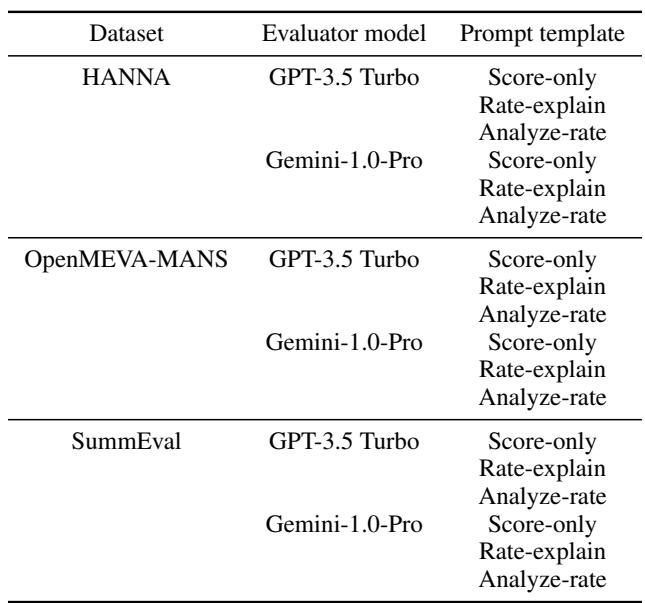
(Note: While Table 3 is discussed, we are visualizing the Evaluator Modes used for these datasets in Table 5 below.)

On these datasets, the improvement was present but smaller. This suggests that calibration is most critical when the judges are noisy or when the task is subjective (like story writing), and slightly less critical (though still useful) when using very strong judges (like GPT-4) on clearer tasks.
The Impact of Human Data
Finally, the researchers asked: “How much human data do we actually need?”
They ran experiments increasing the amount of “In-Distribution” human data (from 10% up to 100%) to see how the error rate changed.
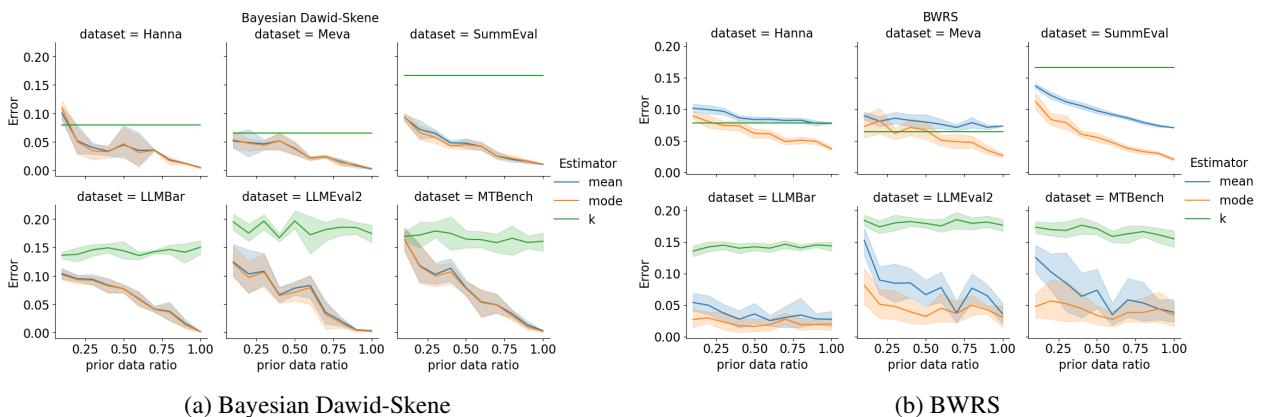
The graphs in Figure 2 tell a clear story:
- The Green Line (\(k\)) is the baseline observed win rate. It is a flat line because it doesn’t use the human data.
- The Blue and Orange Lines (Bayesian estimators) slope downward.
- Crucial Insight: You don’t need 100% human labels. Just having human labels for about 20-30% of the data allows the Bayesian models to learn the judge’s bias and drastically reduce the error. This is a massive cost saving compared to fully human evaluation.
Conclusion and Implications
We are entering an era where AI development is bottlenecked by evaluation. We can train models faster than we can grade them. The industry has standardized on “LLM-as-a-judge” because it is convenient, but this paper serves as a necessary wake-up call: Convenience does not equal accuracy.
The naive approach—counting how many times GPT-4 prefers Model A—is mathematically guaranteed to be wrong unless GPT-4 is perfect. However, this paper provides a path forward. By treating evaluation as a statistical inference problem rather than a simple counting task, we can calibrate our results.
Key Takeaways for Students and Practitioners:
- Distrust Raw Win Rates: Always remember that \(Observed \neq True\).
- Accuracy is Asymmetric: Judges might be good at spotting good answers but bad at spotting bad ones (\(q_0 \neq q_1\)).
- Bayesian Methods are robust: Even without human data, statistical models like Dawid-Skene can improve reliability.
- Use Priors: If you have labeled data from a similar task, use it to calibrate your judge.
This research moves us toward a future where we can have the best of both worlds: the speed of AI evaluation with the statistical reliability of rigorous science.
Limitations
It is worth noting that these methods have boundaries. The mathematical inversion in the BWRS method (Equation 11) is only stable if the judge is essentially “better than random.”

As shown in this condition, if the judge is extremely biased or adversarial (performing worse than random chance in specific ways), the math breaks down, and the estimated probability \(p\) might fall outside the range of 0 to 1. In such cases, the Bayesian Dawid-Skene model is generally safer, but ultimately, there is no substitute for having at least a decent evaluator to start with.