](https://deep-paper.org/en/paper/2411.05045/images/cover.png)
In the current landscape of Artificial Intelligence, we are often faced with a dilemma: do we choose intelligence or efficiency? Large Language Models (LLMs) like GPT-4 or Claude are incredibly smart, capable of understanding nuance and context that smaller models miss. However, they are also slow, expensive, and computationally heavy—often too much so for high-volume production environments.
On the other hand, smaller Pre-trained Language Models (PLMs) like BERT are lightning-fast and cheap to run, but they often struggle with complex tasks, specifically when labeled training data is scarce or when the task involves hundreds of different categories.
What if we could bridge this gap? What if an LLM could act as a private tutor, specifically analyzing where a smaller model is failing and generating custom study materials to fix those gaps?
This is the premise behind Performance-Guided Knowledge Distillation (PGKD), a novel approach presented by researchers from Amazon. In this post, we will deconstruct their paper to understand how they achieved a 130x speedup and 25x cost reduction compared to LLMs, while outperforming traditional training methods.
The Problem: The High Cost of Intelligence
Imagine you are building a system to classify customer support tickets for a massive e-commerce platform. You might have 300+ different categories (Intent Detection).
Using an LLM for every single ticket is overkill. It introduces latency (customers wait longer) and skyrockets infrastructure costs. Conversely, a standard BERT classifier might fail to distinguish between subtle categories like “Shipping Delay” versus “Shipping Damage” without thousands of hand-labeled examples, which are expensive to acquire.
The researchers identified that while Knowledge Distillation (KD)—transferring knowledge from a large “teacher” to a small “student”—is a common solution, existing methods are often “blind.” They usually involve the teacher generating generic data without knowing what the student actually needs to learn.
The Solution: Performance-Guided Knowledge Distillation (PGKD)
The core contribution of this paper is a dynamic, iterative framework where the Teacher (the LLM) creates a feedback loop with the Student (the smaller model).
Instead of just dumping synthetic data on the student, the Teacher looks at the Student’s report card. It sees exactly which classes the student is failing and, more importantly, where the student is making confident mistakes.
The PGKD Workflow
The process operates as a cycle of evaluation and generation. It moves beyond static datasets into an active learning routine.
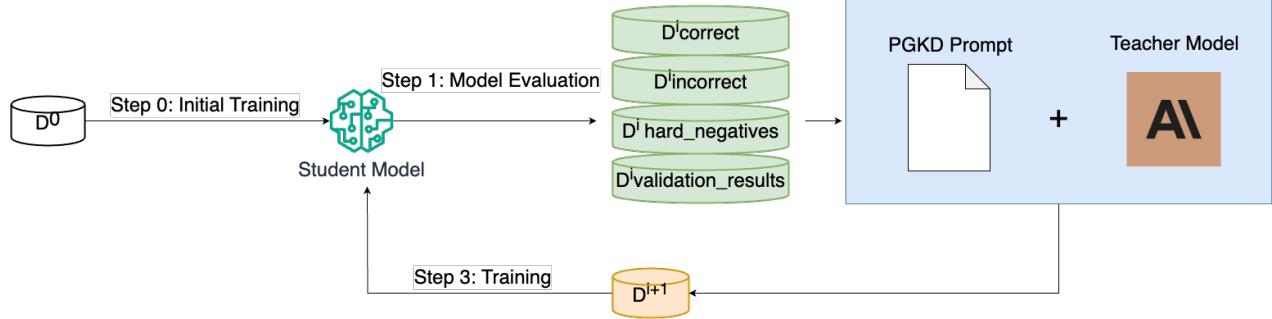
As illustrated in Figure 1, the workflow consists of four distinct phases:
- Initialization (Step 0): A baseline Student Model (e.g., BERT-base) is trained on a small initial dataset of real, labeled data.
- Evaluation (Step 1): The Student Model is evaluated on a validation set. This generates a detailed report, separating predictions into:
- Correctly classified examples.
- Incorrectly classified examples.
- Hard Negatives (more on this shortly).
- Validation Metrics (Precision, Recall, F1-score per class).
- Generation (Step 2): An LLM (the Teacher) receives this report. It uses this “diagnostic” information to generate new synthetic training samples that specifically target the Student’s weak points.
- Retraining (Step 3): The new data is added to the training pool, the Student is retrained, and the cycle repeats until the model stops improving (early stopping).
The “Secret Sauce”: Hard Negative Mining & Validation Reports
The genius of PGKD lies in how it prompts the Teacher. It doesn’t just ask for “more data.” It asks for specific data based on two critical inputs.
1. Gradual Evaluation Checks
The Teacher receives the actual validation metrics of the Student. If the Student has a low F1-score on the “Sports” category but a high score on “World News,” the LLM knows to generate more nuanced examples for “Sports.” This solves the issue of class imbalance automatically; the Teacher focuses its effort where the Student is struggling.
2. Hard Negative Mining
This is arguably the most impactful component. A Hard Negative is a sample that the Student classified incorrectly, but with high confidence.
For example, if the Student looks at a sentence about a computer virus and confidently classifies it as “World News” instead of “Technology,” that is a dangerous error. It means the model’s decision boundary is fundamentally wrong in that area.
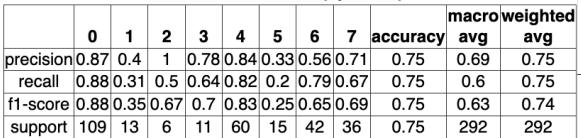
As shown in the figure above, the PGKD system identifies these specific failures. It feeds the text of the mistake (e.g., the virus article) and the wrong label into the Teacher. The Teacher then generates new examples that clarify the distinction, effectively saying, “Here are examples of Technology news that look like World news, learn the difference.”
Experiments and Performance
The researchers tested PGKD on four multi-class datasets ranging from simple to very complex:
- AG-News: 4 classes (World, Sports, etc.)
- Yahoo Answers: 10 classes
- Huffington Post: 41 classes
- Amazon Reviews: 335 classes
The base model was a standard BERT-base, and the Teacher was Claude-3 Sonnet.
Accuracy Results
The results, summarized in the table below, show a clear trend: the harder the task, the better PGKD performs.
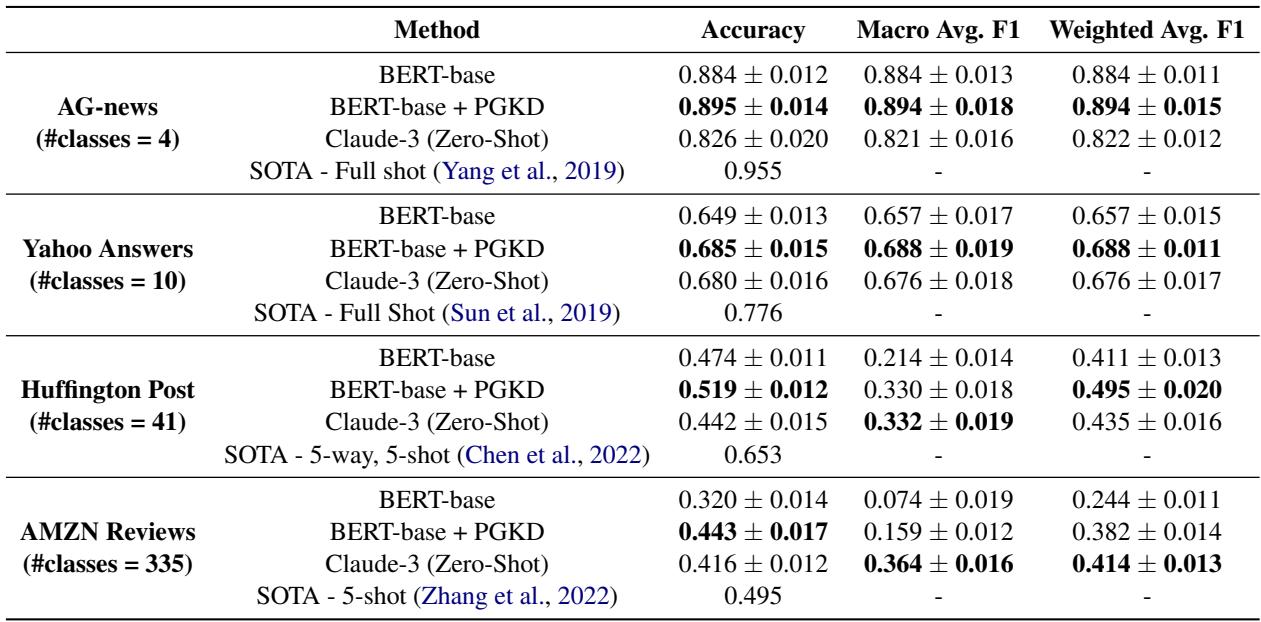
On simple datasets like AG-News (4 classes), the improvement was modest because the baseline was already high. However, on the Amazon Reviews dataset (335 classes), PGKD provided a massive boost:
- Accuracy: Increased from 32.0% to 44.3%.
- Weighted F1 Score: Increased from 0.244 to 0.382.
Crucially, the distilled BERT model (BERT-base + PGKD) often outperformed the zero-shot performance of Claude-3 itself on F1 metrics, proving that a specialized small model can beat a generalist giant.
Impact of Training Data Size
A common question in Knowledge Distillation is: “Does this only work if I have very little data?”
The authors analyzed this by varying the number of initial training samples from 1,000 to 10,000.
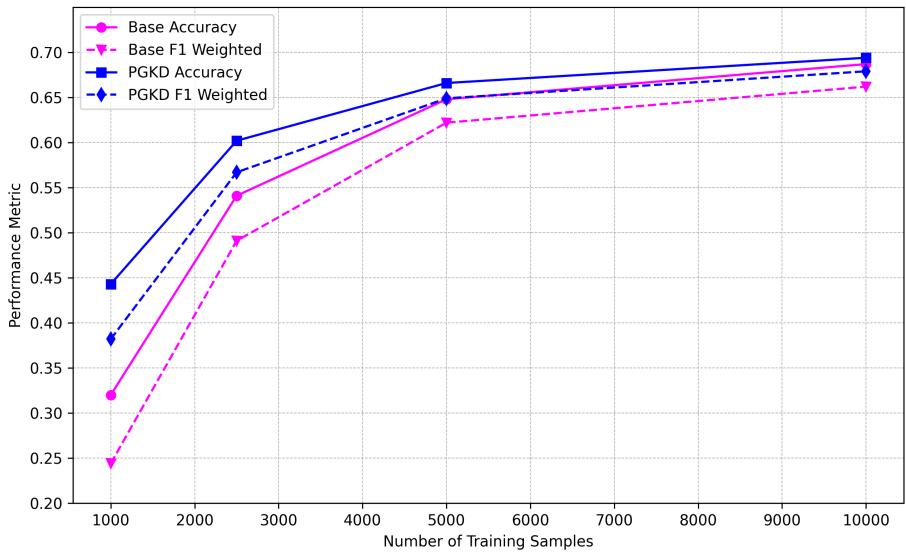
As seen in the graph, while the gap narrows as real data becomes more abundant (diminishing returns), PGKD consistently yields a better model than standard training at every single data point. It effectively squeezes more value out of the existing data by synthetically augmenting the “hard” parts.
Why It Works: The Ablation Study
To prove that the specific components of PGKD (Validation Reports and Hard Negatives) were necessary, the researchers performed an ablation study. They turned off these features one by one to see what would happen.
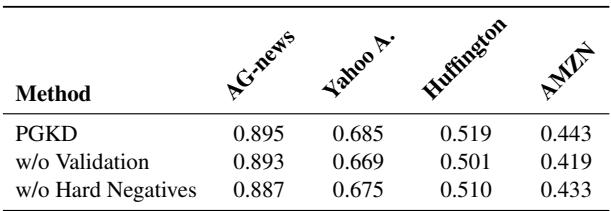
- Without Validation Reports: The Teacher didn’t know which classes were weak, leading to a significant drop in accuracy (e.g., -2.4% on Amazon Reviews).
- Without Hard Negatives: The Teacher didn’t see the confident errors, leading to a loss in robustness.
This confirms that the feedback loop is the driver of success, not just the presence of an LLM.
The Bottom Line: Cost and Speed
For industrial applications, accuracy is only half the battle. The model must be affordable. The comparison below is staggering.
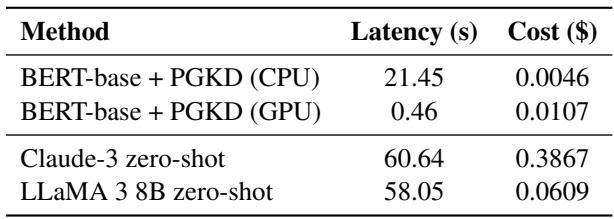
- Speed: On a GPU, the PGKD-trained BERT model takes 0.46 seconds for a batch, compared to 60.64 seconds for Claude-3. That is roughly 130x faster.
- Cost: Running the PGKD model is approximately 25x to 35x cheaper than prompting an LLM for the same classification task.
Conclusion
The “Performance-Guided Knowledge Distillation” paper offers a compelling blueprint for the future of efficient AI. It demonstrates that we do not always need to deploy massive models to achieve high performance. Instead, we can use massive models as part of the training process to build compact, efficient, and highly accurate specialists.
By establishing an active learning loop—where the teacher monitors the student’s report card and specifically targets their confident mistakes—we can tackle complex, multi-class problems that were previously difficult for smaller models.
For students and practitioners, the takeaway is clear: Don’t just fine-tune. Distill. By treating the LLM as a collaborator in the training loop rather than just an inference engine, you can build systems that are robust, lightning-fast, and ready for scale.