](https://deep-paper.org/en/paper/2411.05289/images/cover.png)
Introduction
If you have ever stared at a blinking cursor waiting for a Large Language Model (LLM) to finish a paragraph, you have experienced the “memory wall.” LLMs are autoregressive, meaning they generate text one token at a time. To generate the 100th word, the model must first generate the 99th, then feed it back into itself. This sequential dependency prevents us from utilizing the massive parallel processing power of modern GPUs.
Speculative Decoding has emerged as a popular solution to this bottleneck. The idea is simple: use a smaller, faster “draft” model to guess the next few tokens, and then use the large “target” model to verify them all at once in parallel.
However, current methods for verifying these drafts are far from optimal. Standard approaches, like Recursive Rejection Sampling (RRS), often fail to accept tokens later in the draft sequence, wasting the computational effort used to generate them. On the other end of the spectrum, mathematical frameworks like Optimal Transport (OTM) can theoretically maximize acceptance rates but are too computationally heavy to run in real-time.
In this post, we dive into SpecHub, a new research contribution that bridges this gap. SpecHub simplifies the complex Optimal Transport problem into a manageable Linear Programming model. By introducing a “Hub” token strategy—creating a sparse joint distribution focused on the most probable token—SpecHub achieves the theoretical rigor of optimal transport with the speed required for live inference.
Background: The Draft-and-Verify Paradigm
To understand SpecHub, we first need to understand the mechanics of Multi-Draft Speculative Decoding (MDSD).
The Token Tree
In standard speculative decoding, a draft model generates a single chain of tokens. MDSD takes this further by generating a token tree. Instead of just guessing “The cat sat,” the draft model might explore multiple possibilities simultaneously, branching out to “The cat sat,” “The cat lay,” and “The cat is.”
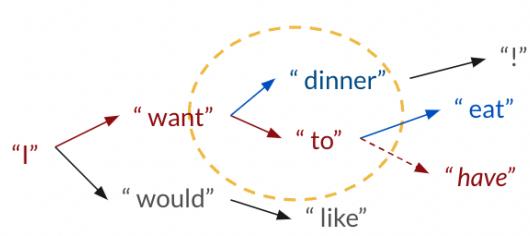
As shown in Figure 2 above, the draft model generates a tree of potential sequences (arrows from “I”). The target model then processes all these tokens in parallel. The goal is to find a valid path through this tree that matches the target model’s distribution.
The Challenge of Rejection Sampling
How do we decide which draft tokens to keep? We use Rejection Sampling. We accept a draft token if it aligns with what the target model would have predicted.
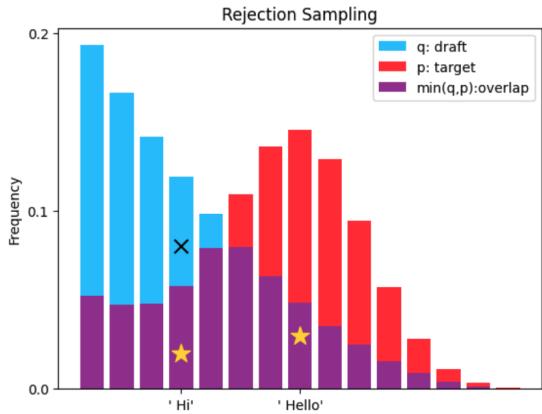
Figure 3 illustrates the concept. The blue curve (\(q\)) is the draft distribution, and the red curve (\(p\)) is the target.
- Overlap: If the draft samples a token where \(q\) and \(p\) overlap (the purple area), we usually accept it.
- Residual: If we reject the draft, we must sample from the “residual” distribution—the parts of the target distribution (\(p\)) that the draft (\(q\)) didn’t cover.
The Problem with RRS (Recursive Rejection Sampling): RRS is the standard greedy approach. It checks the first draft token; if accepted, it moves to the second. The issue arises when we move to the second token. The target distribution for the second token depends on the first. If we are forced to sample from the residual distribution (because the first draft was imperfect), the distribution for the second draft often becomes misaligned with the original draft.
This misalignment causes the acceptance rate to plummet for subsequent tokens. You might get the first token “free,” but the second and third drafts are likely to be rejected, rendering the “multi-draft” aspect useless.
The Core Method: SpecHub
The researchers propose SpecHub to solve the efficiency decay of RRS without incurring the massive cost of full Optimal Transport.
1. From Optimal Transport to Linear Programming
The researchers realized that maximizing the acceptance rate of multiple drafts is actually an Optimal Transport (OT) problem. We are trying to move “probability mass” from the draft distribution (\(Q\)) to the target distribution (\(p\)) with the least amount of “cost” (rejection).
The mathematical definition of the cost function for a coupling \(\pi\) is:
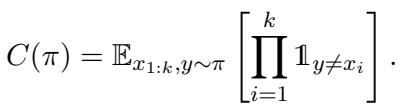
Minimizing this cost ensures we accept as many tokens as possible. A full OTM solution would require solving for a transport plan \(\pi\) across the entire vocabulary space. For a vocabulary of 32,000 tokens and 2 drafts, this involves solving for variables in the order of \(|\mathcal{V}|^3\), which is computationally impossible for real-time text generation.
The Simplification: SpecHub simplifies this by formulating it as a Linear Programming (LP) problem that focuses only on the scenarios where we actually accept a token. We don’t need to map the rejections explicitly; we just need to maximize the probability of acceptance.
The simplified minimization objective looks like this:
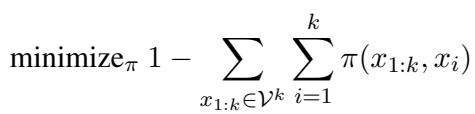
Subject to constraints ensuring valid probability distributions:

This reduces the complexity drastically, but for large vocabularies, it is still too slow. This leads us to the second, more crucial innovation of the paper.
2. The “Hub” Token Strategy
To make the math fast enough for inference, SpecHub changes how we construct the draft distribution \(Q\). Instead of a “dense” distribution where any token can follow any other token, SpecHub constructs a sparse distribution.
The algorithm identifies a single Hub Token (denoted as \(a\)). This is simply the token with the highest probability in the draft model.
The rule is simple: We only sample pairs that include the Hub. If we are using 2 drafts, we only consider pairs \((x, a)\) or \((a, x)\). We never sample a pair like \((b, c)\) where neither is the top token.
The joint draft distribution \(Q\) is defined as:
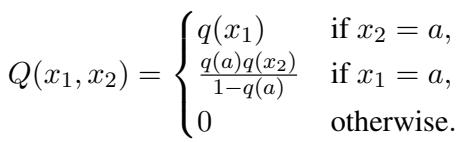
This structure is brilliant because it turns a complex web of probabilities into a “star” topology. The Hub token acts as a central transfer station for probability mass.
3. Visualizing the Difference
Let’s compare the standard Optimal Transport (OTM) approach with SpecHub visually.
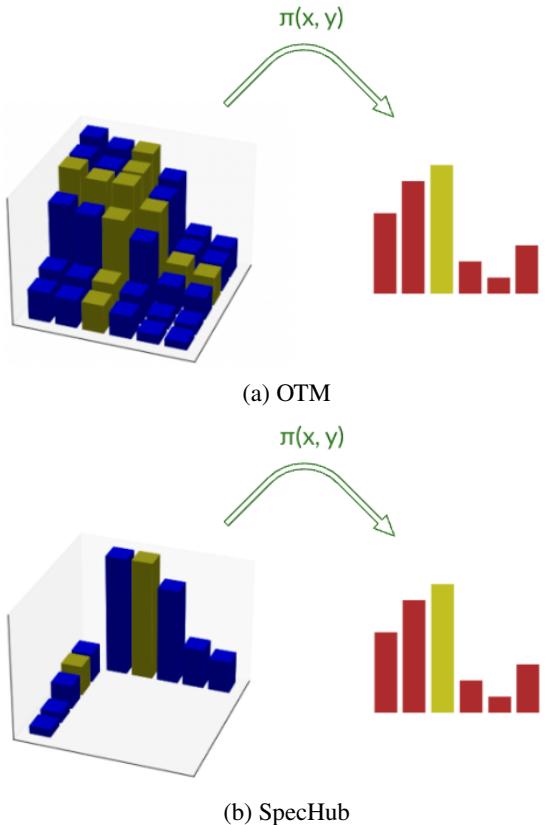
- Left (a) OTM: You see a dense 3D matrix. The algorithm tries to map every possible pair of draft tokens to the target. It’s accurate but slow.
- Right (b) SpecHub: The distribution is sparse. Most of the grid is empty. We only care about the “Hub” (the yellow bars). This sparseness allows the Linear Program to be solved in linear time, \(O(|\mathcal{V}|)\).
4. How the “Hub” Transports Probability
By solving the simplified LP with this sparse distribution, we get a closed-form solution for the transport plan. This tells us exactly how to verify tokens.

Here is a concrete example of how SpecHub moves probability mass compared to RRS.
Imagine we have a Draft Model and a Target Model.
- Draft: High confidence in token ‘a’ (0.5), moderate in ‘b’ (0.3).
- Target: Low confidence in ‘a’ (0.1), high in ‘b’ (0.6).
In RRS (standard method), because the draft over-predicted ‘a’, it gets rejected. The residual distribution essentially zeros out ‘a’. When we try to verify the second draft, we are stuck dealing with a messy residual.
In SpecHub, we look at the pair. Since we sampled pairs involving ‘a’, and ‘a’ was oversampled by the draft, SpecHub uses ‘a’ as a Hub to “pay for” the acceptance of ‘b’.
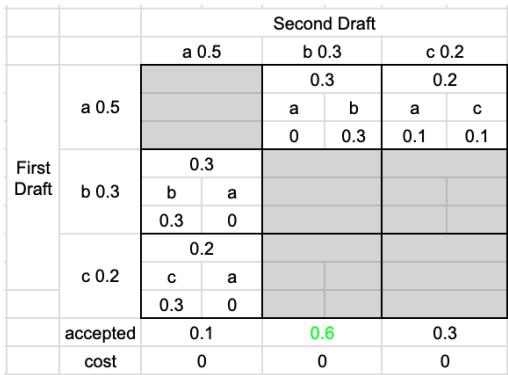
In Figure 6 above, notice how the probability mass flows. The draft over-predicted ‘a’ (\(q=0.5, p=0.1\)). SpecHub takes that excess draft probability and effectively reallocates it to help accept ‘b’, which was under-predicted by the draft but wanted by the target. RRS cannot do this “trading”—it treats every step independently. SpecHub treats the sequence as a joint package.
5. The Algorithm
The final implementation of SpecHub is elegant. It doesn’t require an external solver; the closed-form solutions derived from the LP allow for a direct algorithmic implementation.
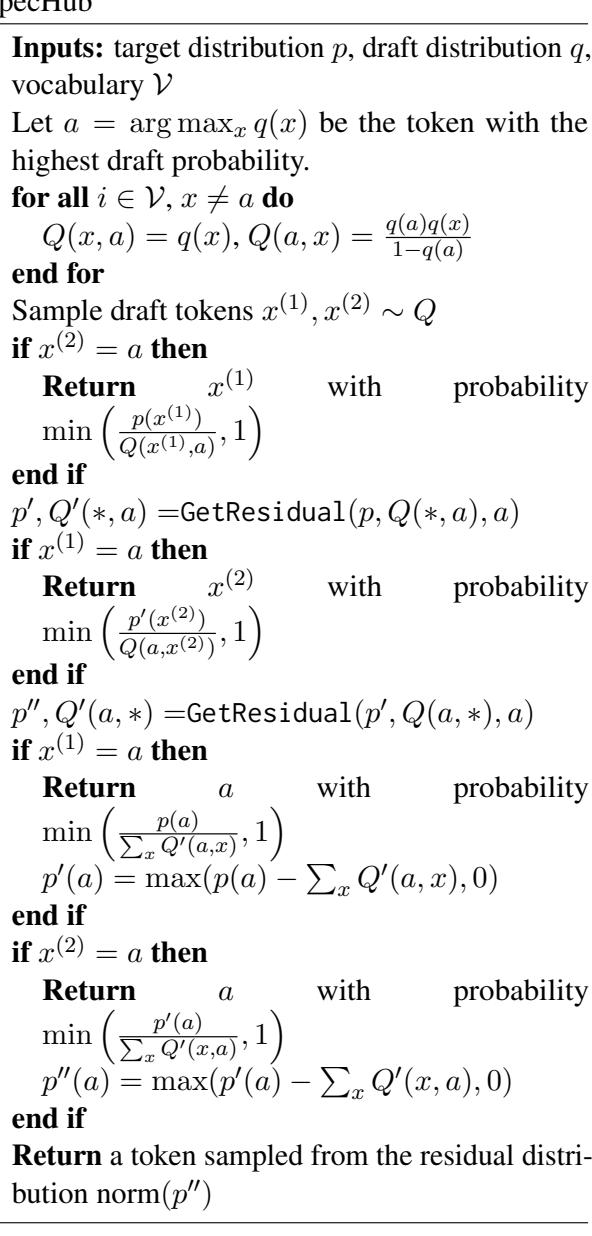
The algorithm essentially performs these steps:
- Identify the Hub token \(a\).
- Construct the sparse probabilities.
- Sample pairs \((x^{(1)}, x^{(2)})\).
- Verify them using the optimized acceptance probabilities derived from the math above (Theorem 2 in the paper proves this maintains the correct target distribution).
Experiments & Results
The researchers tested SpecHub against RRS and RRSw (RRS without replacement) using Llama-2 models on standard datasets (CNN DailyMail, OpenWebText).
Batch Efficiency
The primary metric is Batch Efficiency—the average number of tokens generated per model step. A higher number means the speculative decoding is working better.
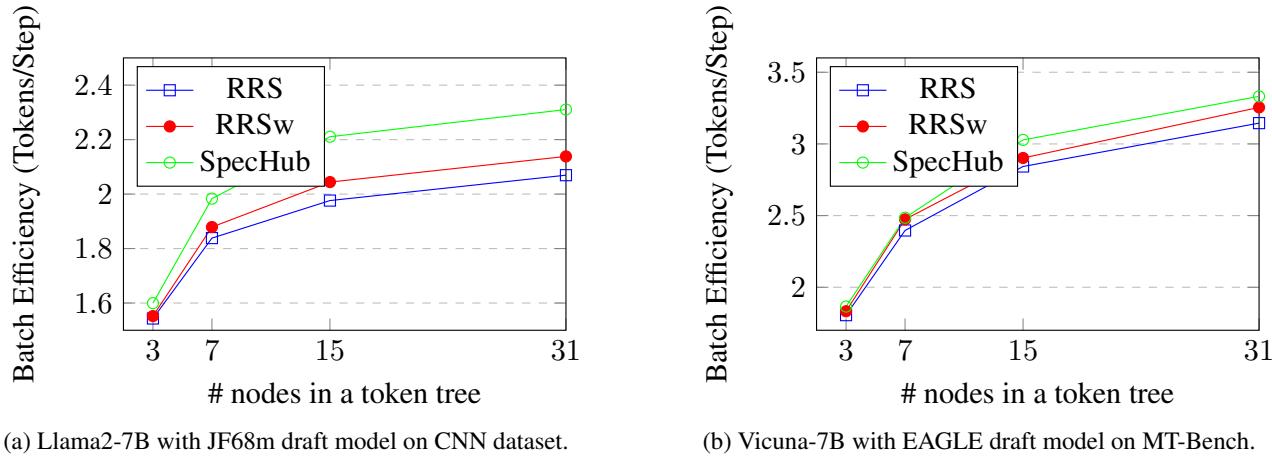
As seen in Figure 1:
- Graph (a): On Llama2-7B, SpecHub (green line) scales significantly better as the number of nodes in the token tree increases. While RRS plateaus, SpecHub continues to utilize the extra drafts to generate more tokens.
- Graph (b): On Vicuna-7B (a chat model), the gap is even wider. SpecHub generates nearly 3.5 tokens per step, whereas RRS struggles to break 2.0.
Robustness Across Temperatures
LLMs are often run at different “temperatures.” Low temperature makes the model deterministic; high temperature makes it creative (and the distribution flatter/harder to predict).
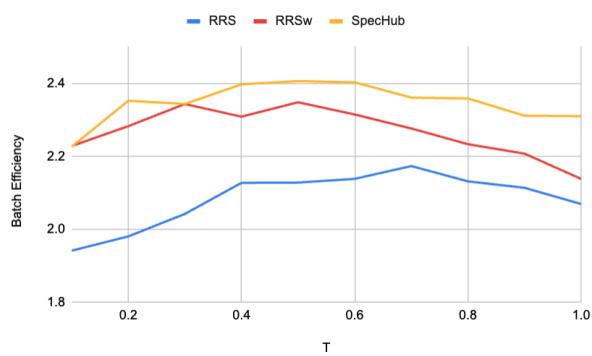
Figure 7 shows that SpecHub’s advantage holds regardless of temperature.
- At low temps (left), distributions are sharp. SpecHub mimics greedy decoding and performs similarly to RRSw.
- At high temps (right), where distributions are flatter and harder to match, SpecHub’s ability to “transport” probability mass via the Hub allows it to maintain higher efficiency than the baselines.
Why Not Just Add More Drafts?
You might wonder, why stop at 2 drafts (\(k=2\))? Why not 5 or 10?
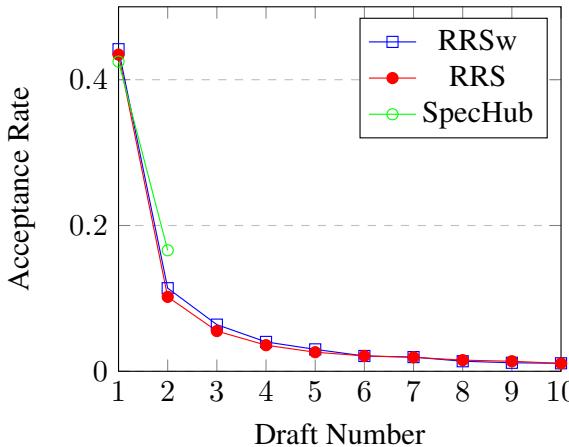
Figure 9 illustrates the “diminishing returns” of MDSD. The acceptance rate (y-axis) drops precipitously after the first couple of drafts. By draft 4 or 5, the acceptance rate is near zero for all methods. Because the computational cost of Optimal Transport grows exponentially with \(k\) (the number of drafts), SpecHub focuses on optimizing the case of \(k=2\). It squeezes the maximum possible efficiency out of the first few most important drafts.
Conclusion
SpecHub represents a significant step forward in making Large Language Models faster and more efficient. It successfully identifies that the bottleneck in Multi-Draft Speculative Decoding isn’t just about generating more drafts—it’s about how we verify them.
By re-imagining the verification step as a Linear Programming problem and introducing the “Hub” token constraint, the authors managed to:
- Reduce Complexity: Bringing the cost from polynomial down to linear.
- Increase Acceptance: Provably outperforming heuristic methods like RRS.
- Maintain Accuracy: Ensuring the final output distribution exactly matches the target model.
For students and researchers in NLP, SpecHub is a perfect example of how theoretical constraints (like the heavy compute of Optimal Transport) can be overcome by clever algorithmic design (Sparsity and Linear Programming), resulting in real-world acceleration.