](https://deep-paper.org/en/paper/2411.07061/images/cover.png)
Introduction
If you have ever trained a deep neural network, you know the “dark art” of learning rate scheduling. You pick an optimizer (like Adam or SGD), but that’s just the beginning. To get state-of-the-art convergence, you inevitably have to decay the learning rate over time. Should you use a step decay? Cosine annealing? A warmup period? The choices are endless, and tuning them consumes a massive amount of compute and researcher time.
Recently, a method called Schedule-Free SGD has gained traction. Developed by Defazio et al., it promises a world where you don’t need a learning rate schedule at all. You pick a single parameter, and the algorithm handles the rest, achieving performance competitive with carefully tuned schedules.
While empirically impressive, there was a theoretical gap. The original theory for Schedule-Free methods was limited to convex optimization. However, deep learning is fundamentally a nonconvex problem. We know it works in practice, but do we know why?
This is where the paper “General framework for online-to-nonconvex conversion: Schedule-free SGD is also effective for nonconvex optimization” enters the picture. The researchers bridge the gap between convex theory and deep learning reality. They not only prove that Schedule-Free SGD is optimal for nonconvex problems, but they also provide a general framework that turns abstract online learning concepts into concrete optimization algorithms.
In this post, we will deconstruct this paper. We will explore how “Online Learning” relates to training neural nets, how the authors built a general machine for creating optimizers, and how Schedule-Free SGD emerges naturally from this framework.
Background: The Landscape of Optimization
Before diving into the proofs, we need to establish the ground rules of the game we are playing.
Nonconvex and Nonsmooth
In deep learning, we try to minimize a loss function \(F(x)\).
- Nonconvex: The loss landscape has hills, valleys, and saddle points. We aren’t guaranteed to find a global minimum, so we look for a “stationary point” (a point where the gradient is zero).
- Nonsmooth: Modern networks use ReLU activations and max-pooling, making the loss function technically non-differentiable at certain points.
Because the function might be nonsmooth, we can’t just say “find where the gradient is zero,” because the gradient might not exist everywhere. Instead, the authors use a concept called \((\lambda, \epsilon)\)-stationarity.

Roughly speaking, this definition looks for a point \(x\) that is “close” to a region where the gradient is small. If an algorithm can find such a point efficiently, it is considered successful.
Online Learning: The Engine Under the Hood
The core theoretical tool used in this paper is Online Learning. In the online learning game, a “learner” makes a decision, suffers a loss, and updates its strategy. The goal is to minimize Regret—the difference between the learner’s cumulative loss and the loss of the best possible fixed decision they could have made in hindsight.
The authors focus specifically on Discounted Regret, where recent mistakes matter more than old ones. This is crucial for nonconvex optimization because the landscape changes as we move; old information becomes stale.

Here, \(\beta\) is a discount factor (close to 1). If an algorithm has low discounted regret, it adapts well to changing environments.
The General Framework: A Machine for Optimizers
The paper’s first major contribution is a general algorithmic framework (Algorithm 1) that converts any online learning algorithm into a nonconvex optimization algorithm. This is called Online-to-Nonconvex Conversion.
Here is the intuition:
- We have an Online Learner (let’s call it \(\mathcal{A}\)) that predicts update directions.
- We use these predictions to move our weights (\(w_t\)).
- We maintain a separate reference point (\(x_t\)).
- We calculate gradients at an interpolated point (\(y_t\)) between \(x_t\) and \(w_t\).
The magic of this framework is its flexibility. It maintains three sequences of variables:
- \(w_t\): The “active” weights derived from the online learner.
- \(x_t\): A “center” or “anchor” point that we can design however we want.
- \(y_t\): The point where we actually ask PyTorch (or your framework of choice) to compute the gradient.
By choosing different strategies for updating \(x_t\), this single framework can recover standard SGD with Momentum, Adam, or—as we will see—Schedule-Free SGD.
The Guarantee
The authors prove a powerful theorem: If your online learner has low regret (it’s good at predicting gradients), and your choice of \(x_t\) is “stable” (it doesn’t jump around wildly), then the algorithm will converge to a stationary point.
The convergence bound looks like this:

This equation says that the gradient size (stationarity) is bounded by a small constant \(\epsilon\) plus a term depending on the “sum of loss decrements” (\(F(x_t) - F(w_t)\)). If we can keep \(F(x_t)\) and \(F(w_t)\) close or telescoping, the algorithm converges optimally.
Deriving Schedule-Free SGD
Now we arrive at the core contribution. How does this abstract framework produce the Schedule-Free SGD algorithm?
Step 1: The Online Learner
First, the authors choose a specific online learner: Discounted Online Mirror Descent (OMD). The update rule for the learner (denoted by \(\delta\)) is:
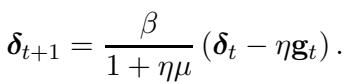
This is a standard algorithm in online learning. It takes the previous direction \(\delta_t\), subtracts the gradient \(g_t\) (scaled by learning rate \(\eta\)), and applies a discount factor.
Step 2: The Choice of \(x_t\)
Recall that the framework allows us to choose \(x_t\) arbitrarily. To recover Schedule-Free SGD, the authors propose a specific, clever update, referred to as Option III:

Here, \(x_t\) is updated by moving in the direction of the learner’s output \(\delta_t\). Why this specific choice? It forces the variables to align in a way that creates a “telescoping sum” in the proof, canceling out error terms and ensuring stability.
Specifically, it enforces a very tight relationship between the anchor point \(x_t\) and the weight \(w_{t-1}\):

This relationship is the key. It ensures that the distance between the two variables we care about is controlled purely by the gradient size.
Step 3: The “Z” Transformation
At this point, the algorithm looks like a mess of \(\delta\), \(x\), and \(w\) variables. It doesn’t look like standard SGD. To reveal the structure, the authors introduce a phantom variable, \(z_t\), defined as an extrapolation:
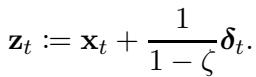
When we substitute this definition into the update rules, something remarkable happens. The complex updates collapse into a simple SGD step on \(z\):
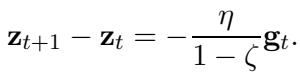
This \(z_t\) represents the “base trajectory” of SGD. It moves simply by subtracting gradients. Meanwhile, our actual model weights (\(y_t\)) and our anchor points (\(x_t\)) orbit around this \(z\) trajectory using averages.
Visualizing the Architecture
The authors provide a diagram to illustrate how these variables interact.
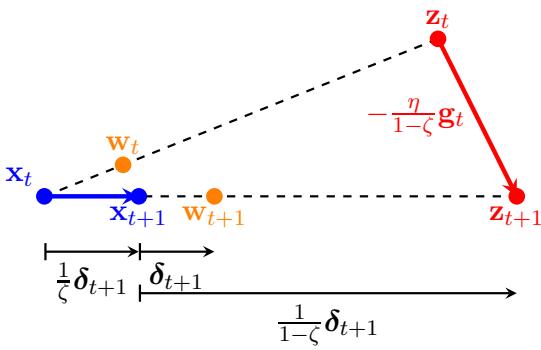
In this diagram:
- The dashed line represents the path of \(z_t\) (the base SGD trajectory).
- The blue dots (\(x_t\)) are weighted averages that stabilize the trajectory.
- The gradients are computed at intermediate points (\(y_t\)), but the underlying progress is driven by \(z\).
The Resulting Algorithm
When you rewrite the “Option III” math using the \(x, y, z\) notation, you get the exact formulation of Schedule-Free SGD:
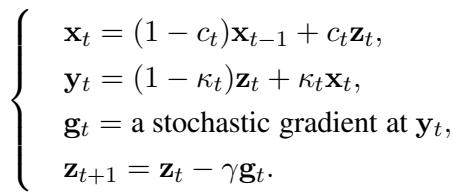
- \(x_t\): The “schedule-free” average.
- \(y_t\): The evaluation point (interpolation).
- \(z_t\): The base optimizer (SGD).
This derivation proves that Schedule-Free SGD is not just a heuristic; it is a direct instance of a theoretically sound online-to-nonconvex conversion.
Why This Matters: Optimality and Parameters
The derivation isn’t just a mathematical parlor trick. It gives us concrete guidance on how to use the optimizer.
1. Optimal Convergence
The paper proves that this method achieves the optimal convergence rate for nonsmooth, nonconvex functions:

This \(O(1/T)\) rate (or more precisely \(\epsilon^{-4}\) complexity) matches the best known theoretical limits for SGD with momentum. This confirms that we lose nothing theoretically by abandoning the schedule.
2. Solving the \(\kappa\) Mystery
In the original Schedule-Free paper, there was a parameter \(\kappa\) (kappa) that controlled how much we interpolate between the average and the current weights. Empirically, Defazio et al. found that \(\kappa\) needed to be very close to 1 (e.g., 0.98 or higher) for good performance. Convex theory couldn’t explain why.
This new nonconvex analysis provides the answer. The optimal parameters derived from the proof require:

The math shows that \(1 - \zeta\) (which corresponds to the interpolation weight) must scale with \(\epsilon^2\). Since \(\epsilon\) is small (we want small gradients), the interpolation weight must be tiny, meaning \(\kappa\) must be very close to 1. The theory perfectly matches the empirical reality.
3. Justifying Large Learning Rates
Another empirical observation was that Schedule-Free SGD allows for (and benefits from) much larger learning rates than standard SGD.
The analysis supports this. The effective step size for the \(z\) sequence is derived as \(\gamma = \frac{\eta}{1-\zeta}\). Because \(1-\zeta\) is very small, the effective learning rate \(\gamma\) becomes significantly larger than the base online learning rate \(\eta\). The geometry of the algorithm naturally stabilizes these large steps.
Conclusion
The transition from theoretical optimization to practical deep learning is often messy. Methods that work in practice (like Adam or Schedule-Free) often wait years for a theory that explains them.
Ahn, Magakyan, and Cutkosky have closed the loop for Schedule-Free SGD. By building a general Online-to-Nonconvex framework, they demonstrated that:
- Schedule-Free SGD is mathematically sound for deep learning (nonconvex/nonsmooth).
- It achieves optimal convergence rates without a schedule.
- The specific “magic numbers” used in practice (high \(\kappa\), high learning rate) are theoretically justified.
This paper serves as a strong signal that we can move beyond the trial-and-error phase of learning rate scheduling. With solid theoretical backing, Schedule-Free methods are poised to become a standard tool in the deep learning optimizer toolkit.