](https://deep-paper.org/en/paper/2411.08753/images/cover.png)
Introduction
Imagine you are trying to learn how to repair a bicycle wheel or perfect a basketball jump shot. You find a video tutorial online, but it’s not just a standard video—it’s a multi-view experience recorded by five different cameras. One camera is strapped to the instructor’s head (egocentric), while four others are placed on tripods around the room (exocentric).
This rich data is fantastic for capturing every detail, but it presents a massive cognitive load. As a viewer, you cannot watch five screens simultaneously. You need a director—someone (or something) to switch to the “best” view at every moment. When the mechanic is tightening a spoke, you want the close-up of their hands. When the basketball player is driving to the hoop, you want the wide angle showing the court.
Traditionally, solving this view selection problem requires expensive manual labor. Humans have to watch hours of footage and manually label which camera is “best” at every second. This simply isn’t scalable.
In this post, we explore a research paper titled “Which Viewpoint Shows it Best? Language for Weakly Supervising View Selection in Multi-view Instructional Videos.” The researchers propose a novel framework called LANGVIEW. Their solution is elegant: instead of asking humans to label good views, they use the language accompanying the video (like the script or instructions) to teach an AI model which view is most informative.
The Problem: All Views Are Not Created Equal
In multi-view instructional videos, information is distributed unevenly. At any given timestamp, one camera might show a clear view of the critical action, while another might be blocked by the instructor’s back or simply too far away.
Existing methods to automate this selection usually fall into two camps:
- Heuristics: Simple rules like “always pick the view with the most motion” or “pick the view with the most skin color detection.” These are often too crude to understand complex activities.
- Supervised Learning: Training neural networks on datasets where humans have explicitly labeled the best view. This is accurate but requires creating massive, expensive datasets.
The researchers behind LANGVIEW asked a different question: Can we use the narration of the video as a weak supervisor?
The Core Hypothesis
The central idea of this paper is intuitive but powerful: The “best” view is the one that best matches the text description of the activity.
If a text narration says, “The person inspects the rear wheel with both hands,” and Camera 1 clearly shows the wheel and hands, a video captioning AI watching Camera 1 should be able to generate a caption very similar to that text. However, if Camera 3 is blocked by the person’s body, the captioning AI might generate something vague like “A person is standing in a room.”
Therefore, the accuracy of a generated caption relative to the ground-truth narration can serve as a proxy for the quality of the viewpoint.
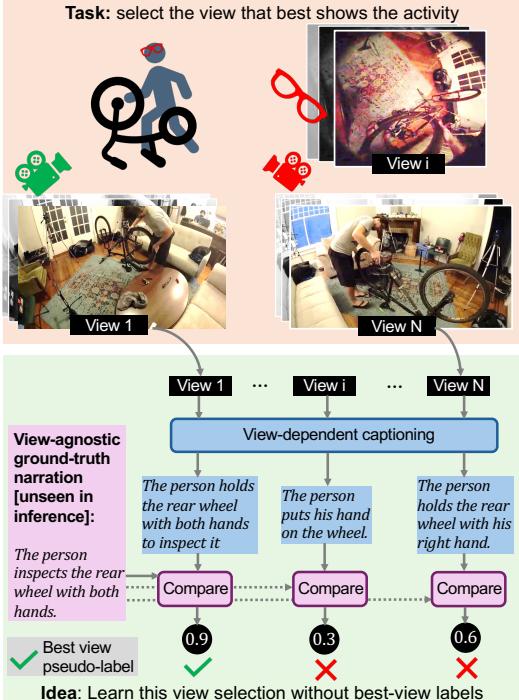
As shown in Figure 1, the system compares the captions generated from different angles against the actual narration. The view that produces the most accurate caption is automatically “pseudo-labeled” as the best view.
The LANGVIEW Framework
The LANGVIEW framework operates in two distinct phases:
- The Best View Pseudo-Labeler (Training only): Generating labels using language.
- The Best View Selector (Inference): The actual model that predicts the best view using only video.
Let’s break these down.
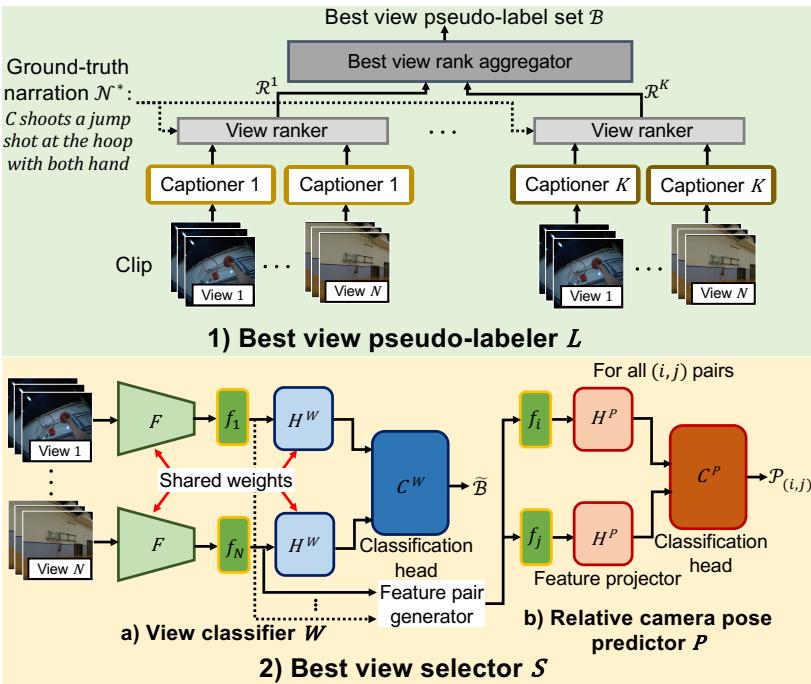
1. The Best View Pseudo-Labeler
The first challenge is creating a training dataset without human labels. The researchers use off-the-shelf video captioning models (like Video-Llama) to do the heavy lifting.
For a specific video clip, the system takes the View-Agnostic Ground-Truth Narration (the script describing the action) and the video feeds from all \(N\) cameras.
The process flows as follows:
- Caption Generation: Each of the \(N\) views is fed independently into a video captioner.
- Comparison: The generated caption for each view is compared to the ground-truth narration.
- Ranking: The views are ranked based on how semantically similar their generated caption is to the ground truth.
For example, look at the caption comparisons below:
In the top example, the ground truth is “C catches the ball with his hands.” The best view allows the model to predict exactly that. The worst view leads to a generic caption: “C receives the ball.” The system assigns a high score to the first view and selects it as the target label.
Because individual captioning models can be noisy, the researchers use a Rank Aggregator. They run multiple different captioning models (e.g., Video-Llama and VideoChat2) and combine their rankings to find a consensus on the best view.
2. The Best View Selector
Once the pseudo-labels are generated, the researchers train the actual View Selector model. This is the model that will be used in the real world. Crucially, at inference time, this model does not need text narrations or camera poses—it only looks at the video pixels.
The Architecture
The View Selector (shown in the bottom-left of Figure 2a) uses a TimeSformer visual encoder. It processes video patches from a specific view to create a visual feature representation. These features are passed to a classification head that predicts whether the current view is the “best” one (based on the pseudo-labels generated earlier).
The Training Objective
The primary loss function is a variation of cross-entropy. Since there might be multiple “good” views for a single action, the loss function is designed to handle multiple correct pseudo-labels.

Here, \(\mathcal{L}^W\) encourages the model to predict one of the views identified as “best” by the pseudo-labeler.
The Secret Sauce: Auxiliary Camera Pose Prediction
Training a model solely on caption-derived pseudo-labels has a risk. Captioning models are often pre-trained to be robust to viewpoint changes—they try to describe the scene correctly even from a bad angle. This could result in the model learning features that are invariant to the viewpoint, which is the exact opposite of what we want. We want the model to be highly sensitive to the viewpoint.
To solve this, the researchers introduced an auxiliary task: Relative Camera Pose Prediction.
While the model learns to select the best view, it is simultaneously tasked with predicting the geometric relationship between two camera views (e.g., “Camera A is 30 degrees to the left of Camera B”).
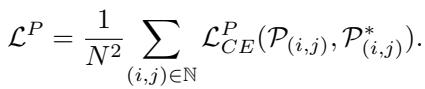
By forcing the model to understand where cameras are located relative to each other, the visual encoder is compelled to learn geometric, view-dependent features. This acts as a regularizer, ensuring the model doesn’t just learn high-level semantic features that look the same from every angle.
The impact of this auxiliary task is visualized below using t-SNE plots, which show how the model clusters data.
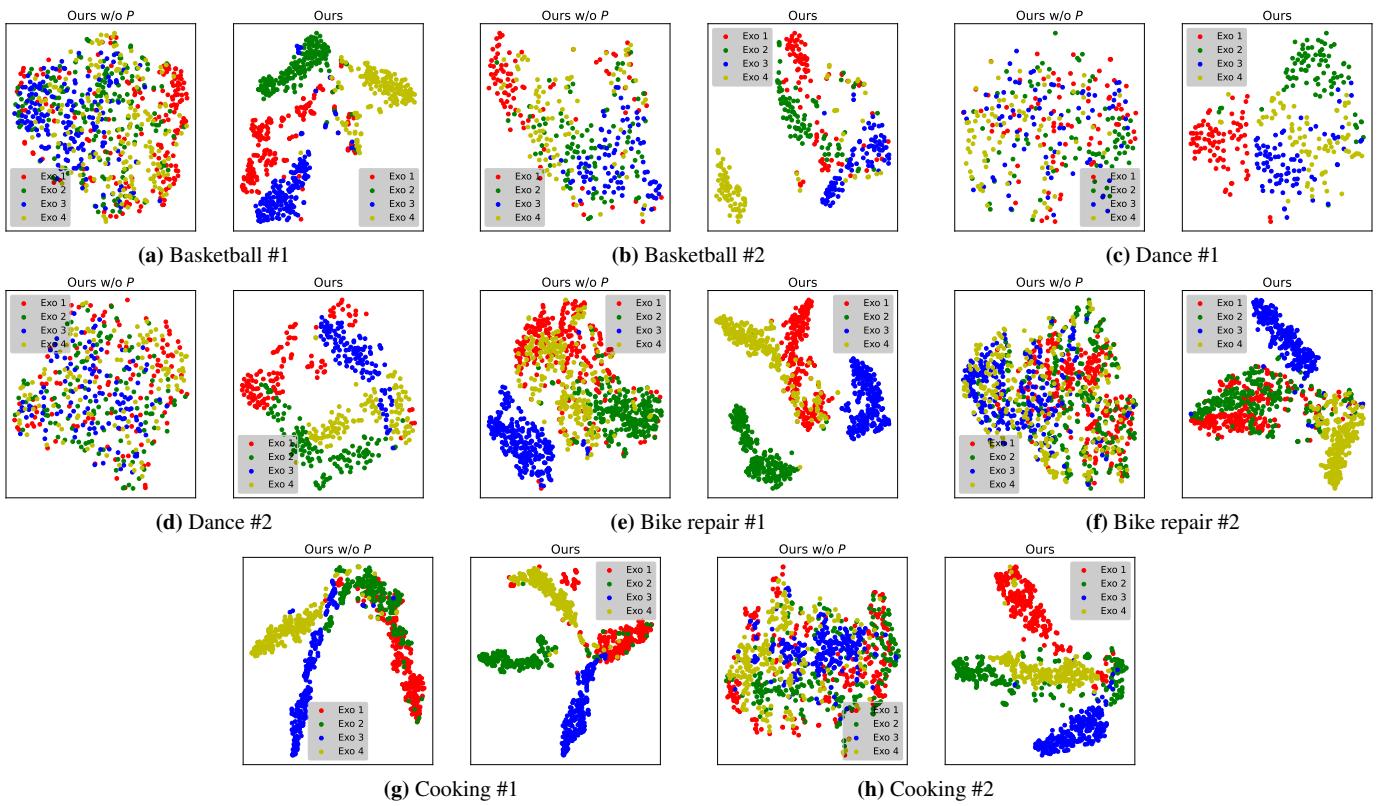
On the left (without pose prediction), the features for different cameras are jumbled. On the right (with pose prediction), the features for Camera 1, Camera 2, etc., form distinct clusters. This proves the model has learned to distinguish between viewpoints effectively.
Experiments and Results
The model was evaluated on two challenging multi-view datasets: Ego-Exo4D (skilled human activities like cooking or bike repair) and LEMMA (household activities).
The researchers compared LANGVIEW against several baselines:
- Heuristics: Random selection, Center-view only.
- Intelligent Baselines: Selecting views based on Hand/Object detection confidence, or Body Pose visibility.
- SOTA: Previous state-of-the-art methods like “Snap Angles.”
Quantitative Analysis
To measure success, they used the selected views to generate new captions and checked how well those captions matched the ground truth. If the model picks a bad view, the resulting caption will be poor.
They also looked at Attention Heatmaps to see what the model was focusing on when making a decision.

As seen in Figure 5, the model learns to focus on the hands, the tools, and the active objects—exactly the regions a human would want to see.
Human Evaluation
Metrics are useful, but the ultimate test for a “best view” selector is human preference. The researchers conducted a study where humans were shown two views side-by-side (one selected by LANGVIEW, one by a baseline) and asked to pick the better one for learning the activity.

In the “Success cases” on the left of Figure 3, LANGVIEW (green boxes) consistently picks views that show the interaction clearly (e.g., the knife on the cutting board). In the “Failure cases” on the right, the model sometimes struggles when the difference between views is subtle or stylistic.
Overall, the human evaluation showed a significant preference for LANGVIEW over strong baselines like “Hand-Object” detection. This suggests that “informativeness” is more than just seeing hands; it’s about the semantic coherence of the action, which the language supervision captures effectively.
Why This Matters
The LANGVIEW paper presents a significant step forward in video understanding. Here are the key takeaways:
- Language is a Supervisor: We don’t always need explicit labels. The semantic information in text can act as a powerful, low-cost signal to train vision models.
- Viewpoint Sensitivity: Standard vision models try to be “invariant” to camera angles (recognizing a cat as a cat from any angle). For tasks like cinematography or robotics, we need models that are “sensitive” to angles. The auxiliary pose prediction task is a clever way to enforce this.
- Instructional Efficiency: As we move toward AI assistants that teach us skills (augmented reality tutors), the ability to automatically present the most informative visual perspective is crucial.
By leveraging the connection between what we see and how we describe it, LANGVIEW teaches computers to direct their own movies, ensuring we never miss the critical moment of the action.