](https://deep-paper.org/en/paper/2411.12915/images/cover.png)
Introduction: The Paradox of the Generalist
In the rapid evolution of Artificial Intelligence, we have seen the rise of massive “Generalist” Vision-Language Models (VLMs) like GPT-4o and Gemini. These models are incredibly impressive—they can write poetry, analyze charts, and even joke about a photograph. However, when it comes to high-stakes fields like healthcare, being a “jack of all trades” often means being a master of none.
A generalist VLM might look at a chest X-ray and correctly identify the lungs, but fail to notice a subtle fracture or a developing tumor that a trained radiologist would spot instantly. Why? Because these models rely on memorized internet knowledge rather than deep, domain-specific visual expertise. They are prone to hallucinations, confidently stating medical facts that are simply wrong.
To solve this, researchers from NVIDIA have proposed a new framework: VILA-M3.
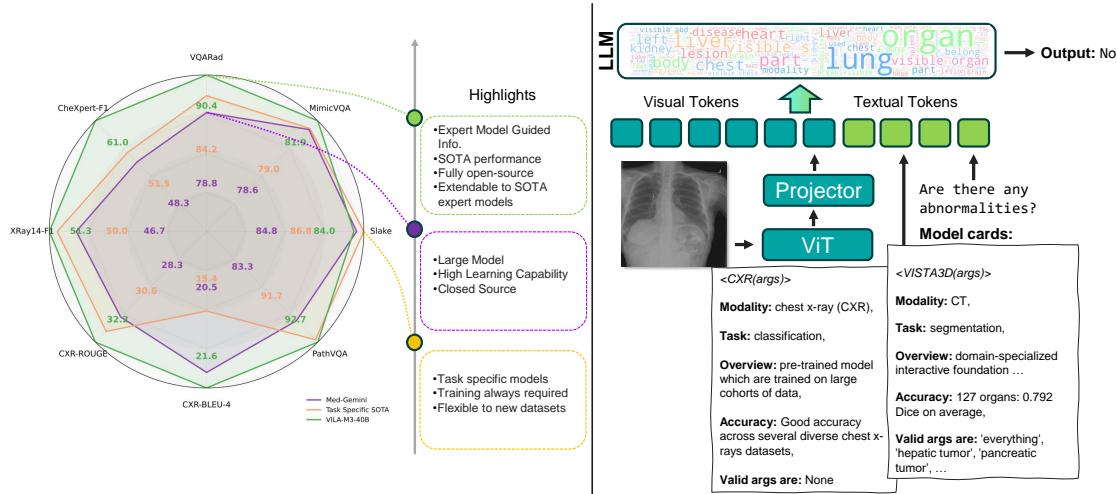
Instead of just making the model bigger (a common trend in AI), they made it smarter. They designed a system that acts like a primary care physician who knows when to call a specialist. VILA-M3 doesn’t just look at an image; it learns to trigger “expert models”—specialized AI tools designed for segmentation and classification—and incorporates their findings into its diagnosis.
The result? A model with 40 billion parameters that outperforms Google’s Med-Gemini (a 1.5 trillion parameter model) on major medical benchmarks. In this post, we will tear down how VILA-M3 works, how it learns to use tools, and why this “expert-in-the-loop” approach might be the future of medical AI.
Background: The Gap Between Language and Vision
To understand VILA-M3, we first need to understand the limitations of current Medical VLMs.
Standard VLMs are trained in three stages:
- Vision Pre-training: Teaching an image encoder (like a Vision Transformer) to understand images.
- Vision-Language Pre-training: aligning the image data with text data so the model understands that a picture of a cat relates to the word “cat.”
- Instruction Fine-Tuning (IFT): Teaching the model to follow user instructions (e.g., “Describe this image”).
In medicine, typical IFT uses a mix of generic and healthcare data. However, the visual features in medical imaging are incredibly subtle. A generic vision encoder trained on internet photos might miss the “fine-grained” features of a lesion in a CT scan.
Conversely, we have “Expert Models” (or Narrow AI). These are highly specialized models trained for one specific task, such as:
- VISTA3D: A state-of-the-art model for segmenting organs and tumors in 3D CT scans.
- TorchXRayVision: An ensemble of models specifically for classifying diseases in chest X-rays.
- BRATS models: Specialized in segmenting brain tumors in MRI scans.
These expert models are precise but rigid. They can’t chat with you or write a report. They just output a mask or a probability score. The genius of VILA-M3 is bridging this gap: giving the conversational ability of a VLM access to the precision of these expert models.
Core Method: VILA-M3 Architecture
VILA-M3 is built upon the VILA framework, an auto-regressive multi-modal Large Language Model. Here is how the researchers adapted it for the medical domain.
1. The Setup: Visual Tokens as a Foreign Language
At its core, VILA-M3 treats images like a foreign language. An input image (like an X-ray) is processed by a visual encoder and chopped into “visual tokens.” These tokens are fed into the Large Language Model (LLM) alongside text tokens. A “projector layer” acts as the translator between the visual encoder and the LLM.
However, VILA-M3 introduces a crucial Fourth Stage of training: Expert-Guided Instruction Fine-Tuning.
2. Learning to Call the Experts
This is the most significant contribution of the paper. During this fourth stage, the model is not just trained to answer questions; it is trained to recognize when it needs help.
The model is provided with “model cards”—descriptions of available expert tools (see Figure 1 right side). It learns to generate a specific text trigger when it encounters a complex case. For example, if asked about a liver tumor in a CT scan, VILA-M3 might predict the token string: <VISTA3D(hepatic tumor)>.
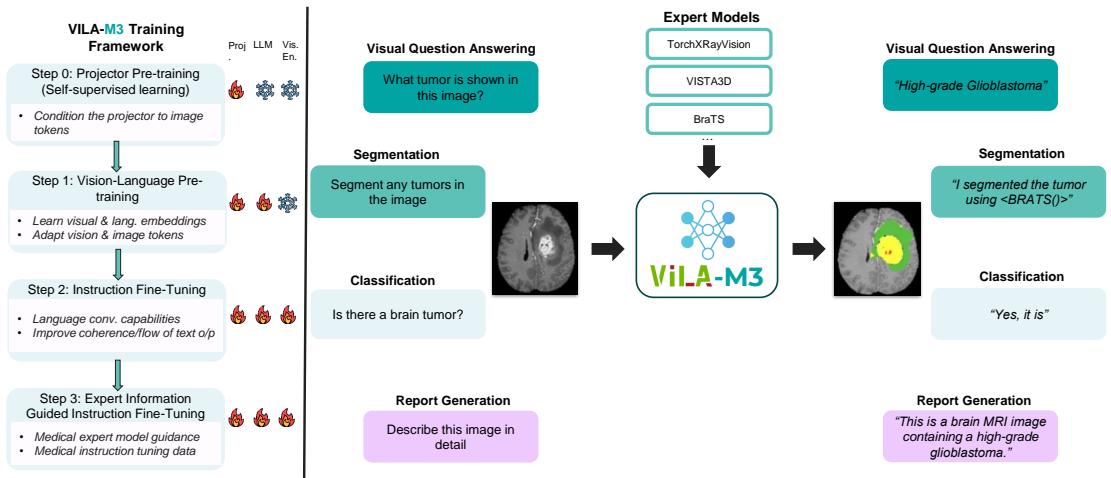
As shown in the architecture diagram above, the workflow is distinct:
- Input: User provides an image and a prompt (e.g., “Identify the tumor”).
- Reasoning: The VILA-M3 LLM analyzes the request. If it decides it needs expert help, it generates the trigger tag.
- Expert Execution: The system pauses the generation, runs the requested external model (like VISTA3D), and gets the result (e.g., a segmentation mask).
- Feedback Loop: The result is processed into a text description or visual overlay and fed back into the VILA-M3 context.
- Final Output: VILA-M3 uses this new “expert” information to generate a precise, accurate final response.
3. Handling Different Modalities
The researchers integrated diverse experts to handle the complexity of medical data.
For CT Scans (Computed Tomography): The model utilizes VISTA3D. Interestingly, VILA-M3 operates on 2D inputs, but VISTA3D is a volumetric 3D model. When triggered, VISTA3D analyzes the full 3D context of the patient scan and returns the relevant segmentation.
The model is smart enough to choose arguments for the tool. It doesn’t just say “Segment.” It says “Segment the liver” or “Segment the skeleton.”
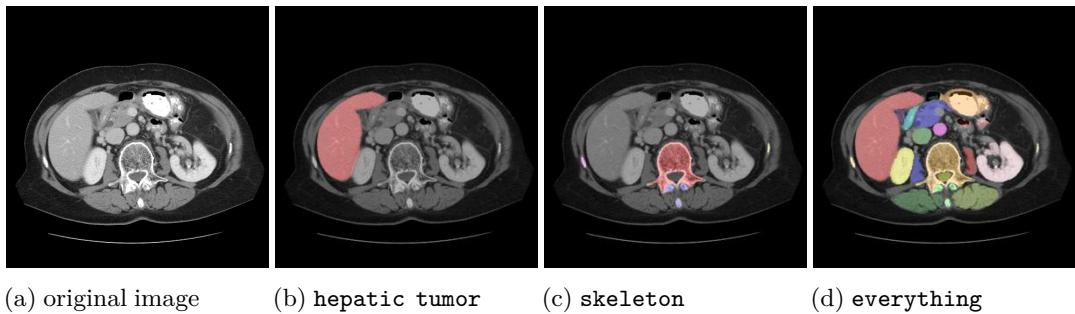
Look at the image above. It demonstrates the granularity of control VILA-M3 has. It can isolate specific pathologies (like the hepatic tumor in red) or map out the entire anatomy depending on the user’s prompt.
For Chest X-Rays (CXR): The model calls upon an ensemble of classifiers from TorchXRayVision. It receives feedback in the form of a list of probabilities for 18 different diseases, effectively giving the VLM a “second opinion” before it writes its report.
For MRIs: It utilizes the MONAI BRATS model, specifically tuned for segmenting brain tumor sub-regions in multimodal MRI scans.
The Importance of Data Curation
A major hurdle in training medical VLMs is the data. Public medical datasets are often “unbalanced.” You might have millions of “normal” X-rays but very few examples of rare diseases. If you train on raw data, the model becomes lazy—it learns to just guess “healthy” every time because it’s statistically safe.
The researchers tackled this by balancing the dataset. They increased the sampling frequency of low-count datasets (like VQA and specific expert segmentation data) while down-sampling the massive, repetitive report generation datasets.
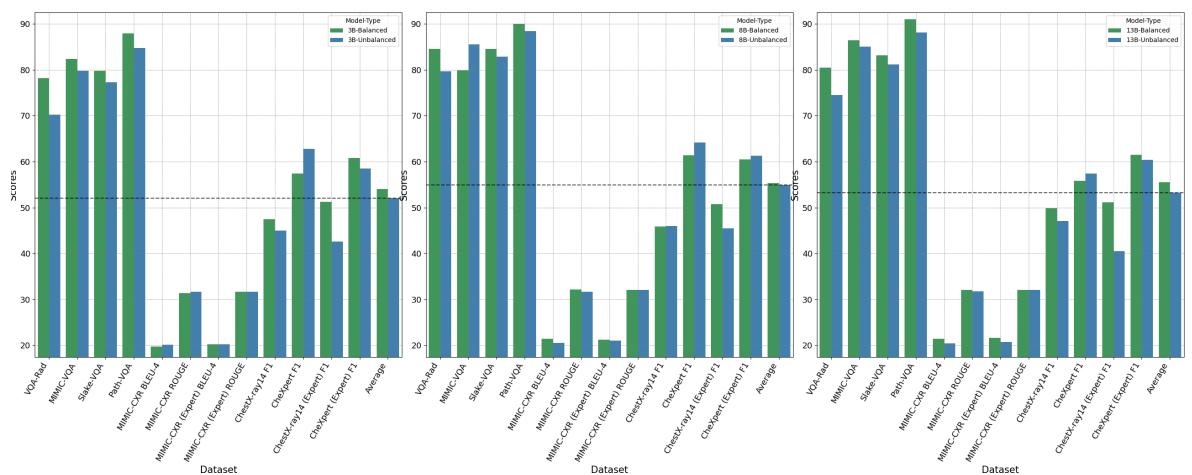
As visible in the charts above, the “Balanced” approach (green bars) yields consistently higher scores across almost every metric compared to the “Unbalanced” approach (blue bars). This step was critical to ensure the model didn’t just memorize common patterns but actually learned to reason about rare cases.
Experiments & Results
The researchers evaluated VILA-M3 against the current heavyweights of the industry, including Google’s Med-Gemini (1.5 Trillion parameters) and specialized task-specific models. They used a variety of model sizes for VILA-M3, ranging from 3 Billion (3B) to 40 Billion (40B) parameters.
1. Quantitative Performance: David vs. Goliath
The results were striking. Despite being a fraction of the size of Med-Gemini, VILA-M3 achieved state-of-the-art (SOTA) performance.
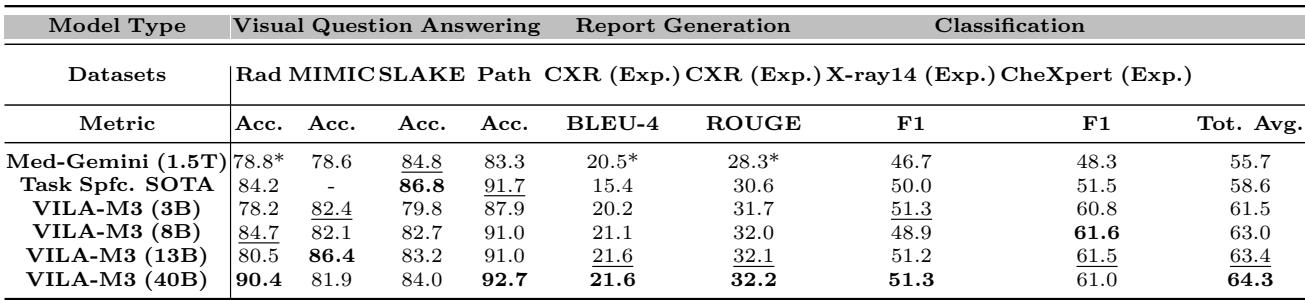
Key Takeaways from the Data:
- Total Average Score: VILA-M3 (40B) scored 64.3, significantly higher than Med-Gemini’s 55.7.
- Visual Question Answering (VQA): On the VQA-Rad dataset, VILA-M3 scored 90.4, beating the previous SOTA.
- Efficiency: Even the tiny VILA-M3 (3B) model outperformed the massive Med-Gemini in Report Generation accuracy (82.4 vs 78.6).
This proves a vital hypothesis: Domain expertise trumps raw parameter count. A smaller model equipped with the right tools and training is more effective than a massive model relying on general knowledge.
2. The “With Expert” vs. “Without Expert” Test
To prove that the expert models were actually doing the heavy lifting, the researchers performed ablation studies—running the same tasks with the expert modules turned off.
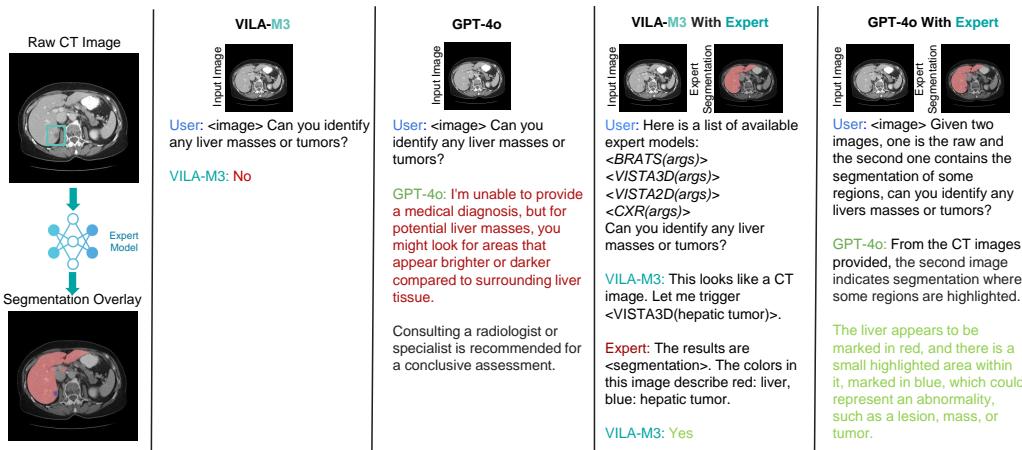
The qualitative results (shown above) are undeniable.
- Top Row (No Expert): When asked to identify a liver mass on a raw CT image, both VILA-M3 and GPT-4o fail. VILA-M3 simply says “No,” and GPT-4o gives a vague, cautious refusal.
- Bottom Row (With Expert): Once the expert model (VISTA3D) is triggered and provides the segmentation overlay (the red and blue masks), VILA-M3 correctly confirms the tumor.
Quantitatively, this held true as well. In classification tasks for Chest X-rays, adding expert feedback improved the accuracy significantly.

Looking at the CheXpert classification table above, notice the columns for “With Expert.” The scores for detecting specific conditions like Atelectasis and Cardiomegaly jump up when the expert ensemble is consulted.
3. Training Stability and Scaling
Finally, it is worth noting that despite the complexity of adding these external tools, the training remained stable. The researchers observed that the models followed standard “scaling laws”—meaning that as they added more parameters (from 3B up to 40B) and trained for more steps, the error rate dropped predictably.
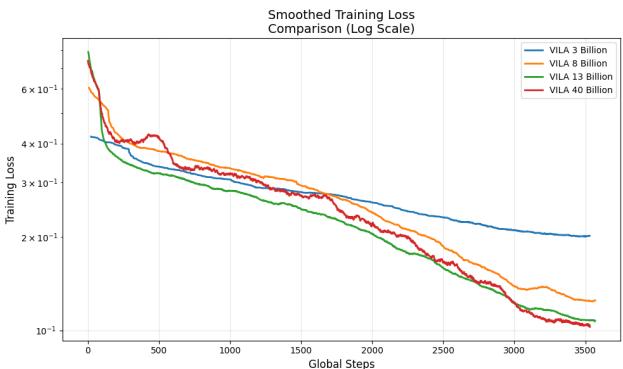
The 40B model (the yellow line in the graph above) had a slightly noisier training curve, likely due to its different architecture (Yi-34B backbone), but it still converged to a potent final state.
Conclusion & Implications
VILA-M3 represents a shift in how we think about Medical AI. For a long time, the assumption was that if we just make the “brain” (the LLM) bigger, it would eventually learn everything. This paper suggests a different path: Collaboration.
By treating the VLM as a coordinator that orchestrates specialized expert tools, we can achieve:
- Higher Accuracy: Beating trillion-parameter models with far less compute.
- Better Interpretability: We know exactly which expert tool was used to make a decision.
- Flexibility: New expert models can be swapped in without retraining the entire massive VLM.
This “Chain of Thought” capability—where a model reasons about how to solve a problem by selecting the right tool—is likely the next frontier for AI in high-precision fields like radiology. VILA-M3 is not just a chatbot; it’s a medical assistant that knows how to use its instruments.