](https://deep-paper.org/en/paper/2411.14205/images/cover.png)
Introduction
We are currently living through a golden age of visual synthesis. Text-to-image models like Stable Diffusion, Midjourney, and DALL-E have revolutionized how we create content, allowing us to conjure photorealistic scenes from a single sentence. However, if you have spent any time experimenting with these tools, you have likely encountered the “uncanny valley” of AI generation: the anatomy problem.
You ask for a portrait of a guitarist, and the model generates a stunning lighting setup, perfect skin texture, and… three hands. Or perhaps a person standing in a field, missing an ear, or with legs that merge into the grass. These “abnormal human bodies” are not just minor glitches; they are structural failures that shatter the illusion of realism.
To fix these images, we first have to answer a deceptively simple question: Is this generated person actually physically possible?
Intuitively, you might think we could just ask a powerful Vision-Language Model (VLM) like GPT-4V or Claude to “spot the error.” After all, these models can explain complex memes and analyze charts. But as it turns out, even the most advanced VLMs are shockingly bad at fine-grained anatomical inspection.

This blog post dives deep into a recent research paper titled “Is this Generated Person Exist in Real-world? Fine-grained Detecting and Calibrating Abnormal Human-body.” We will explore HumanCalibrator, a novel framework designed to automatically detect these specific anatomical horrors and—even better—fix them without ruining the rest of the image.
The Problem with Current AI and Evaluation
Before we look at the solution, we need to understand why this is a unique problem. In the landscape of AI-Generated Content (AIGC), detection usually focuses on one of two things:
- Deepfake Detection: Is this image generated by AI or taken by a camera?
- Quality Assessment: Is the image blurry? Is the lighting good? Does it match the text prompt?
However, neither of these addresses the specific issue of anatomical correctness. An image can be high-resolution, perfectly aligned with the text prompt “A girl playing guitar,” and clearly generated by AI, yet still contain a massive structural error like an extra arm.
The researchers introduce a new task to fill this gap: Fine-grained Human-body Abnormality Detection (FHAD).
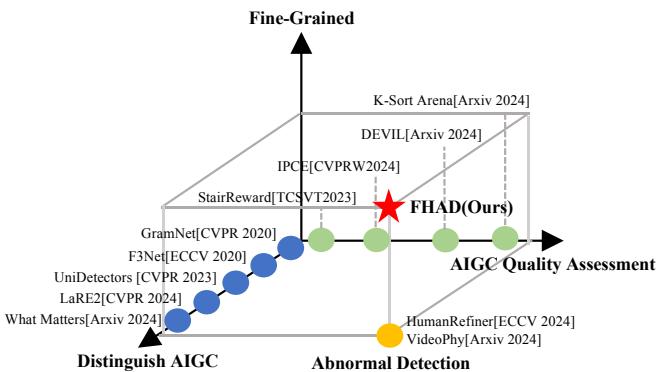
As shown in Figure 2 above, FHAD is distinct because it requires the model to identify what is wrong (e.g., “redundant arm”) and where it is (the bounding box).
Why Can’t We Just Use GPT-4?
This is one of the most fascinating findings of the paper. The researchers tested state-of-the-art VLMs on their ability to spot missing or extra limbs. You would expect these massive models to understand that humans usually have two arms.
However, because these models are trained on general image-text alignment rather than specific “right vs. wrong” anatomical datasets, they struggle. When shown a picture of a person with a missing hand, a model like GPT-4o often hallucinates that the hand is simply “hidden” or “obscured,” rather than recognizing it as a generation failure.
The Data Challenge: Building the Ground Truth
To train a model to spot errors, you need data. But you can’t just download a dataset of “mangled AI hands” easily because the errors are random. The researchers approached this by creating two distinct datasets:
- COCO Human-Aware Val: A synthetic dataset created from real photos. They took real images of people (from the COCO dataset) and digitally “erased” body parts (like masking out a leg) to simulate absent abnormalities.
- AIGC Human-Aware 1K: This is the “real deal” dataset. The authors collected videos generated by AI (using Pika) and manually annotated 1,000 frames where the AI messed up.
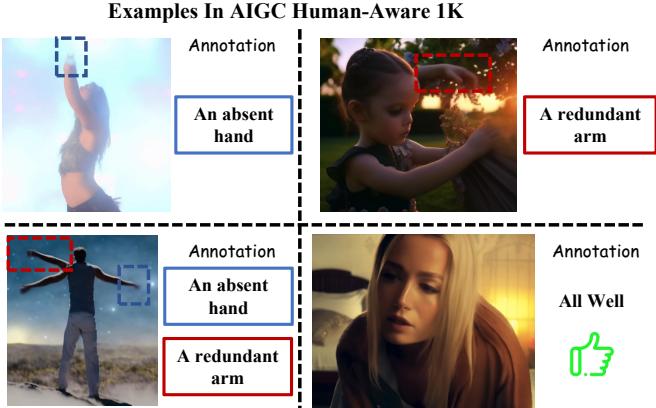
This dataset is crucial because it captures the weirdness of AI hallucinations—like a hand growing out of a shoulder—that are hard to simulate synthetically.
The Core Method: HumanCalibrator
The researchers developed HumanCalibrator, a framework that doesn’t just ask “is this wrong?” but applies a rigorous, multi-step process to verify human anatomy.
They observed that anatomical errors come in two flavors, each requiring a different detection strategy:
- Absent Parts: A hand or leg that should be there but isn’t.
- Redundant Parts: An extra limb that shouldn’t be there.
1. Detecting Absent Parts: The Correlation Strategy
How do you know something is missing? You look at what is present. If you see a forearm extending towards an object, your brain expects a hand at the end of it. This is body part correlation.
The researchers trained a specialized component called the Absent Human-body Detector (AHD).
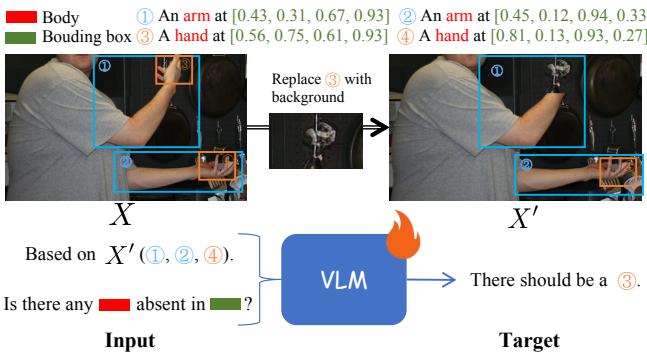
As visualized in Figure 4, the training process involves:
- Taking a normal photo of a human.
- Identifying body parts (arms, hands, etc.).
- Masking one part out (replacing it with background).
- Forcing the VLM to answer the question: “Based on the remaining body parts, is there an absent part here?”
This trains the model to understand the relationships between body parts. If it sees a shoulder and an elbow, it learns to demand a forearm and a hand.
2. Detecting Redundant Parts: The Re-generation Test
Detecting extra limbs is harder because they can appear anywhere. An extra hand might be floating near the head or attached to the knee. You can’t rely on the “shoulder-elbow-hand” chain logic as easily.
For this, HumanCalibrator uses a clever Inpainting Consistency Check.
The logic is simple:
- Identify all potential body parts in the image.
- For a suspicious part (e.g., a hand), mask it out.
- Ask a standard, high-quality inpainting model (which knows what humans generally look like) to fill that hole back in, using the text prompt “hand.”
- Compare: Does the inpainting model actually draw a hand? Or does it draw background/clothing?
If the inpainting model—driven by standard anatomical knowledge—refuses to draw a hand in that spot and draws a shirt texture instead, it means the original “hand” was likely a redundancy error.
Mathematically, this looks at the semantic difference between the original part and the regenerated part. If the difference is high (below a certain similarity threshold \(\tau\)), the part is flagged as redundant:

3. The HumanCalibrator Framework
These two strategies are combined into a cyclical framework. The model doesn’t just look once; it loops.
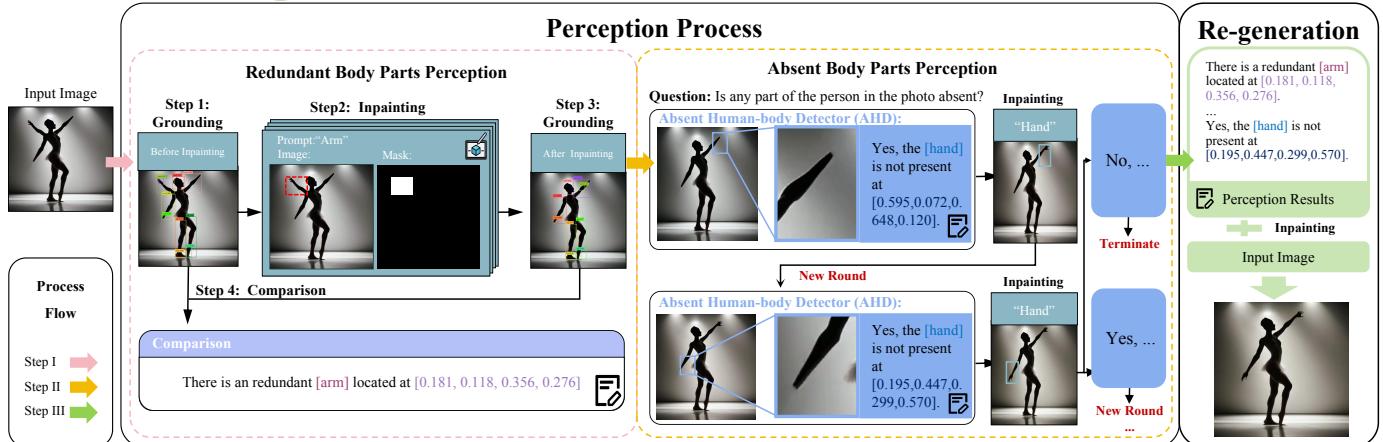
The Workflow:
- Perception (Redundant): Scan for extra limbs using the inpainting check. Remove them if found.
- Perception (Absent): Use the AHD (trained on correlations) to check for missing parts.
- Regeneration: If a part is missing (e.g., a hand), use an inpainting model to generate it in the correct spot.
- Cycle: The output image is fed back into the detector. “Did we fix it? Is anything else missing?” This repeats until the anatomy is clean.
This cyclical approach allows the model to perform “self-refinement,” ensuring that fixing one error doesn’t introduce another.
Experiments and Results
So, does it work? The results are quite stark when compared to general-purpose models.
The Failure of Baselines
The authors compared their specialized AHD model against giants like GPT-4o, InternVL2, and CLIP on the task of finding missing body parts.
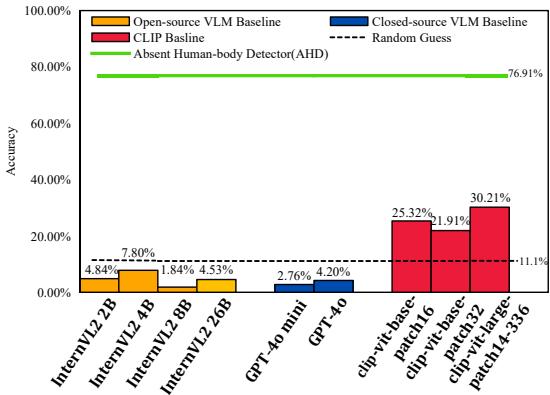
Figure 6 is devastating for current VLMs. The dashed line represents “Random Guess.” Most multi-billion parameter models perform worse or barely better than random guessing when asked if a body part is missing. The specialized AHD (green bar), however, achieves high accuracy.
Quantitative Success
When tested on the real-world AIGC Human-Aware 1K dataset (the one with actual AI video errors), HumanCalibrator dominated the field.
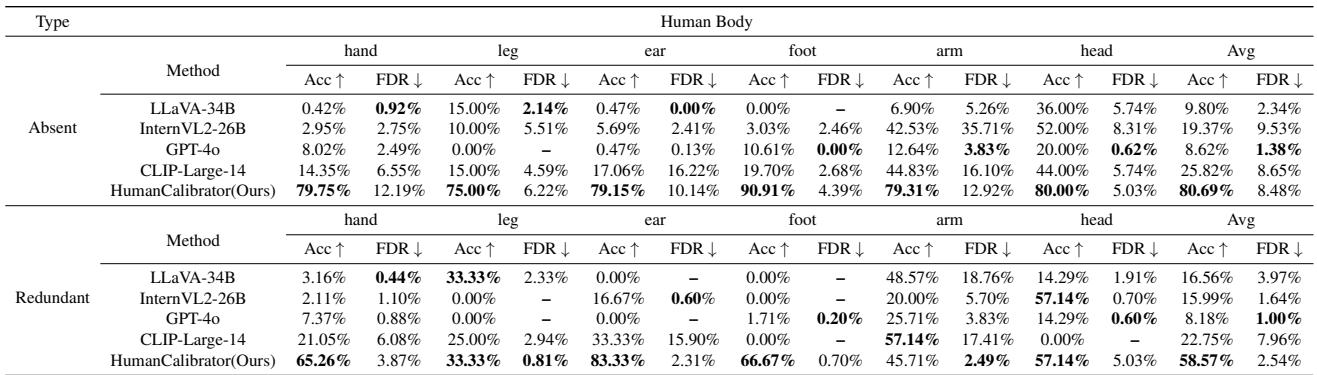
Looking at Table 1:
- Hand Detection: HumanCalibrator reached 79.75% accuracy for detecting absent hands, whereas GPT-4o only managed 8.02%.
- Redundant Parts: For identifying extra hands, HumanCalibrator hit 65.26% accuracy, compared to GPT-4o’s 7.37%.
The “False Discovery Rate” (FDR) is also crucial—you don’t want the model deleting real hands. HumanCalibrator maintains a balance, keeping FDR relatively low while actually finding the errors.
Visual Proof: The Repairs
Numbers are great, but in visual generation, seeing is believing. The repair quality of HumanCalibrator is impressive because it fixes the anatomy without altering the style or background of the image.
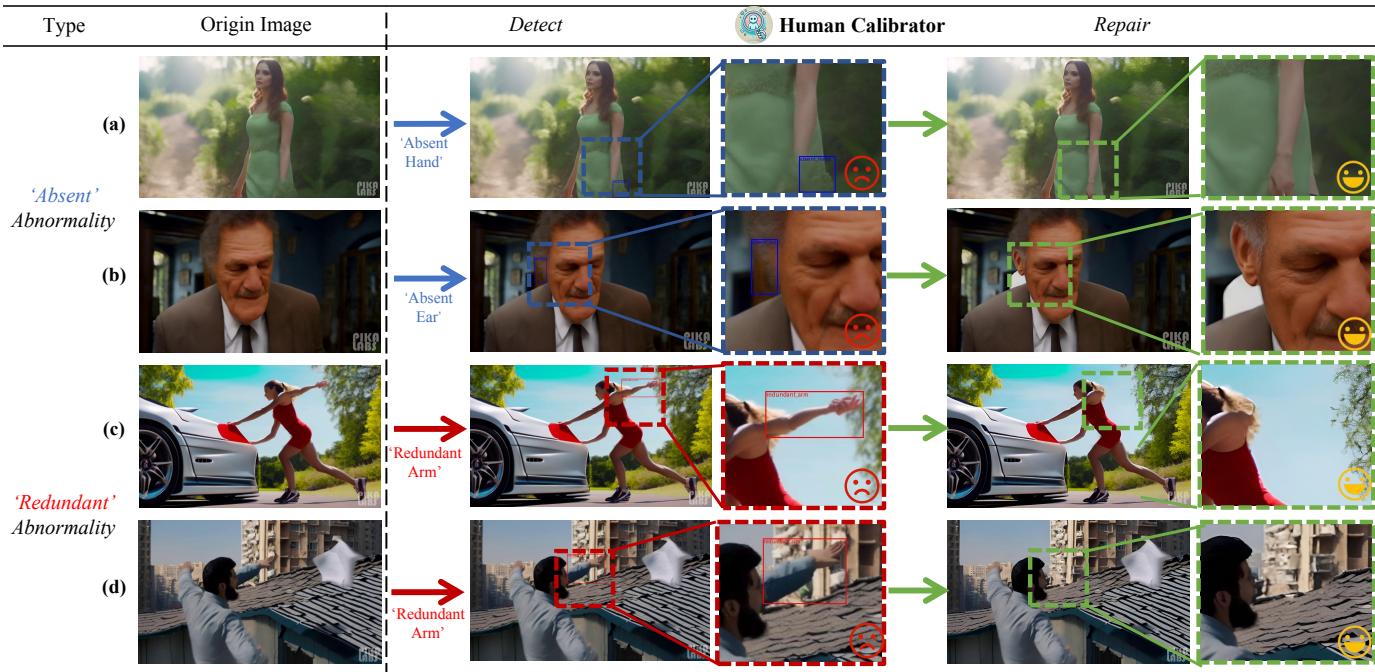
- Case (a): The woman’s arm ends in a stump. HumanCalibrator generates a hand that matches the lighting and skin tone.
- Case (c): A woman has a terrifying extra arm growing out of her shoulder. The model removes it and seamlessly fills in the background (the wall/window).
Beyond Images: Fixing Video
One of the most powerful applications of this technology is in video. Video generation models (like Sora, CogVideo, or Runway) often flicker or morph anatomy between frames.
HumanCalibrator can be applied to keyframes (specifically the first and last frames) of a video. By fixing the start and end points and using interpolation, the overall video consistency improves dramatically.
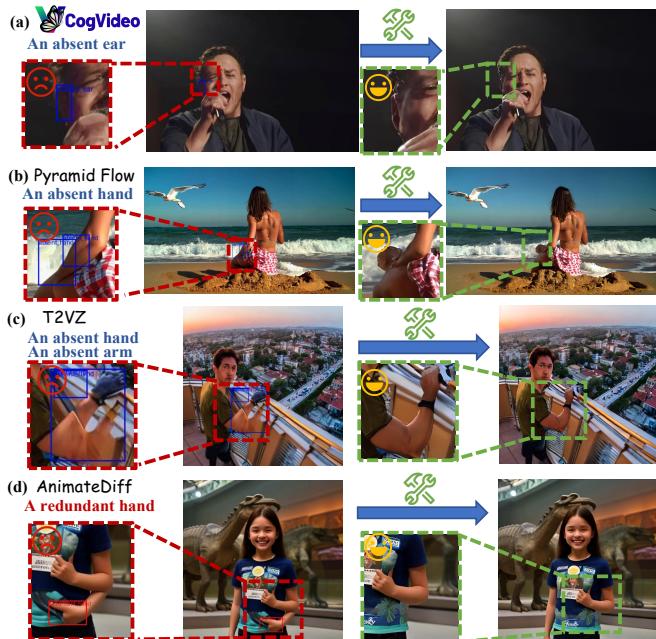
Figure 9 shows that HumanCalibrator isn’t just for one specific model—it acts as a universal “post-processor.” Whether the image came from AnimateDiff, T2VZ, or Pyramid Flow, HumanCalibrator can act as a safety net, catching the extra ears and missing hands that the base models hallucinated.
Conclusion and Implications
The “Is this Generated Person Exist in Real-world?” paper highlights a critical blind spot in the current AI boom. We have focused so much on scaling up models to generate more pixels and wilder concepts that we have neglected the basic physical constraints of reality.
Key Takeaways:
- VLMs have a blind spot: We cannot blindly trust GPT-4 or similar models to quality-check AI images for fine-grained anatomy. They simply don’t “see” what we see.
- Context is King: Detecting missing parts requires understanding the correlation between visible parts (shoulder \(\to\) elbow \(\to\) ?).
- Inpainting as a Truth Test: Using generative models to check themselves (via the inpainting consistency check) is a clever way to spot hallucinations.
- Automated Repair is Possible: We are moving toward a workflow where human verification is replaced by specialized “Calibrator” agents that clean up outputs before a human ever sees them.
HumanCalibrator represents a significant step toward “physically grounded” AI generation. As these detection frameworks improve, we can expect the days of counting fingers on AI-generated hands to be numbered. The future of generative AI isn’t just about high resolution—it’s about anatomical reality.