](https://deep-paper.org/en/paper/2411.14628/images/cover.png)
Introduction
In the world of 3D computer vision and graphics, representing shapes accurately is half the battle. While point clouds and meshes are classic formats, Implicit Neural Representations have taken the field by storm. Specifically, Neural Signed Distance Functions (SDFs) have become the gold standard for representing watertight, high-fidelity surfaces.
An SDF is a mathematical function that tells you, for any point in 3D space, how far you are from the surface of an object. If you are inside the object, the value is negative; if you are outside, it is positive; and if you are exactly on the surface, the value is zero.
But there is a catch. Training a neural network to learn a perfect SDF from raw data (like a point cloud) is notoriously difficult. The standard loss functions used today often fail to guarantee a mathematically valid distance field, leading to artifacts, “ghost” geometries, or training instability.
In this post, we are diving into HotSpot, a fascinating paper from UC San Diego. The authors propose a novel way to optimize SDFs by borrowing concepts from thermodynamics—specifically, the physics of heat diffusion. By replacing standard geometric constraints with a “heat loss,” they achieve theoretically guaranteed convergence and significantly better reconstruction of complex shapes.
The Problem: Necessary vs. Sufficient
To train a neural network to represent an SDF, we usually rely on the Eikonal equation.
Mathematically, a true Signed Distance Function \(f(x)\) must satisfy the property that its gradient has a magnitude of 1 almost everywhere. Intuitively, this means that if you move 1 unit in space away from the surface, the distance value should change by exactly 1 unit.
\[||\nabla f(x)|| = 1\]Standard methods, like IGR or SAL, try to enforce this by adding an “Eikonal loss” to the training objective:
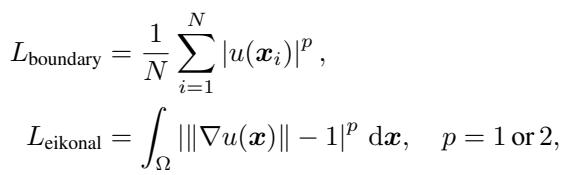
Here lies the problem: Satisfying the Eikonal equation is a necessary condition for an SDF, but it is not sufficient.
Think of it like this: All squares are rectangles. If you want to find a square, you might search for a shape with four right angles (the “rectangle condition”). However, finding a rectangle doesn’t guarantee you’ve found a square—you might have found a non-square rectangle.
Similarly, there are many functions that satisfy \(||\nabla f(x)|| = 1\) that are not valid distance functions. They might have weird singularities or incorrect zero-level sets (phantom surfaces).

As shown in Figure 2, minimizing Eikonal loss allows for solutions that are “Eikonal” but not distance functions.
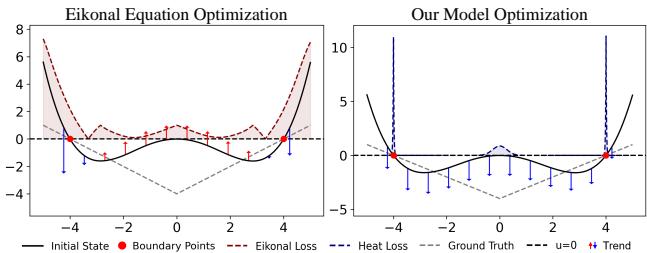
To illustrate this practically, look at Figure 3 below. We want the neural network to learn the “Ground Truth” distance (the dashed V-shape). The Eikonal loss (red) creates a function that has a gradient of 1 almost everywhere (the slope is constant), but it oscillates wildly or creates sharp kinks. It satisfies the math locally but fails globally.
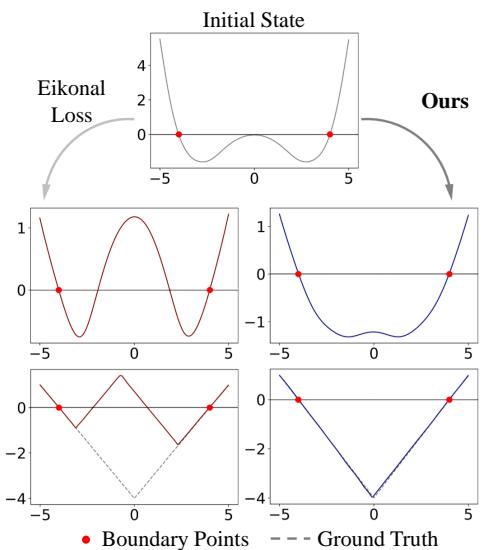
Furthermore, optimizing the Eikonal loss is numerically unstable. It is based on a hyperbolic partial differential equation (PDE), which preserves errors rather than smoothing them out. If the network makes a small mistake in one region, that error propagates outward indefinitely along characteristics (rays).
The HotSpot Solution: The Screened Poisson Equation
The researchers propose a method called HotSpot that uses a completely different physical intuition: Heat Transfer.
They utilize a relationship between distance and the Screened Poisson Equation. Imagine the surface of the object is a heat source fixed at a specific temperature. The rest of the 3D space is a medium that absorbs heat. The equation describes how that heat diffuses through the space.
The Screened Poisson Equation is defined as:
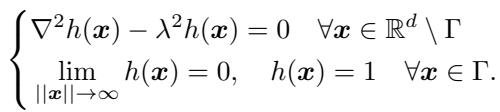
Here, \(h(x)\) is the “heat field” and \(\lambda\) (lambda) is an absorption coefficient. The boundary condition states that on the surface \(\Gamma\), the heat \(h(x) = 1\), and far away from the object, the heat drops to 0.
From Heat to Distance
Why does this matter for distance fields? There is a classic mathematical result (Varadhan, 1967) that connects this heat field to the distance \(d_\Gamma(x)\) to the surface:
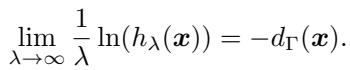
This equation says that as the absorption coefficient \(\lambda\) gets very large, the log-transformed heat field converges exactly to the distance function.
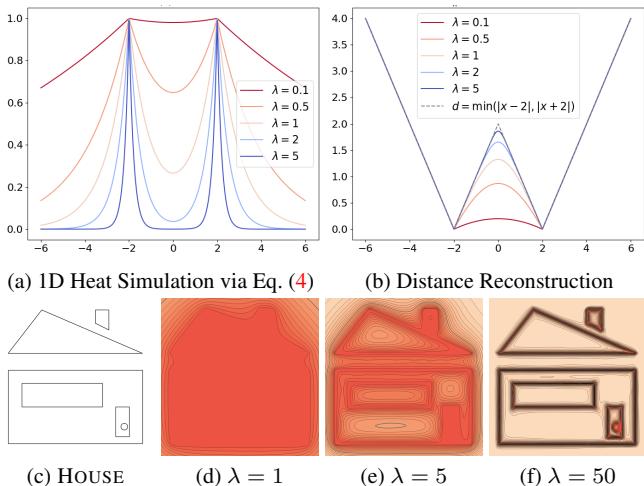
The intuition is visualized in Figure 4 below.
- Top (1D): As \(\lambda\) increases, the reconstructed distance (blue curve) hugs the ground truth V-shape tighter and tighter.
- Bottom (2D): The heat diffuses from the house-shaped boundary. With high \(\lambda\), the heat decay is sharp, providing a precise distance gradient.
Designing the Loss Function
The goal is to train a neural network \(u(x)\) to output the SDF. Instead of forcing \(u(x)\) to satisfy the Eikonal equation directly, the authors force it to satisfy the physics of the Screened Poisson equation.
They define the relationship between the network output \(u\) and the heat \(h\) as:
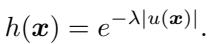
By substituting this into the energy functional of the Poisson equation, they derive a new loss function, \(L_{heat}\):

When the network minimizes this loss, it is effectively solving the heat equation. The total loss function becomes a weighted sum of the boundary loss (to pin the zero-level set to the point cloud), the Eikonal loss (for regularization), and this new Heat loss:

Why HotSpot Works Better
The shift from a pure Eikonal constraint to a Heat-based constraint brings three major advantages: Sufficiency, Stability, and Topology.
1. Asymptotically Sufficient
Unlike the Eikonal loss, the HotSpot formulation provides an asymptotically sufficient condition. The authors prove mathematically that as \(\lambda\) increases, the solution is bounded close to the true distance function.

This means the network isn’t just “allowed” to be the distance function; it is forced to converge to it.
2. Optimization Stability
The Screened Poisson equation is elliptic, which means it has smoothing properties. In the Eikonal (hyperbolic) world, a small bump in the function creates a “shockwave” of error that extends to infinity. In the Heat (elliptic) world, a local error decays exponentially as you move away from it.
Figure 5 visualizes the gradient flow (how the function updates during training).
- Left (Eikonal only): The updates are chaotic.
- Right (HotSpot): The updates are smooth and monotonic, pushing the function naturally toward the correct V-shape distance profile.
3. Handling Complex Topology
Standard SDF methods often struggle with “high-genus” shapes—objects with many holes, like a lattice or a donut. They tend to “close up” holes or create thin membranes where there should be empty space because they implicitly minimize surface area too aggressively.
HotSpot naturally penalizes surface area but does so without distorting the distance field. It respects the topology implied by the heat diffusion process.
Experimental Results
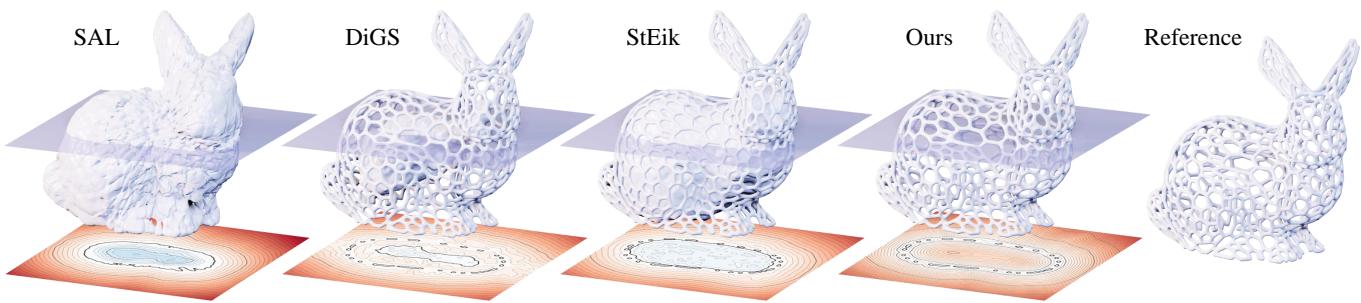
The authors put HotSpot to the test against state-of-the-art methods like DiGS, StEik, and SAL.
2D Reconstruction
In 2D experiments, the model had to reconstruct complex vector shapes. While other methods smoothed out corners or failed to capture intricate disconnected parts, HotSpot maintained high fidelity.
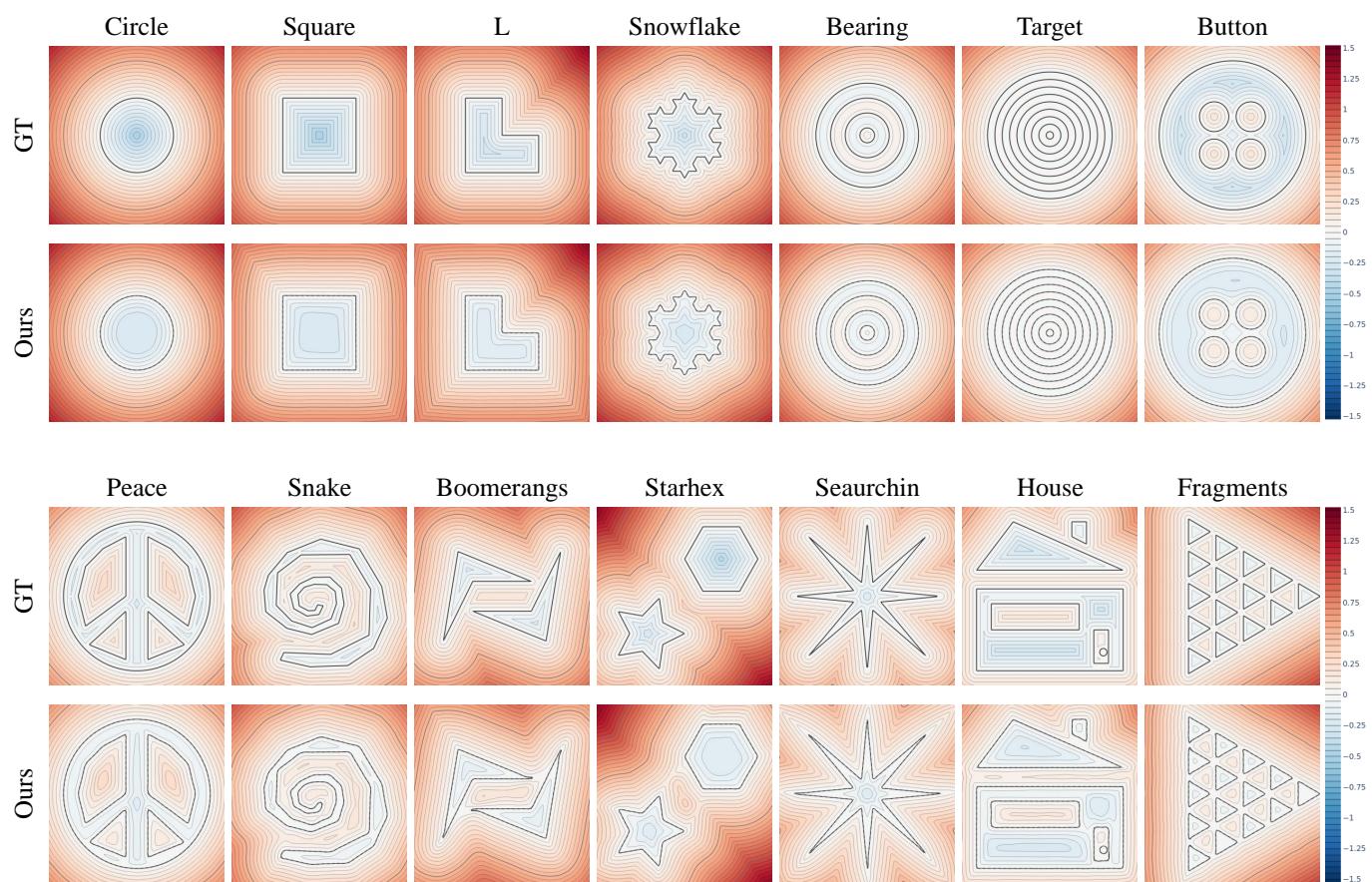
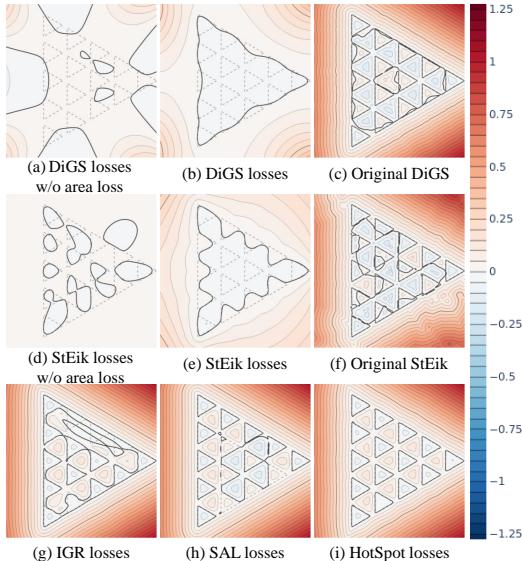
An ablation study (removing specific loss components) showed that the heat loss is the critical factor for capturing correct topology (see the sharp triangles below). Without it, methods fall into local optima, creating “dents” or extra walls.
3D High-Genus Shapes
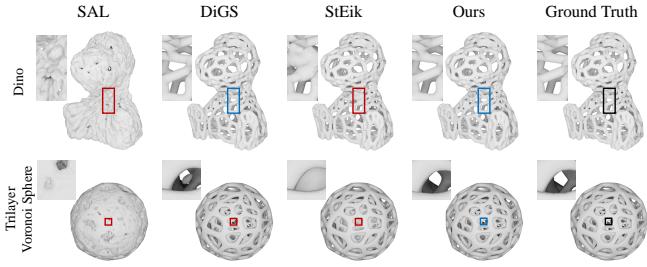
The most striking results come from 3D shapes with complex holes. In the example below, look at the Genus6 (top row) and Kangaroo (middle row).
- SAL, DiGS, StEik: They struggle to define the holes, often filling them in or creating noisy artifacts.
- HotSpot (Ours): It captures the clean loops of the Genus shape and the lattice structure of the Kangaroo with significantly fewer training iterations (10k vs 20k).
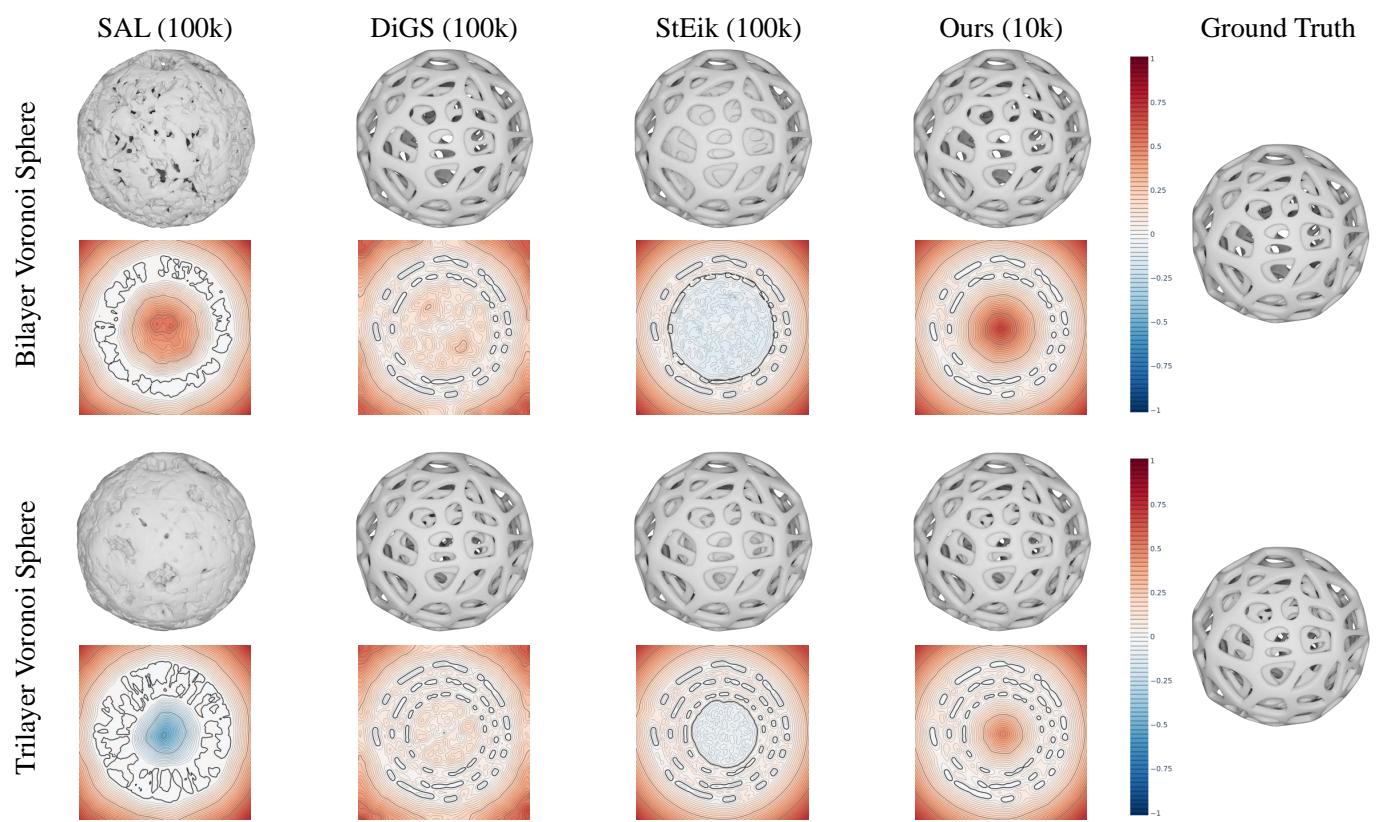
The same holds for the Voronoi Spheres (below). HotSpot cleanly separates the inner and outer layers of the lattice, whereas baselines produce “chaotic and noisy interiors.”
Better Distance Fields = Faster Rendering
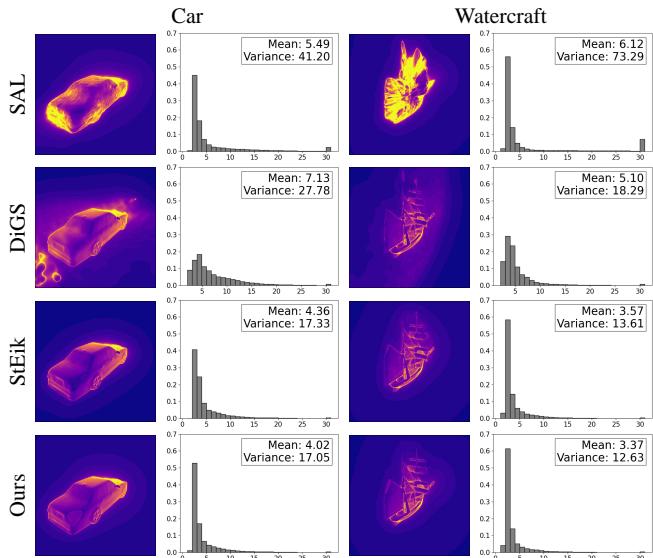
SDFs are often rendered using Sphere Tracing, an algorithm that marches along a ray until it hits the surface. The step size depends on the distance value returned by the SDF. If the SDF is inaccurate (returns a value larger than the true distance), the ray might overshoot. If it’s too small, the ray takes tiny steps, wasting computation.
Because HotSpot learns a more accurate distance field, sphere tracing converges much faster. As shown in the heatmaps below, HotSpot (darker pixels) requires fewer iterations per pixel to render the image compared to SAL or DiGS.
Conclusion
The HotSpot paper highlights a fundamental issue in neural geometric deep learning: just because a loss function looks mathematically correct (like the Eikonal equation) doesn’t mean it’s computationally sufficient to solve the problem.
By translating the geometric problem into a thermodynamic one, the authors leveraged the well-behaved properties of the heat equation to stabilize optimization.
- Guaranteed Convergence: It asymptotically approaches the true distance.
- Stability: It smooths out errors rather than propagating them.
- Accuracy: It handles complex, hole-filled shapes that break other methods.
For students and researchers in 3D vision, this work serves as a great reminder: sometimes the best way to solve a geometry problem is to treat it like a physics problem.
All images and equations are derived from the research paper “HotSpot: Signed Distance Function Optimization with an Asymptotically Sufficient Condition” by Wang et al.