](https://deep-paper.org/en/paper/2411.15099/images/cover.png)
In the rapidly evolving landscape of computer vision and multimodal learning, models like CLIP and SigLIP have set the standard. By training on massive datasets of image-text pairs, these models learn robust representations that perform remarkably well on “zero-shot” tasks—classifying images they’ve never seen before simply by matching them to text descriptions.
But there is a catch. While these models are generalists, they often struggle when we need them to be specialists. When a downstream task involves specific, fine-grained categories or a distribution of images that differs significantly from the web-scraped training data, zero-shot performance can plateau. To fix this, practitioners usually turn to few-shot adaptation: giving the model a handful of example images (shots) to learn from.
Traditionally, adapting a model requires fine-tuning or complex optimization at test time. But what if the model was born ready to adapt?
In this post, we dive into Context-Aware Multimodal Pretraining (LIxP), a research paper that proposes a simple yet profound shift in how we pretrain vision-language models. By teaching the model to utilize “context” during its initial training phase, the researchers achieved up to a four-fold improvement in sample efficiency during downstream tasks, bridging the gap between static zero-shot models and highly adaptive few-shot learners.
The Problem: The Disconnect Between Training and Testing
To understand the innovation of LIxP, we first need to look at the disconnect in the standard lifecycle of a vision-language model.
1. Pretraining (Zero-Shot Optimization): Standard models are trained using contrastive learning (like CLIP or SigLIP). The goal is simple: pull the embedding of an image close to the embedding of its corresponding text caption, and push it away from unrelated text. This optimizes the model for zero-shot retrieval.
2. Inference (Few-Shot Adaptation): At test time, however, we often have access to a “support set”—a few labeled images of the classes we care about. We want the model to use this extra information. Techniques like Tip-Adapter or k-Nearest Neighbors (k-NN) use these support images to adjust the model’s predictions without retraining the whole network. This is called training-free, metric-based adaptation.
The Disconnect: The problem is that the model was never trained to “look at” other images to make a decision. During pretraining, it looked at one image and one text at a time. It doesn’t know how to leverage a support set effectively because it never practiced doing so. It assumes it must rely solely on its internal weights.
The researchers behind LIxP asked: Can we modify the pretraining stage to explicitly prepare the model for this context-based adaptation?
Background: Contrastive Learning & Adaptation
Before dissecting the solution, let’s briefly establish the baseline.
Standard Pretraining
Most state-of-the-art vision-language models use a variation of the InfoNCE loss or the Sigmoid loss (SigLIP).

As shown in the equation above, the SigLIP loss (\(\mathcal{L}_{\mathrm{SigLIP}}\)) looks at pairwise similarities between image embeddings (\(x_i\)) and text embeddings (\(t_j\)). It encourages the dot product to be high when \(i=j\) (matching pair) and low otherwise.
Metric-Based Adaptation
At test time, if we have a few labeled images (the support set), we can create a classifier on the fly. For example, a Prototypical Classifier averages the embeddings of all support images for a specific class to create a “prototype” vector (\(\mu_c\)).
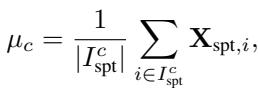
When a new test image comes in, we compare it to these prototypes rather than just the text descriptions. More advanced methods, like Tip-Adapter, combine the zero-shot text prediction with this visual similarity to get the best of both worlds.

Here, the final logits are a blend of the text-based prediction (\(x_{test}\mathbf{T}^T\)) and the visual similarity to the support set (\(\mathbf{X}_{spt}\)).
The Core Method: Language-Image Contextual Pretraining (LIxP)
The core contribution of this paper is LIxP. The idea is to simulate the test-time availability of a support set during pretraining.
Instead of processing an image in isolation, LIxP forces the model to look at other images in the current batch—treating them as context—to help predict the correct text label. This turns the batch into a temporary “support set.”
1. The Contextual Representation
The researchers introduce a contextualized representation of an image, denoted as \(x_i^{ctx}\). This is generated using a cross-attention mechanism. The current image \(x_i\) acts as the Query, while a buffer of other images serves as the Keys (\(\mathcal{M}_K\)) and Values (\(\mathcal{M}_V\)).
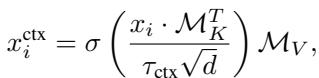
In this equation:
- \(x_i\) is the standard image embedding.
- \(\mathcal{M}_K\) and \(\mathcal{M}_V\) represent the context buffer (other images).
- \(\sigma\) is the softmax function.
- The term inside the softmax calculates similarity: “How similar is my current image to the images in the context buffer?”
- The output is a weighted sum of the context values.
By doing this, the representation \(x_i^{ctx}\) is no longer just “what the image looks like,” but “how this image relates to the other images available right now.”
2. Designing the Buffer
Where does this “context buffer” come from during training? The researchers opted for an elegant, efficient solution: The batch itself is the buffer.

The Key buffer (\(\mathcal{M}_K\)) consists of the normalized image embeddings of the current batch. The Value buffer (\(\mathcal{M}_V\)) consists of the unnormalized embeddings. This allows the model to learn from the immediate surroundings without maintaining an expensive external memory bank.
3. The Combined Objective
If we trained the model only using context, it might become “lazy” and fail to learn robust standalone features (zero-shot capability). It would rely entirely on finding a similar image in the batch.
To prevent this, LIxP uses a composite loss function. It trains the model to perform well in two scenarios simultaneously:
- Standard Mode: Predicting text using only the image (standard SigLIP loss).
- Context Mode: Predicting text using the contextualized representation.

Here, \(\alpha\) acts as a balancing term. The authors found that setting \(\alpha\) around 0.9 (mostly standard loss, small context boost) works best. This ensures the model retains its powerful zero-shot capabilities while learning how to use context when available.
4. Critical Implementation Details
Two subtle but crucial engineering choices make this work:
A. Masking Self-Attention: When calculating the context representation, an image is technically part of the batch. If the model is allowed to attend to itself in the buffer, it will simply copy its own features (perfect similarity) and ignore the rest of the context. To force the model to look at other images, the researchers apply a mask (\(\mathbf{M}\)) that sets the diagonal similarities to \(-\infty\).

B. Uncoupled Temperatures: Contrastive learning relies heavily on a “temperature” parameter (\(\tau\)) that scales the logits. The researchers discovered that the temperature required for the standard loss (\(\tau_1\)) is different from what is needed for the contextual loss (\(\tau_2\)), and different again from the temperature used inside the attention mechanism (\(\tau_{ctx}\)).
Making these temperatures independently learnable was essential. If forced to share a temperature, the competing objectives (zero-shot vs. few-shot) would degrade each other’s performance.
Experiments & Results
Does teaching a model to use context actually help? The results are compelling.
1. Sample Efficiency and Few-Shot Performance
The primary metric is sample efficiency: how many examples does the model need to reach a certain accuracy?
The figure below shows a comparison between a standard ViT-S/16 model (SigLIP) and the LIxP version.
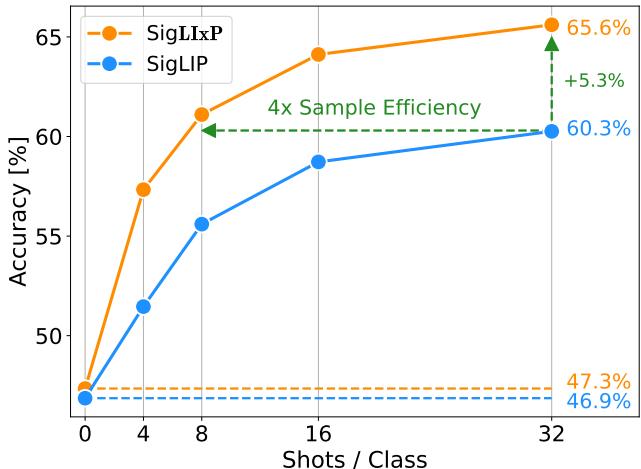
Key Takeaway: The LIxP model (orange line) achieves with 8 shots what the standard model (blue line) needs 32 shots to achieve. That is a 4x improvement in sample efficiency. Furthermore, the zero-shot performance (at 0 shots) remains virtually identical, proving that adding context capability didn’t hurt general performance.
2. Consistency Across Datasets
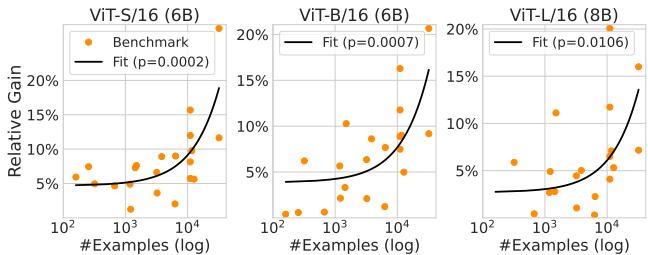
This isn’t a fluke on one dataset. The researchers tested this on 21 diverse benchmarks, ranging from satellite imagery (EuroSAT) to fine-grained species classification (Stanford Dogs).
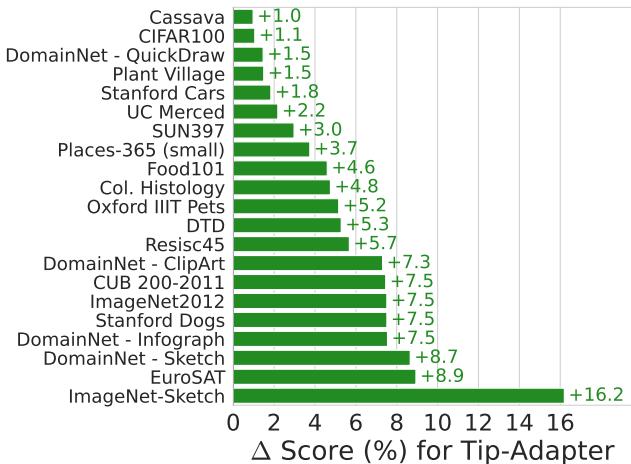
As shown in Figure 2, every single dataset saw an improvement, with some (like ImageNet-Sketch) seeing gains of over 16%.
3. Robustness to Adaptation Methods
LIxP prepares the representations for any metric-based adaptation method. Whether you use a simple Prototypical classifier, Tip-Adapter, or a complex k-NN voting scheme, the context-aware embeddings provide a better foundation.
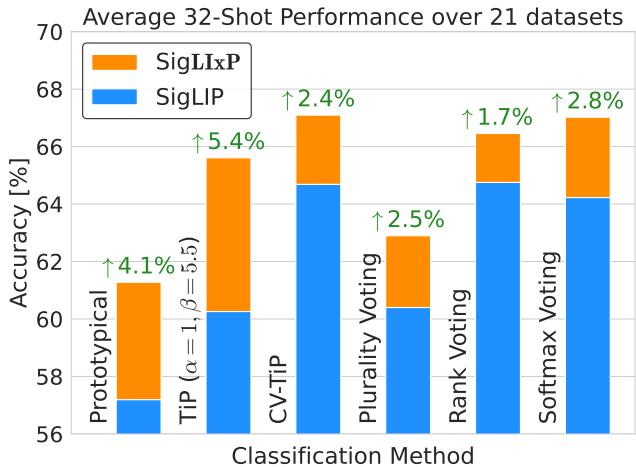
In Figure 3, we see that regardless of the method used (x-axis), the LIxP model (orange top bars) consistently outperforms the baseline.
4. Scaling Up
One of the most important questions in modern AI is: “Does it scale?” The researchers verified their method across different model sizes (ViT-Small to ViT-Large) and data scales (1.5 Billion to 15 Billion examples).
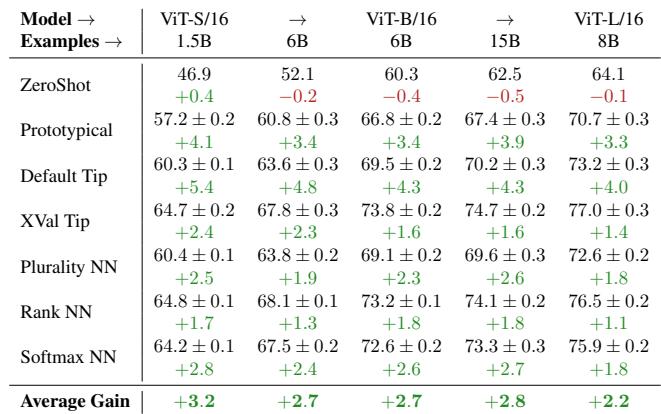
Table 1 confirms that the gains are persistent. Even as the models get larger and trained on more data, the context-aware objective continues to provide a significant boost (roughly +3-4% average gain) in few-shot scenarios.
5. Training-Free vs. Optimization
Perhaps the most striking result is the comparison against optimization-based methods. These are techniques where you actually run gradient descent at test time to fine-tune the model or learn prompts (e.g., CoOp, MaPLe). These are expensive and slow.
LIxP, combined with a simple training-free classifier (like k-NN), often outperforms these heavy methods.
In Table 2, “SigLIxP” (bottom row) beats sophisticated prompt-learning methods like CoOp and MaPLe on major benchmarks. This suggests that if your representations are good enough (context-aware), you don’t need complex fine-tuning algorithms at test time.
Analyzing the Training Dynamics
Why does this work? The researchers analyzed the training curves to see how the model learns to use context.
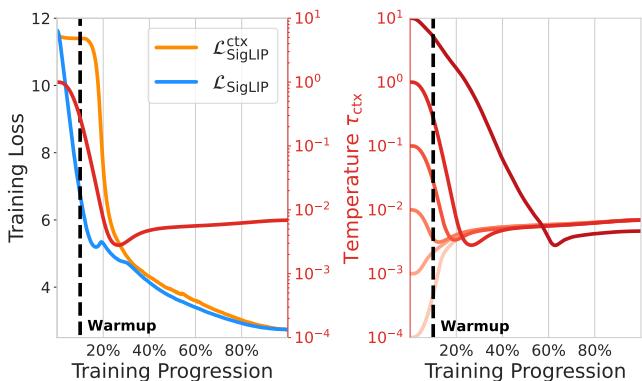
The graphs reveal an interesting “emergent” behavior:
- Early Training: The contextualization temperature (\(\tau_{ctx}\)) starts high. The model effectively ignores the context and focuses on learning basic visual features via the standard loss.
- Inflection Point: Once the base representations are decent, \(\tau_{ctx}\) drops. The model “switches on” the context mechanism.
- Synergy: The model then refines its features to be useful both independently and as context for other images.
This confirms that the learned temperatures control a curriculum, automatically prioritizing standard feature learning first and context usage second.
Can You Fix an Old Model? (Post-Training)
Finally, what if you already have a pre-trained SigLIP model? Do you have to start from scratch?
The answer is no. The researchers showed that you can perform Context-Aware Post-Training.
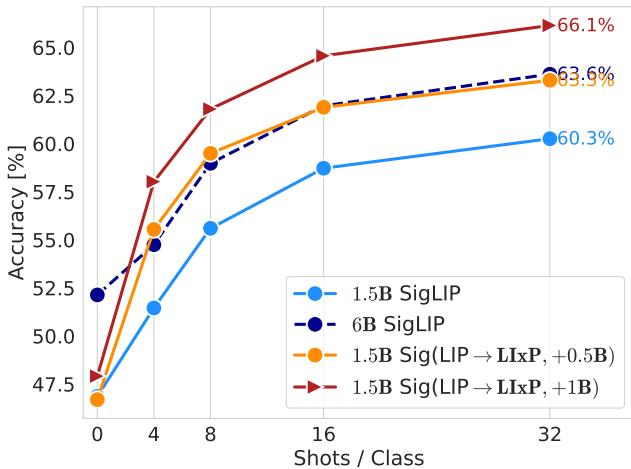
Figure 4 shows that taking an existing model and fine-tuning it with the LIxP objective for a short period (0.5B or 1B examples) yields massive gains, rapidly catching up to models trained from scratch for much longer.
Conclusion and Implications
The “Context-Aware Multimodal Pretraining” paper highlights a fundamental inefficiency in how we used to train vision models. We expected models to be good at adapting to new examples without ever teaching them how to look at examples.
By introducing a simple, batch-based contextual loss, LIxP creates models that are:
- Better Learners: They adapt to new tasks with 4x fewer examples.
- More Efficient: They allow for cheap, training-free adaptation (like k-NN) that rivals expensive fine-tuning.
- Scalable: The method works across model sizes and datasets.
For students and practitioners, this underscores an important lesson: align your training objective with your inference goal. If you want a model that can adapt using context at test time, you should provide context during training time.