](https://deep-paper.org/en/paper/2411.15138/images/cover.png)
In the world of computer graphics, creating a 3D model is only half the battle. The shape—or geometry—gives an object its form, but the material gives it its soul. Is the object made of shiny gold, dull wood, or rusted iron? How does light bounce off its scratches?
For years, creating these physically accurate materials has been a tedious bottleneck. Artists often use complex software like Substance 3D Painter to manually paint textures. While recent AI advancements have automated 3D geometry generation, they often fail at the next step: generating high-quality materials. Most AI models simply “paint” colors onto a shape, baking in lighting and shadows that make the object look fake when moved to a new environment.
Enter Material Anything. Developed by researchers at Northwestern Polytechnical University, Shanghai AI Lab, and Nanyang Technological University, this new framework acts as a universal solution for 3D material generation. Whether you have a raw 3D mesh, a generated object with fake lighting, or a 3D scan with real-world shadows, Material Anything can automatically clothe it in high-quality, physically based materials.
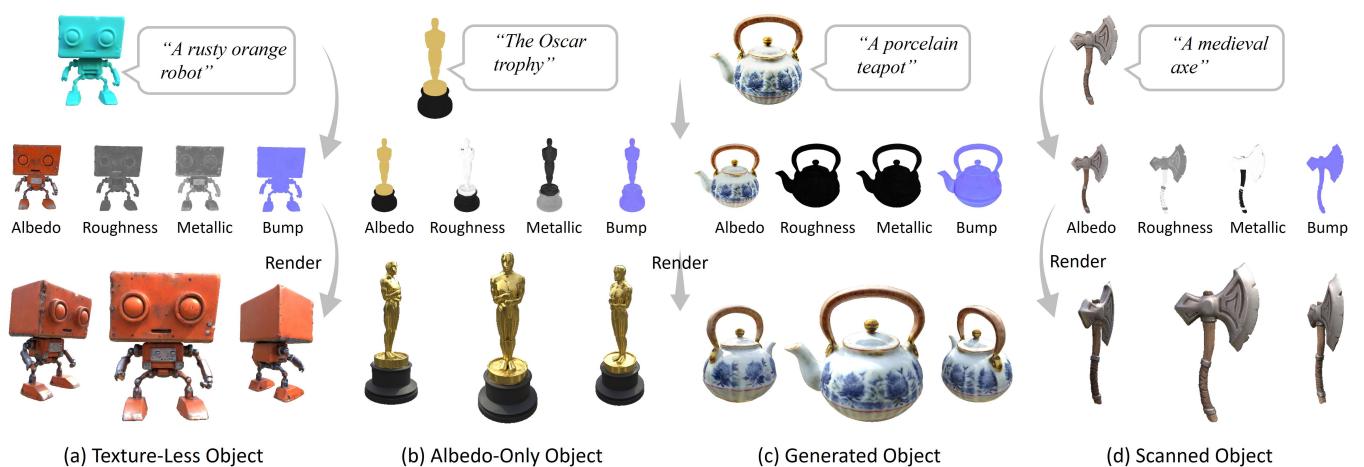
The Problem: Geometry is Solved, Materials Are Not
To understand why this paper is significant, we need to understand Physically Based Rendering (PBR). In modern graphics (like video games or movies), we don’t just want a colored image of an object. We need a set of maps that tell the rendering engine how light interacts with the surface:
- Albedo: The base color of the object without any shadows or highlights.
- Roughness: How microscopic irregularities on the surface scatter light (matte vs. glossy).
- Metallic: Which parts of the object behave like a metal (conductive) versus a dielectric (plastic, wood).
- Bump/Normal: Fine surface details like cracks or pores that create the illusion of depth.
Existing automated methods struggle to separate these properties. If you use a standard AI model to texture a “golden trophy,” it might paint a bright yellow highlight directly onto the texture. If you then put that trophy in a dark room, that bright highlight remains, breaking the illusion. This is called “entangled” lighting.
Current solutions are either too slow (optimization-based methods taking nearly an hour per object) or too fragile (requiring complex pipelines involving multiple separate AI models). Material Anything proposes a unified, robust, and fast solution.
The Material Anything Framework
The core idea behind Material Anything is to reformulate 3D material generation as an image-to-material estimation problem, solved via diffusion.
The pipeline handles four types of input:
- Texture-less objects: Grey shapes with no color.
- Albedo-only objects: Objects with color but no lighting information.
- Generated objects: Meshes created by other AIs, often with “fake” lighting baked in.
- Scanned objects: Real-world scans with realistic but unwanted lighting/shadows.
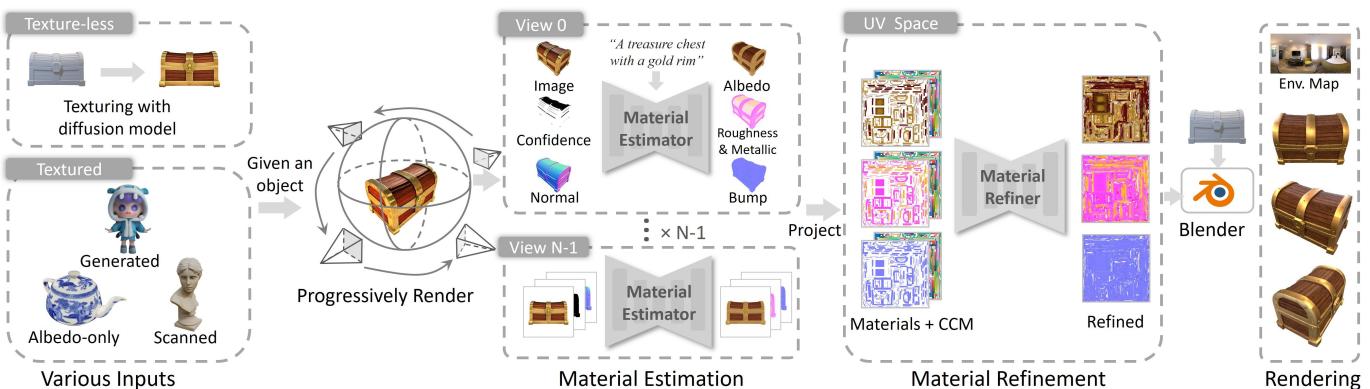
As shown in Figure 2, the process is split into two main stages: Image-Space Material Estimation and UV-Space Material Refinement.
1. The Triple-Head Material Estimator
The researchers utilize a pre-trained Stable Diffusion model, adapting it to predict material maps instead of standard images. However, standard diffusion models are designed for 3 channels (RGB). PBR materials require at least 8 channels of data (Albedo, Roughness, Metallic, Bump).
To solve this, the authors introduce a Triple-Head U-Net architecture.
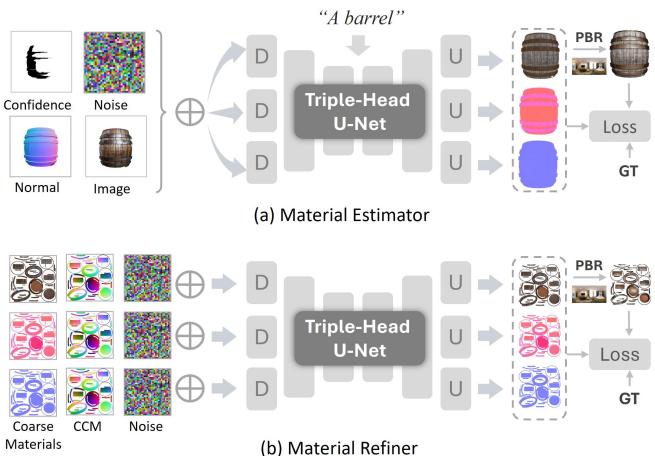
Instead of squeezing all material data into one output, the network branches out. It shares a common “backbone” to understand the object’s structure but splits into three specialized heads:
- Albedo Head
- Roughness-Metallic Head
- Bump Head
This separation ensures that the prediction of color doesn’t interfere with the prediction of surface height or reflectivity.
The “Secret Sauce”: Confidence Masks
A major challenge in training this model is the variation in input lighting.
- If the input is a scanned object, the image contains real shadows and highlights. The model should use these as clues to determine roughness and shape.
- If the input is texture-less or has generated lighting (which might be physically incorrect), the model shouldn’t trust the lighting cues in the image.
To handle this, the researchers introduce a Confidence Mask. This acts as a switch.
- High Confidence (1): “Trust the illumination.” Used for realistic lighting scenarios.
- Low Confidence (0): “Ignore the illumination; generate materials based on semantic context.” Used for texture-less or generated inputs.
This allows a single model to handle disparate input types without retraining.
Rendering Loss
Because material maps look very different from natural images, training a diffusion model directly on them can be unstable. The authors implemented a Rendering Loss. During training, the predicted materials are rendered using a differentiable renderer under random lighting. The result is compared to the ground truth image. This forces the model to generate materials that, when lit, actually look like the object is supposed to.
2. Consistency via Progressive Generation
Predicting materials for a single view of an object is useful, but a 3D object has many sides. If you predict materials for the front and back separately, the colors or styles might not match at the seams.
Material Anything uses a Progressive Material Generation strategy.
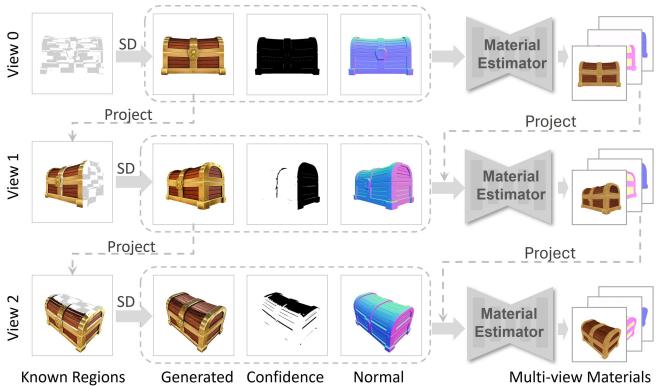
- View 0: Generate materials for the first view.
- Project: Project these generated materials onto the 3D mesh.
- View 1: Rotate the camera. Some parts of the object are now covered by the materials from View 0 (Known Regions), and some are new (Unknown Regions).
- Inpaint: The diffusion model generates materials for the new regions while staying consistent with the projected known regions.
This cycle repeats until the entire object is covered.
3. UV-Space Refinement
Once the views are stitched together, they are unwrapped into a 2D “UV Map” (like flattening a globe into a map). This process often leaves seams or small holes where the camera couldn’t see.
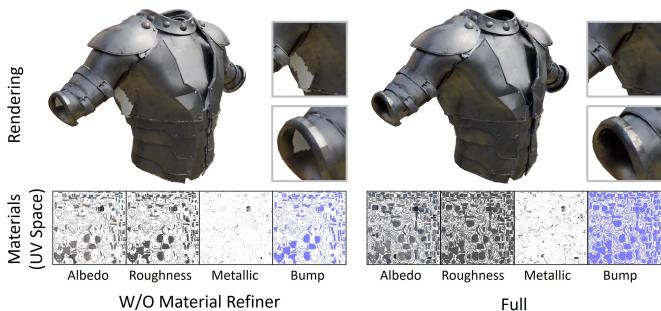
To fix this, the researchers employ a second diffusion model: the Material Refiner. This model operates directly in UV space. It takes the coarse, stitched texture map and “heals” it, filling in holes and smoothing out seams while preserving the high-quality details generated in the previous step.
The Material3D Dataset
Training deep learning models requires massive data. Since high-quality 3D objects with perfect PBR materials are scarce, the team curated the Material3D dataset. They selected 80,000 high-quality objects from the Objaverse dataset that possessed complete material maps.
Crucially, they didn’t just render clean images. They simulated inconsistent lighting and degradations (blur, noise) during training. This forced the model to learn how to ignore artifacts and inconsistencies, making it much more robust when applied to real-world or messy AI-generated inputs.
Experiments and Results
Material Anything was tested against several state-of-the-art methods, including texture generation models (like Text2Tex and Paint3D) and optimization-based methods (like NvDiffRec).
Visual Quality
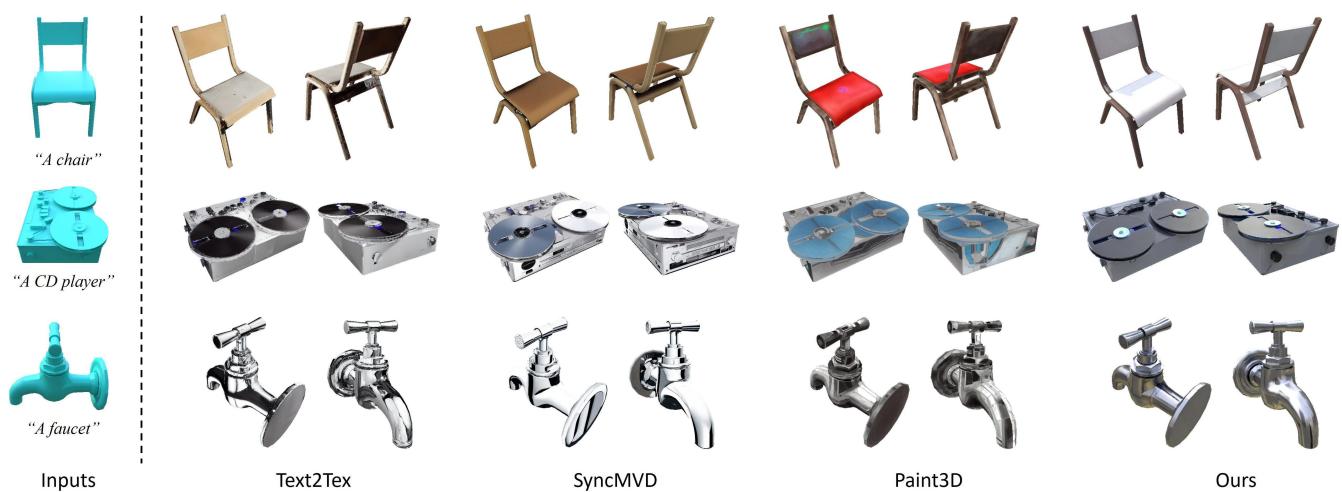
The difference is striking. In the comparison below, note how other methods (Text2Tex, SyncMVD) essentially paste a flat image onto the object. Material Anything, however, understands that a “faucet” should be metallic and shiny, while a “chair” might have wood grain roughness.
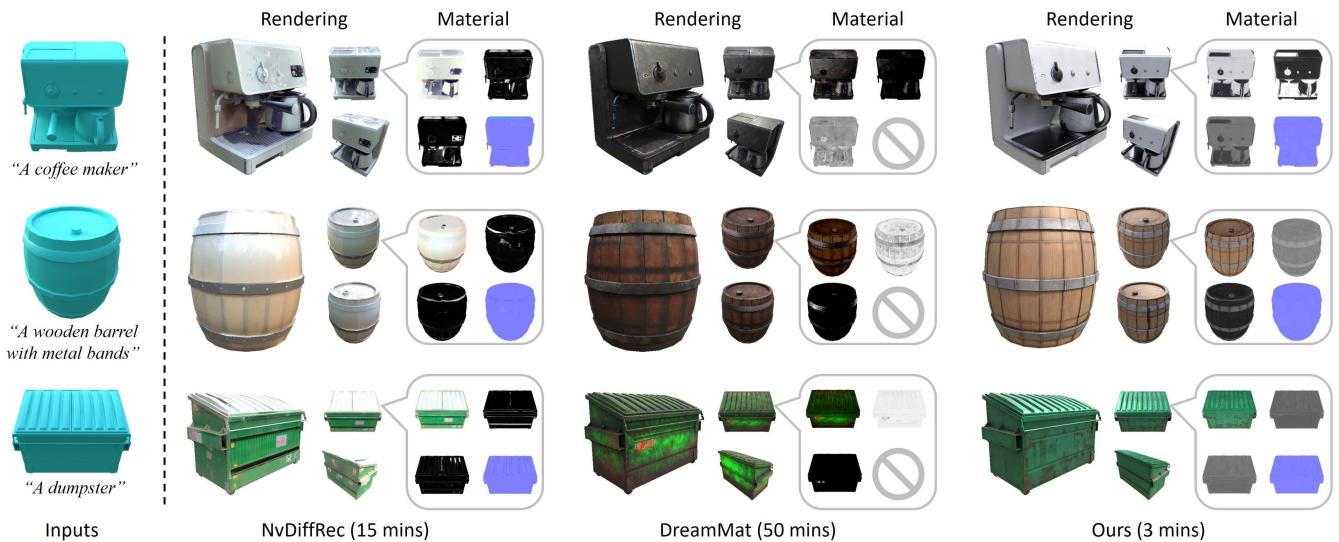
When compared to optimization methods (which try to mathematically solve for materials over thousands of iterations), Material Anything is not only faster (minutes vs. hours) but often produces more logical material definitions.
Quantitative Analysis
The visual results are backed by numbers. The researchers measured FID (Fréchet Inception Distance), where a lower score indicates higher image quality, and CLIP Score, which measures how well the texture matches the text description.
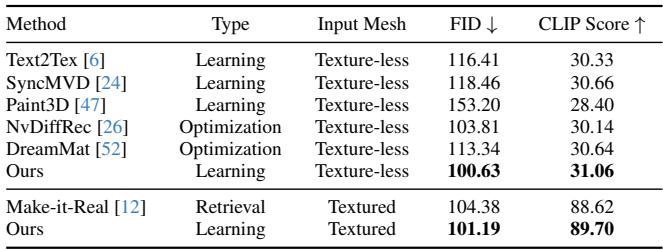
Material Anything achieves the lowest FID and highest CLIP scores among the learning-based methods, indicating that it generates the most realistic and semantically accurate materials.
The Power of the Confidence Mask
The ablation studies reveal just how critical the “Confidence Mask” is. Without it, the model struggles to differentiate between a shadow on the object and a dark-colored material.
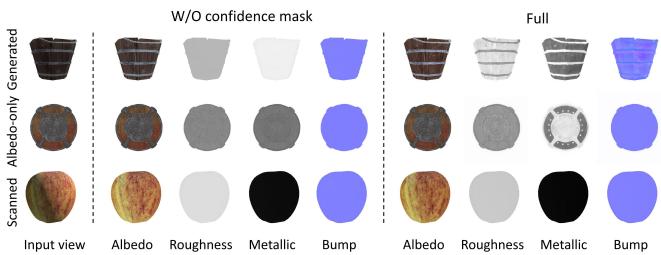
In Figure 10, looking at the “W/O confidence mask” column, the model produces muddy results. With the full model (right), the wood grain on the barrel and the distinct surface of the apple are clearly defined.
Applications: Relighting and Editing
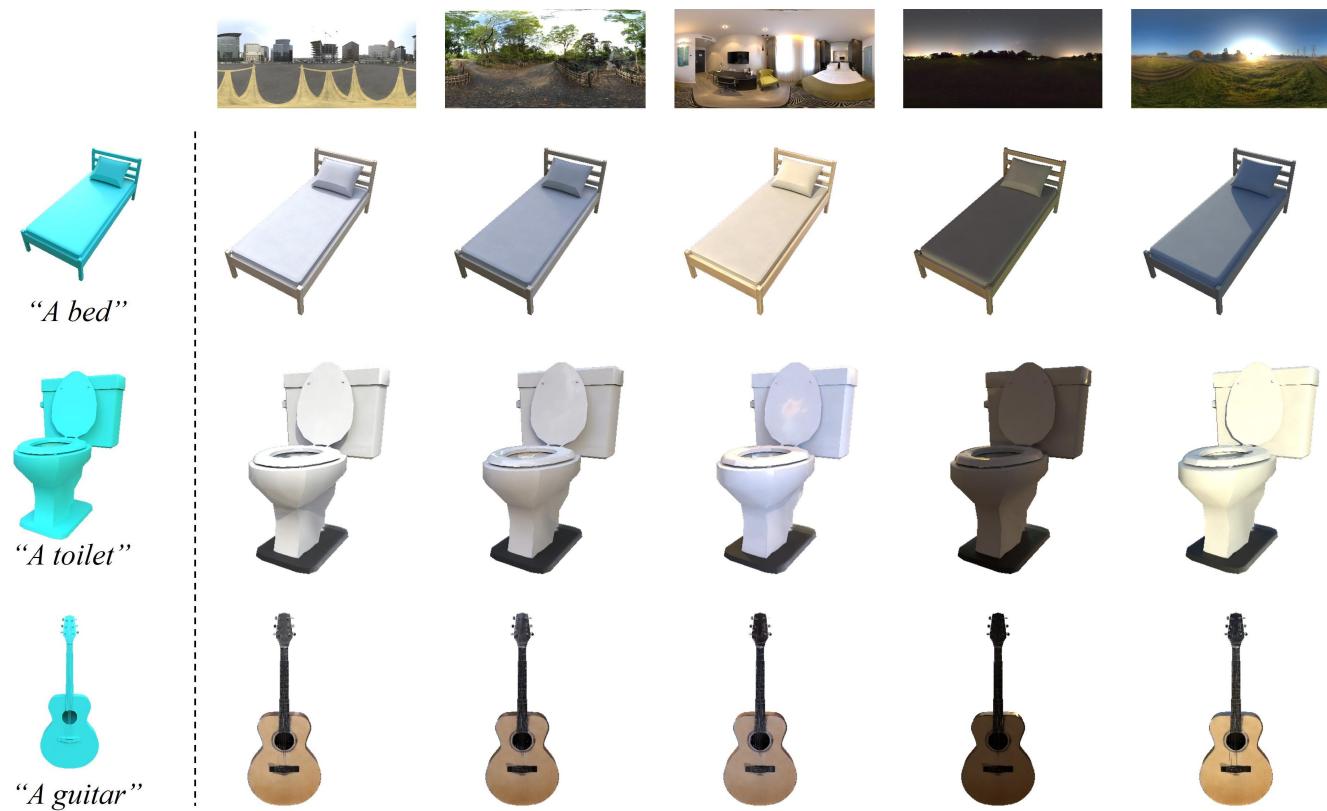
The ultimate test of a PBR material is relighting. Because Material Anything separates albedo, roughness, and metallic properties, the generated objects can be placed into any virtual environment—a sunset, a studio, or a night scene—and they will reflect light accurately.
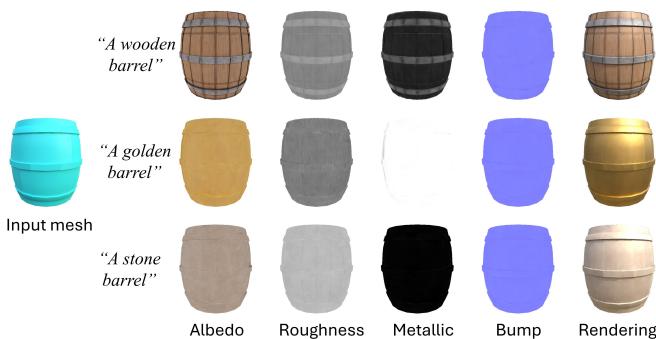
Furthermore, the system allows for text-guided editing. You can take a simple mesh of a barrel and prompt it to be “A golden barrel” or “A wooden barrel,” and the model adjusts not just the color, but the reflectivity and surface bumps accordingly.
Conclusion
Material Anything represents a significant leap forward in 3D content creation. By treating material generation as a conditional diffusion problem and solving the specific challenges of channel depth (via Triple-Head U-Net) and lighting ambiguity (via Confidence Masks), the authors have created a robust tool that bridges the gap between geometry and photorealism.
For students and researchers, this paper illustrates the power of adapting pre-trained 2D models for 3D tasks and highlights the importance of thoughtful data simulation (like the confidence mask strategy) to handle noisy real-world inputs. As virtual reality and gaming worlds grow larger, tools like Material Anything will be essential for populating them with realistic objects at scale.