](https://deep-paper.org/en/paper/2411.15580/images/cover.png)
If you have ever played around with text-to-image models like Stable Diffusion or Midjourney, you know they are incredible at generating complex scenes. However, they often fail at a task that is trivial for traditional CGI but essential for graphic design and game development: generating a foreground object on a clean, removable background.
Try prompting a model for “a cat on a solid green background.” You will likely get a cat, but the fur might be tinted green, the shadows might look unnatural, or the background might have weird textures. This is known as “color bleeding,” and it makes extracting the subject—a process known as chroma keying—a nightmare.
Previously, solving this required expensive fine-tuning of the model or collecting massive datasets of transparent images. But a new paper, “TKG-DM: Training-free Chroma Key Content Generation Diffusion Model,” changes the game. The researchers have discovered a way to mathematically manipulate the initial random noise of a diffusion model to force it to generate a specific background color, without changing a single weight in the neural network.
In this deep dive, we will unpack how TKG-DM works, the math behind “Channel Mean Shifting,” and why this method might just be the future of asset generation.
The Problem: Why is a Green Screen so Hard for AI?
To understand the solution, we first need to understand why standard diffusion models struggle with this task.
Diffusion models are trained to denoise images based on text prompts. When you ask for a “green background,” the model tries to incorporate “greenness” into the entire image concept. Because the model’s attention mechanisms (how it focuses on different parts of the image) mix the concepts of “cat” and “green background,” you often end up with a green-tinted cat.
Existing solutions fall into two buckets:
- Prompt Engineering: Adding words like “solid green background” or “chroma key.” This is unreliable and causes color contamination.
- Fine-Tuning: Training a new model (like LayerDiffuse) on millions of transparent images. This works well but is computationally expensive and relies on datasets that aren’t always public.
The researchers behind TKG-DM asked a different question: Instead of changing the prompt or the model, what if we changed the noise?
Background: The Role of Initial Noise
Diffusion models start with random Gaussian noise—television static—and iteratively refine it into a clear image. Usually, we treat this initial noise (\(z_T\)) as purely random. However, research suggests that the statistical properties of this noise actually influence the layout and color of the final image.
If the initial noise happens to have more high values in a certain channel, the final image might lean towards specific colors. TKG-DM exploits this by intentionally “rigging” the initial noise to force the model to generate a specific background color.
The Core Method: TKG-DM
The Training-Free Chroma Key Content Generation Diffusion Model (TKG-DM) is built on three main pillars: Channel Mean Shift, Init Noise Selection, and the interplay of Attention Mechanisms.
1. Channel Mean Shift: Hacking the Colors
The most innovative part of this paper is the discovery that you can control the color of an image by shifting the mean value of the noise channels.
Stable Diffusion operates in a “latent space” (a compressed representation of the image) which typically has 4 channels. The researchers found a correlation between these channels and the resulting colors. For example, shifting the mean of Channel 2 and Channel 3 towards positive values strongly encourages the generation of green and yellow tones.
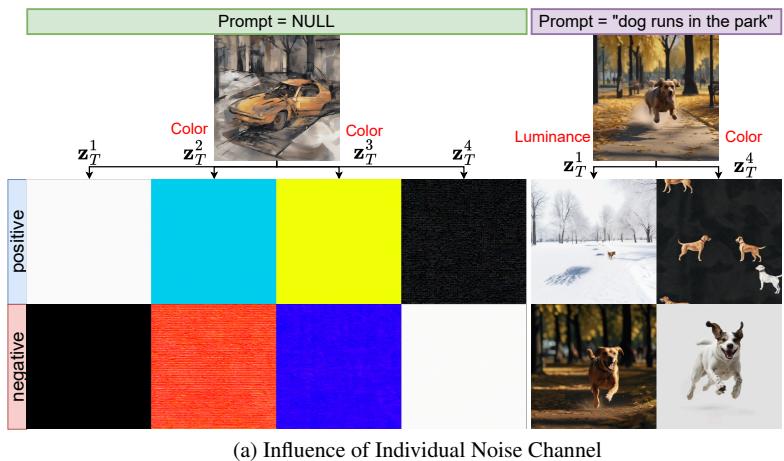
As seen in Figure 3 above, manipulating specific noise channels (\(z_T\)) results in distinct color shifts.
- Top Row (a): Notice how shifting specific channels changes the background from white to cyan, yellow, or black.
- Bottom Row (b): By combining shifts (additive color mixing), the authors can precisely target specific hues like the “lime green” required for chroma keying.
The math behind this is straightforward but clever. They define a Target Ratio for positive pixels in a specific noise channel:


Here, the researchers iteratively adjust the mean of the noise channel until the ratio of positive pixels meets the target (e.g., adding +7% more positive values). This transformed noise is called the Init Color Noise (\(z^*_T\)). If you were to run this noise through Stable Diffusion with no prompt, it would generate a solid color image.
2. Init Noise Selection: The Best of Both Worlds
Now we have a problem. We have “Color Noise” that makes a perfect green screen, but if we use it for the whole image, the foreground object (e.g., a cat) might also turn green or look distorted. Conversely, “Normal Noise” makes a great cat but a chaotic background.
The solution is to combine them. TKG-DM uses a Gaussian Mask to spatially blend the two types of noise.

In this equation:
- \(z_T\) is the normal random noise (good for the object).
- \(z^*_T\) is the modified color noise (good for the background).
- \(A(i, j)\) is a Gaussian mask that is 1 in the center (foreground) and 0 at the edges (background).
This creates a composite noise tensor (\(z^{key}_T\)). The center of the noise tensor contains the randomness needed to generate a diverse object, while the surrounding area contains the biased noise that forces a solid color background.
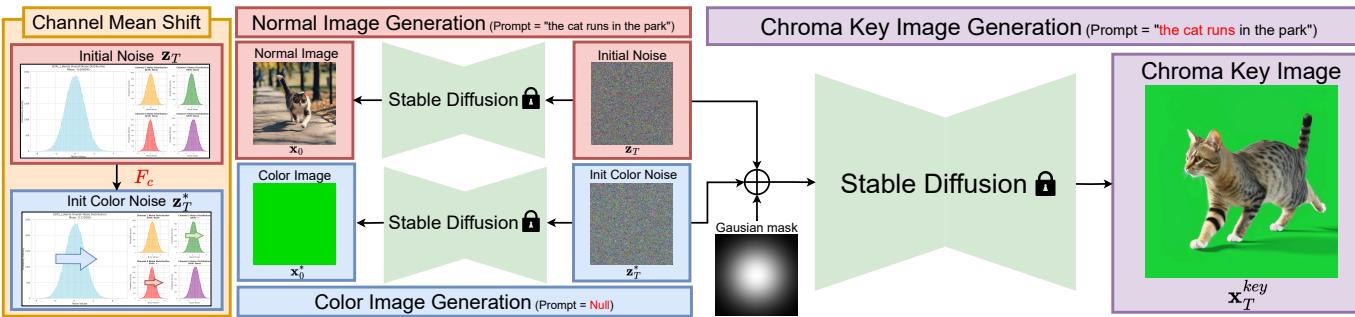
Figure 2 visualizes this pipeline perfectly.
- Left: The process starts with random noise.
- Top Path: The noise acts normally to generate a standard image.
- Bottom Path: The noise is shifted (F_c) to create “Init Color Noise,” which generates a solid green image.
- Right: The two noise maps are merged using the mask. The result is a clean chroma key image where the foreground is unaffected by the background color.
3. Why It Works: The Attention Mechanism
You might wonder: “If we just change the noise, won’t the model still try to draw background details because of the prompt?”
This is where the behavior of Self-Attention vs. Cross-Attention comes into play.
- Cross-Attention connects the image to the text prompt (e.g., “a cat”). Since training datasets usually describe the foreground object in detail, the cross-attention focuses heavily on the object area.
- Self-Attention ensures the image is consistent with itself. It relies heavily on the initial noise structure to determine textures and background coherence.
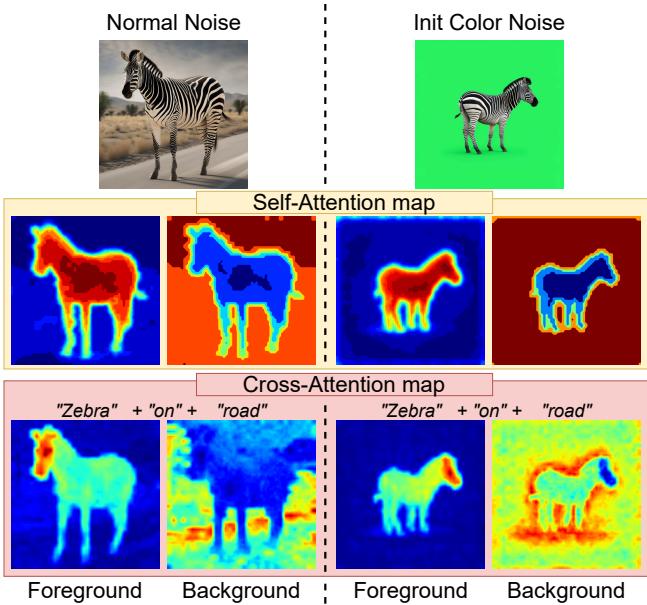
As shown in Figure 4, the model’s self-attention (top row) is heavily influenced by the noise we provided. Because the background noise (\(z^*_T\)) is statistically biased toward a solid color, the self-attention mechanism “agrees” to generate a solid background. Meanwhile, the cross-attention (bottom row) focuses on the “zebra” prompt in the center, ensuring the object is generated correctly.
By manipulating the noise, TKG-DM effectively “tricks” the self-attention mechanism into ignoring the background, while the cross-attention keeps generating the object.
Experiments and Results
Does this actually work better than just typing “green background” into the prompt? The results are compelling.
Qualitative Comparison
Let’s look at a direct comparison using Stable Diffusion 1.5 (SD1.5).
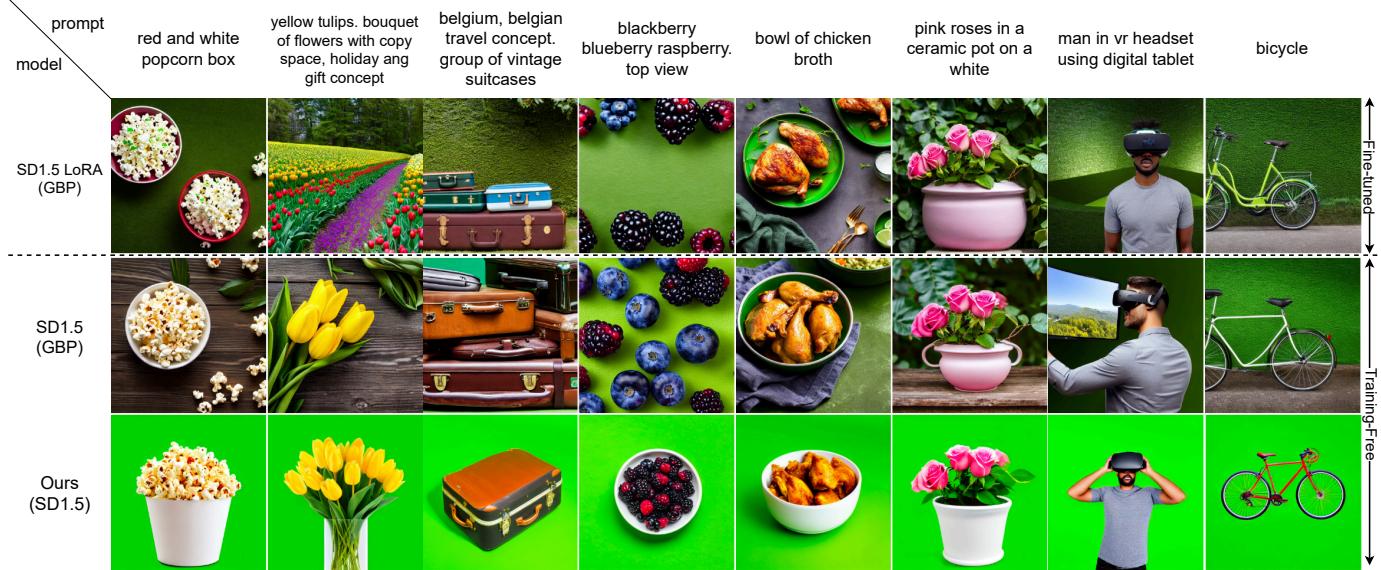
In Figure 5, look at the “SD1.5 (GBP)” row (GBP stands for Green Background Prompt). Notice how the backgrounds are often cluttered, textured, or the wrong shade of green. Even worse, the color bleeds onto the objects (like the popcorn box). Now look at the “Ours” row at the bottom. The backgrounds are perfectly flat, lime green, and the objects retain their natural colors and lighting. This is achieved without any fine-tuning.
Quantitative Analysis
The researchers measured performance using metrics like FID (Fréchet Inception Distance), which measures how realistic the images look, and CLIP-Score, which measures how well the image matches the text prompt. They also introduced m-FID to measure the quality of the foreground mask.
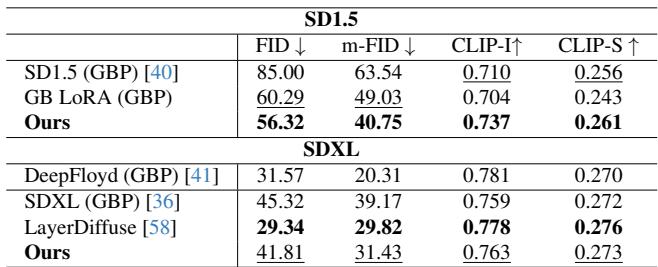
Table 1 confirms the visual results. TKG-DM (Ours) achieves significantly lower (better) FID scores compared to standard SD1.5 and SDXL with green background prompts. Remarkably, it rivals LayerDiffuse, which is a state-of-the-art model that requires massive fine-tuning. TKG-DM achieves similar quality purely through noise manipulation.
The Denoising Process Visualized
To truly understand the power of TKG-DM, it helps to watch the image generation process step-by-step.
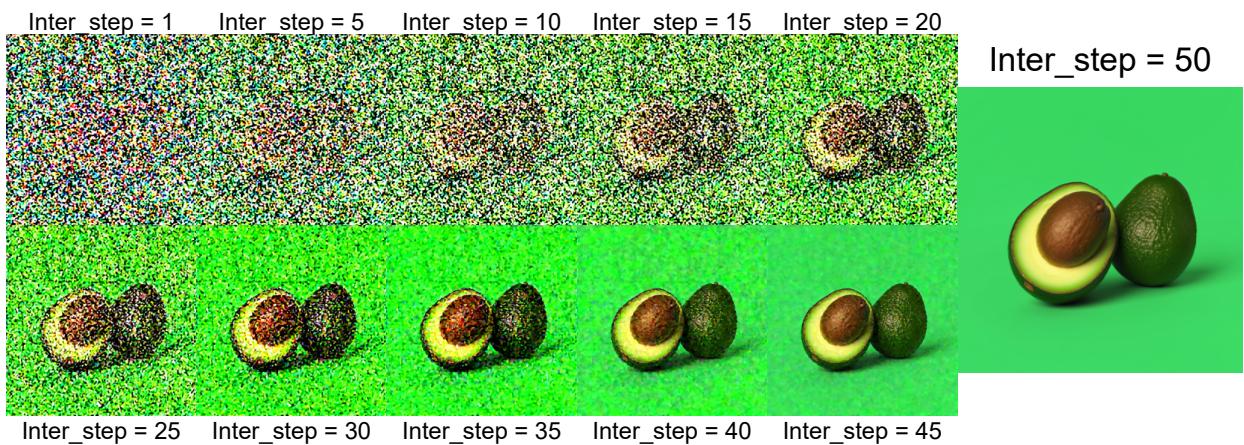
In Figure 21, observe the TKG-DM process. From Step 1, the background is already green. The model doesn’t have to “figure out” the background; the noise forces it to be green immediately. This allows the model to spend all 50 steps refining the avocado in the center.
Compare this to the standard approach:
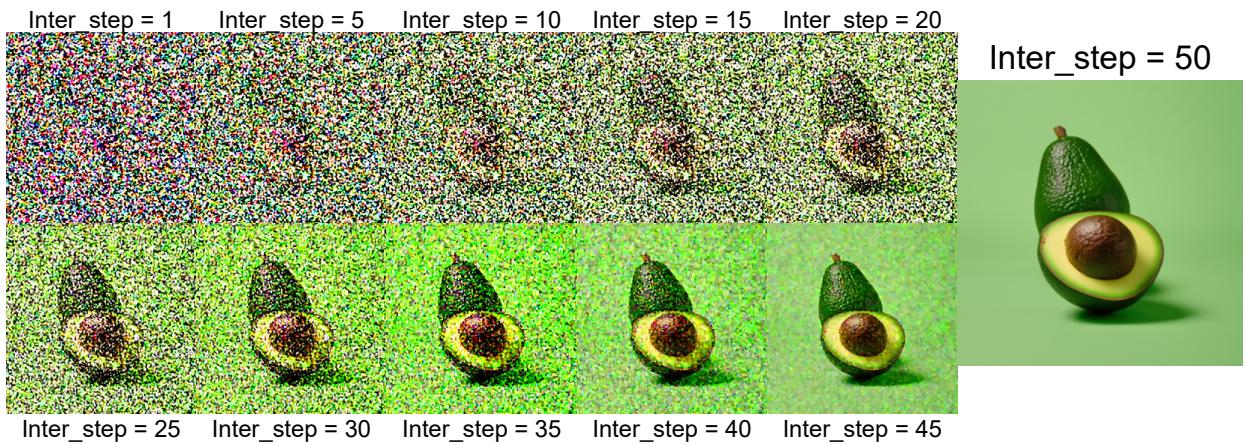
In Figure 20 (standard SDXL with prompt), the background starts as chaotic noise and slowly resolves into green. This struggle to resolve the background consumes the model’s capacity and often leads to artifacts or color bleeding on the object.
Beyond Images: Applications
Because TKG-DM is training-free and operates on the initial noise, it is incredibly versatile. It can be plugged into almost any diffusion-based pipeline.
ControlNet Integration
ControlNet allows users to guide generation using edges or poses. TKG-DM works seamlessly here, allowing for precise structural control plus a perfect green screen.
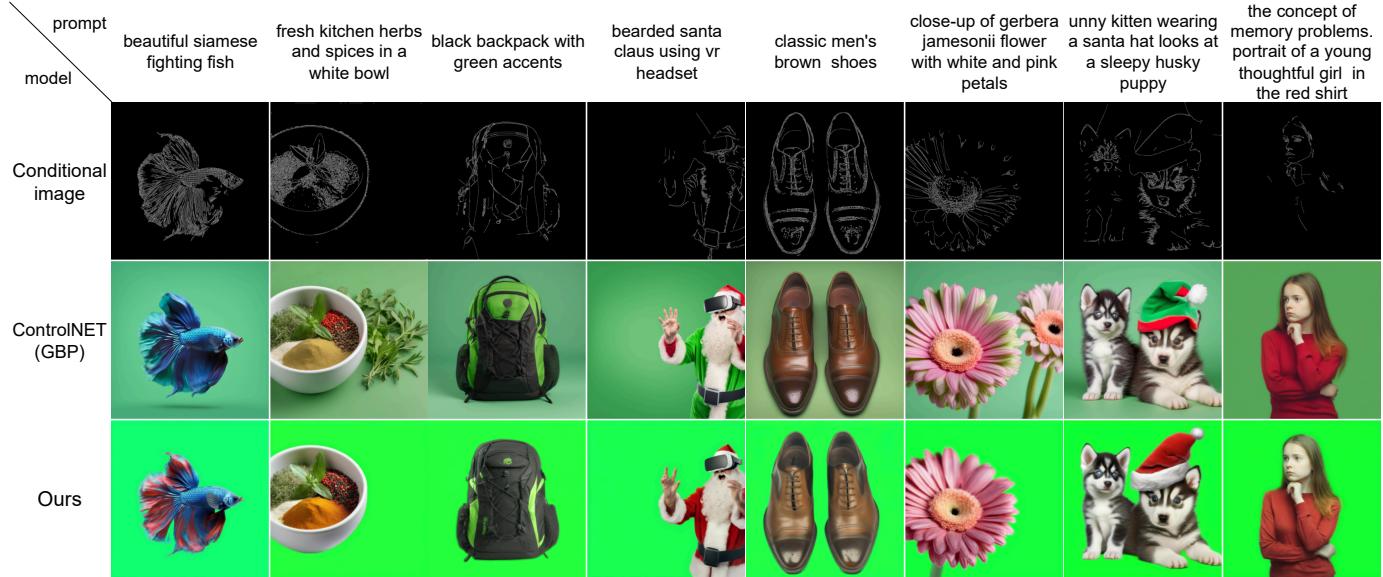
Figure 9 shows ControlNet results. The “Ours” row shows crisp objects that follow the control edges perfectly, sitting on a clean background.
Video and Animation
Perhaps the most exciting application is video. Maintaining temporal consistency (smoothness over time) is hard in AI video. By applying TKG-DM to video diffusion models (like AnimateDiff), creators can generate animated assets that are pre-keyed and ready for compositing.
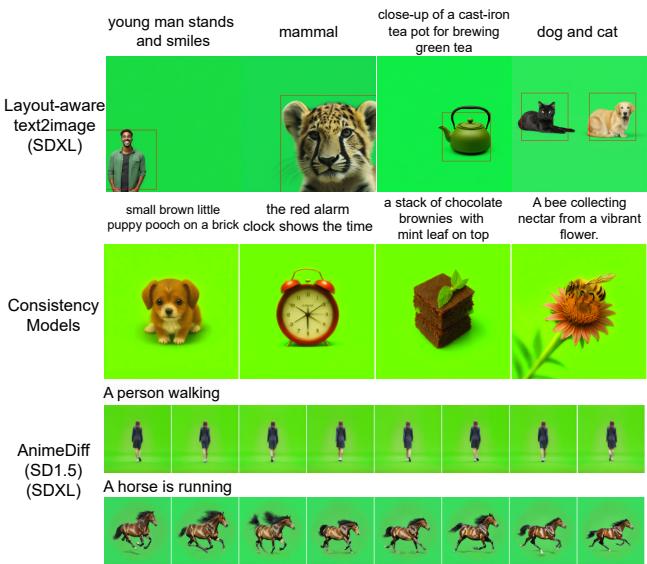
As shown in Figure 10 (bottom rows), TKG-DM can generate consistent animations of walking figures or running horses on solid backgrounds, a huge potential timesaver for animators.
Conclusion and Future Implications
TKG-DM represents a shift in how we think about controlling Generative AI. Instead of treating the model as a black box that we must retrain or prompt-engineer into submission, this research shows that we can guide the model’s behavior by understanding its mathematical foundations—specifically, the latent noise space.
Key Takeaways:
- No Training Required: You can use this with existing models (SD1.5, SDXL) immediately.
- Noise = Color: Shifting the mean of noise channels controls the output color.
- Separation of Concerns: By masking the noise, we separate the background generation (noise-driven) from the foreground generation (prompt-driven).
While the method has some limitations—it requires defining the object’s position via the mask, and it focuses primarily on solid color backgrounds rather than complex scenery—it solves a specific, high-value problem for content creators. It bridges the gap between the chaotic creativity of diffusion models and the precise requirements of professional workflows.
For students and researchers, TKG-DM is a reminder: sometimes the answer isn’t a bigger model or a larger dataset. Sometimes, the answer is just a little bit of noise.