](https://deep-paper.org/en/paper/2411.15678/images/cover.png)
When you snap a photo with your smartphone, a massive amount of processing happens instantly. The sensor captures a raw signal, but before it reaches your screen, an Image Signal Processor (ISP) compresses it, adjusts the colors, balances the white, and tone-maps the shadows. The result is an sRGB image—optimized for the human eye.
But here is the critical question for computer vision researchers: Is an image optimized for human vision actually good for machine vision?
The authors of the paper “Towards RAW Object Detection in Diverse Conditions” argue that the answer is “no.” By relying on sRGB images, traditional object detection models lose crucial information hidden in the original RAW data—information that becomes vital when trying to detect a pedestrian in a dark alley or a car through heavy fog.
In this deep dive, we will explore how this research team is shifting the paradigm from sRGB to RAW object detection. We will look at their new massive dataset, AODRaw, and their novel method for pre-training models directly on RAW data using knowledge distillation.
The Problem with the Human Eye Standard
To understand why RAW matters, we first need to understand what we lose when we convert to sRGB.
A typical camera sensor captures images with a high bit depth (usually 12 to 14 bits). This allows for a massive dynamic range, preserving details in both the brightest highlights and the darkest shadows. However, standard computer vision pipelines use 8-bit sRGB images. The ISP compresses the dynamic range and applies non-linear transformations to make the image look “natural” to humans.
In perfect lighting, this doesn’t matter much. But in adverse conditions—like low light, rain, or fog—that compression discards the exact signal differences a neural network needs to distinguish an object from the background.
The researchers classify object detection approaches into three categories, illustrated below:
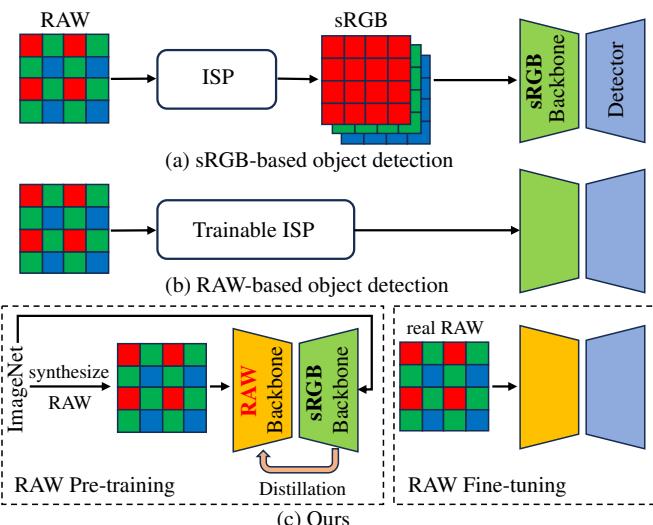
- Traditional sRGB-based (Figure 1a): The standard approach. The camera’s ISP processes the data, throwing away information before the AI ever sees it.
- Trainable ISP (Figure 1b): A middle-ground approach. Researchers try to replace the fixed ISP with a neural network that learns how to process RAW data specifically for detection. While better, this adds computational overhead and complexity.
- The Proposed Method (Figure 1c): Direct RAW Pre-training. The model consumes RAW data directly, utilizing a clever “Teacher-Student” distillation setup to learn robust features without needing a separate ISP module.
Introducing AODRaw: A Benchmark for the Real World
One of the biggest hurdles in RAW object detection has been the lack of data. You can scrape millions of JPEGs from the internet to train an sRGB model, but you cannot easily scrape RAW files. They are large, proprietary, and hard to come by. Previous datasets were either too small, focused only on low-light, or relied on synthetic data that didn’t capture real-world noise.
To fix this, the authors introduced AODRaw (Adverse condition Object Detection with RAW images).
Dataset Diversity
AODRaw is not just a collection of dark photos. It is a comprehensive dataset designed to test the limits of machine perception. It includes 7,785 high-resolution real RAW images with over 135,000 annotated instances.
What makes AODRaw unique is the matrix of environmental conditions it covers. The researchers captured scenes across 9 distinct conditions, mixing lighting (Daylight, Low-light) with weather (Clear, Rain, Fog).

As seen in the figure above, the dataset captures the complexity of real-world driving and surveillance scenarios. A car driving at night in the rain looks fundamentally different in RAW data than a car in a sunny parking lot.
Statistical Significance
AODRaw isn’t just diverse in weather; it’s diverse in content. Many previous RAW datasets focused on a handful of categories (like cars and pedestrians). AODRaw scales this up to 62 categories, ranging from traffic lights to potted plants.
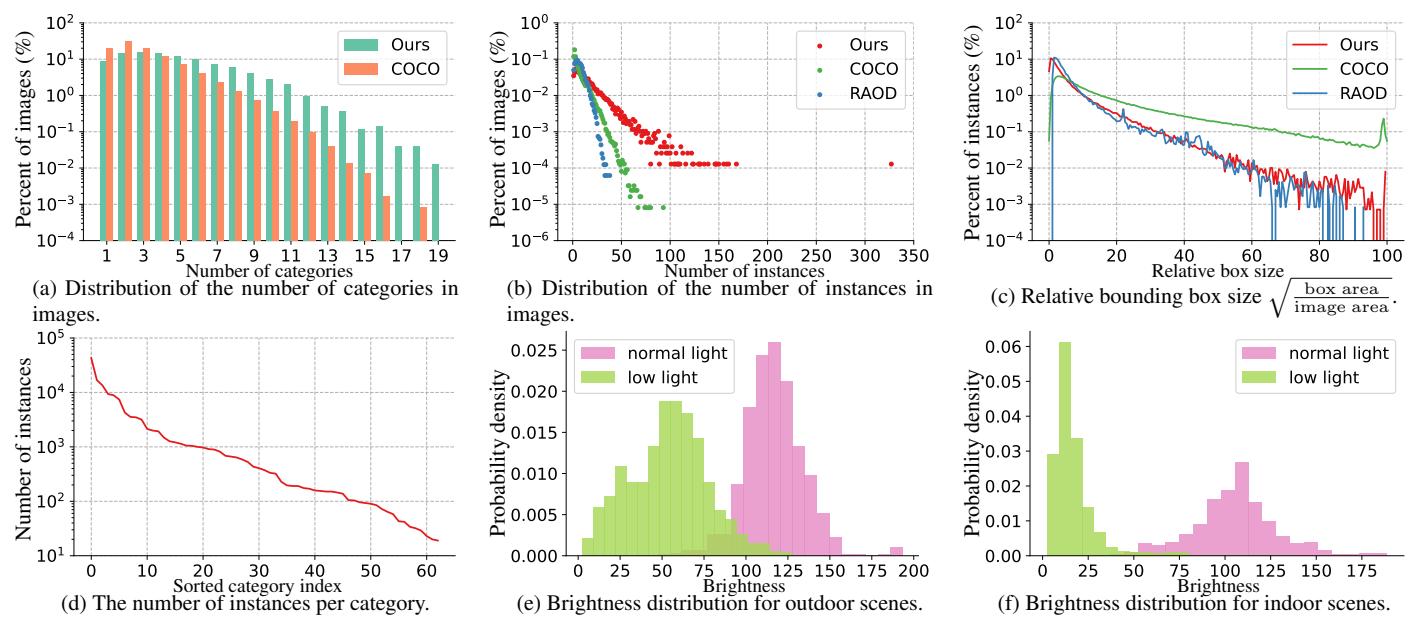
The statistics in Figure 3 highlight the difficulty of this dataset. The distribution of object sizes (Figure 3c) shows a high prevalence of small objects, which are notoriously difficult to detect in adverse weather. The long-tail distribution of categories (Figure 3d) ensures that models are tested on their ability to generalize, not just memorize the most common objects.
The Core Method: Direct RAW Pre-training
Having a dataset is the first step. The second step is training a model to actually use it.
The researchers discovered a significant Domain Gap. If you take a standard detection model (like ResNet or ConvNeXt) that was pre-trained on ImageNet (sRGB) and try to fine-tune it on RAW images, performance is suboptimal. The features learned from processed RGB images simply don’t translate perfectly to the linear, noisy world of RAW data.

Table 4 illustrates this gap clearly. A model trained on sRGB performs poorly on RAW (28.0% AP), and vice versa. To unlock the full potential of RAW detection, the model needs to be pre-trained on RAW data.
1. Synthesizing ImageNet-RAW
Since there is no “ImageNet for RAW” with millions of images, the authors synthesized one. They took the standard ImageNet dataset and applied an “unprocessing” pipeline. This reverses the ISP steps—inverting the tone mapping and gamma correction—and crucially, adds realistic shot noise to simulate camera sensors.
2. The Challenge of Noise
Here lies the paradox: RAW data contains more information (signal), but it also contains more noise. In sRGB images, denoising algorithms have smoothed everything out. In RAW, the noise is intact.
When the researchers tried to pre-train a model on this synthetic RAW data, they hit a wall. The model struggled to learn high-quality representations because the noise patterns made convergence difficult.
3. Cross-Domain Knowledge Distillation
To solve the noise problem, the authors proposed a Distillation strategy. They used a standard, pre-trained sRGB model as a “Teacher” and the new RAW-based model as a “Student.”
The idea is elegant: The Teacher sees the clean, processed sRGB image. The Student sees the noisy, unprocessed RAW version of the same image. The Student is tasked with predicting the same output as the Teacher.
Because the Teacher’s output is consistent regardless of the noise added to the Student’s input, the Student learns to look “through” the noise to find the underlying semantic features.
The distillation involves two specific loss functions.
Logit Distillation (\(L_l\)): The Student tries to match the final classification probability distribution of the Teacher.

Feature Distillation (\(L_f\)): The Student tries to match the internal feature maps of the Teacher, ensuring that the intermediate representations are also aligned.
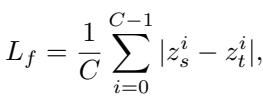
By minimizing these losses, the RAW model effectively inherits the robust semantic knowledge of the sRGB model while learning to process the raw sensor data directly.
Experiments and Results
Does this complex pre-training pipeline actually yield better results? The experiments suggest a resounding yes.
Robustness to Lighting and Noise
One of the most compelling results comes from analyzing how the models handle changes in brightness and noise levels. The researchers took the synthetic ImageNet-RAW data and manipulated the brightness and noise to see how the models coped.
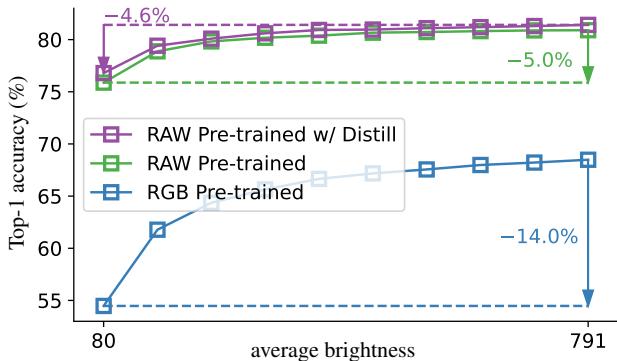
In Figure 5, the purple line (RAW Pre-trained with Distillation) degrades much more gracefully than the standard RGB Pre-trained model (blue line) as brightness drops. This indicates that the distilled model has learned features that are invariant to lighting conditions—a holy grail for night-time object detection.
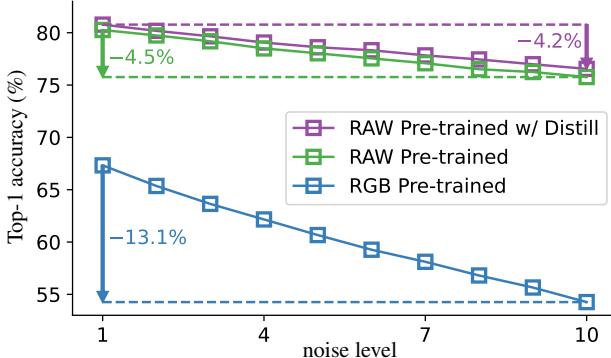
Similarly, Figure 6 shows robustness against noise. As noise levels increase (moving right on the x-axis), the RGB pre-trained model’s performance collapses. The distilled RAW model maintains significantly higher accuracy.
Comparison with State-of-the-Art
The ultimate test is performance on the AODRaw benchmark. The researchers compared their method against standard sRGB baselines and other RAW-adaptation methods (like RAOD and RAW-Adapter).
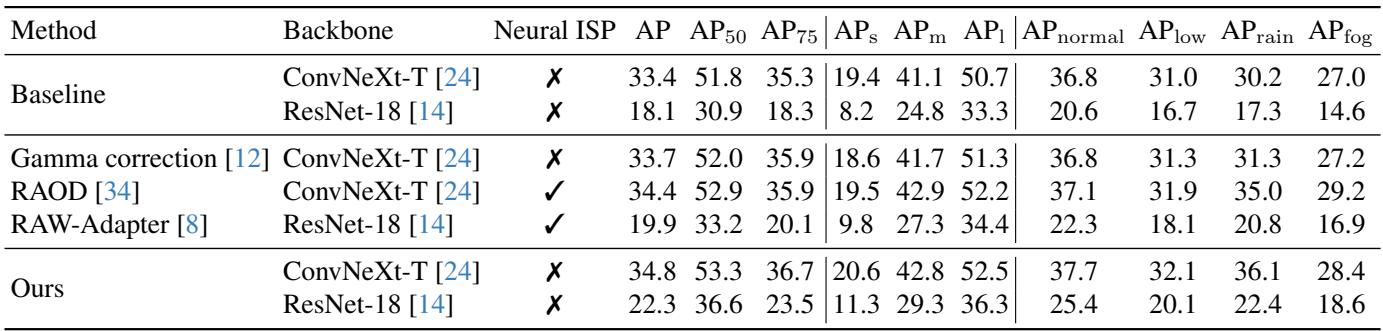
Table 5 summarizes these findings. The proposed method (Ours) achieves 34.8% AP, outperforming the baseline sRGB approach (33.4%) and existing RAW-specific methods.
Crucially, look at the columns for APlow (low light), APrain, and APfog. The proposed method shows substantial gains in these adverse categories. For example, in rain conditions, the method jumps to 36.1% AP, significantly higher than the 30.2% of the baseline. This confirms the hypothesis: RAW data contains recoverable signal in adverse weather that sRGB processing destroys.
Conclusion
The work presented in “Towards RAW Object Detection in Diverse Conditions” offers a compelling glimpse into the future of computer vision. By moving the detection pipeline closer to the sensor, we can bypass the limitations of human-centric image processing.
The authors made three distinct contributions that push the field forward:
- AODRaw: A rich, diverse dataset that finally allows for rigorous testing of RAW detection in the wild.
- Domain Analysis: A clear demonstration that sRGB pre-training creates a bottleneck for RAW tasks.
- Distilled Pre-training: A method to train RAW models that are robust to noise and lighting changes without requiring expensive ISP hardware or modules.
For students and engineers working on autonomous driving, surveillance, or robotics, this paper serves as a reminder: sometimes the best way to improve a model isn’t to make it deeper, but to give it better, rawer data. Robots don’t need pretty pictures; they need the truth, and the truth is in the RAW.