](https://deep-paper.org/en/paper/2411.16198/images/cover.png)
Introduction
Imagine an autonomous vehicle driving through a busy intersection. It suddenly brakes for a pedestrian. As an engineer or a user, you might ask: Did it actually see the pedestrian? Or did it react to a shadow on the pavement that looked like a person?
In the era of deep learning, answering this question is notoriously difficult. We have entered the age of Object-level Foundation Models—powerful AI systems like Grounding DINO and Florence-2 that can detect objects and understand complex textual descriptions (e.g., “the guy in white”). While these models achieve incredible accuracy, they operate as “black boxes.” Their internal decision-making processes are vast, complex webs of parameters that are opaque to humans.
Interpreting these models is not just an academic exercise; it is a safety necessity. However, existing methods for “explaining” AI decisions are hitting a wall. They struggle with the massive scale of foundation models and the complex way these models fuse visual data with text.
In this post, we will dive deep into a paper titled “Interpreting Object-level Foundation Models via Visual Precision Search.” The researchers propose a novel, gradient-free method called Visual Precision Search (VPS). This technique effectively “interrogates” the model to create precise heatmaps showing exactly which parts of an image led to a specific detection, outperforming current state-of-the-art methods.

As shown in Figure 1 above, while traditional attribution maps might give a vague, noisy heatmap (right), Visual Precision Search (left) identifies specific, semantic clues—like the “guy” and “white” attributes—that drove the model’s decision.
The Problem with Current Interpretation Methods
Before we unpack the solution, we must understand why interpreting modern Vision-Language models is so hard. Generally, researchers use two types of methods to explain AI decisions:
- Gradient-based methods (e.g., Grad-CAM, ODAM): These look at the gradients (derivatives) flowing through the neural network to see which pixels influenced the output.
- The Flaw: In multimodal models (Vision + Language), text and image features are fused deep inside the network. This “entanglement” means gradients often get messy, failing to pinpoint the specific visual region responsible for a detection.
- Perturbation-based methods (e.g., D-RISE): These involve masking (hiding) random parts of the image and seeing if the model changes its mind.
- The Flaw: Random masking is inefficient and noisy. It often produces scattered, grainy saliency maps that lack fine-grained detail.
The researchers behind Visual Precision Search realized that to get a clean explanation, they needed a method that didn’t rely on internal gradients (avoiding the fusion problem) and didn’t rely on random chance (avoiding the noise problem).
The Solution: Visual Precision Search
The core idea of Visual Precision Search is to treat interpretability as a search problem. Instead of asking “what are the gradients?”, the method asks: “What is the smallest set of image regions I need to keep for the model to still detect the object correctly?”
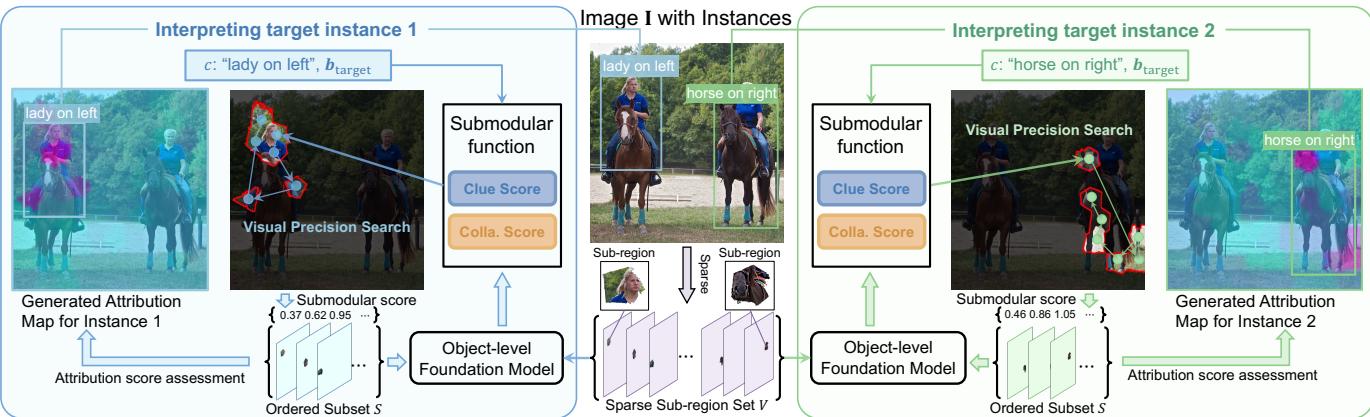
As illustrated in Figure 2, the framework follows a logical flow:
- Sparsification: Break the image into meaningful chunks (sub-regions).
- Scoring: Use a smart scoring function to evaluate how important each chunk is.
- Optimization: Use an algorithm to find the most critical chunks.
- Attribution: Generate a final heatmap based on these findings.
Let’s break down the mechanics of this process.
Step 1: Sparsification (Superpixels)
Analyzing every single pixel in a high-resolution image is computationally impossible for a search algorithm. Instead, the authors use a technique called superpixel segmentation (specifically the SLICO algorithm).
This divides the input image \(I\) into a set of \(m\) sub-regions, denoted as \(V = \{I^s_1, ..., I^s_m\}\). These aren’t just square grids; they are clusters of pixels that share similar colors or textures, making them semantically meaningful “pieces” of the image.
Step 2: The Mathematical Goal
The goal is to select a subset \(S\) of these sub-regions that maximizes a specific interpretability score, denoted as \(\mathcal{F}(S)\). We want to find the most important regions (subset \(S\)) from the total available regions (\(V\)).
Mathematically, this is expressed as:
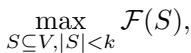
This looks like a standard optimization problem, but the magic lies in how the function \(\mathcal{F}\) is defined. The authors introduce two distinct scores to guide this search: the Clue Score and the Collaboration Score.
The Clue Score
The Clue Score (\(s_{clue}\)) measures the positive contribution of a region. It asks: If I only show the model this specific region, how confident is it that the object exists here?
It takes the model’s output—specifically the bounding box overlap (IoU) and the confidence score—to determine if a region contains “clues” that align with the target object.

This score ensures the search prioritizes regions that actually look like the object (e.g., the face or body of a person).
The Collaboration Score
However, an object isn’t just a collection of independent parts. Context matters. The Collaboration Score (\(s_{colla}\)) measures sensitivity. It asks: If I remove this region, does the detection fail?
This captures the “combinatorial effects” of features. Sometimes, a region might not look like the object itself, but it provides essential context (like a surfboard under a surfer).

The Submodular Function
The final objective function combines these two perspectives. It balances finding evidence for the object (Clue) with identifying regions necessary for the detection (Collaboration).

Step 3: Greedy Search and Submodularity
Solving this search problem perfectly is NP-hard (computational suicide). However, the researchers prove that their scoring function \(\mathcal{F}\) is submodular.
In simple terms, submodularity is the mathematical concept of “diminishing returns.” The benefit of adding a key region to your set decreases as you add more regions. Because the function has this property, the researchers can use a Greedy Search algorithm. They pick the best region first, then the next best, and so on. This guarantees a near-optimal solution without checking every possible combination.
Once the regions are ranked, an Attribution Score \(\mathcal{A}\) is assigned to each region based on its marginal contribution:

This process results in a clean, precise saliency map that highlights exactly what the model was looking at.
Experimental Results
The researchers validated VPS on major datasets like MS COCO (object detection) and RefCOCO (visual grounding). They tested it on two massive foundation models: Grounding DINO (a transformer-based detector) and Florence-2 (a multimodal Large Language Model).
Faithfulness: Does the explanation match reality?
To measure “faithfulness,” researchers use Insertion and Deletion metrics.
- Insertion (Higher is better): If we slowly reveal the image starting with the most “important” regions, the model’s confidence should shoot up quickly.
- Deletion (Lower is better): If we remove the “important” regions, the model’s confidence should crash immediately.
The results were impressive.
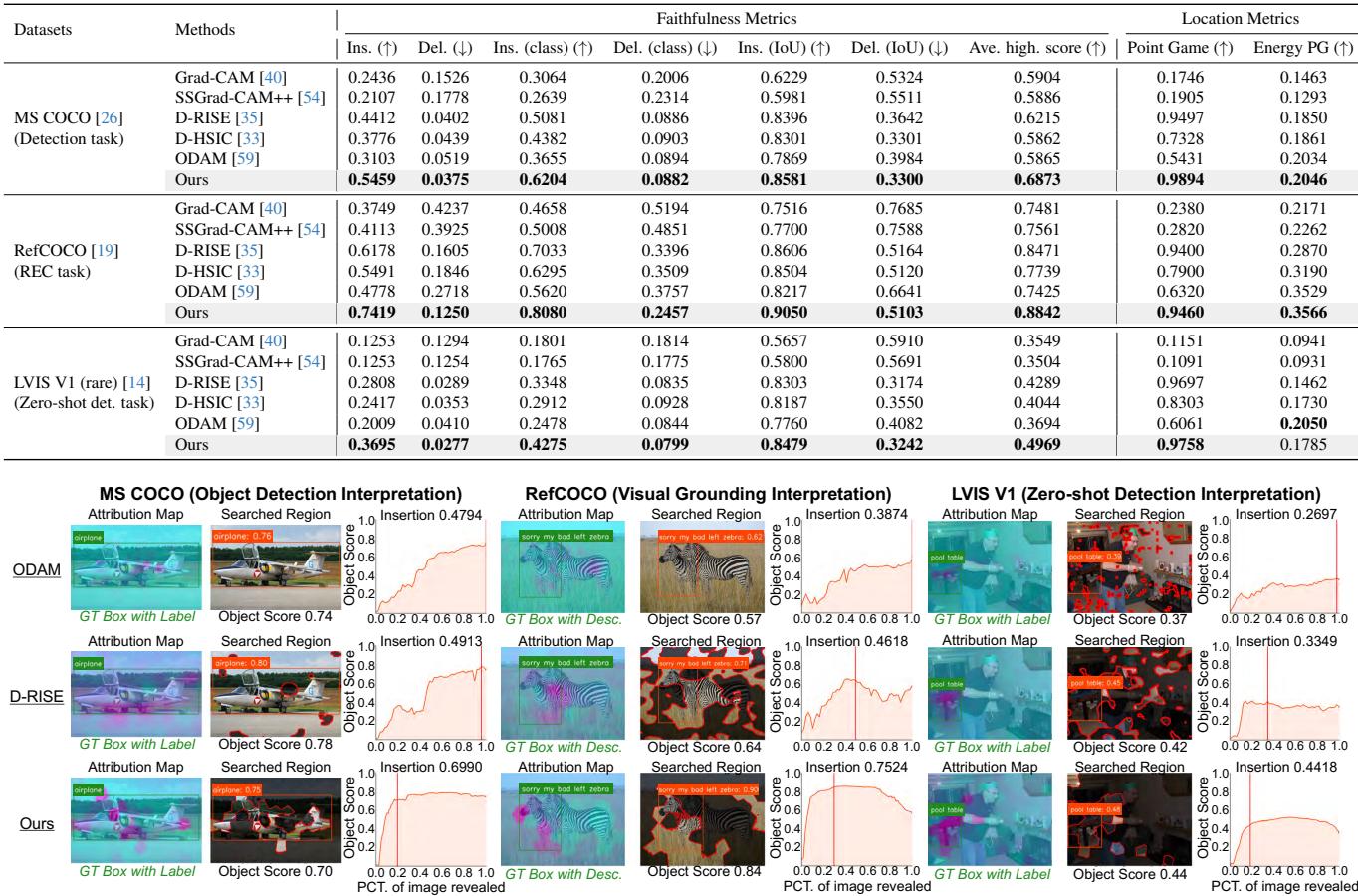
In Figure 3, compare the columns. The D-RISE method (third row) produces scattered, noisy red dots. ODAM (bottom row) is often too broad or diffuse. Visual Precision Search (Ours) (top row) tightly hugs the object boundaries.
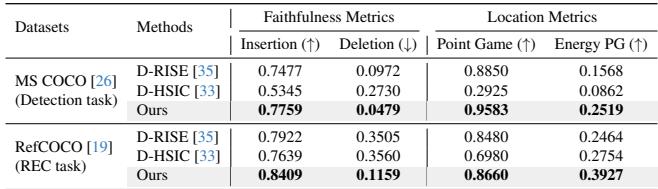
The quantitative data backs this up. In the table below (Table 2), looking at the Florence-2 model results, VPS outperforms D-RISE significantly on the Deletion metric (0.0479 vs 0.0972 on MS COCO), indicating it is much better at identifying the truly critical pixels.
Interpreting Failures
One of the most powerful applications of interpretability is understanding why a model failed. VPS excels here because it can search for the cause of a negative result.
Misclassification (Hallucinations)
Sometimes, a model sees a “truck” when there is actually a “car,” or imagines an object that isn’t there. VPS can highlight the input regions that confused the model.
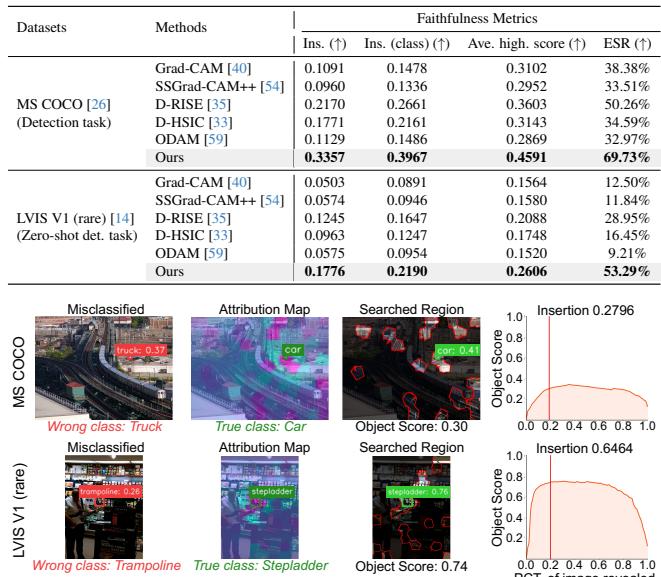
In Figure 6, notice the top example. The model misclassified a Car as a “Truck.” The cyan region (the explanation) highlights the back of the vehicle, suggesting the boxy shape of the rear caused the confusion. In the bottom example, a stepladder is misclassified as a “Trampoline” likely due to the mesh pattern highlighted by the search.
Missed Detections
What about when the model simply misses an object?
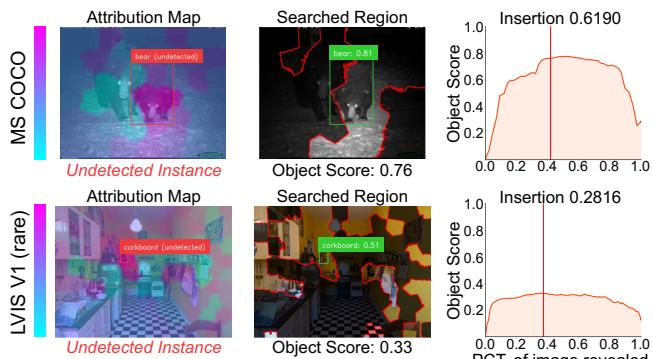
In Figure 7 (top), the model missed the “bear.” The interpretation shows the model was looking at the bear (cyan regions) but likely couldn’t distinguish it from the similar-looking animal next to it. This suggests the failure was due to feature confusion, not because the model didn’t “look” at the right spot.
Ablation: Why Sub-regions Matter
You might wonder: Does the size of the chunks (sub-regions) matter?
The researchers conducted an ablation study to test this.
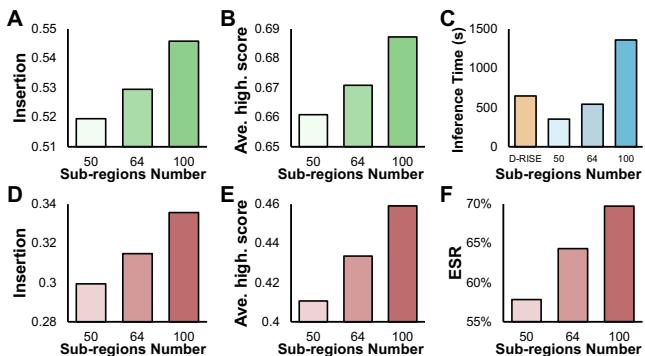
As shown in Figure 8 (Charts A and B), increasing the number of sub-regions (making the chunks smaller and more precise) improves the Insertion score and average high score. However, there is a tradeoff: Chart C shows that increasing the number of regions also increases inference time. The default setting of 100 sub-regions strikes a balance between precision and speed.
Conclusion
The “Visual Precision Search” method represents a significant step forward in making AI transparent. By abandoning gradient-based methods—which get tangled in the complex fusion layers of foundation models—and adopting a rigorous, math-backed search approach, the researchers achieved state-of-the-art results.
Key Takeaways:
- Gradient-Free: VPS works by searching the input space, making it robust for multimodal models where text and images mix.
- Submodularity: The use of “Clue” and “Collaboration” scores within a submodular framework guarantees that the greedy search finds meaningful regions.
- Versatility: It works for detecting objects, understanding text descriptions, and, crucially, diagnosing why models fail.
As we rely more on object-level foundation models for tasks like autonomous driving and robotics, tools like Visual Precision Search will be essential for building trust and ensuring safety. We can finally move from asking “Did the car see the pedestrian?” to knowing exactly what it saw.