](https://deep-paper.org/en/paper/2411.16310/images/cover.png)
Introduction
Imagine you are a robot in a kitchen. You receive a simple command: “Turn on the microwave.” To you, a human, this is trivial. You look at the microwave, spot the “Start” button, and press it.
But for an Artificial Intelligence, this is a monumental challenge. First, the AI must understand that “turn on” implies interacting with a specific button. Second, it must visually locate that tiny button within a complex 3D environment filled with other objects, shadows, and occlusions. Standard computer vision models are great at finding the microwave (the whole object), but they often fail spectacularly at finding the specific functional part (the button) needed to complete a task.
This problem is known as Functionality Understanding. It requires a dual capability: World Knowledge (understanding how objects work based on language) and Fine-Grained Perception (precisely segmenting small, interactive elements in 3D).
In this post, we are diving deep into Fun3DU, a groundbreaking research paper that proposes a training-free method to solve this problem. Fun3DU leverages the power of Large Language Models (LLMs) and Vision-Language Models (VLMs) to interpret natural language commands and segment functional objects in 3D scenes with remarkable accuracy.
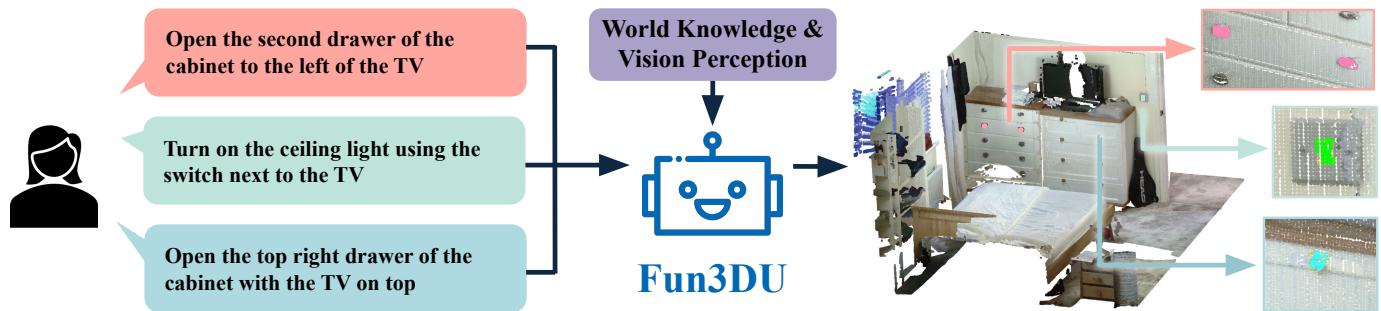
As shown above, Fun3DU takes a command like “Open the second drawer,” processes it through world knowledge modules, and outputs a precise 3D segmentation of the specific handle required to do the job.
The Background: Why is this so hard?
To understand why Fun3DU is significant, we have to look at the limitations of current Open-Vocabulary 3D Segmentation (OV3DS) methods.
Traditional OV3DS methods, such as OpenMask3D or LERF, allow users to query 3D scenes using text. You can type “chair,” and the model highlights the chairs. However, these models rely on datasets heavily biased toward large, distinct objects (furniture, walls, floors). When you ask them to find “the handle of the bottom drawer,” they usually fail. They might highlight the entire cabinet because their training data never taught them to distinguish the handle from the wood it’s attached to.
Furthermore, commands are often ambiguous. “Turn on the light” doesn’t explicitly mention a “switch.” An embodied agent (like a robot) needs to infer the missing link.
The SceneFun3D Benchmark
The researchers validated their work on SceneFun3D, a dataset specifically designed for this challenge. It contains high-resolution scans of indoor environments and task descriptions that require reasoning (e.g., “Open the cabinet with the TV on top”). As we will see later, standard baselines perform poorly on this benchmark, highlighting the need for a specialized approach like Fun3DU.
The Core Method: Fun3DU
The brilliance of Fun3DU lies in its modular design. It doesn’t try to train a massive new neural network from scratch. Instead, it acts as a conductor, orchestrating several powerful, pre-trained “foundation models” to solve the puzzle step-by-step.
The method is training-free. It uses frozen, pre-trained models, meaning it can be deployed immediately without the need for expensive fine-tuning on new datasets.
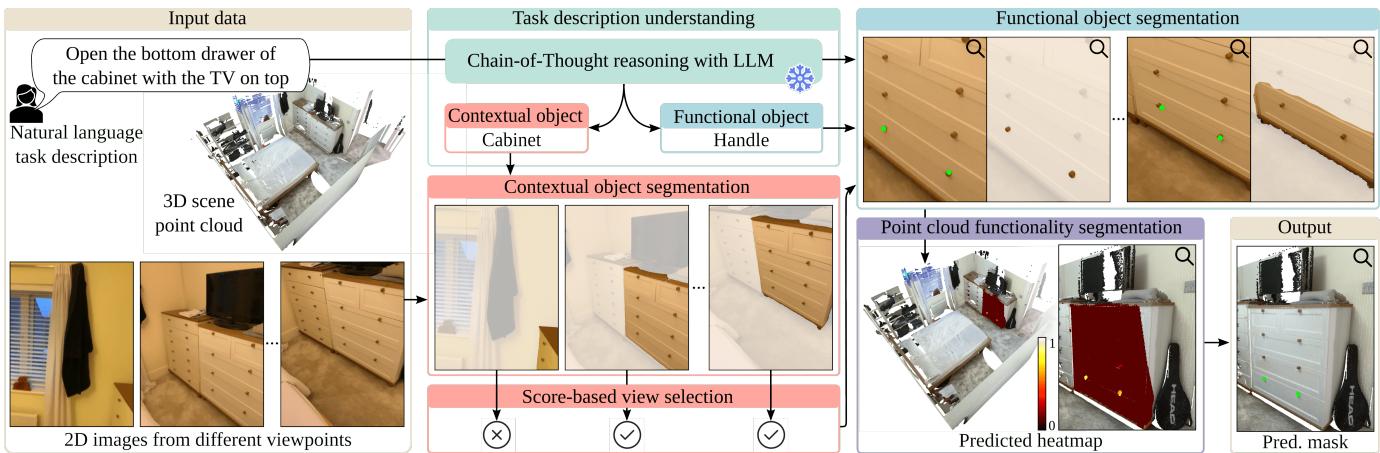
As illustrated in Figure 2, the architecture consists of four distinct modules:
- Task Description Understanding: Using an LLM to reason about the request.
- Contextual Object Segmentation & View Selection: Finding the general area and choosing the best camera angles.
- Functional Object Segmentation: Pinpointing the specific interactive part.
- Point Cloud Functionality Segmentation: lifting the result to 3D.
Let’s break these down in detail.
1. Task Description Understanding (The Brain)
The input is a raw text command, \(D\). The goal is to identify two things:
- The Contextual Object (\(O\)): The large object related to the task (e.g., “Cabinet”).
- The Functional Object (\(F\)): The specific part to interact with (e.g., “Handle”).
The system uses a Large Language Model (LLM) utilizing Chain-of-Thought (CoT) reasoning. It doesn’t just ask for the object names; it asks the LLM to outline a “task solving sequence.”
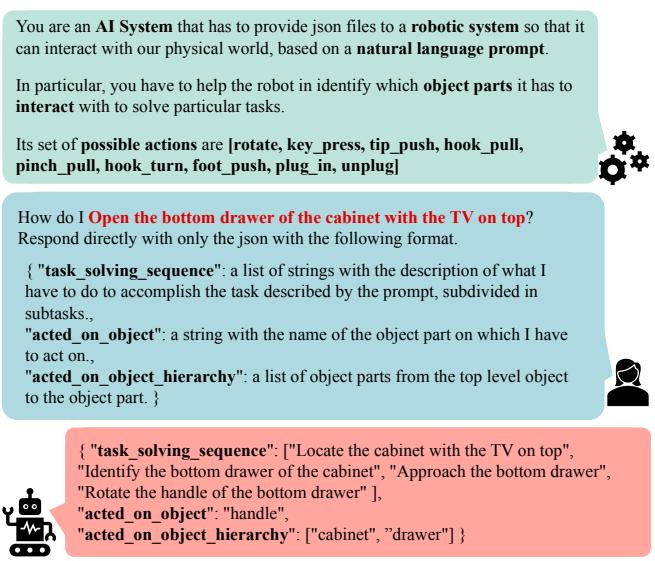
In the example above, the prompt “Open the bottom drawer of the cabinet…” leads the LLM to deduce a hierarchy. It identifies the “Contextual Object” as the cabinet and the “Functional Object” as the handle. This solves the ambiguity problem: even if the user says “Turn on the light,” the LLM infers “Light Switch.”
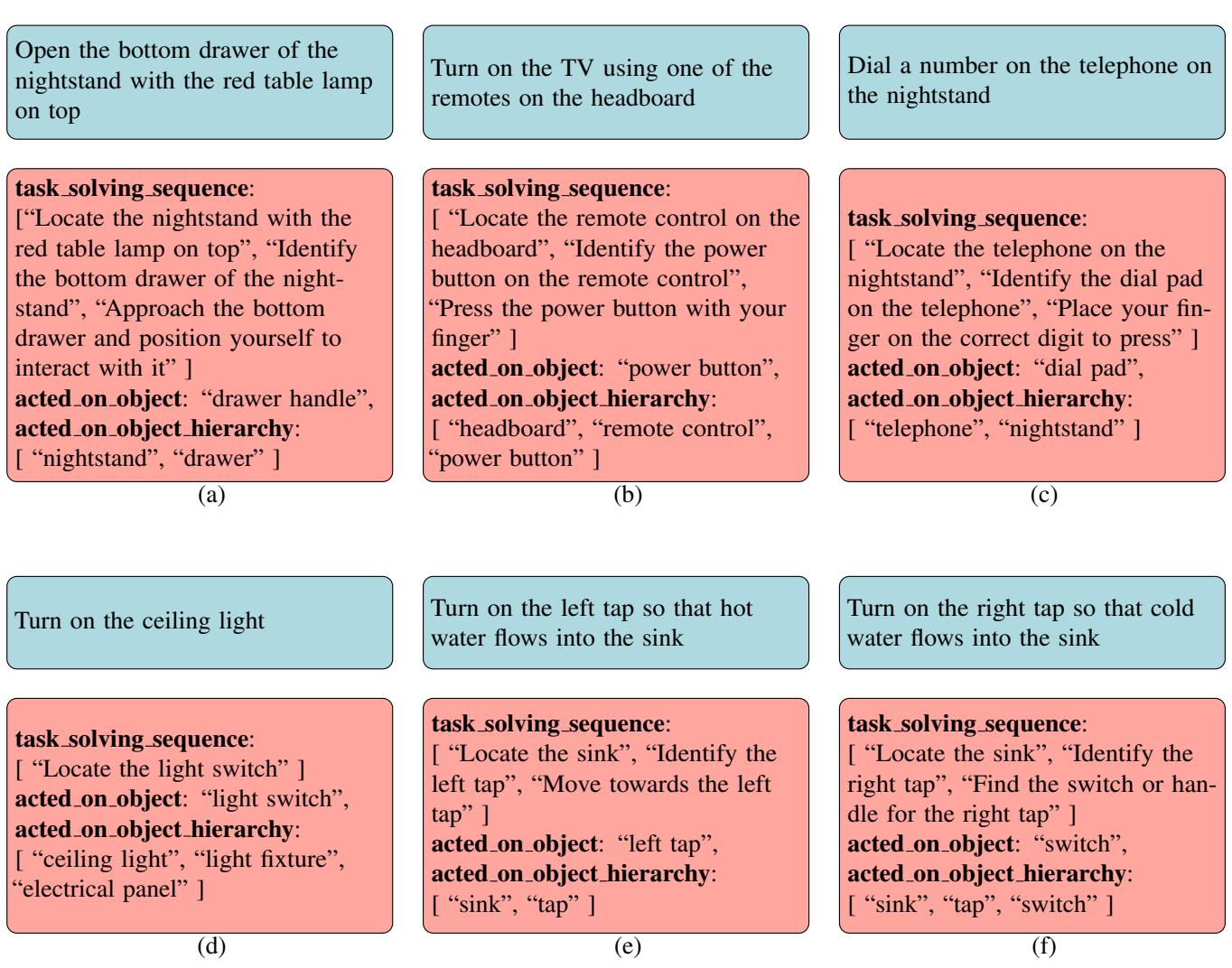
Additional examples of this reasoning capabilities can be seen below:
2. Contextual Object Segmentation & View Selection (The Eyes)
Once the system knows it is looking for a “Cabinet” (\(O\)), it needs to find it in the visual data. A 3D scene is composed of thousands of 2D images (frames) taken from different angles. Processing all of them with heavy vision models is computationally expensive and inaccurate (many views might be blurry or show the back of the object).
Contextual Segmentation: The system first uses an open-vocabulary segmentor (like OWLv2) to find the Contextual Object (\(O\)) in all available views.
Score-Based View Selection: This is a crucial innovation. The system needs to filter thousands of views down to a handful of the “best” ones. But what makes a view “good”?
- Confidence: The detector is sure it sees the object.
- Centering: The object is near the center of the image.
- Completeness: The object isn’t cut off at the edges.
To achieve this, the authors introduce a scoring mechanism based on polar coordinates. For a pixel mask \((x, y)\), they compute the distance \(d\) and angle \(\alpha\) relative to the image center:

They then compare the distribution of these distances and angles against a uniform distribution using Kullback-Leibler (KL) divergence. A mask that is centered and well-distributed will have a high similarity score (\(S\)) to a uniform distribution.

The final score for a view (\(S_O^n\)) combines the model’s confidence (\(S_m\)) with these spatial scores:

This math ensures that the system ignores views where the cabinet is barely visible in the corner and focuses on views where the cabinet is front-and-center.
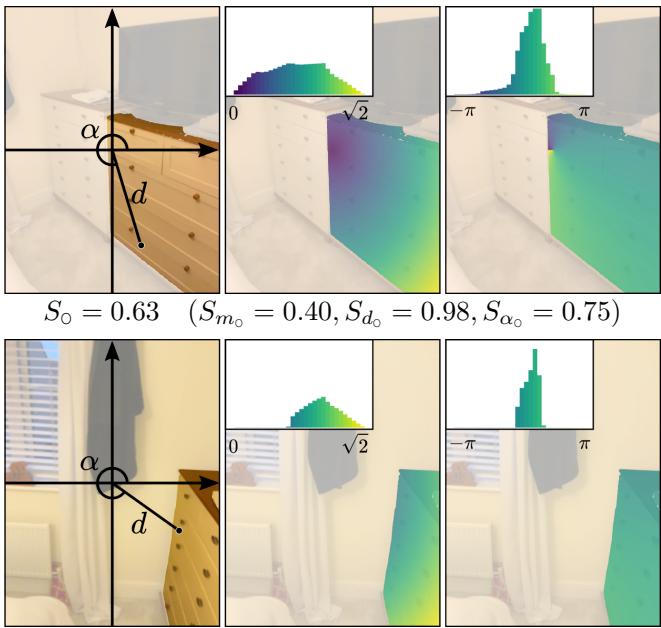
Figure 4 (above) visualizes this perfectly. The heatmaps show that views with centered distributions (top row) get high scores, while off-center or partial views (bottom row) get low scores.
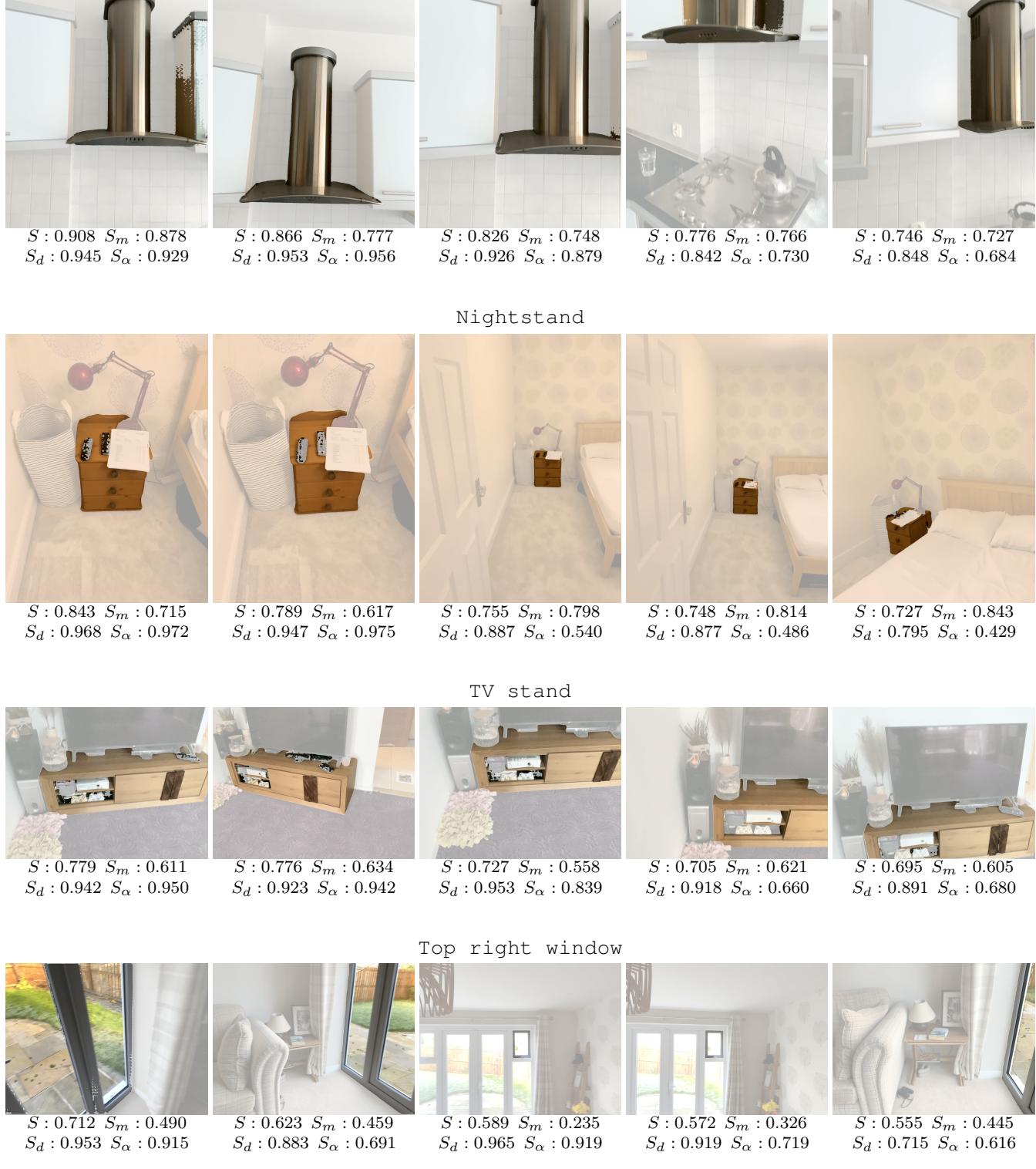
You can see the results of this selection process below. The images on the left (high rank) show clear, unobstructed views of the objects, while images on the right (low rank) are occluded or poorly framed.
3. Functional Object Segmentation (The Precision)
Now that the system has a set of “best views” containing the Contextual Object (e.g., the cabinet), it needs to find the Functional Object (e.g., the handle).
Fun3DU uses a Vision-Language Model (VLM), specifically Molmo. The VLM is prompted with the image and the text: “Point to all the [Functional Object] in order to [Task Description].”
Including the full task description is vital. If there are two handles, but the task is “Open the bottom drawer,” the VLM uses the text context to point only to the bottom handle.
The output of the VLM is a set of 2D points. These points are then fed into SAM (Segment Anything Model), a “promptable segmentor.” SAM takes the vague points and expands them into precise pixel-perfect masks.
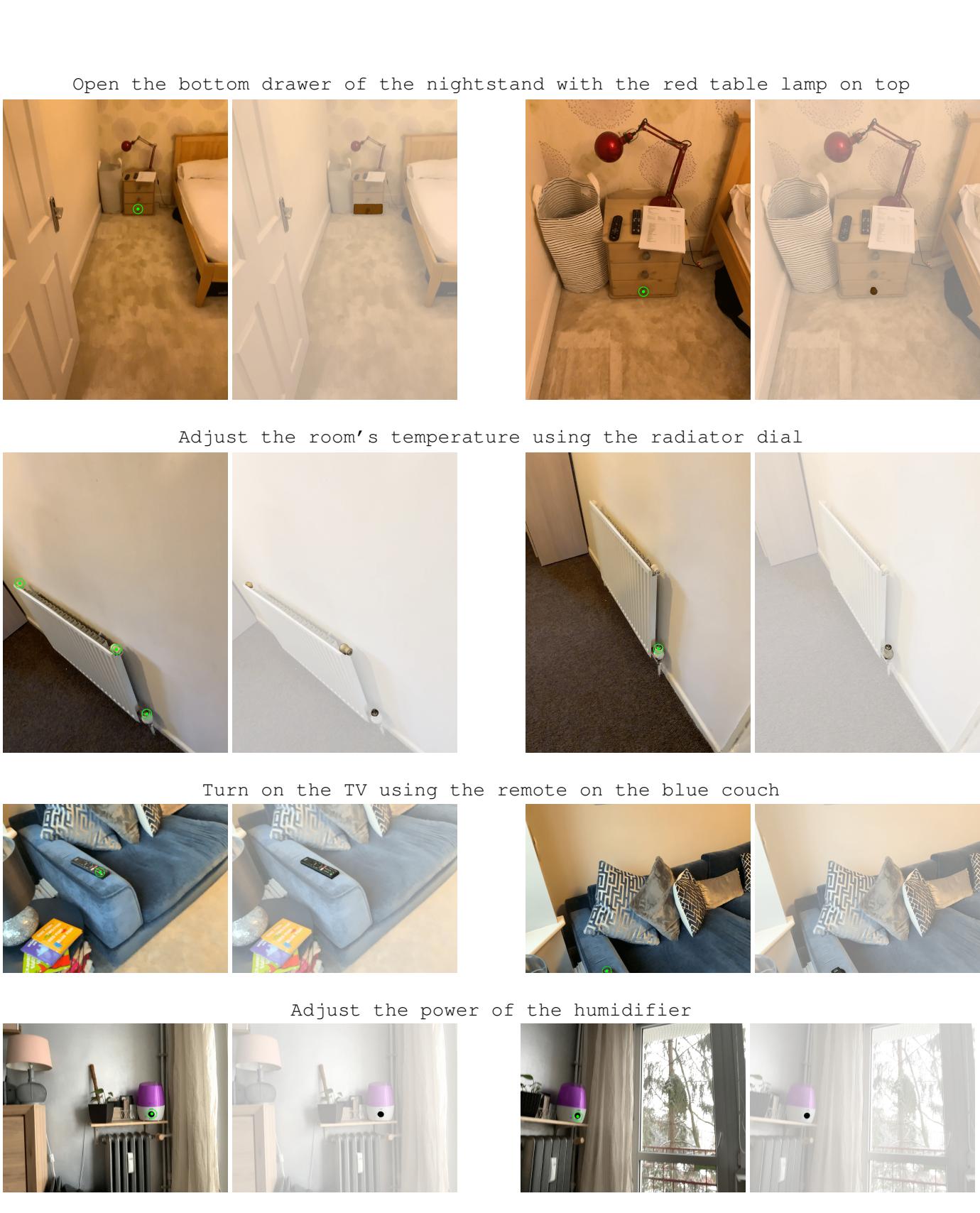
In the figure above, you can see the green dot provided by the VLM and the resulting high-quality mask generated by SAM.
4. Point Cloud Functionality Segmentation (The Map)
The final step is 3D aggregation. We have precise 2D masks from several different camera angles. We need to combine them into a single 3D prediction on the point cloud.
The system uses Multi-View Agreement. It projects the 2D masks onto the 3D points. If a 3D point is selected in multiple different views, its “score” increases.
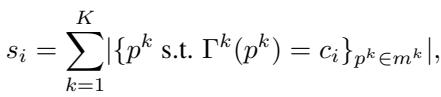
Points that accumulate enough votes (crossing a threshold \(\tau\)) are considered part of the final functional object. This voting mechanism naturally filters out noise—if a VLM makes a mistake in one weird angle, the other 50 angles will correct it.
Experiments & Results
The researchers compared Fun3DU against state-of-the-art baselines: OpenMask3D, OpenIns3D, and LERF. The evaluation metric was Average Precision (AP) and Intersection over Union (IoU) on the SceneFun3D dataset.
Quantitative Analysis
The results were not close. The baselines struggled significantly, often achieving near-zero precision. This is because those models tend to segment the contextual object (the whole dresser) rather than the functional object (the knob).
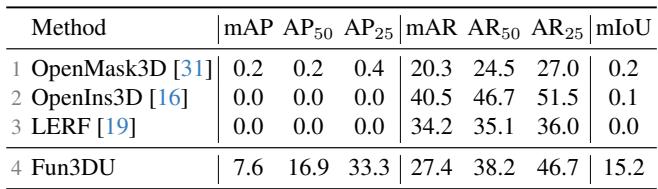
As shown in Table 1, Fun3DU achieves an \(AP_{25}\) of 33.3, while the next best method (OpenMask3D) only manages 0.4. The discrepancy is massive.
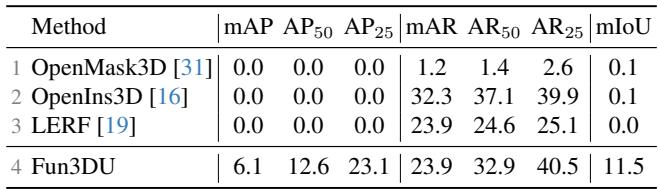
Table 2 shows results on Split 1 (a harder dataset). The trend continues, with Fun3DU maintaining a significant lead.
Qualitative Analysis
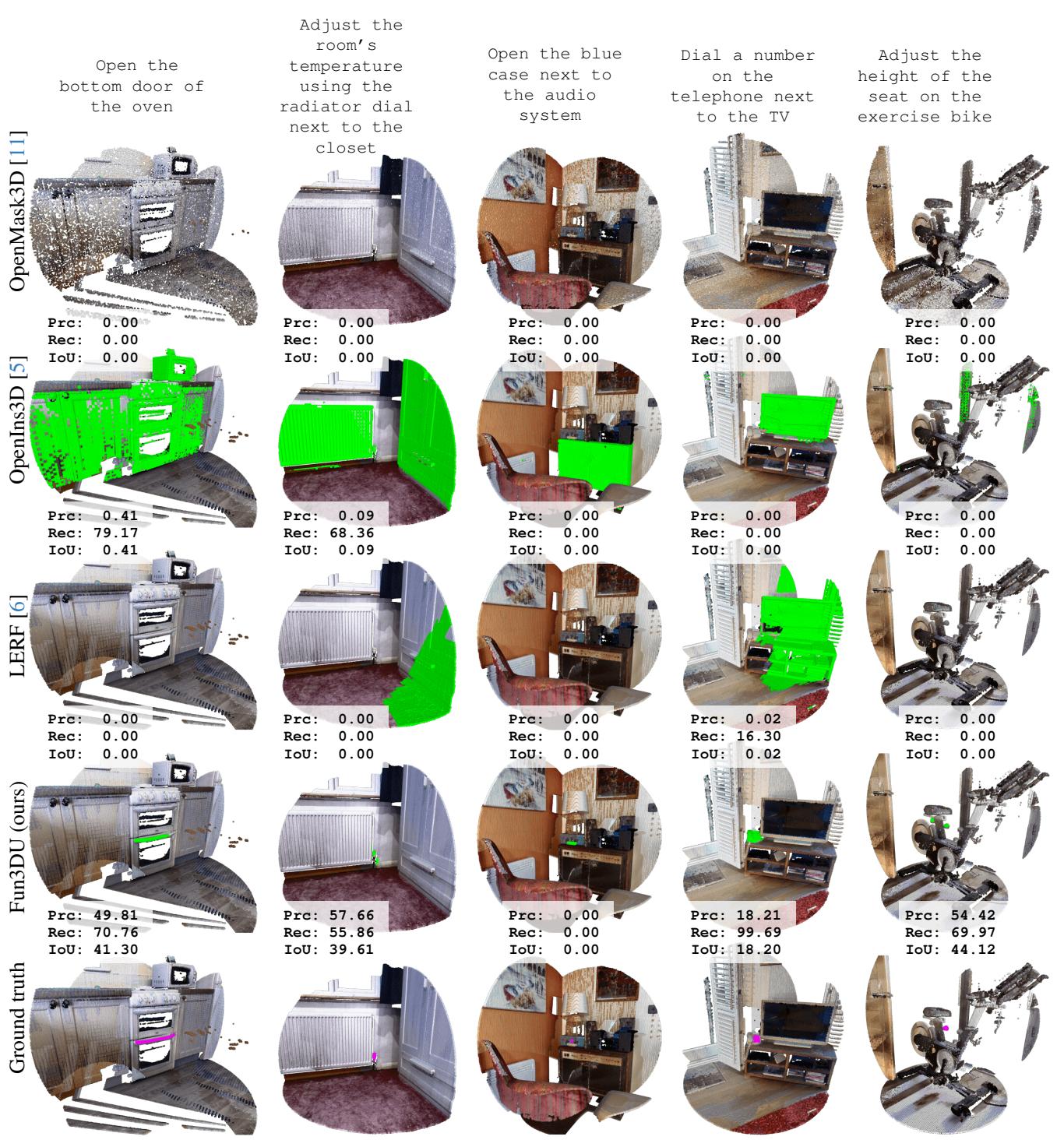
Numbers are one thing, but seeing the masks explains why the baselines fail.
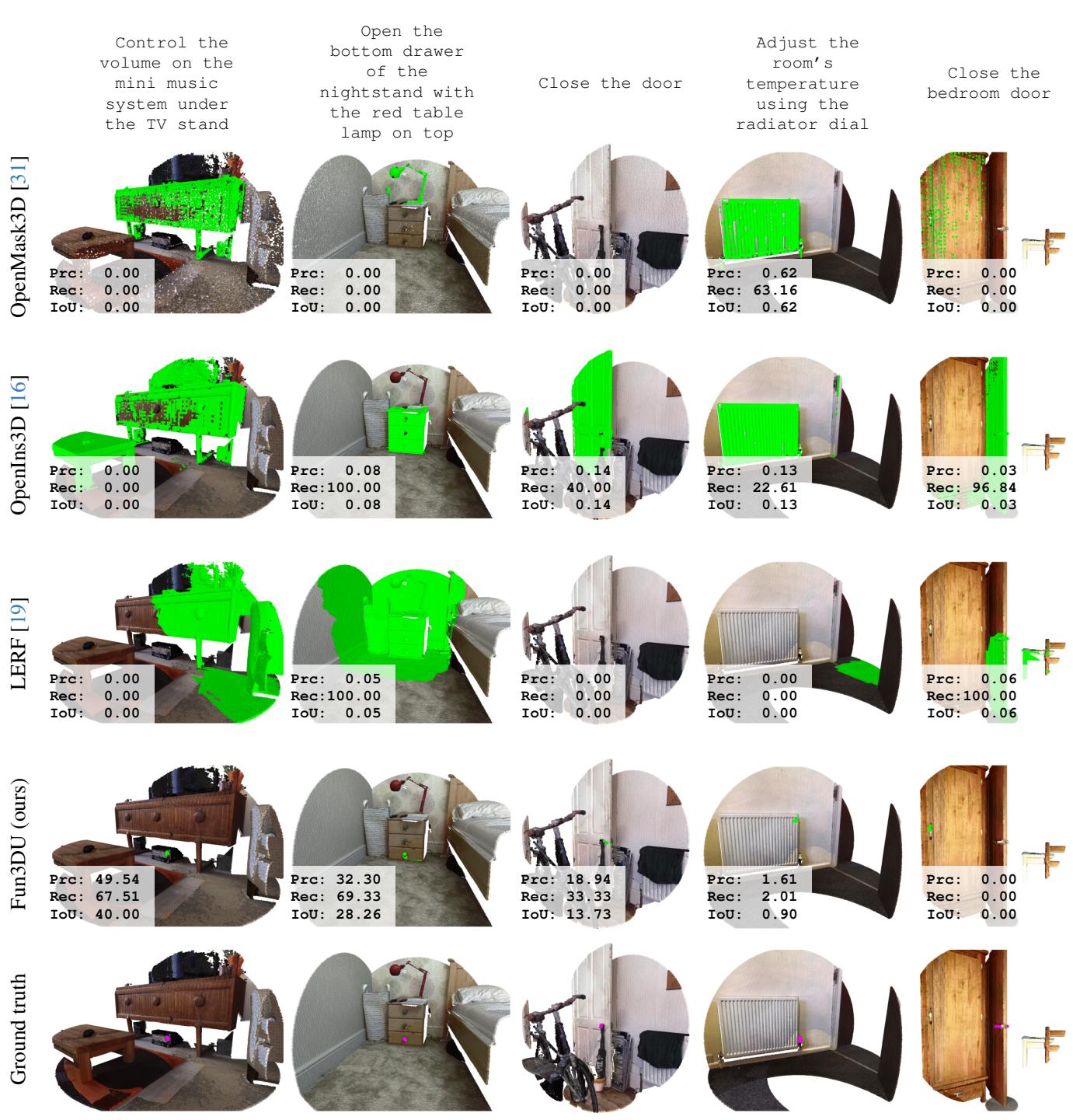
In Figure 5, look at the “Control the volume” task (first column).
- Baselines: They struggle to find anything or highlight the entire TV stand.
- Fun3DU: Correctly highlights the small button/knob area.
The difference is even clearer in the “Open the bottom drawer” task. The baselines highlight the lamp or the whole nightstand. Fun3DU highlights the handle.
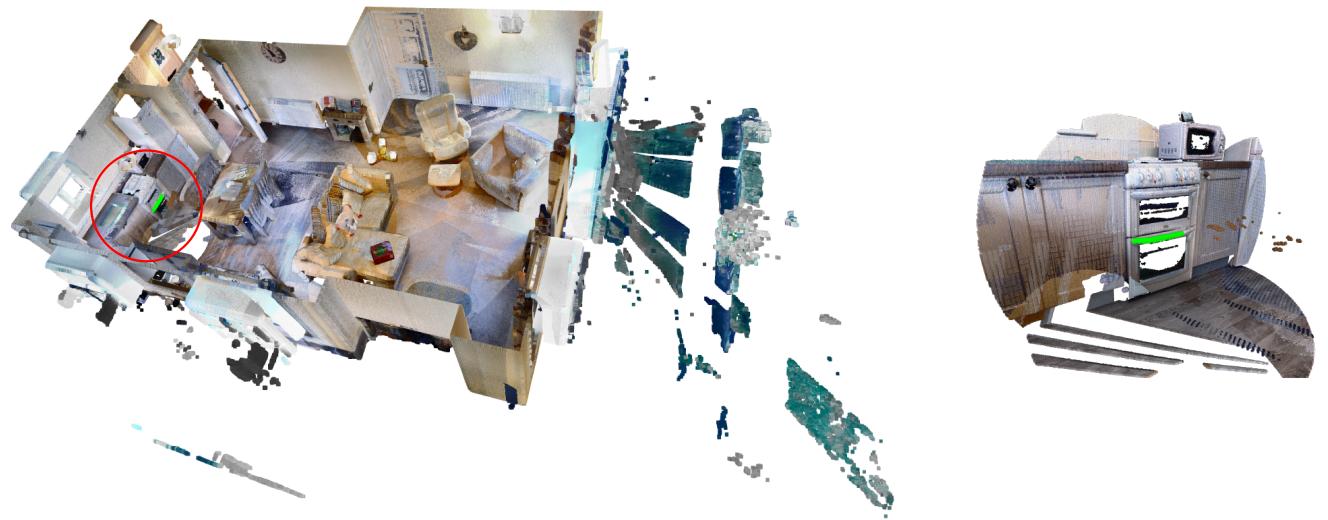
Here are more qualitative examples showing Fun3DU’s ability to handle complex prompts like “Open the bottom door of the oven”:
And a visualization of the final 3D point cloud output:
Ablation Studies: What matters most?
The researchers performed ablation studies to see which components drove performance.
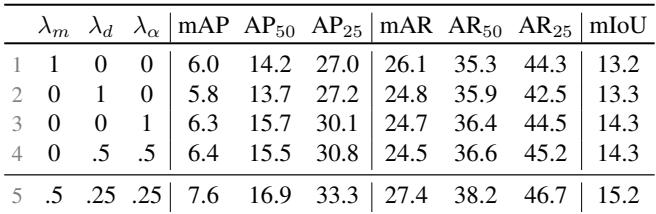
Does View Selection matter? Yes. As shown in Table 4, removing the scoring system (\(\lambda_m=1\), meaning relying only on detection confidence) drops performance. The combination of spatial centering and confidence is key.
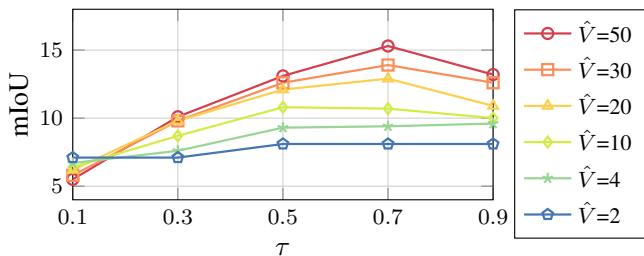
Do we need many views? Figure 6 shows the impact of the number of views (\(\hat{V}\)). Performance improves as you add more views, peaking around 50 views. Interestingly, even with just 10 carefully selected views, the model performs respectably, proving the efficiency of the selection algorithm.
Conclusion and Implications
Fun3DU represents a significant leap forward in embodied AI perception. By moving away from training massive task-specific networks and instead chaining together pre-trained “experts” (LLMs for reasoning, VLMs for pointing, SAM for segmentation), the authors created a system that is both flexible and precise.
Key Takeaways:
- Context Matters: You can’t find a “handle” without first understanding it belongs to a “cabinet.”
- View Quality > Quantity: Intelligently selecting the best camera angles is more efficient than processing everything.
- Foundation Models are Legos: The future of 3D understanding might not be new architectures, but better ways to compose existing powerful models.
This method opens the door for robots that can truly understand instructions like “charge my phone” or “turn down the heat,” navigating the messy reality of 3D homes to interact with the tiny, functional parts of the world.