](https://deep-paper.org/en/paper/2411.16788/images/cover.png)
Deep learning models are notoriously brittle. You train a model on high-quality photographs of dogs, and it achieves 99% accuracy. But show that same model a simple line sketch of a dog, or a photo of a dog in an unusual environment, and it falls apart.
This problem is known as Domain Generalization (DG). Specifically, we often face the challenge of Single-Source Domain Generalization (SSDG), where we only have data from one domain (e.g., photos) but need the model to work everywhere (sketches, paintings, cartoons).
The traditional solution has been data augmentation—bombarding the training data with noise, rotations, and color jitters to force robustness. But a recent paper, “TIDE: Training Locally Interpretable Domain Generalization Models Enables Test-time Correction,” argues that augmentation isn’t enough. The authors suggest that models fail because they learn “global” statistics (like background textures) rather than “local” concepts (like a beak or whiskers).
In this post, we will dive deep into TIDE, a novel framework that uses Large Language Models (LLMs) and Diffusion Models to teach neural networks where to look, ensuring they learn concepts that remain true regardless of the artistic style or domain.
The Problem: Global vs. Local Features
Why does a model trained on photos fail on sketches? Often, it’s because the model is “cheating.” It might associate the class “bird” with the green texture of a forest background rather than the shape of a beak. When you present a sketch of a bird on a white background, the green texture is gone, and the model is lost.
This is a semantic shift. Existing methods rely on data augmentation to cover diverse domains, but accounting for every possible change in viewpoint or background is impossible.
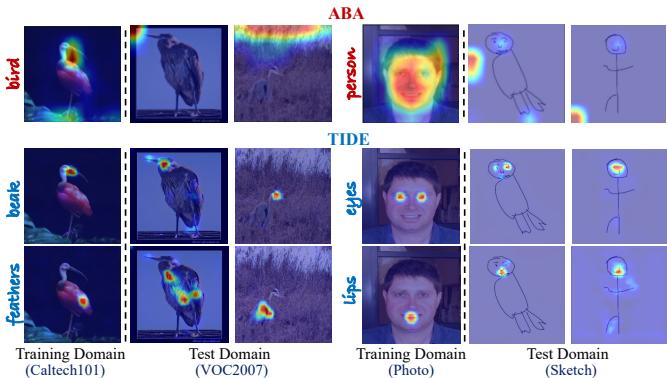
Take a look at Figure 1 above. On the top row, a state-of-the-art method called ABA fails to classify the images correctly. Notice the heatmaps (the red/yellow regions): the model is looking at the dark background or random noise, not the object itself.
On the bottom row, we see TIDE. Even when the domain shifts from a photo to a sketch (right side), TIDE correctly identifies the “feathers” and “beak” (for the bird) or “eyes” and “lips” (for the person). Because these local concepts—beaks, eyes, feathers—are invariant across domains, TIDE correctly classifies the image.
The TIDE Pipeline
The researchers introduce a comprehensive pipeline to solve this. It isn’t just a new loss function; it’s a new way of generating data, training models, and even correcting mistakes after training.
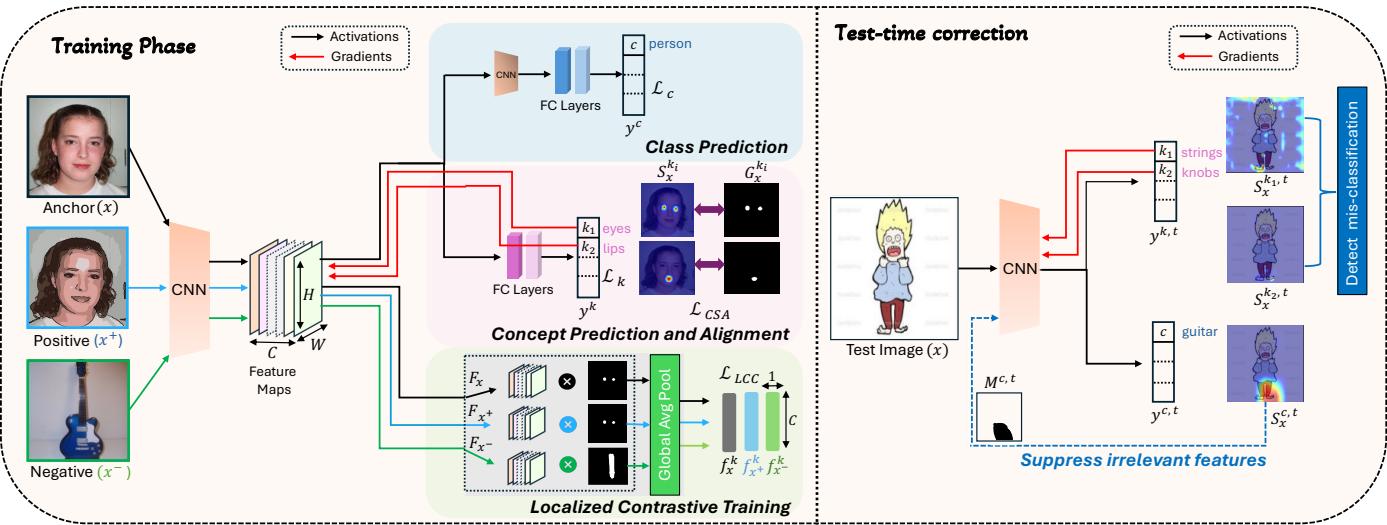
As illustrated in Figure 2, the approach has three distinct phases:
- Annotation Generation: Creating ground truth maps for concepts using Generative AI.
- TIDE Training: Training the model to align with these concepts using novel loss functions.
- Test-Time Correction: Using the learned concepts to fix predictions on the fly.
Let’s break these down.
Phase 1: The Annotation Challenge
The first hurdle the authors faced was a lack of data. There are no standard datasets that provide pixel-level annotations for specific concepts like “cat whiskers” or “dog snouts” across thousands of images. Manually annotating them would be prohibitively expensive.
To solve this, the authors devised a clever automated pipeline using LLMs and Diffusion Models.
Step 1: Identify Concepts. They query GPT-3.5 to list discriminative features for a class. For a “cat,” the LLM might return “whiskers,” “ears,” and “eyes.”
Step 2: Generate Synthetic Attention Maps. They use a text-to-image Diffusion Model (like Stable Diffusion) to generate an image of a cat based on those concepts. Crucially, they extract the cross-attention maps from the diffusion model. These maps tell us exactly which pixels the model used to generate the “whiskers” or “eyes.”
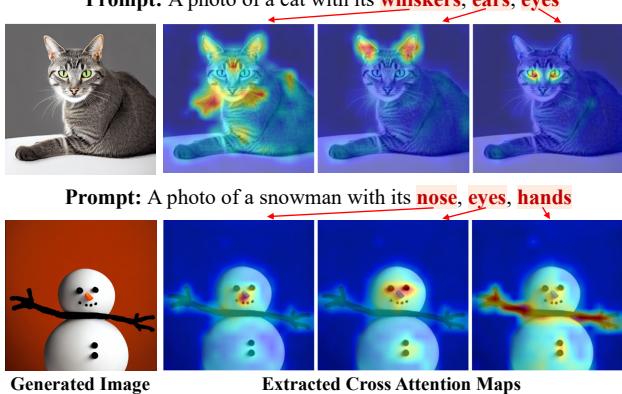
Figure 3 shows this in action. The diffusion model generates a cat (top) and a snowman (bottom). The cross-attention layers naturally isolate the whiskers, ears, and eyes with high precision.
Step 3: Transfer to Real Data. Now we have concept maps for synthetic images, but we need them for our real training dataset. The authors use a technique called Diffusion Feature Transfer (DIFT). Because diffusion models learn highly semantic internal representations, the authors can find correspondences between the synthetic image and real images.
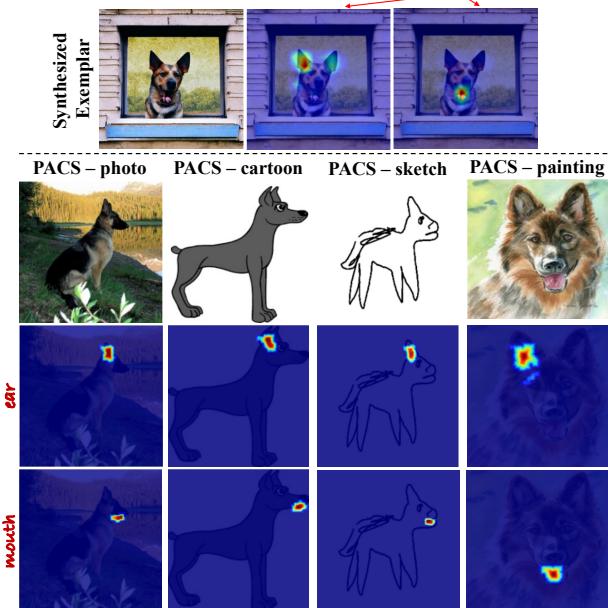
In Figure 4, you can see how the attention map for an “ear” on a synthetic dog is successfully transferred to photos, cartoons, sketches, and paintings of dogs. This creates a “pseudo-ground-truth” dataset of concept saliency maps (GT-maps) without any human labeling.
Phase 2: Training with TIDE
With these generated ground-truth maps (denoted as \(G_x^k\)), the authors introduce the TIDE training scheme. The goal is to force the model to look at these specific regions.
Concept Saliency Alignment (CSA)
First, the model needs to look at the right pixels. If the ground truth map says the “beak” is in the center, the model’s gradient-based saliency map (\(S_x^k\)) should also highlight the center.
They calculate the overlap between the model’s attention and the ground truth. To discover which concepts are actually important for a specific class (filtering out noise), they use the following overlap metric:

Based on this overlap, they select the most important concepts (\(\mathcal{K}_c\)) for each class:
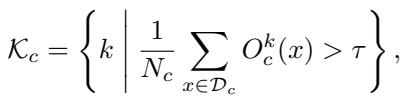
Finally, the Concept Saliency Alignment (CSA) loss forces the model’s attention to match the ground truth maps:

This loss ensures that if the model predicts “bird,” it is doing so because it identified the beak and feathers, not because it saw a green background.
Local Concept Contrastive (LCC) Loss
Knowing where to look is half the battle. The model also needs to learn that a “beak” in a photo looks semantically similar to a “beak” in a sketch. This is domain invariance.
To achieve this, TIDE extracts concept-specific feature vectors. Instead of pooling the whole image into one vector, they use the ground truth maps to pool features only from the relevant regions (e.g., just the pixels corresponding to the eye).
The feature vector extraction is defined as:
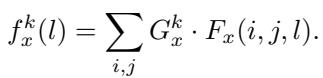
Here, \(F_x\) is the feature map from the CNN, and \(G_x^k\) is the ground truth map for concept \(k\).
The Local Concept Contrastive (LCC) loss then acts as a triplet loss. It pulls the representation of a concept (e.g., “eye”) in an image close to the same concept in an augmented version of that image (\(x^+\)), while pushing it away from a different concept (\(k'\)) in a negative sample (\(x^-\)).

The impact of this is visualized beautifully using t-SNE plots.
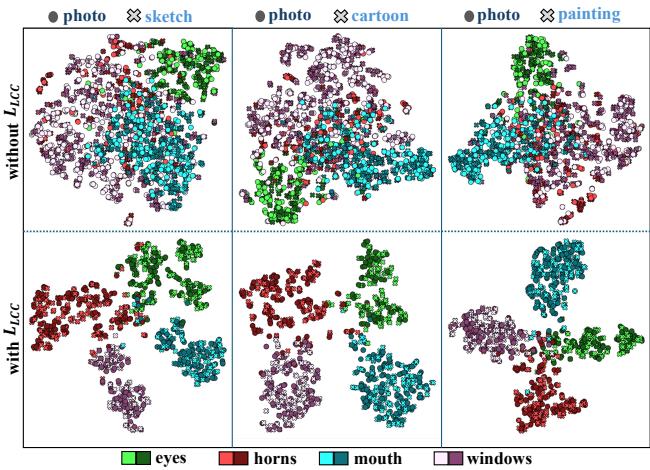
In Figure 5, look at the top row (without LCC). The features for different concepts (eyes, horns, mouth) are somewhat scattered and overlapping between domains. In the bottom row (with LCC), the concepts cluster tightly together. All “eyes” (green dots)—whether from sketches, cartoons, or paintings—are grouped together, and they are well-separated from “mouths” (cyan triangles). This separation is critical for robust classification.
Phase 3: Test-Time Correction
This is perhaps the most innovative contribution of the paper. Because TIDE learns interpretable, localized concepts, it can “debug” itself during testing.
Standard models give a prediction, and you have to trust it. TIDE, however, stores Local Concept Signatures—prototypical feature vectors (\(p^k\)) for every concept (like the “average eye vector”) calculated over the training set.
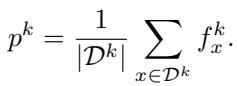
How Correction Works:
- Prediction: The model receives a test image (e.g., a sketch) and predicts a class (e.g., “Guitar”).
- Verification: The model looks at the regions it used to predict “Guitar” (e.g., it thinks it saw “strings”). It compares the features from that region to the stored “Guitar String” signature.
- Detection: If the features don’t match the signature (i.e., the distance is large), the model realizes it is hallucinating. It might be looking at an elephant’s trunk and calling it a guitar string.
- Correction: The model masks out that specific region of the image and re-runs the prediction. It iteratively forces itself to look elsewhere until the features align with a known concept signature.
(Refer back to the right side of Figure 2 for the visual flow of this correction).
Experimental Results
The authors evaluated TIDE on four standard Domain Generalization benchmarks: PACS, VLCS, OfficeHome, and DomainNet. These datasets test the ability to transfer between photos, art, sketches, and more.
Quantitative Superiority
The results are staggering. In a field where improvements are often measured in fractions of a percentage, TIDE achieved an average improvement of 12% over state-of-the-art methods.
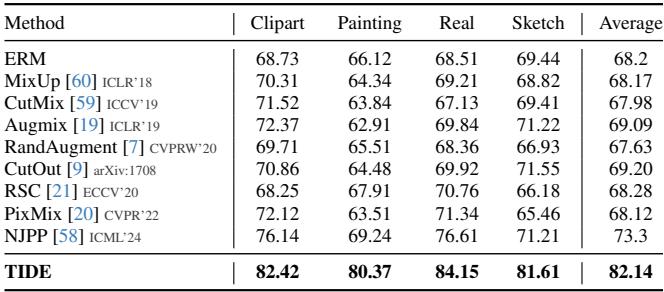
Table 1 (Figure 15) details these results. In the PACS dataset (row ‘a’), TIDE achieves 86.24% accuracy, significantly higher than competitors. The gains are consistent across VLCS, OfficeHome, and DomainNet.
The ablation study confirms that every piece of the puzzle matters.

As shown in Table 2, adding the concept losses (\(\mathcal{L}_{CSA}\) and \(\mathcal{L}_{LCC}\)) provides a massive jump in accuracy (from ~49% to ~73% on average). The Test-time correction adds another substantial boost, pushing the average up to 80.02%.
Qualitative Interpretability
Numbers are great, but TIDE is about interpretability. Does it actually look at the right concepts?
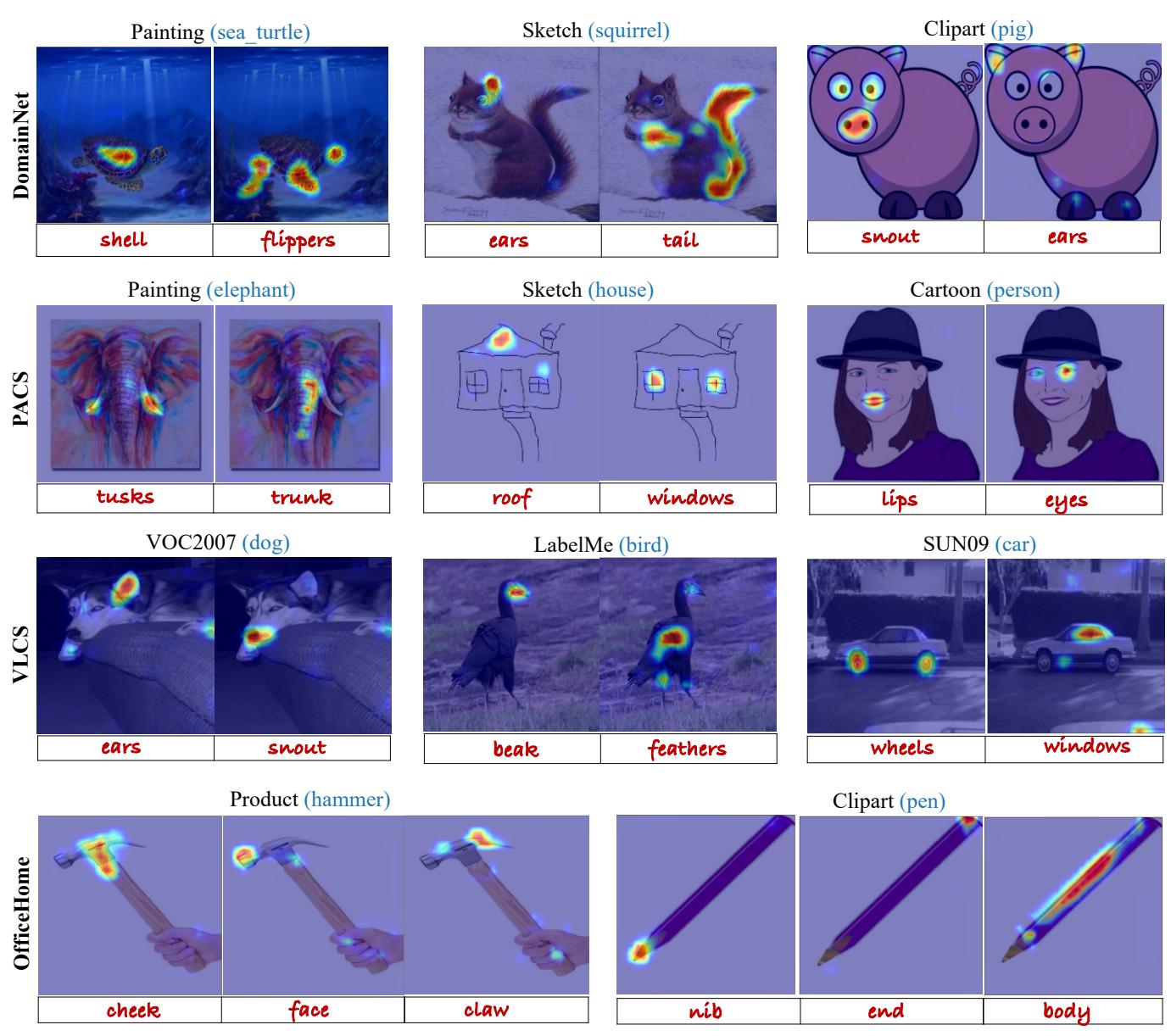
Figure 10 shows the model’s attention maps. Whether it’s a painting of a sea turtle, a sketch of a house, or a photo of a car, TIDE consistently highlights the semantically relevant parts: the shell, the roof, the wheels. This proves the model isn’t relying on background artifacts.
The Power of Correction
To see the test-time correction in action, look at Figure 7.

On the left, the model initially sees a sketch of a person but predicts “Dog”. Why? The heatmap shows it is focusing on the ears and mouth area, misinterpreting them as a dog’s snout. The signature verification step detects this mismatch. The correction algorithm masks those features and forces the model to look again. In the bottom row, the model shifts focus to the eyes and lips, correctly identifying the image as a “Person”.
Similarly, on the right, a House is misclassified as an Elephant because the roof lines look like tusks. After correction, the attention shifts to the windows and roof structure, leading to the correct classification.
However, the system isn’t perfect. There are cases where the “wrong” features look scarily similar to the “right” features of another class.
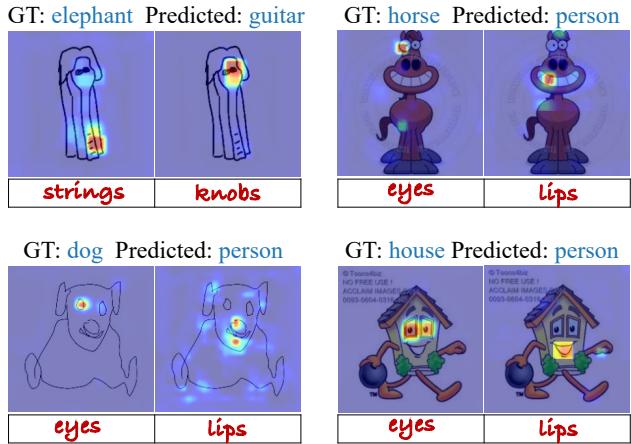
Figure 8 shows failure cases. A sketch of an elephant is misclassified as a guitar because the trunk looks like strings. Because the visual similarity is so strong, the signature verification doesn’t flag it as an error—the “trunk” features are close enough to “string” features in the embedding space to pass the check.
Conclusion
TIDE represents a shift in how we think about robust deep learning. Rather than treating the neural network as a black box and feeding it more augmented data, TIDE cracks the box open. By defining what the model should learn (local concepts) and where those concepts are located, TIDE achieves two goals that are often at odds: higher performance and better interpretability.
The ability to correct predictions at test-time is particularly powerful for deployment in the real world. If a self-driving car or a medical diagnostic tool can “realize” it is looking at the wrong feature and correct itself, we are one step closer to truly reliable AI.
Key Takeaways:
- Local over Global: Robustness comes from learning invariant local concepts (beaks, eyes) rather than global statistics.
- Generative Annotation: We can use LLMs and Diffusion Models to generate massive amounts of detailed training data (concept maps) without human effort.
- Self-Correction: Interpretable features allow models to verify their own predictions and refine their attention loops to fix mistakes.