](https://deep-paper.org/en/paper/2411.17440/images/cover.png)
Imagine you want to direct a short film. You have a script, and you have a photo of your lead actor. In the traditional world, this requires cameras, lighting crews, and days of shooting. In the world of Generative AI, we have moved closer to doing this with just a text prompt.
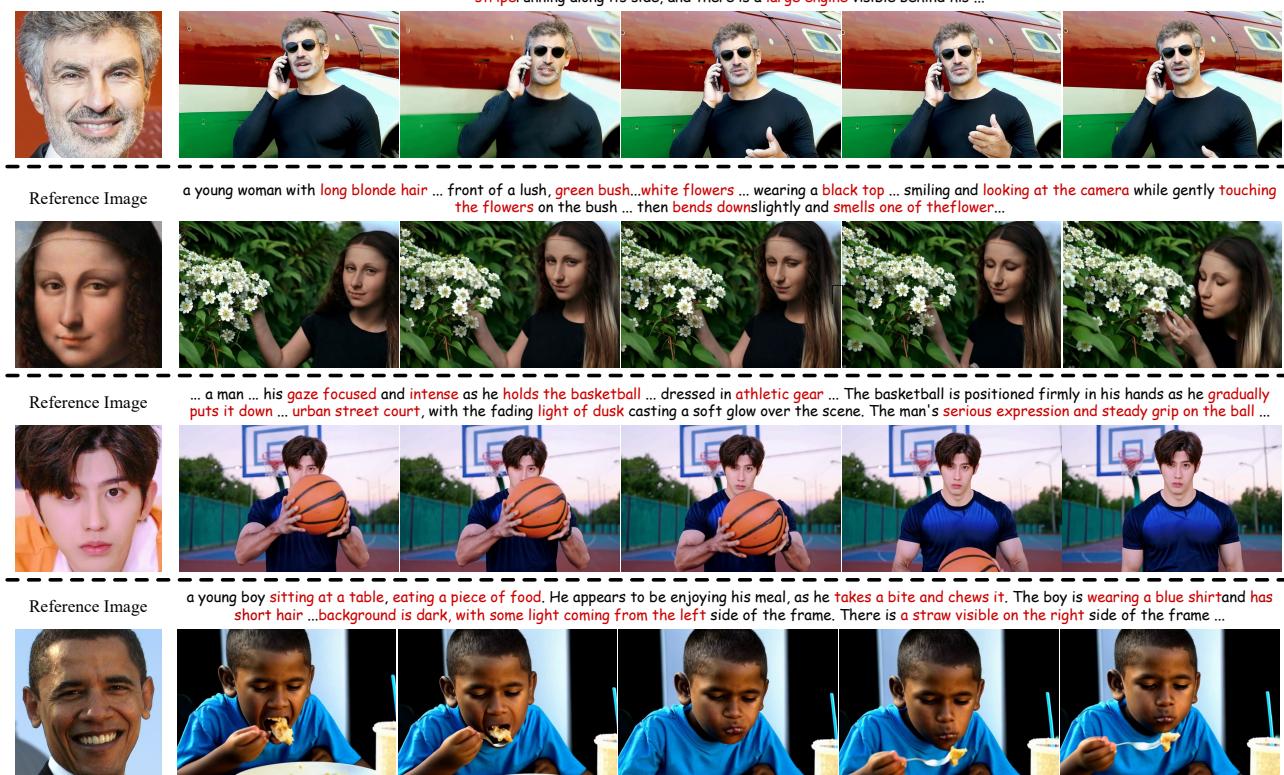
However, if you have ever tried to generate a video of a specific person using standard text-to-video models, you have likely encountered the “Identity Problem.” You might upload a photo of yourself and ask for a video of you playing basketball. The result? A person playing basketball who looks vaguely like you in one frame, like your cousin in the next, and like a complete stranger in the third.
Preserving human identity consistently across video frames—without expensive, case-by-case fine-tuning—is the Holy Grail of current video generation research.
In this post, we are diving deep into ConsisID, a groundbreaking paper that proposes a frequency decomposition method to solve this. The researchers identified that the reason current models struggle with identity is that they treat all visual information the same. By separating facial features into low-frequency (structure, shape) and high-frequency (details, texture) signals, ConsisID achieves state-of-the-art, tuning-free identity preservation.
The Core Problem: Why is Identity so Hard?
Before we dissect the solution, we need to understand the bottleneck.
Most modern video generation models are based on Diffusion Models. While early versions used U-Net architectures (like Stable Diffusion), the state-of-the-art is shifting toward Diffusion Transformers (DiT) (like Sora or CogVideoX). DiTs are powerful, scalable, and excellent at understanding temporal dynamics. However, they have a weakness when it comes to control.
The authors of ConsisID highlight two critical limitations of using DiTs for identity preservation:
- Training Convergence: DiTs lack the long skip connections found in U-Nets. This makes it harder for them to learn pixel-level predictions from scratch without strong guidance.
- Frequency Blindness: Transformers are naturally good at capturing global context (the “big picture”) but struggle with high-frequency information. High-frequency signals contain the fine details—the specific curve of an eyelid, the texture of the skin, the exact shape of the nose—that make a person look like themselves.
Current solutions either require fine-tuning (training the model on the specific person for hours) or use “tuning-free” adapters that often result in a loss of likeness or inability to edit the video context.
The Solution: Frequency Decomposition
The researchers propose a method called ConsisID. The core philosophy is simple yet profound: Don’t feed the model the face all at once. Break it down.
Facial features can be decomposed into two types of signals:
- Low-Frequency (Global features): The face profile, head proportions, and general contours.
- High-Frequency (Intrinsic features): Identity markers that remain unaffected by pose or lighting, such as specific facial details.
ConsisID creates two separate pathways to inject these signals into the Diffusion Transformer at the exact points where the model can best utilize them.
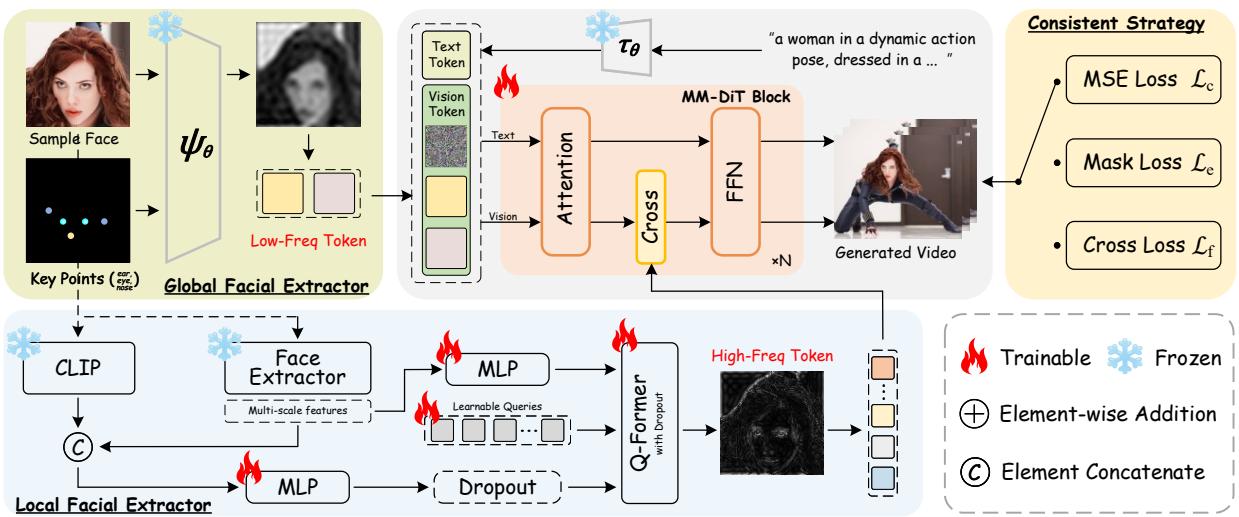
As shown in the architecture diagram above, the model consists of three main components:
- Global Facial Extractor (Low-Frequency)
- Local Facial Extractor (High-Frequency)
- Consistency Training Strategy
Let’s break these down step-by-step.
1. The Global Facial Extractor (Low-Frequency View)
The first challenge is helping the DiT converge and understand the basic structure of the face.
Based on the finding that shallow (early) layers of a network rely on low-frequency features for pixel prediction, ConsisID takes the reference face image and processes it uniquely. Instead of just feeding the raw image, the researchers extract facial key points (landmarks for eyes, nose, jawline) and convert them into a heatmap-style RGB image.
They concatenate the original reference image with these key points and feed them into the model’s input alongside the noisy latent variables.
Why key points? If you just feed a photo of a face, it includes lighting, shadows, and background noise. By including key points, the model is given a “structural map.” This guides the model to focus on the facial layout (low-frequency signal) right from the start. This acts as a strong anchor, ensuring the generated person has the correct head shape and proportions throughout the video.
2. The Local Facial Extractor (High-Frequency View)
This is where the magic of likeness happens. The structural map ensures the head is shaped right, but it doesn’t ensure the person looks like you. For that, the model needs high-frequency details.
The researchers found that DiTs are somewhat “deaf” to high-frequency details if they are just injected at the beginning. These details need to be injected deep inside the transformer blocks.
The Local Facial Extractor uses a clever dual-tower approach:
- Face Recognition Backbone: Extracts “intrinsic identity” features. These are features that face recognition systems use to identify you regardless of your expression or age.
- CLIP Image Encoder: Extracts semantic features (e.g., “blonde hair,” “smiling”). This allows the video to be editable via text.
These features are fused using a Q-Former (a module designed to bridge different modalities). This results in a rich feature set containing both the “soul” of the identity and the semantic details needed for generation.
Injection Strategy: Crucially, these high-frequency tokens are fused with the visual tokens inside the Attention Blocks of the DiT.
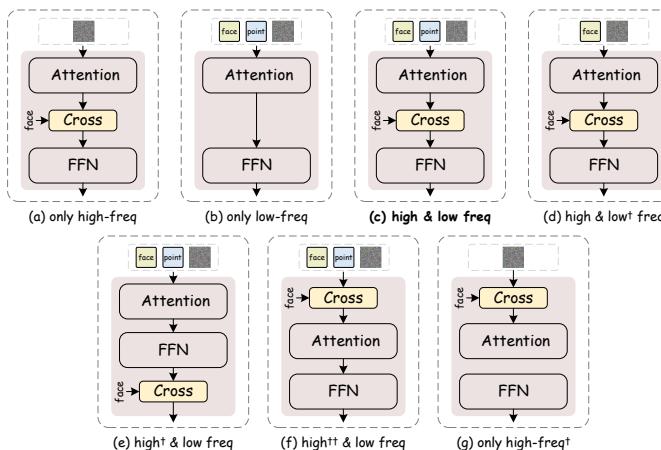
The visualization above (specifically c) shows the winning strategy. Notice how the high-frequency information (Local) interacts directly within the attention mechanism, while the low-frequency information (Global/Points) enters at the input level. This ensures the model processes structure first and paints in the identity details during the generation process.
3. Consistency Training Strategy
Architecture alone isn’t enough; the model needs to be taught how to prioritize the face. The authors introduce a hierarchical training recipe:
- Coarse-to-Fine Training: The model first learns the low-frequency global features (the “shape” of the person) and then progressively focuses on the high-frequency textures.
- Dynamic Mask Loss: In standard training, the model tries to optimize the whole image (background + person). Here, the researchers calculate a loss specifically for the face region (using a mask) and weigh it higher. This forces the model to “care” more about getting the face right than the background trees.
- Dynamic Cross-Face Loss: To prevent the model from just “copy-pasting” the reference image, they sometimes use a reference image that is different from the target video frame (e.g., a different photo of the same person). This forces the model to learn the identity, not just copy pixels.
Experimental Results
Does it actually work? The results are compelling, particularly when compared to existing open-source solutions like ID-Animator.
Qualitative Analysis
In visual comparisons, the difference is stark. ID-Animator often struggles to generate bodies or complex actions, limiting itself to “talking head” style videos. ConsisID, however, generates full-body motion, diverse backgrounds, and complex interactions while keeping the face consistent.
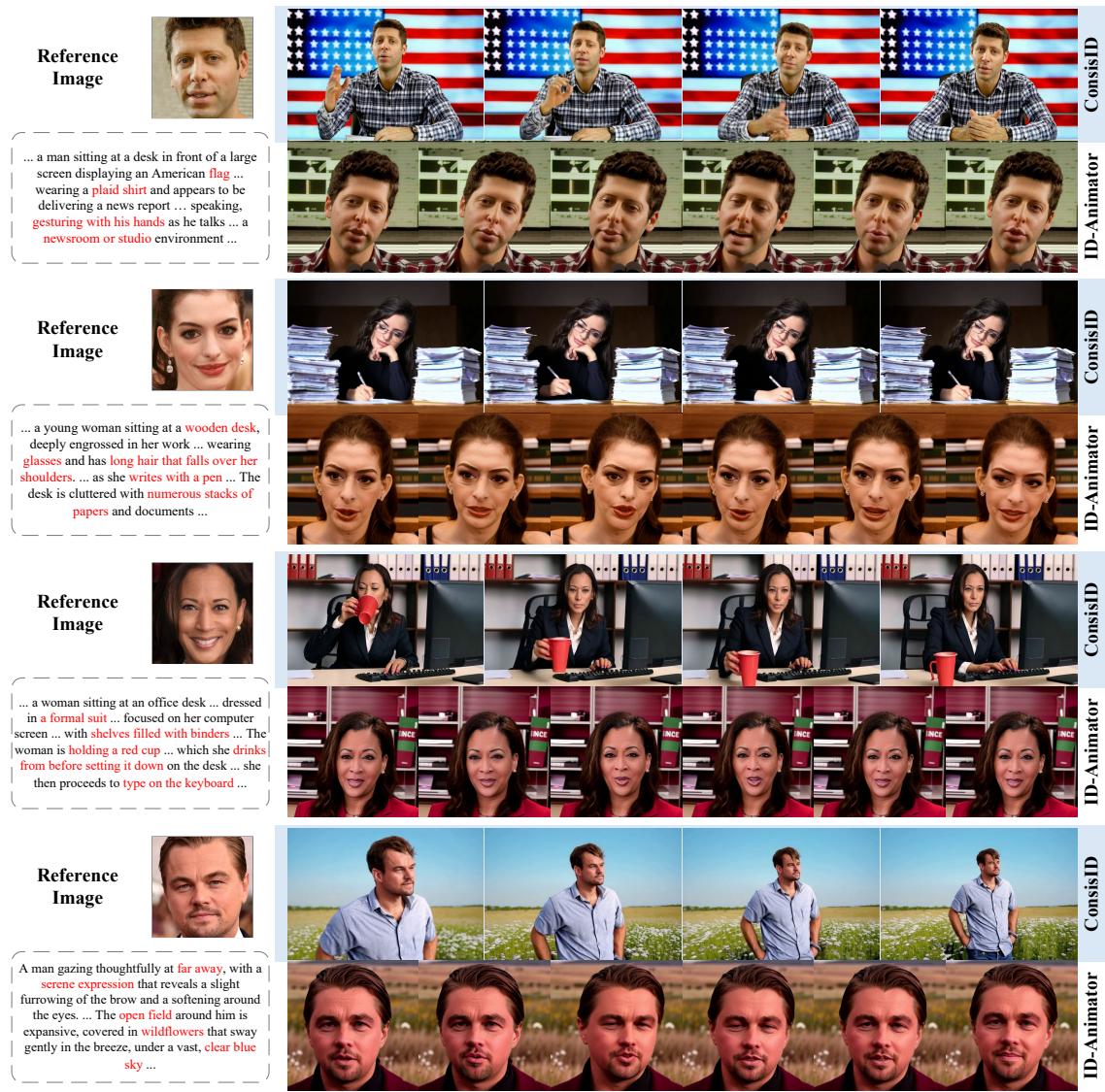
In the figure above, look at the fourth column. ConsisID successfully generates a cinematic shot of a man in a field, maintaining his facial structure and beard texture. ID-Animator produces a face that looks somewhat similar but lacks the integration with the body and environment.
Quantitative Analysis
The researchers used metrics like FaceSim (Face Similarity) and CLIPScore (how well the video matches the text prompt).

As shown in Table 1, ConsisID significantly outperforms ID-Animator in identity preservation (FaceSim-Arc: 0.58 vs 0.32). This is a massive jump, indicating that the generated faces are mathematically much closer to the reference faces.
The Frequency Proof
One of the most interesting parts of the paper is the validation of their core hypothesis: that frequency decomposition actually happens. They applied Fourier transforms to the generated videos to visualize the frequency information.
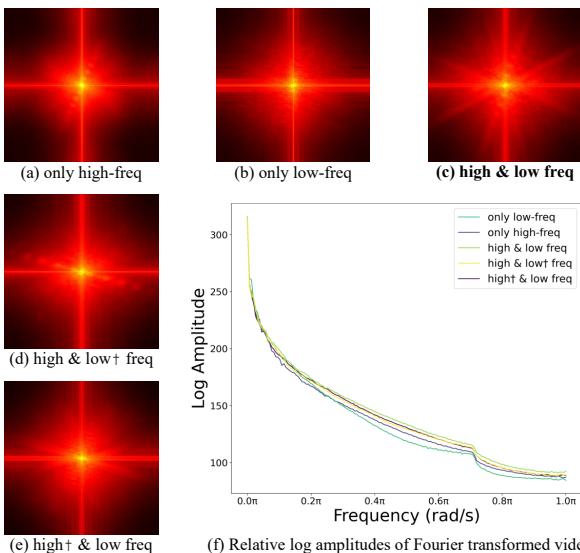
In Figure 7, look at the “starburst” patterns in the Fourier spectrums (a-e).
- (a) Only high-freq injection: Sharp lines (details) but poor convergence.
- (b) Only low-freq injection: Blurry center (structure) but lacks the sharp outer lines (details).
- (c) ConsisID (High & Low): Shows both the strong central glow (structure) and the sharp radiating lines (details).
This visualization scientifically proves that injecting signals at different stages of the DiT effectively reconstructs both the shape and texture of the face.
Ablation Studies: Do we need all the parts?
The authors performed “ablation studies”—systematically removing parts of the model to see what breaks.
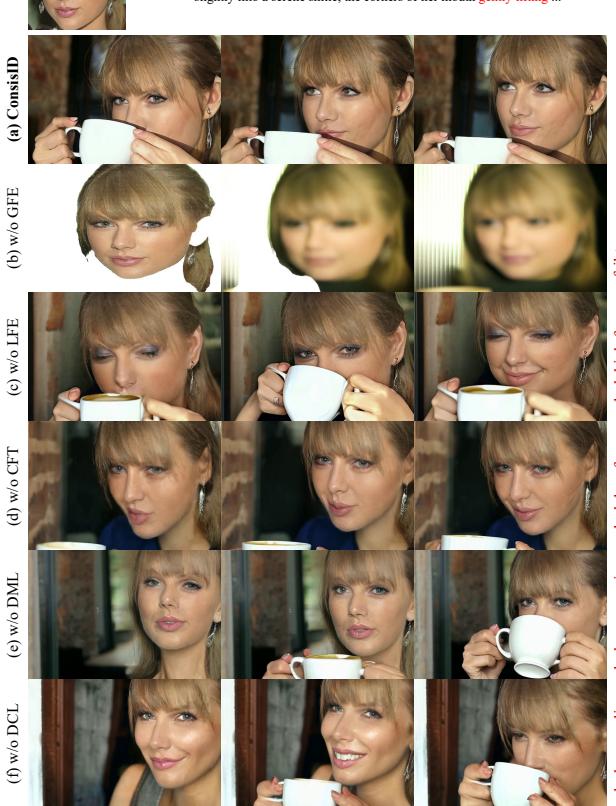
- w/o GFE (Global Facial Extractor): The model fails to converge (Panel b). The face looks like a blurry mess because the model “doesn’t know where the head is.”
- w/o LFE (Local Facial Extractor): The video is generated, but the person looks like a generic human, not the specific reference identity (Panel c). The high-frequency details are gone.
- w/o DML (Dynamic Mask Loss): The identity is preserved, but the background quality suffers because the model wasn’t balancing the foreground/background focus correctly.
Conclusion and Implications
ConsisID represents a significant step forward in personalized video generation. By acknowledging that not all features are created equal, the researchers successfully adapted the powerful Diffusion Transformer architecture for identity-preserving tasks.
The key takeaways for students and practitioners are:
- DiTs behave differently than U-Nets: You cannot simply apply old U-Net tricks (like simple concatenation) to Transformers and expect them to work for fine details.
- Frequency matters: Thinking about images in terms of frequency (structure vs. detail) allows for more targeted architectural interventions.
- Tuning-free is the future: We are moving away from 30-minute fine-tuning sessions toward instant, zero-shot personalization.
As this technology matures, we can expect to see applications ranging from personalized gaming avatars and virtual try-ons to AI-assisted film production where a single actor can be consistently rendered across infinite generated scenes. ConsisID proves that we don’t need to retrain a model to remember a face; we just need to speak to the model in the frequencies it understands.