](https://deep-paper.org/en/paper/2411.17646/images/cover.png)
The release of the Segment Anything Model (SAM) and its video successor, SAM2, marked a pivotal moment in computer vision. These models are incredibly powerful; given a point or a bounding box, they can segment an object with near-perfect accuracy and track it through a video.
But there is a catch: SAM2 is “mute.” It doesn’t understand natural language. You cannot simply ask it to “segment the cat climbing the tree” or “track the red car turning left.” It requires explicit geometric prompts (clicks or boxes). Furthermore, while SAM2 is a master of pixel-matching, it lacks high-level reasoning about time and motion. It sees a video as a sequence of images to track, not as an event where actions unfold.
In this post, we dive into SAMWISE, a new research paper that injects “wisdom”—specifically natural language understanding and temporal reasoning—into the frozen SAM2 model. We will explore how this method achieves State-of-the-Art (SOTA) performance on complex video segmentation tasks by adding a negligible number of parameters.
The Problem: Referring Video Object Segmentation (RVOS)
The task at hand is Referring Video Object Segmentation (RVOS). The goal is to segment and track an object in a video based on a descriptive text query.
This is much harder than standard object detection for two reasons:
- Multimodal reasoning: The model must align visual features (pixels) with linguistic features (text).
- Temporal reasoning: Often, the text describes an action (e.g., “the person sitting down” vs. “the person standing up”). The model must understand motion over time to distinguish between similar objects.
The Limitations of Current Approaches
Most existing methods fall into two traps:
- Offline methods: They process the entire video at once. This allows for great context but makes them heavy, slow, and impossible to use in real-time streaming applications.
- Clip-based methods: They chop the video into independent clips. This is faster but loses global context. If an object is occluded for a few seconds, the model forgets it exists.
SAM2 offers a third way: Streaming. It processes frames as they come, using a memory bank to remember the past. However, because SAM2 wasn’t trained with text or motion understanding, simply plugging a text encoder into it doesn’t work well.
SAMWISE: The “Wise” Architecture
The researchers propose SAMWISE, a framework that wraps around a frozen SAM2 backbone. The core philosophy is efficiency: instead of retraining the massive SAM2 model, they insert small, learnable modules that “translate” text and time into a language SAM2 can understand.
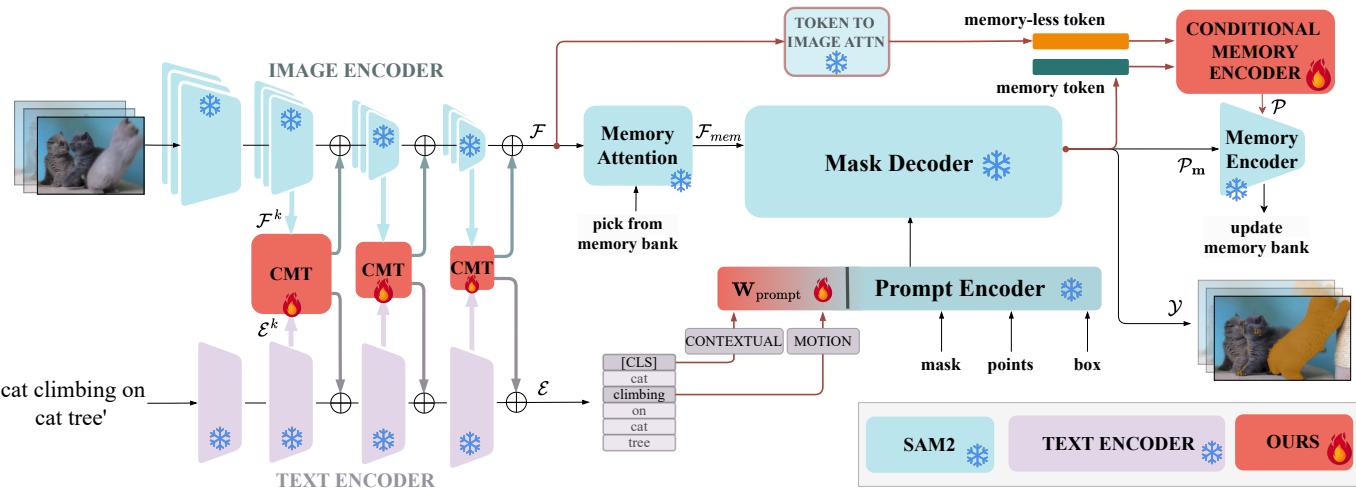
As shown in Figure 2, the architecture retains the original Image Encoder and Mask Decoder of SAM2. The magic happens in two key additions:
- Cross-Modal Temporal (CMT) Adapter: A module inserted into the encoder to mix text, vision, and time.
- Conditional Memory Encoder (CME): A mechanism to fix SAM2’s tendency to get “stuck” on the wrong object.
Let’s break these down.
1. The Cross-Modal Temporal (CMT) Adapter
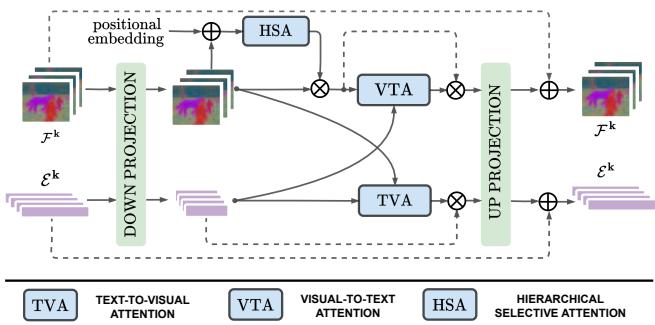
Standard adapters usually just project features from one space to another. The CMT Adapter in SAMWISE is more ambitious. It is placed inside the transformer layers of the encoders and performs two specific jobs: Cross-Modal Adaptation and Temporal Adaptation.
Visual-Text Interaction
As seen in Figure 3, the adapter enables a two-way conversation between the text and the image:
- Visual-to-Text Attention (VTA): The image features “look at” the text to identify which words correspond to the visible regions.
- Text-to-Visual Attention (TVA): The text features “look at” the image to ground abstract words (like “running”) in visual reality.
Temporal Adaptation (HSA)
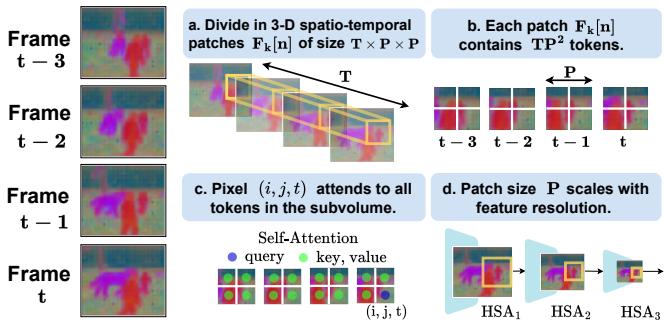
To understand motion (e.g., distinguishing a walking cow from a standing cow), the model needs to look at more than one frame at a time. However, attending to every pixel in a video clip is computationally expensive.
The authors introduce Hierarchical Selective Attention (HSA). Instead of global attention, HSA focuses on 3D Spatio-Temporal Patches (see Figure 4 below). It assumes that motion is local—a pixel in frame \(t\) is most related to its spatial neighbors in frames \(t-1\) and \(t+1\).
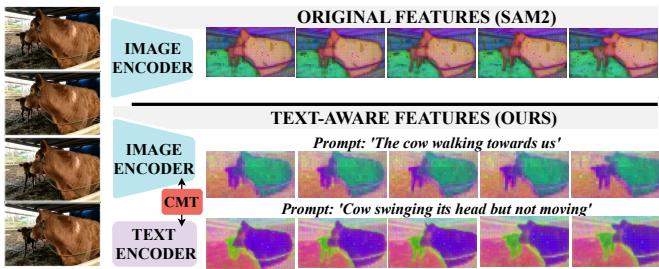
This allows SAMWISE to encode motion cues directly into the visual features. The impact of this is visualized in Figure 5 below. When the text prompt changes from “walking” to “swinging head,” the “heat” of the feature map shifts to different parts of the image (the legs vs. the head), proving that the adapter is successfully guiding the visual encoder.
2. Solving “Tracking Bias” with the Conditional Memory Encoder
One of the most fascinating insights in this paper is the identification of Tracking Bias in SAM2.
SAM2 is designed to be a robust tracker. Once it locks onto an object, it tries very hard not to lose it, even during occlusions. In RVOS, this is a double-edged sword.
Imagine a video with two cats. The prompt is “the cat climbing the tree.”
- In Frame 1, both cats are on the ground.
- SAM2 picks one cat arbitrarily (or the one that matches “cat” best) and starts tracking it.
- In Frame 50, the other cat starts climbing the tree.
- The Problem: SAM2 ignores the second cat because it is biased toward the one it is already tracking. It “trusts” its memory more than the current visual evidence.
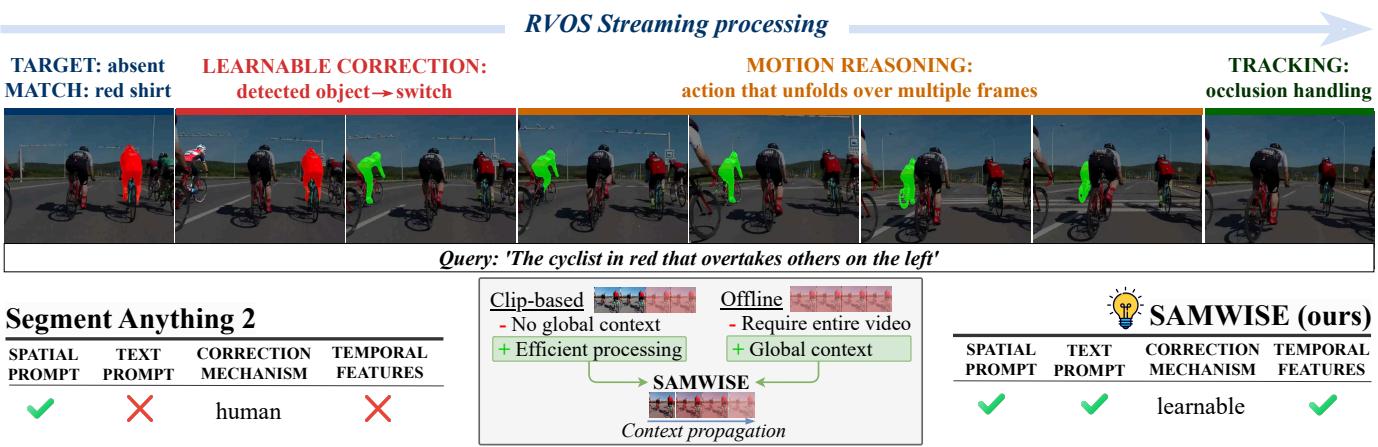
Figure 1 illustrates this perfectly. The cyclist target isn’t present initially, so a standard model tracks the wrong person. When the correct target appears, SAM2 would typically ignore it.
To fix this, SAMWISE introduces the Conditional Memory Encoder (CME).
How CME Works
The CME acts as a referee. At every frame, it compares two things:
- Memory Features: What SAM2 is currently tracking (biased by the past).
- Memory-Less Features: What the current frame looks like, aligned with the text (unbiased).
If the “Memory-Less” features show an object that matches the text strongly—and it’s different from what is being tracked—the CME fires a signal. It tells the Memory Bank: “Hey, the object we are tracking is no longer the best match. Switch focus to this new object.”
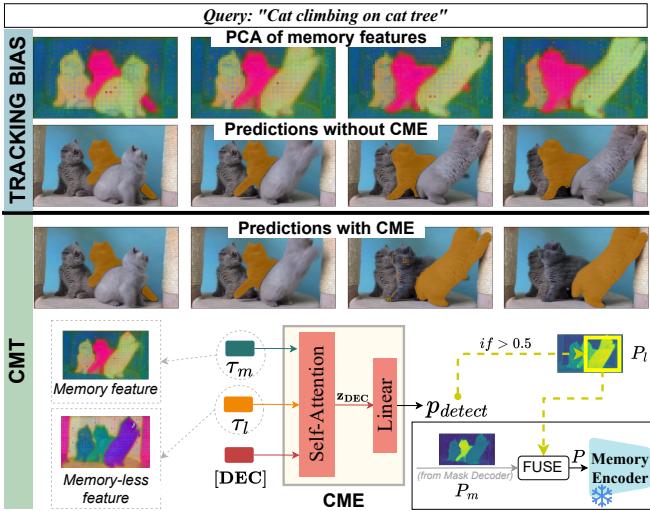
As shown in Figure 6, the CME detects the moment the cat starts “climbing” (the discriminative action) and injects this new information into the memory bank. This allows the model to seamlessly switch targets mid-video, a capability lacking in the original SAM2.
Experimental Results
The researchers tested SAMWISE on several benchmarks, including Ref-YouTube-VOS, Ref-DAVIS, and the challenging MeViS dataset. MeViS is particularly difficult because the queries rely heavily on motion (e.g., “the fish that swims away” vs “the fish staying still”).
Quantitative Success
SAMWISE achieves state-of-the-art results.
- On MeViS, it outperforms previous methods significantly, proving its ability to handle complex motion expressions.
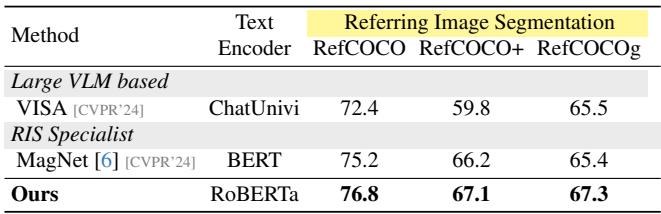
- It achieves these results with <5M trainable parameters, whereas full fine-tuning or Large Vision-Language Model (VLM) approaches require training or running massive models (billions of parameters).
Qualitative Success
The visual results confirm the numbers. In Figure 10 below, we see SAMWISE handling difficult scenarios:
- (a) Distinguishing a car based on its trajectory (“driving straight”).
- (e) Identifying a specific man based on his action (“moving to right and watching”).
The model is also robust enough to reject incorrect switches. Sometimes, the CME might suggest a new object that looks correct in the current frame but makes no sense in the global context. Because SAMWISE balances the CME output with the existing memory bank, it can maintain stability when necessary.
Conclusion
SAMWISE represents a smart approach to modern AI development: don’t reinvent the wheel; just make it roll better.
Instead of training a new video segmentation model from scratch, the authors leveraged the massive power of SAM2. By surgically inserting “wisdom” via the CMT Adapter (for text/time understanding) and the CME (for bias correction), they turned a geometric tool into a semantic one.
This work bridges the gap between static “segment anything” capabilities and the dynamic, messy reality of video understanding. It offers a blueprint for how we might adapt other foundational models for complex, multimodal tasks in streaming environments.
Key Takeaways
- Frozen Foundation: You don’t need to fine-tune massive models to get SOTA results; efficient adapters work wonders.
- Time Matters: Video isn’t just a stack of images. Explicitly modeling temporal patches (via HSA) is crucial for understanding actions.
- Bias Correction: Strong trackers like SAM2 can be too stubborn. Mechanisms like the CME are essential to allow models to “change their mind” when new evidence appears.