](https://deep-paper.org/en/paper/2411.17662/images/cover.png)
Imagine a robot arm working in a bustling kitchen or on a manufacturing floor. To collaborate safely with humans or other machines, this robot needs to know exactly where it is in space relative to the camera watching it. This is known as robot pose estimation.
Usually, this is straightforward because we can cheat: we ask the robot’s internal motor encoders what its joint angles are. But what if we can’t trust those sensors? What if we are observing a robot we don’t control? Or what if we simply want a purely vision-based redundancy system?
This presents a significantly harder problem: estimating both the robot’s pose (position and orientation) and its joint angles from a single RGB image.
In this deep dive, we will explore RoboPEPP, a novel research paper that introduces a clever way to solve this using “Embedding Predictive Pre-Training.” The researchers realized that standard computer vision models treat robots like just another object. RoboPEPP changes the game by forcing the AI to understand the physical structure of the robot—its joints and linkages—before it even tries to estimate a pose.
![Comparison of an existing robot pose estimation method [5] with the RoboPEPP framework.](/en/paper/2411.17662/images/001.jpg#center)
As shown in Figure 1, traditional methods often struggle to integrate the physical constraints of the robot into the learning process. RoboPEPP (bottom) specifically targets this by masking joints during training, forcing the network to “fill in the blanks” using its understanding of the robot’s kinematics.
The Problem with “Unknown States”
To estimate a robot’s pose relative to a camera, you typically need two things:
- 2D Keypoints: Where specific parts of the robot are in the image (pixels).
- 3D Geometry: Where those parts are in the physical world (meters).
If you match the 2D pixels to the 3D coordinates, you can use an algorithm called Perspective-n-Point (PnP) to calculate the camera’s position.
However, articulated robots move. If you don’t know the joint angles (the “state”), you don’t know the shape of the robot in 3D space. You cannot perform PnP without the 3D shape.
Previous attempts to solve this fell into two camps:
- Render-and-Compare: These systems guess the pose, render a 3D model of the robot, compare it to the image, and refine the guess. This is accurate but computationally expensive and slow.
- Direct Prediction: These use neural networks to predict everything in one pass. They are fast but often struggle with accuracy, especially when the robot is partially blocked (occluded) or cut off by the edge of the frame.
The authors of RoboPEPP argue that these direct prediction methods fail because they don’t truly “understand” the robot. They see a collection of pixels, not a series of rigid links connected by joints.
The RoboPEPP Solution
The core innovation of RoboPEPP is a two-stage training process designed to bake “physical intuition” into the neural network.
- Pre-Training: A self-supervised phase where the model learns the robot’s structure by predicting hidden joints.
- Fine-Tuning: The model is trained on the actual task of predicting angles and keypoints.
Let’s break down the full architecture.
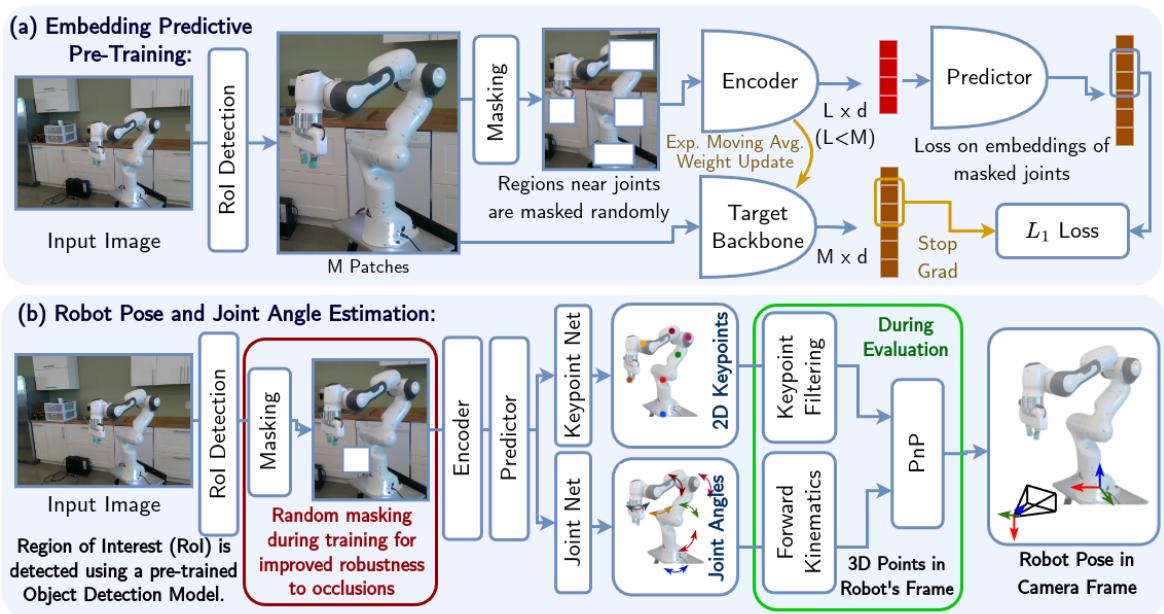
The framework, visualized in Figure 2 above, consists of an Encoder (which processes the image) and a Predictor (which reconstructs features). Once pre-trained, this system feeds into two downstream networks: the Joint Net and the Keypoint Net.
Phase 1: Embedding Predictive Pre-Training
How do you teach a neural network about robot physics without showing it equations? You use masking.
Masked Image Modeling (MIM) is a popular technique in computer vision where parts of an image are hidden, and the model must reconstruct them. However, random masking only teaches the model about textures and general shapes.
RoboPEPP introduces Joint-Masking.
Instead of masking random patches of grass or background, the researchers specifically mask the regions around the robot’s joints. To successfully reconstruct the information under that mask, the model must look at the surrounding unmasked robot parts (the context) and infer the connection. It essentially forces the model to learn: “If the upper arm is here, and the forearm is there, the elbow must be right here.”
The Architecture
The input image is chopped into small patches (16x16 pixels).
- Context: The unmasked patches are fed into a Vision Transformer (ViT) Encoder.
- Prediction: The encoder outputs “embeddings” (mathematical summaries) of the visible parts. A Predictor network then tries to guess the embeddings of the missing joint patches.
The loss function for this pre-training phase is simple yet powerful:
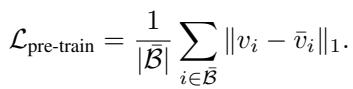
Here, \(v_i\) is the predicted embedding, and \(\bar{v}_i\) is the actual target embedding derived from the original image. By minimizing the \(L_1\) distance between them, the model learns a robust internal representation of the robot’s physical structure.
Phase 2: Downstream Fine-Tuning
Once the encoder understands the robot’s body, it is fine-tuned for the actual job. The system splits into two parallel tasks.
1. The Joint Net (Predicting Angles)
The first goal is to figure out the configuration of the robot. The Joint Net takes the image features and predicts the angle \(\Phi\) for every joint (e.g., shoulder, elbow, wrist).
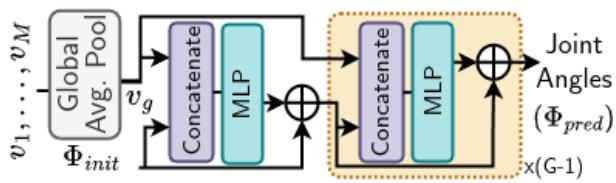
As seen in Figure 3, the Joint Net aggregates all the patch information into a global vector (\(v_g\)). It then uses an iterative Multi-Layer Perceptron (MLP) to refine its guess. It starts with zero as the angle, makes a prediction, feeds that back in, and refines it over 4 steps (G=4). This iterative approach helps dial in precise angles.
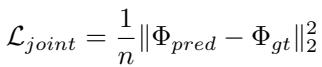
The network is trained using Mean Squared Error (MSE) against the ground truth angles:
2. The Keypoint Net (Predicting 2D Locations)
Simultaneously, the Keypoint Net tries to find the pixel coordinates of the joints.
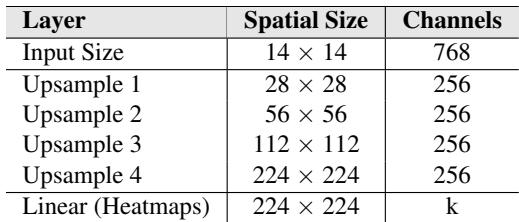
It takes the patch embeddings and progressively upsamples them (as shown in Table 1) to create high-resolution heatmaps. A heatmap is a probability grid where bright spots indicate where the model thinks a joint is located.
To train this, the authors use Focal Loss. This is crucial because, in a 224x224 image, most pixels are not joints. Standard loss functions would get lazy and just predict “no joint” everywhere. Focal loss forces the model to focus on the hard-to-classify examples (the actual joints).

Phase 3: Robustness and Inference
Real-world robotics is messy. Robots get blocked by objects (occlusion) or move partially out of the camera frame (truncation). RoboPEPP includes specific strategies to handle this.
Random Masking for Occlusion
During the fine-tuning phase, the researchers apply random masking to the input images. They artificially block out up to 20% of the image. This prevents the model from becoming over-reliant on seeing the entire robot. Since it was pre-trained to infer missing joints, it handles these gaps naturally.
Confidence-Based Keypoint Filtering
A major issue in pose estimation is “truncation”—when part of the robot is off-screen. A standard neural network will still try to guess a location for the missing joint, usually picking a noisy, incorrect pixel inside the image.
RoboPEPP solves this by looking at the confidence peaks in the heatmaps.
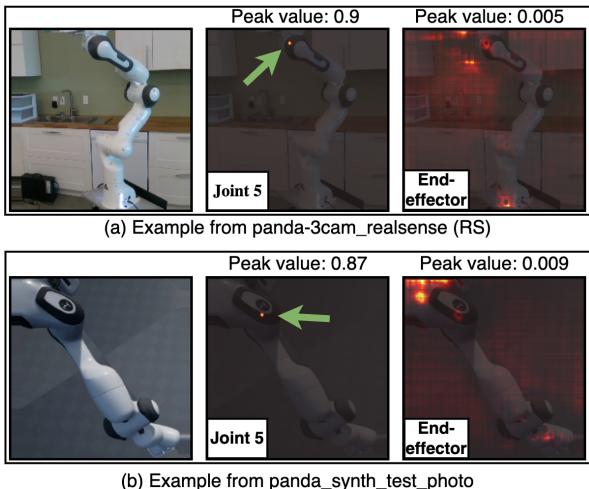
In Figure 4, you can see the difference. Joint 5 (middle column) is visible, and the heatmap has a strong, bright peak (value 0.9 or 0.87). The End-Effector (right column) is out of frame. The heatmap is a messy blur of low values (peak 0.005).
The system applies a threshold. If the confidence is too low, it discards that keypoint. It effectively says, “I can’t see the hand, so I won’t use the hand to calculate position.”
Determining the Final Pose
Finally, the system combines everything:
- 3D Coordinates: Calculated using the predicted joint angles and the robot’s known Forward Kinematics.
- 2D Coordinates: Obtained from the Keypoint Net (after filtering).
These correspondences are fed into the EPnP (Efficient Perspective-n-Point) algorithm, which mathematically solves for the robot’s position and rotation relative to the camera.
Sim-to-Real Transfer
Deep learning models trained on synthetic data (video games) often fail in the real world. To bridge this “Sim-to-Real” gap, RoboPEPP uses a self-supervised fine-tuning step on real images.
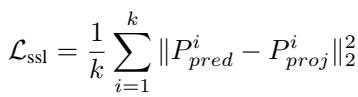
They project the predicted 3D points back onto the 2D image and measure the error. Because they use a differentiable PnP layer, they can backpropagate this error through the whole network without needing ground truth labels for the real-world data.
Experiments and Results
The researchers tested RoboPEPP on the DREAM dataset, which includes various robots (Panda, Kuka, Baxter) in both synthetic and real-world environments.
State-of-the-Art Accuracy
The primary metric used is the ADD (Average Distance) metric, which measures the average distance between the predicted 3D joint positions and the true positions.
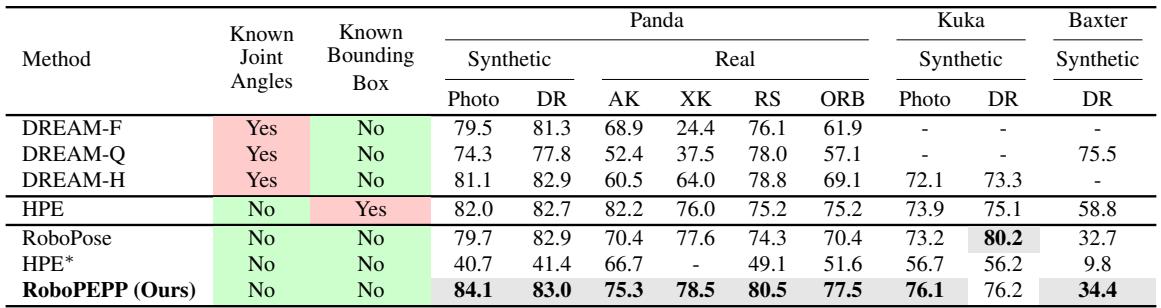
Table 2 shows the results (higher AUC is better). RoboPEPP consistently outperforms existing methods like RoboPose and HPE, particularly in scenarios where joint angles are unknown.
- On the Panda Photo dataset, RoboPEPP scores 80.5, compared to 74.3 for RoboPose.
- It even beats HPE in many cases, despite HPE using known bounding boxes (a significant advantage).
Joint Angle Precision
RoboPEPP isn’t just good at finding where the robot is; it’s excellent at determining how the robot is bent.
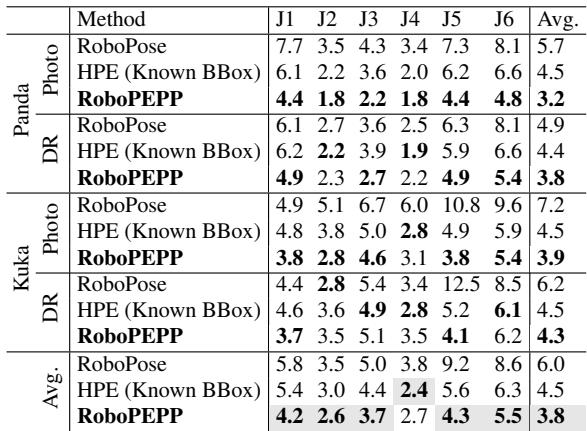
Table 3 shows the error in degrees. RoboPEPP achieves an average error of just 3.8 to 4.3 degrees. This is significantly sharper than RoboPose (~6.0 degrees), proving that the pre-training strategy effectively teaches the encoder about the robot’s internal state.
The Ultimate Test: Occlusion
The most impressive results come from the occlusion tests. The researchers artificially blocked parts of the robot to see if the models would break.
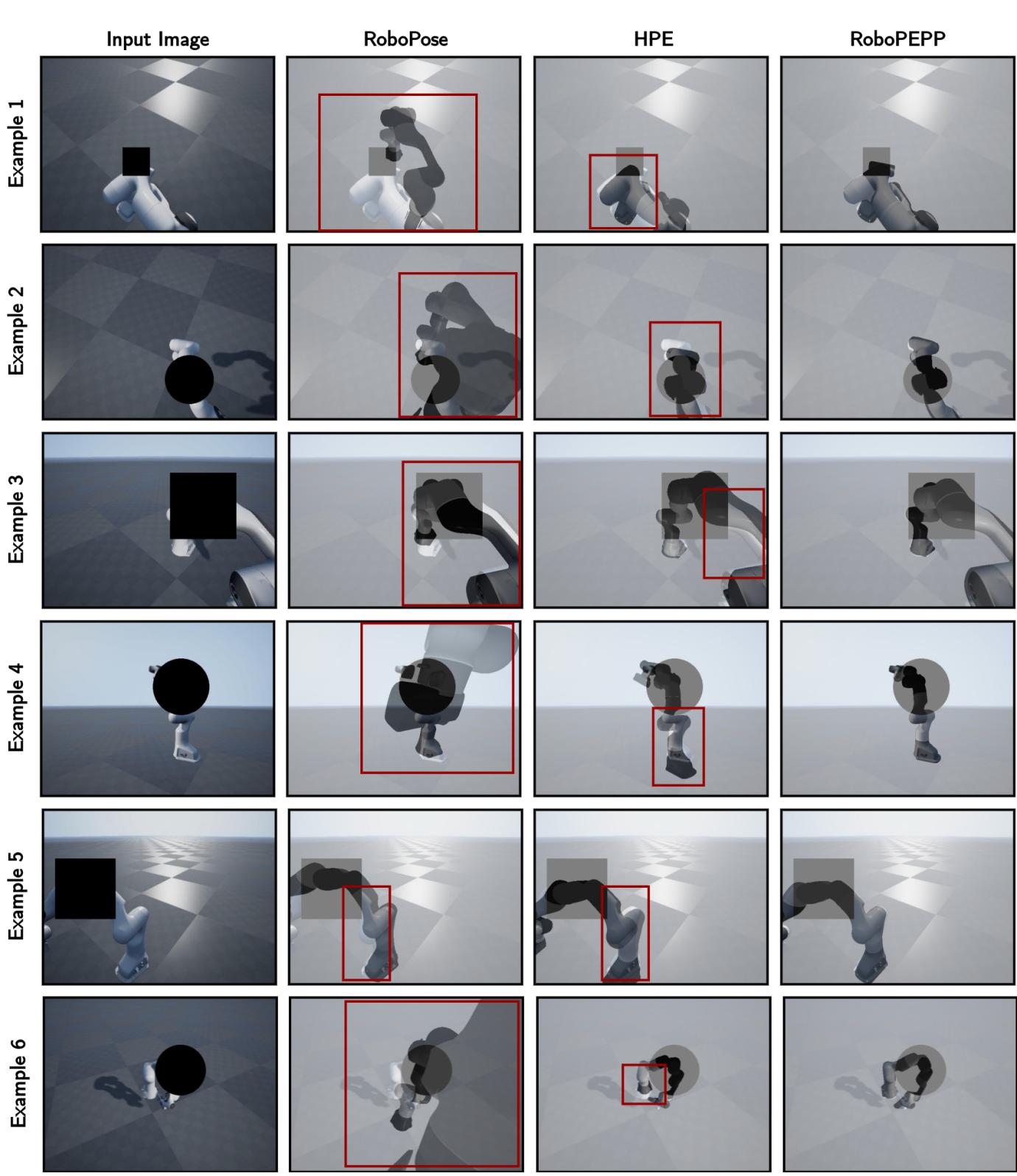
In the figure above (Figure A4 from the appendix), look at the columns.
- Input Image: The robot is heavily blocked by black shapes.
- RoboPose (Red Box): Frequently estimates a pose that is wildly off, twisting the robot into impossible shapes.
- RoboPEPP: Maintains a tight, accurate alignment with the visible parts of the robot mesh, correctly inferring the hidden parts.
Quantitatively, this advantage is massive:
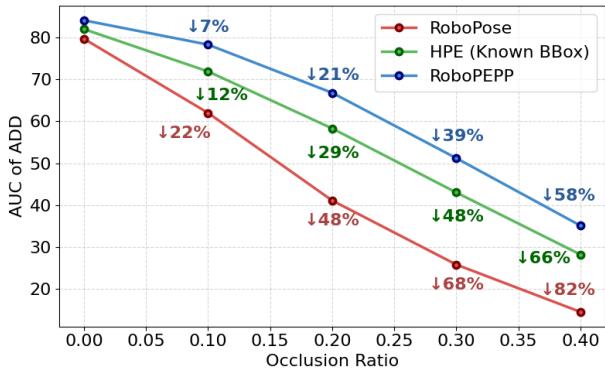
Figure 6 plots performance as occlusion increases (moving right on the x-axis).
- RoboPose (Red Line): Performance crashes immediately.
- RoboPEPP (Blue Line): Retains high accuracy even at 40% occlusion. The drop-off is much flatter, indicating the model is robust.
Speed vs. Accuracy
In robotics, accuracy is useless if it takes 5 seconds to process a frame.
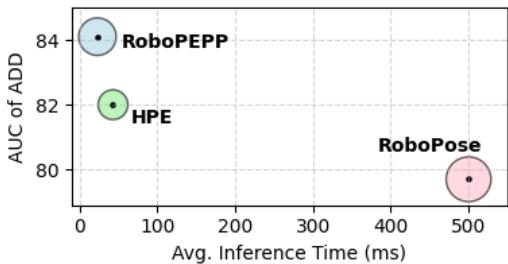
Figure 7 plots accuracy (Y-axis) against time (X-axis).
- RoboPose is accurate but slow (~500ms).
- RoboPEPP is the clear winner in the top-left corner: highest accuracy and extremely fast inference (~23ms). This makes it viable for real-time control loops.
Why it Works: Ablation Studies
The authors performed “ablation studies” (removing parts of the system to see what breaks) to prove their contributions matter.
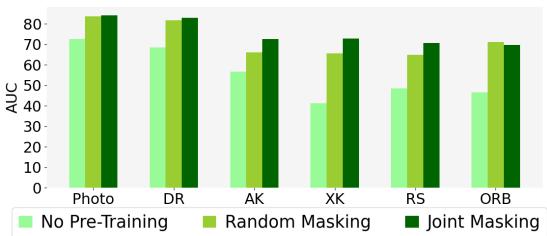
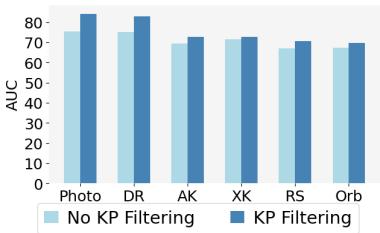
- Keypoint Filtering (Figure 8b): Removing the filtering step (light blue bars) drops performance significantly. Knowing when to ignore a prediction is as important as the prediction itself.
- Sim-to-Real (Figure 8c): The self-supervised fine-tuning provides a solid boost on real-world datasets (AK, XK, RS), validating the differentiable PnP approach.
Conclusion
RoboPEPP represents a significant step forward in vision-based robot perception. By moving away from treating robots as generic objects and instead teaching the AI about physical connectivity through joint-masked pre-training, the researchers achieved state-of-the-art results.
The key takeaways for students and practitioners are:
- Context is King: Masked pre-training forces models to learn semantic structure, not just texture.
- Robustness via Inference: Simple heuristic tricks, like filtering low-confidence keypoints, are essential for making neural networks work in the real world.
- Efficiency: You don’t always need an iterative “render-and-compare” loop. A well-trained feed-forward network can be both faster and more accurate.
This work opens the door for safer, more responsive human-robot interaction, allowing machines to understand their own bodies purely through vision, even when things get cluttered.
The full code for RoboPEPP is available for those interested in diving deeper into the implementation.