](https://deep-paper.org/en/paper/2411.17763/images/cover.png)
Introduction
“Symmetry is what we see at a glance.” — Blaise Pascal.
When you look at a photograph of a car, a chair, or a butterfly, your brain instantly infers its structure. You don’t need to see the other side to know it’s there; you intuitively understand that the object is symmetric. This perception is fundamental to how humans interpret the 3D world. However, for computer vision systems, detecting 3D symmetry from a single, flat 2D image is an immensely difficult task.
Depth is lost in 2D images, perspective distorts shapes, and crucial parts of an object are often occluded. While AI has made strides in detecting symmetry in 3D point clouds or depth maps, doing so “zero-shot” (on objects the model has never seen before) from a single RGB image has remained an open challenge.
Enter Reflect3D.
In the paper “Symmetry Strikes Back,” researchers from the University of Illinois at Urbana-Champaign and Georgia Tech propose a novel framework that not only detects 3D reflection symmetry from single images with state-of-the-art accuracy but also leverages that symmetry to drastically improve the quality of 3D generative AI.
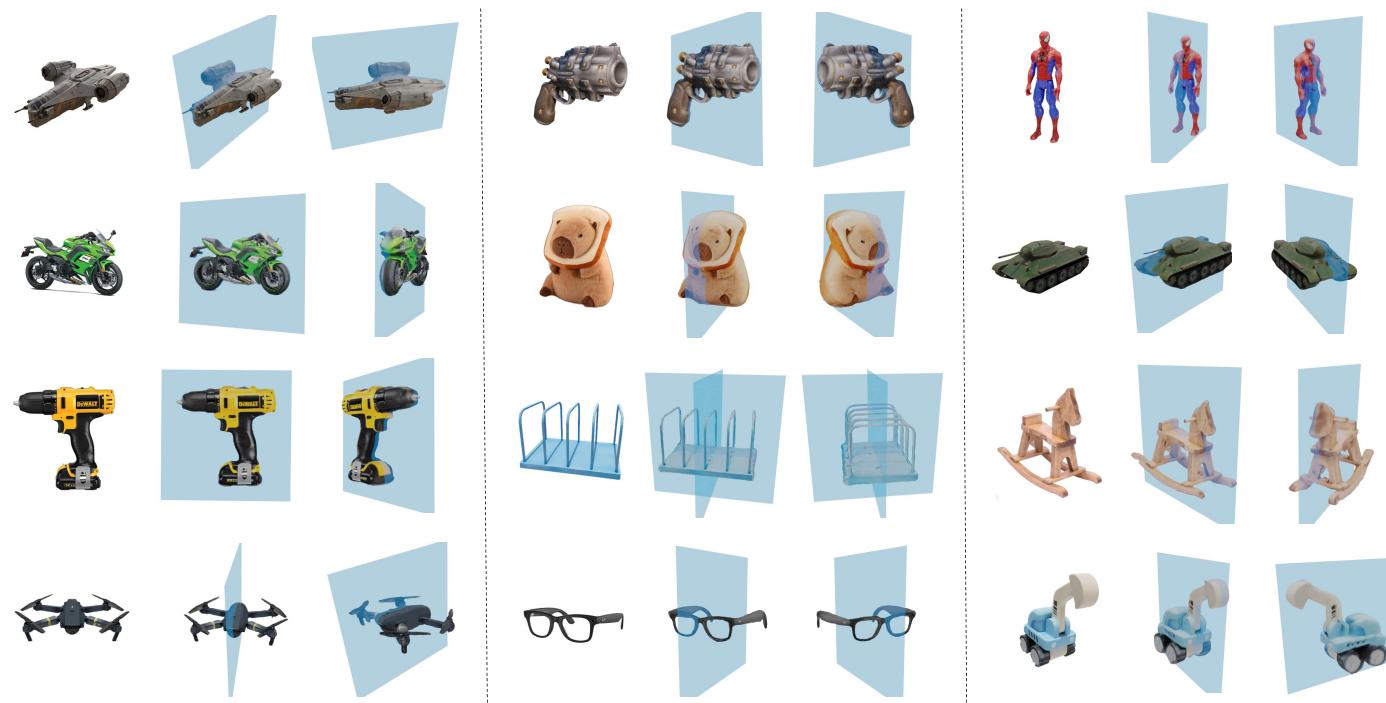
As shown above, Reflect3D works on a diverse range of objects—from spaceships to power drills—detecting their axis of symmetry and using it to render consistent 3D models. In this post, we will dissect how Reflect3D works, how it overcomes the “ambiguity” of single views, and why this matters for the future of 3D content creation.
The Challenge: Single-View Ambiguity
Before understanding the solution, we must define the problem. 3D reflection symmetry is a geometric property. An object is symmetric if there is a plane that acts as a mirror, mapping every point on one side to the other.
Mathematically, a shape \(S\) has reflection symmetry with respect to a plane \(p\) if:

Here, \(M_p\) is the reflection transformation matrix. Essentially, if you flip the object across the plane, it should look identical, and its surface properties (like texture) should be preserved. The matrix is defined by the plane’s normal vector \(\mathbf{n}_p\) and its distance to the origin \(d_p\):
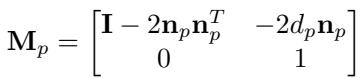
The goal of the research is to find the set of all such symmetry planes \(\mathcal{P}\):

The core difficulty lies in single-view ambiguity. When you only see an object from one angle, perspective distortion and lack of depth information make it hard to tell if an object is truly symmetric or just looks symmetric from that specific viewpoint. Furthermore, determining the “back” of the object is pure guesswork for standard algorithms.
Previous methods attempted to solve this by training on limited categories (like just faces or just cars) or requiring depth data. Reflect3D aims for a general-purpose, zero-shot solution that works on “in-the-wild” internet images.
The Reflect3D Architecture
The researchers tackled this problem by combining two modern AI paradigms: Foundation Models (specifically Transformers) and Generative Priors (Diffusion Models).
The architecture is divided into two main phases: a feed-forward detector that makes the initial guess, and a multi-view enhancement pipeline that refines it.
1. The Feed-Forward Detector
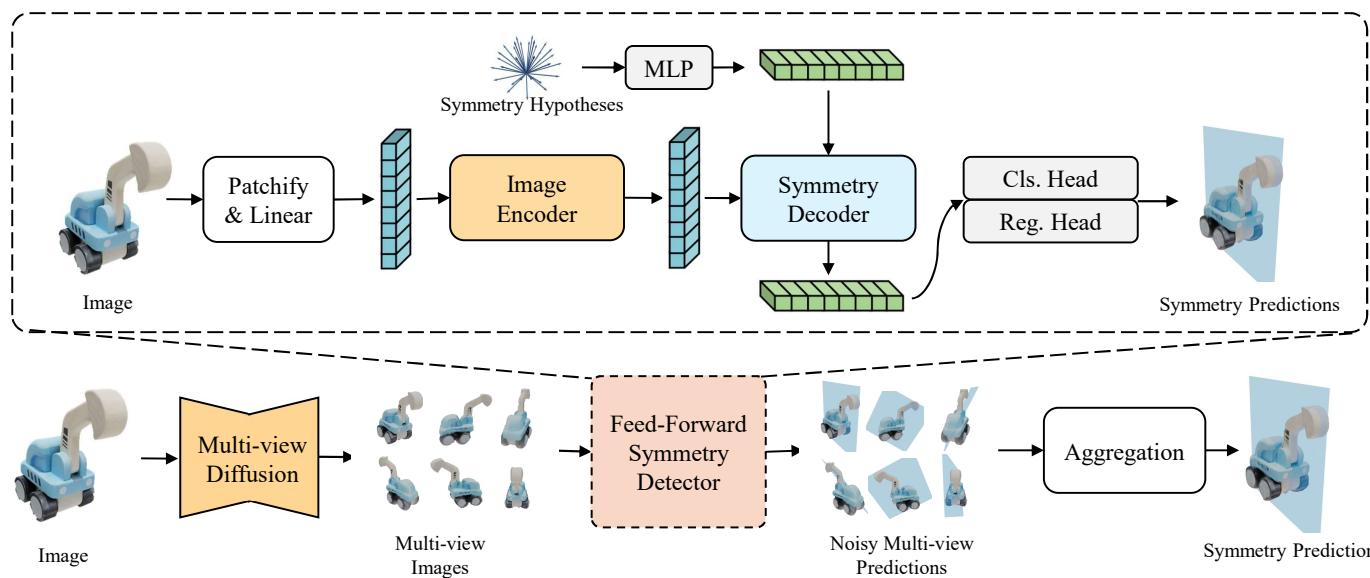
The top half of Figure 2 illustrates the direct detection method. This is a transformer-based model designed to predict symmetry directly from the image.
The Image Encoder (DINOv2): The choice of the image encoder is critical. The authors use DINOv2, a vision transformer foundation model. Unlike models like CLIP, which are trained to align images with text (focusing on semantics, e.g., “this is a dog”), DINOv2 is self-supervised and learns robust geometric and spatial features. This sensitivity to object geometry makes it far superior for detecting structural cues like symmetry. The encoder is kept frozen to retain these rich, pre-trained geometric features.
The Symmetry Decoder: Instead of trying to regress a single symmetry plane immediately, the model uses a “hypothesis” strategy.
- Hypotheses Sampling: The model starts with \(N\) fixed “symmetry hypotheses”—unit vectors evenly distributed across a hemisphere. Each hypothesis represents a potential direction for the symmetry plane.
- Cross-Attention: These hypotheses act as queries in a transformer decoder. They attend to the image features extracted by DINOv2. This allows the model to check the image against various possible symmetry angles simultaneously.
- Classification and Regression: For each hypothesis, the model outputs two things:
- A Classification Score: Is there actually a symmetry plane in this direction?
- A Regression Adjustment: A precise “nudge” (residual rotation) to align the hypothesis perfectly with the true symmetry plane.
This design allows the model to detect multiple symmetry axes if they exist or none if the object is asymmetric.
2. Multi-View Symmetry Enhancement
The feed-forward model is powerful, but it still suffers from single-view ambiguity. To solve this, the authors introduce a “Generative Prior” using diffusion models, shown in the bottom half of Figure 2.
The logic is simple: If we can’t walk around the object to check for symmetry, let’s ask an AI to imagine what the object looks like from other angles.
- Multi-View Diffusion: The input image is fed into a multi-view diffusion model (like Zero-1-to-3). This generates synthetic images of the object from surrounding viewpoints (e.g., side, back, top).
- Parallel Detection: The feed-forward symmetry detector (described above) is run on all these generated views independently.
- Aggregation: The predictions from all views are rotated back into a common coordinate system. The system then performs clustering (K-Means).
- Consensus: By aggregating predictions, outliers caused by bad viewing angles are filtered out. The final prediction is the center of the largest cluster. This effectively hallucinates the 3D structure to confirm symmetry.
Application: Symmetry-Aware 3D Generation
Why does this matter? Aside from robot perception, the “killer app” for this technology is Single-Image 3D Generation.
Current methods for turning a 2D picture into a 3D model (like DreamGaussian) rely on Score Distillation Sampling (SDS). They optimize a 3D representation (like Gaussian Splats) to look like the input image. However, these methods often produce the “Janus problem” (a face on the back of the head) or a blurry, flat backside because the AI doesn’t know what’s behind the object.
Reflect3D solves this by enforcing symmetry as a constraint during the generation process.

The authors integrate symmetry into the pipeline in three stages:
- Symmetry Alignment: Once the symmetry plane is detected, the 3D point cloud is aligned to this plane. This ensures the object is oriented correctly in 3D space.
- Symmetric SDS Optimization: During the optimization, the model doesn’t just check if the rendered image looks good. It checks if the reflected view also looks consistent. They also periodically “densify” the 3D Gaussians symmetrically—if a detail exists on the left, it is copied to the right.
- Symmetric Texture Refinement: When painting the texture onto the 3D model, the system uses the symmetry plane to fill in occluded regions. If the camera sees the left ear but not the right, the system mirrors the texture of the left ear to the right side.
Scaling Up: Data Curation
To train a model that works “zero-shot” on everything from toys to tanks, you need data—lots of it. Previous datasets were too small or limited to specific categories.
The authors curated a massive dataset by combining Objaverse and ShapeNet. They developed an automated pipeline to calculate ground-truth symmetry planes for thousands of objects by sampling points and checking if they align after reflection.
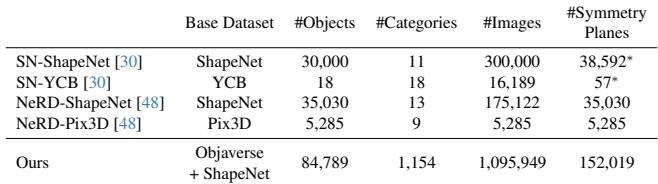
As Table 1 shows, the Reflect3D dataset is an order of magnitude larger than previous efforts, containing over 1 million images and 150,000 symmetry planes across 1,154 categories. This scale is the secret sauce behind the model’s ability to generalize.
Experiments and Results
The researchers evaluated Reflect3D against the previous state-of-the-art method, NeRD (Neural Reflection Detection), using two challenging real-world scanned datasets: Google Scanned Objects (GSO) and OmniObject3D.
Symmetry Detection Accuracy
The results were decisive. The metrics used were F-score (accuracy at different angle thresholds) and Average Geodesic Distance (how far off the predicted angle was).

Looking at Table 2, even the “Feed-Forward” (Reflect3D-FF) version of the model beats NeRD significantly. When the Multi-View aggregation is added (Reflect3D), the error rate (Geodesic Distance) drops by nearly half compared to the baseline.
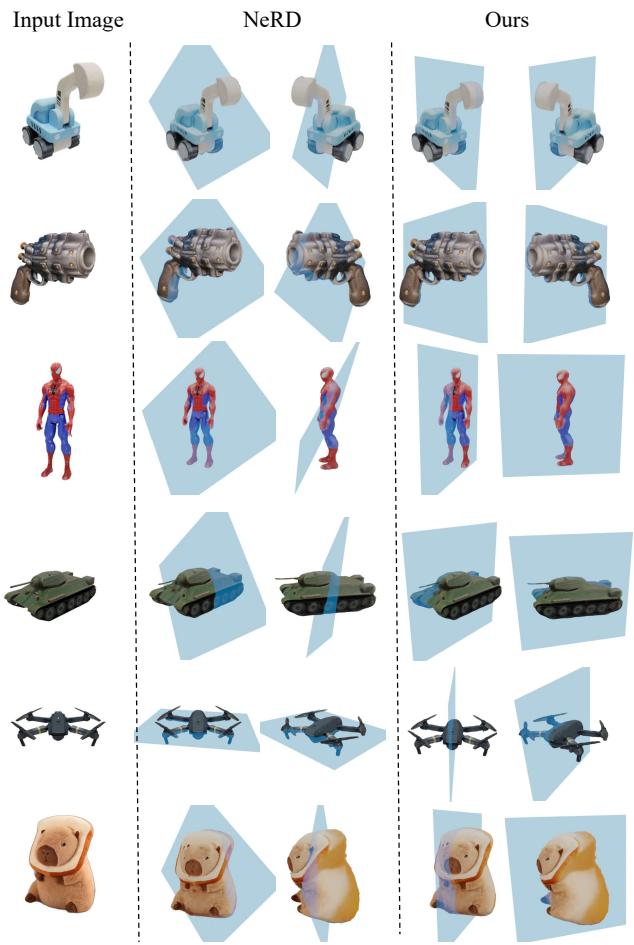
Qualitatively, the difference is stark. In the figure below, NeRD often guesses incorrectly or fails to find a stable plane. Reflect3D consistently identifies the correct mirror plane across diverse objects.
3D Generation Quality
The true visual impact of this research is seen in the 3D reconstruction results. By integrating symmetry into DreamGaussian, the generated models become much more coherent.
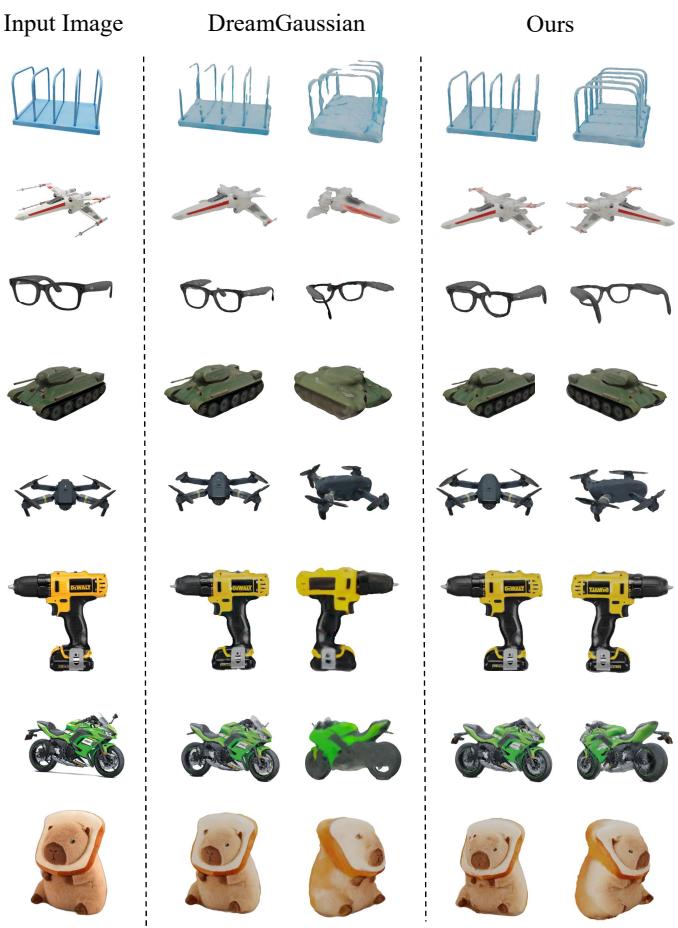
In Figure 6, notice the “DreamGaussian” column versus “Ours.”
- Geometric Accuracy: In row 3 (the glasses), the baseline creates a messy, asymmetric frame. Reflect3D creates a clean, wearable pair of glasses.
- Backside Quality: In the bottom rows (the bear and the motorcycle), the baseline struggles to generate the unobserved back side, resulting in blurry or distorted meshes. Reflect3D uses the front information to perfectly reconstruct the back.
Ablation Studies: Do we need all the parts?
The authors performed ablation studies to verify that every component of their pipeline was necessary. They tested the 3D generation process by removing specific symmetry constraints one by one.
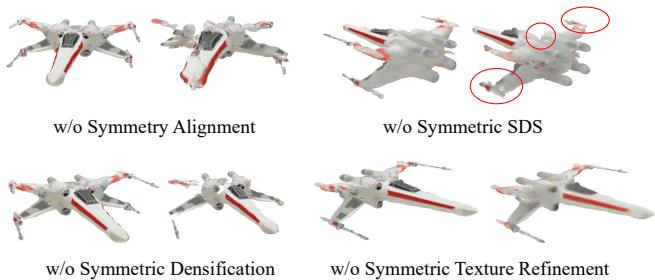
- w/o Symmetry Alignment: The object is generated at a weird angle.
- w/o Symmetric SDS: The geometry gets lumpy and uneven (see the red circles on the X-Wing fuselage).
- w/o Symmetric Densification: The model lacks density and detail in reflected areas.
- w/o Texture Refinement: The shape is fine, but the paint job on the back is blurry.
This proves that symmetry isn’t just a post-processing step; it needs to be deeply integrated into the optimization, densification, and texturing phases.
Conclusion
Reflect3D represents a significant step forward in computer vision. By treating symmetry detection as a foundation model problem and scaling up training data, the researchers created a detector that works in the real world, not just on synthetic test sets.
More importantly, this work highlights the power of inductive priors in generative AI. While pure diffusion models are powerful, they can be chaotic. Constraining them with fundamental physical truths—like “airplanes are symmetric”—leads to higher fidelity, better structure, and more usable 3D assets.
As we move toward a future where 3D content creation is automated, tools like Reflect3D will be essential for ensuring that the virtual worlds we generate make structural sense. Symmetry, as Pascal noted, is what we see at a glance—and now, our AI models can see it too.