](https://deep-paper.org/en/paper/2411.18197/images/cover.png)
In the rapidly expanding worlds of video games, VR, and the metaverse, 3D content creation is booming. We have incredible tools to generate static 3D models from text or images, resulting in millions of digital assets. However, a significant bottleneck remains: movement.
A static 3D model is essentially a digital statue. To make it move—to make it run, jump, or dance—it must undergo two complex processes: rigging (building a digital skeleton) and skinning (defining how the surface moves with that skeleton). Traditionally, this is the domain of skilled technical artists, taking hours of manual labor per character. Even existing automated tools often struggle with non-standard body shapes or characters that aren’t standing in a perfect “T-pose.”
In this post, we are diving deep into Make-It-Animatable, a new research paper that proposes a unified framework capable of taking any 3D humanoid character—whether it’s a high-resolution mesh or a cloud of 3D Gaussian Splats—and making it animation-ready in less than one second.
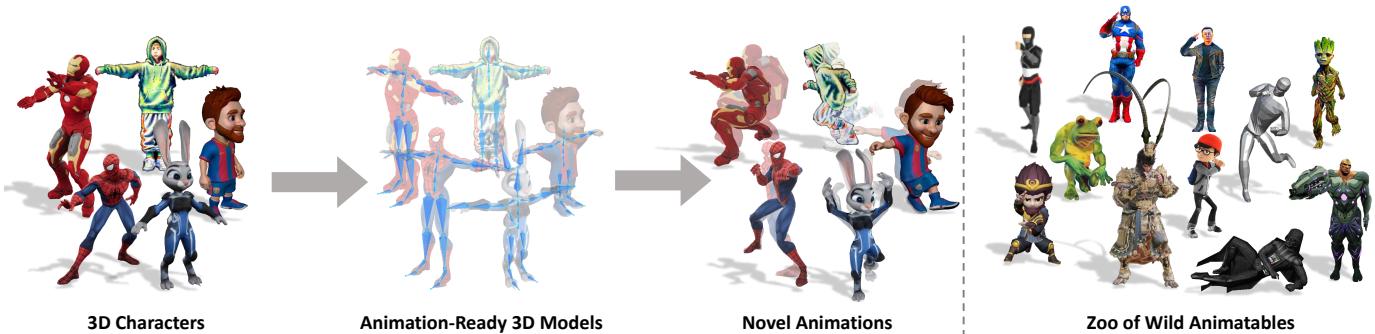
As shown in Figure 1, the system is robust enough to handle diverse shapes, from realistic humans to stylized cartoons, regardless of their input pose.
The Bottleneck: Why is Auto-Rigging So Hard?
Before dissecting the solution, we need to understand the problem. Character animation relies on Linear Blend Skinning (LBS).
The LBS Equation
Mathematically, the deformation of a character is often described as a low-rank approximation of dynamics. Instead of calculating where every single vertex moves individually, we control a small set of Bones (the skeleton). Each vertex on the character’s skin is assigned Blend Weights, which determine how much influence specific bones have on that vertex.
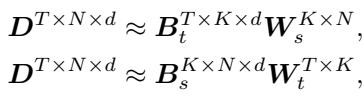
For a system to automatically rig a character, it must predict:
- Joint Locations: Where are the knees, elbows, and spine?
- Rest Pose: If the character is inputted curling a bicep, the system must figure out what the arm looks like straight (the rest pose).
- Blend Weights: Which parts of the mesh move when the “thigh” bone rotates?
Existing solutions usually fail in one of two ways:
- Template-based methods (like fitting a SMPL model) are robust but rigid. If your character is a goblin with a massive head and short legs, the template won’t fit.
- Previous Auto-rigging methods (like RigNet) often require the input to be in a standard T-pose or fail to handle fine details like fingers.
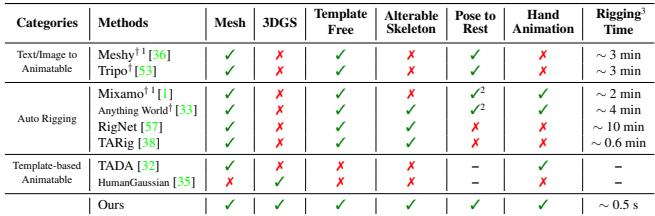
Make-It-Animatable bridges these gaps. As seen in Table 1 below, it is one of the few methods that is template-free, handles arbitrary poses, supports hand animation, and works on both Meshes and 3D Gaussian Splats (3DGS).
The Core Method: A Unified Framework
The researchers proposed a framework that treats the input 3D model as a collection of particles. This “particle-based” approach is clever because it creates a unified representation regardless of whether the input is a mesh (vertices) or 3D Gaussian Splats (points).
The architecture is split into three main stages, illustrated in the pipeline diagram below:
- Shape Encoding: Turning the 3D geometry into a neural representation.
- Decoding Animation Assets: Predicting blend weights and bone attributes.
- Structure-Aware Modeling: refining the skeleton using kinematic logic.
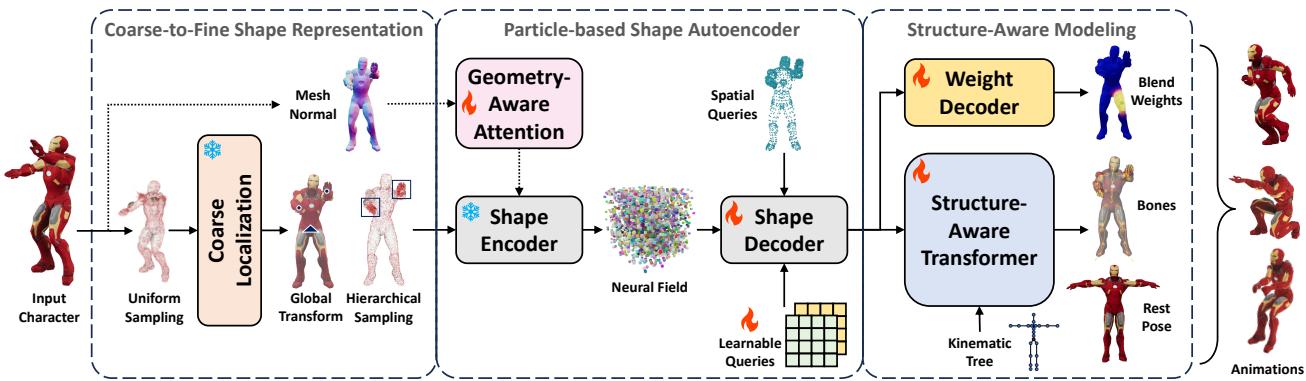
Let’s break these components down step-by-step.
1. Particle-Based Shape Autoencoder
The first challenge is understanding the geometry. The system samples points from the surface of the input character. To handle the loss of geometric detail that comes with point sampling, the researchers introduced Geometry-Aware Attention.
Standard point cloud encoders (like PointNet++) look at spatial coordinates. However, coordinates alone can be ambiguous—points on the inner thigh are spatially close to points on the other leg, but they belong to different bones.
To solve this, the model injects surface normal information. But simply adding normals to the input vector isn’t enough; noisy meshes can lead to overfitting. Instead, they use an attention mechanism that allows the network to decide when to look at normals.
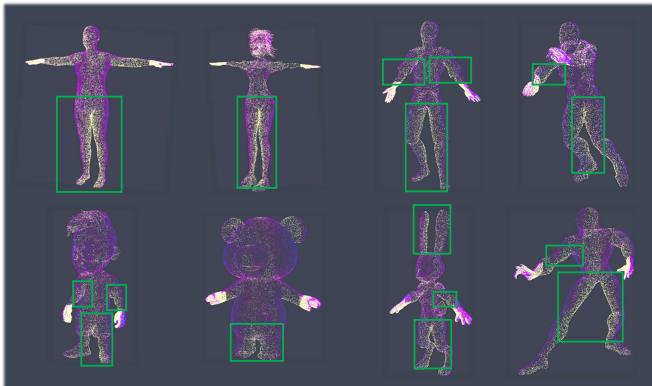
As visualized above, the network learns to pay high attention (yellow areas) to normals in regions where spatial coordinates are confusing, like the gap between the legs or the armpits.
The encoding process results in a neural field \(\mathbf{F}\), which acts as a compact, intelligent description of the character’s shape.
2. Coarse-to-Fine Shape Representation
A major issue in auto-rigging is “The Finger Problem.” Fingers are tiny compared to the body. If you sample points uniformly, you might only get one or two points on a finger, making it impossible to predict a skeleton for the hand.
The authors use a Coarse-to-Fine strategy to solve this:
- Coarse Stage: The model takes a uniformly sampled input and predicts rough joint locations. It also applies a Canonical Transformation to rotate the character to face forward, removing orientation ambiguity.
- Fine Stage (Hierarchical Sampling): Using the rough joint locations from the coarse stage, the system resamples the character, deliberately placing more points near complex joints like the hands.
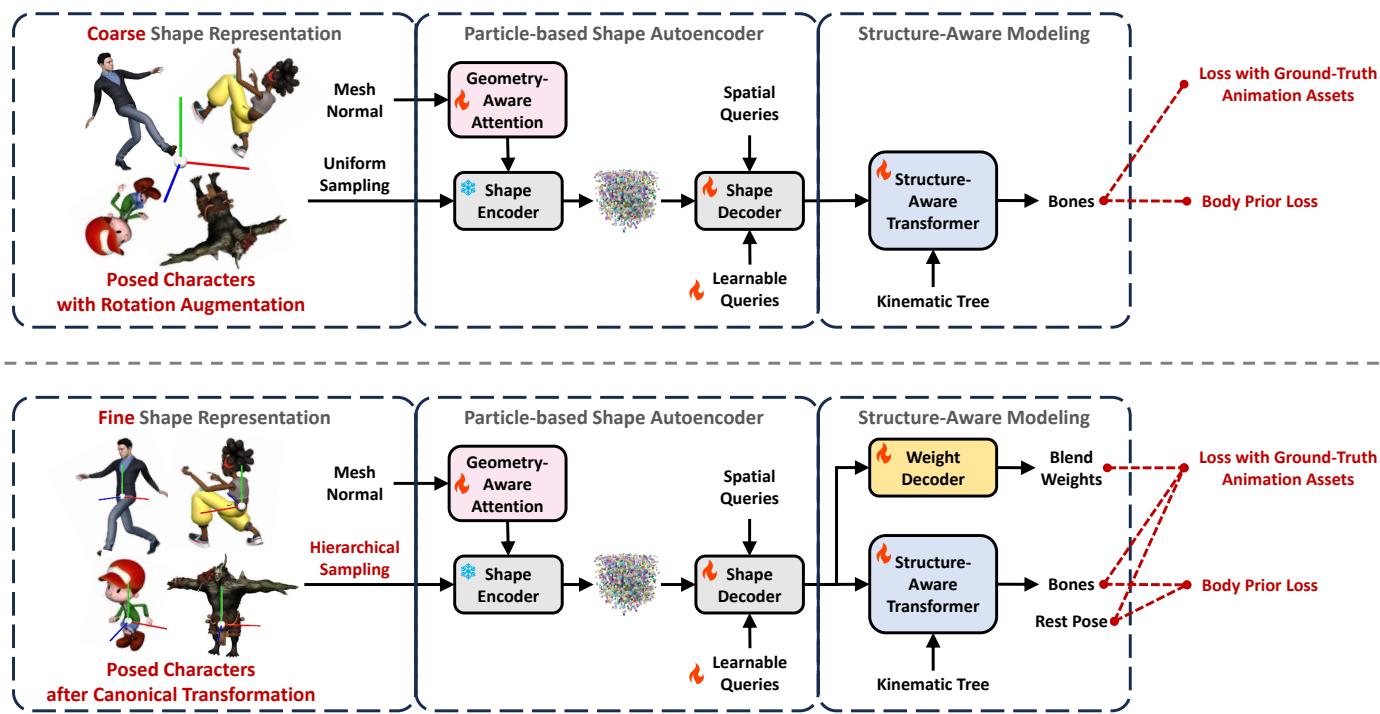
This ensures that the neural field \(\mathbf{F}\) contains enough high-frequency detail to accurately rig the fingers without needing to process millions of points for the whole body.
3. Structure-Aware Modeling of Bones
Once the shape is encoded, how do we get the skeleton? A naive approach would be to ask the network to regress the position of every bone independently. However, skeletons are hierarchical trees; the position of the hand is dependent on the position of the elbow, which depends on the shoulder.
If you predict them independently, you get “broken” skeletons where bones don’t connect.
The researchers introduced a Structure-Aware Transformer. Inspired by Large Language Models (LLMs) that predict the “next token,” this transformer performs “next-child-bone prediction.”
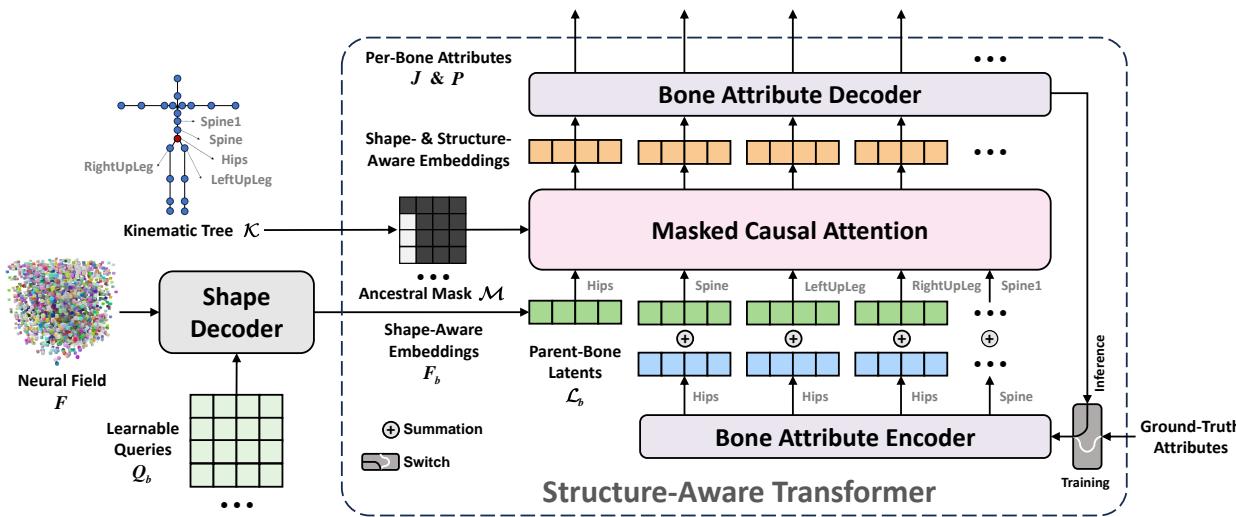
Here is how it works:
- Learnable Queries: The system assigns a learnable query vector to each bone (e.g., a “Left Forearm Query”).
- Causal Attention: When predicting the attributes of a specific bone, the transformer looks at the shape features \(\mathbf{F}\) and the latent features of its parent bone.
- Kinematic Tree Masking: A mask ensures that a bone only attends to its ancestors, enforcing the logical structure of a skeleton.
This approach ensures that the predicted skeleton is topologically valid and that limbs are connected properly.
4. Decoding Animation Assets
Finally, the system needs to output the actual files needed for animation.
- Blend Weights: A weight decoder queries the neural field at every vertex position to output continuous weight maps.
- Bone Attributes: The bone decoder outputs the head/tail positions of joints and the Pose-to-Rest transformation.
The Pose-to-Rest transformation is crucial. If you input a character holding a sword overhead, the system must calculate the rotation required to bring that arm back to a neutral T-pose. The authors found that predicting this as dual quaternions (a mathematical representation of rigid transforms) yielded much smoother optimization than standard rotation matrices.
Experimental Results
The researchers compared Make-It-Animatable against commercial tools (Mixamo, Meshy, Tripo) and state-of-the-art academic methods (RigNet, TARig).
Visual Quality and Robustness
In comparisons with generative AI tools like Meshy and Tripo, the difference is stark. In Figure 4 below, look at the “Bones” and “Animating Results” columns. Meshy (top) fails to create finger bones and struggles with the shoulder deformation. Tripo (bottom) creates disconnected bones. Make-It-Animatable (Ours) produces a clean skeleton with full hand articulation.
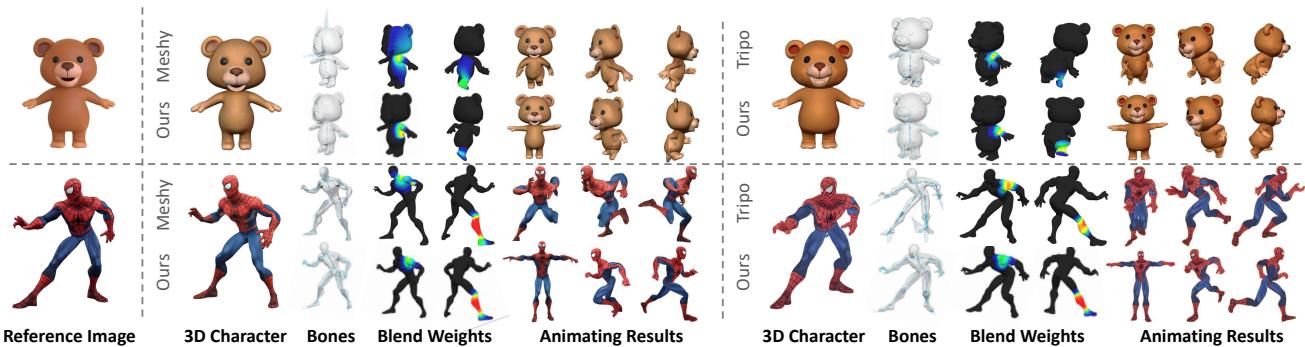
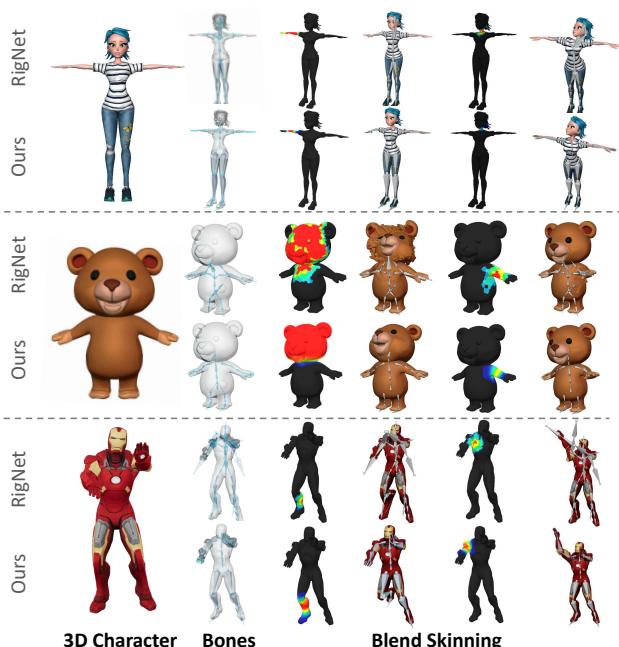
The method also outperforms RigNet, the previous academic standard. RigNet often produces messy weights (skinning) that cause the mesh to tear or distort when moved.
Handling Tricky Cases
One of the most impressive aspects of this paper is the robustness. The system isn’t limited to standard humans. It handles:
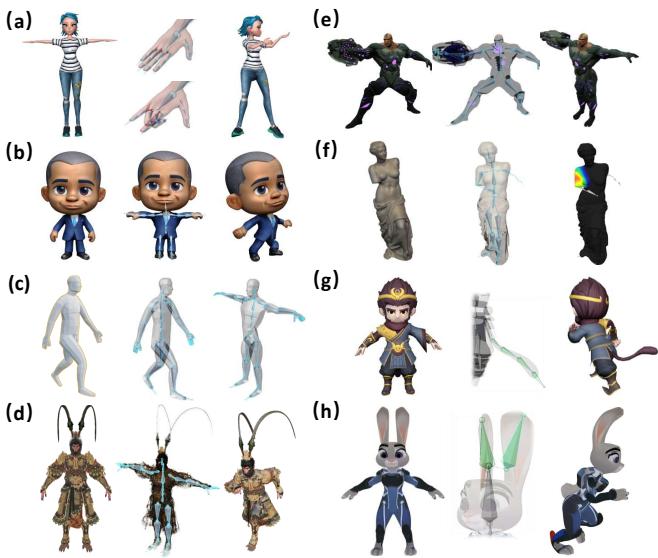
- High Poly Models: The “Wukong” model (Figure S10, d) has over 1 million faces. Because the method is particle-based, it processes this in seconds.
- Asymmetry: Cyborg characters with one massive arm and one normal arm (Figure S10, e).
- Extra Structures: By fine-tuning the last layer, the system can even rig characters with tails or long rabbit ears (Figure S10, g & h).
Speed and Efficiency
For students and developers, efficiency is key. Many neural methods take minutes to process a single asset. Make-It-Animatable achieves sub-second inference speeds.
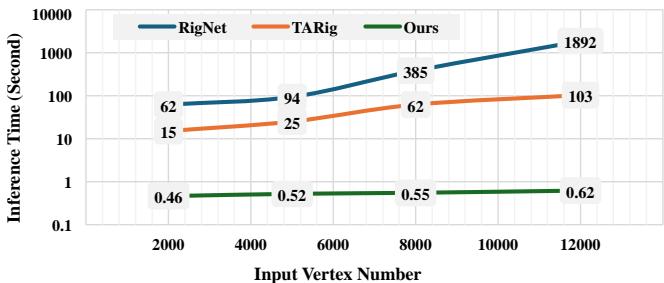
As shown in the graph, RigNet’s processing time explodes as the model resolution increases (taking nearly 30 minutes for high-res meshes). The proposed method remains flat, processing 12,000 vertices in roughly 0.6 seconds.
Conclusion and Future Implications
Make-It-Animatable represents a significant leap forward in automated character creation. By moving away from rigid templates and utilizing a particle-based, structure-aware neural network, the authors have created a tool that is:
- Fast: ~0.5 seconds per character.
- Flexible: Works on Mesh and Gaussian Splats; handles “weird” shapes and poses.
- High Quality: Includes fingers and produces clean, usable skinning weights.
For students interested in computer graphics and machine learning, this paper highlights the power of combining geometric deep learning (neural fields, point encoders) with domain-specific knowledge (kinematic trees, dual quaternions).
The implications are vast. We are moving toward a future where a user can describe a character in text, generate it in 3D, and immediately control it in a game engine—all within seconds. While the current framework focuses on humanoid bipeds, the “extra bone” experiments suggest that auto-rigging spiders, dragons, and aliens is just around the corner.