](https://deep-paper.org/en/paper/2411.18941/images/cover.png)
Introduction
Imagine watching a silhouette of a person sitting at a desk. Their arms are moving. Are they writing a letter, or are they typing on a keyboard? To the casual observer, and indeed to many computer vision algorithms, these two actions look remarkably similar. The posture is the same; the active body parts (arms and hands) are the same. The difference lies in the subtle, fine-grained details of how those joints move relative to one another.
In the field of Computer Vision, Skeleton-based Action Recognition has become a powerhouse for analyzing human behavior. Unlike RGB video analysis, which processes heavy pixel data, skeleton-based methods focus on the geometric graph of human joints (nodes) and bones (edges). This makes them efficient and robust to changes in lighting or background.
However, standard Graph Convolutional Networks (GCNs)—the industry standard for this task—often hit a wall when dealing with actions that share similar motion trajectories. They are excellent at distinguishing “Running” from “Sitting,” but they struggle with “Writing” vs. “Typing.” Why? Because they tend to capture the coarse-grained, global motion patterns while smoothing over the tiny, discriminative details required to separate similar classes.
In this post, we represent a deep dive into ProtoGCN, a novel architecture proposed by researchers from the Chinese Academy of Sciences. This paper introduces a “Prototypical Perspective.” Instead of just learning a generic feature map, ProtoGCN breaks down complex actions into combinations of learnable “prototypes”—fundamental motion units stored in a memory bank.
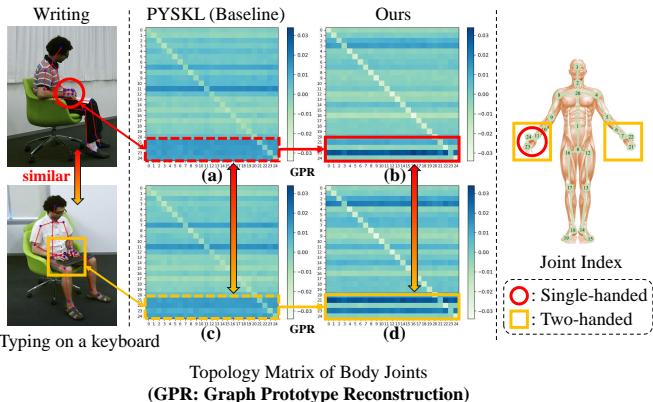
As shown in Figure 1 above, traditional methods (labeled PYSKL) struggle to differentiate the connectivity patterns between writing and typing. In contrast, the proposed method (ProtoGCN) reveals distinct motion patterns (panels b and d), successfully highlighting the subtle differences in hand engagement.
Let’s unpack how this model achieves such fine-grained distinctions.
Background: The Challenge of Similarity
Before understanding the solution, we must understand the specific limitations of current GCNs in this domain.
Human skeletons are naturally represented as graphs, denoted as \(\mathcal{G} = (\mathcal{V}, \mathcal{E})\), where \(\mathcal{V}\) represents joints and \(\mathcal{E}\) represents bones. A sequence of movements is represented as a tensor of shape \(N \times T \times C\) (Joints \(\times\) Time \(\times\) Channels).
The goal of a GCN is to update the features of these joints by aggregating information from neighbors. A standard adaptive GCN layer updates features using the following logic:

Here, \(\mathbf{H}^{(l)}\) is the feature map at layer \(l\), \(\mathbf{W}\) is a weight matrix, and \(\mathbf{A}\) is the topology matrix (the adjacency matrix) that defines which joints talk to which.
The problem is that most existing methods focus on optimizing the structure of the graph (the matrix \(\mathbf{A}\)) to handle general motion. They often neglect the feature details of specific, key body parts. When two actions are 90% similar, the classifier gets confused because the distinct 10% is lost in the noise of global aggregation. The researchers of ProtoGCN realized that to fix this, the network needs to explicitly “reconstruct” actions from a set of distinctive details rather than just averaging them out.
The Core Method: ProtoGCN
The architecture of ProtoGCN is designed to force the network to pay attention to subtle details. It does this through a three-pronged approach:
- Motion Topology Enhancement (MTE): Improving the graph structure to capture richer joint relationships.
- Prototype Reconstruction Network (PRN): The heart of the paper—decomposing actions into learnable prototypes.
- Class-Specific Contrastive Learning (CSCL): A training strategy that pushes different actions apart in the feature space.
Let’s look at the overall architecture.
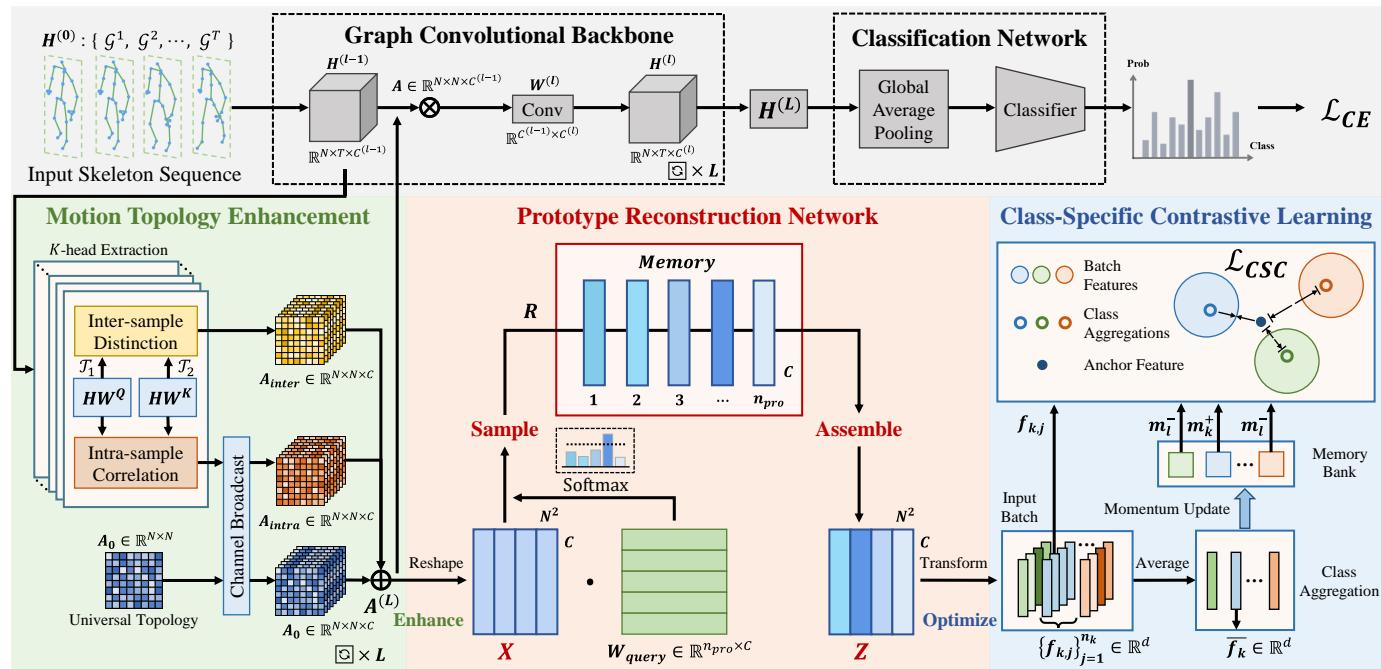
As illustrated in Figure 2, the process flows from left to right. The skeleton sequence enters the backbone. At specific layers, the MTE module refines the topology. The features are then passed to the PRN, which accesses a memory bank of prototypes to reconstruct a high-definition feature representation (\(\mathbf{Z}\)). Finally, the output is governed by contrastive learning modules.
1. Motion Topology Enhancement (MTE)
The quality of any GCN depends heavily on the topology matrix \(\mathbf{A}\)—the map that tells the network how joints relate to each other. A static human skeleton graph (where the wrist connects to the elbow) is not enough because, during an action, the hand might be correlated with the foot (e.g., in walking).
The researchers propose augmenting the standard topology with two new components:
- Intra-sample Correlations (\(\mathbf{A}_{intra}\)): Captures the global relationships within a single skeleton sequence using self-attention.
- Inter-sample Distinctions (\(\mathbf{A}_{inter}\)): Captures differences by comparing pairwise distinctions between joints.
The mathematical formulation for these enhanced topologies is:
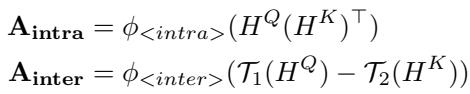
Here, \(H^Q\) and \(H^K\) are projected queries and keys derived from the input features. The system computes the inner product for correlations and the difference for distinctions.
These new topologies are added to the standard adaptive topology \(\mathbf{A}_0\). This gives us a new, richer update rule for the GCN layer:

By including \(\mathbf{A}_{inter}\), the model is explicitly calculating the differences between joints, which helps filter out noise and highlight critical motion parts.
2. The Prototype Reconstruction Network (PRN)
This is the most innovative contribution of the paper. The intuition is that human movements are composed of “atomic” motion units (prototypes). For example, “raising an arm” might be a prototype shared by “waving” and “throwing.”
The PRN creates a Memory Module, a learnable matrix \(\mathbf{W}_{memory}\) containing \(n_{pro}\) prototype vectors.
Instead of passing the raw features forward, the network tries to describe the current action as a weighted combination of these stored prototypes. It does this via an addressing mechanism (Attention). The network asks: “Which prototypes in memory best match my current input?”
It generates a “query” from the input features and compares it against the memory to generate response weights \(\mathbf{R}\):

Once the weights \(\mathbf{R}\) are calculated, the network “assembles” the new, enhanced representation \(\mathbf{Z}\) by pulling the relevant prototypes from memory.
\[ \mathbf{Z} = \mathbf{R} \cdot \mathbf{W}_{memory} \]This process is a bottleneck that acts as a filter. By forcing the representation to be built only from the available prototypes, the network filters out irrelevant noise (jitter, camera movements) and keeps only the core motion patterns defined in the memory.
3. Class-Specific Contrastive Learning
Having a memory bank is great, but how do we ensure the prototypes are actually meaningful? We need to supervise the learning process.
The authors employ Contrastive Learning. The goal is simple:
- Pull samples of the same action class (e.g., all “Writing” clips) closer together.
- Push samples of different classes (e.g., “Writing” vs. “Typing”) far apart.
They maintain a “Class Memory Bank” that stores a centroid (average representation) for each action class. These class centroids, denoted as \(\mathbf{m}_k\), are updated using a momentum strategy to ensure stability:

Here, \(\mathbf{f}_k\) is the feature of the current sample, and \(\alpha\) is a momentum coefficient.
The loss function used is a variation of InfoNCE, called the Class-Specific Contrastive Loss (\(\mathcal{L}_{CSC}\)). It maximizes the similarity between a sample and its correct class centroid while minimizing similarity to all other class centroids.

Training the Model
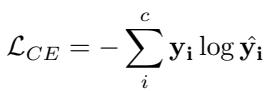
The final model is trained end-to-end. The total loss function combines the standard Cross-Entropy loss (for classification accuracy) with the new Contrastive loss (to enforce feature separation).

(Where \(\mathcal{L}_{CE}\) is the standard classification loss shown below):
Experiments and Results
The researchers tested ProtoGCN on four major benchmarks: NTU RGB+D (60 & 120), Kinetics-Skeleton, and FineGYM. FineGYM is particularly notable because it focuses on gymnastic events where the differences between actions are incredibly subtle and technical.
Comparison with State-of-the-Art
The results show that ProtoGCN consistently outperforms existing methods.
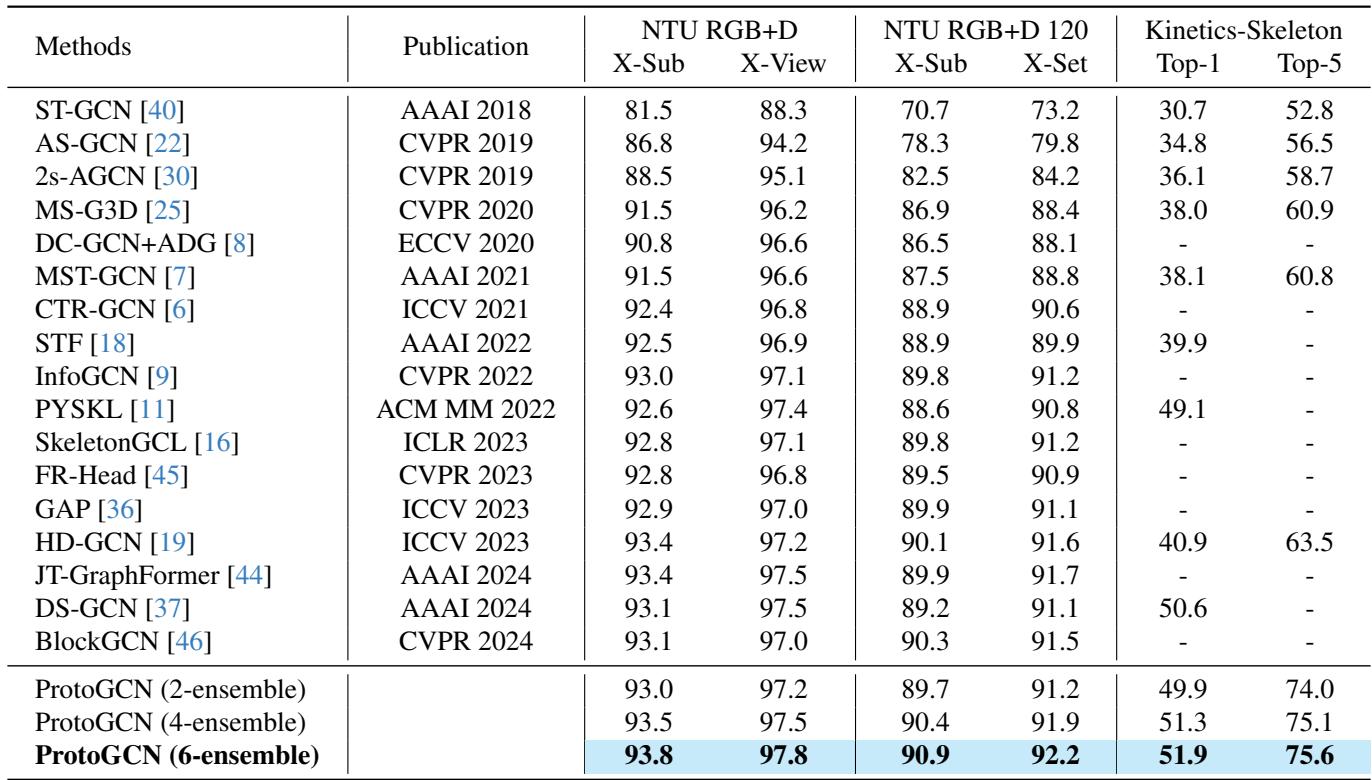
In Table 1, looking at the NTU RGB+D 120 dataset (which is massive and difficult), ProtoGCN achieves 90.9% accuracy on the Cross-Subject split, beating strong competitors like FR-Head and GraphFormer.
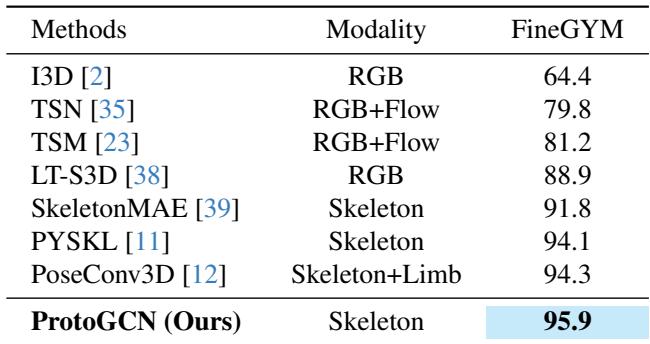
The results on FineGYM (Table 2 below) are perhaps the most telling. This dataset requires distinguishing between fine-grained sub-actions. ProtoGCN achieves 95.9% accuracy, a significant jump over PYSKL (94.3%).
Why does it work? (Ablation Studies)
The authors performed ablation studies to prove that the improvements weren’t just luck. They systematically removed parts of the model to see what happened.
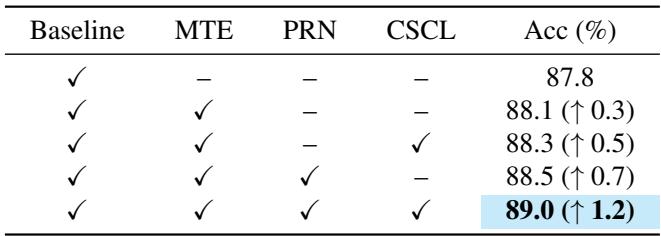
As seen in Table 3:
- Baseline only: 87.8%
- Adding MTE (Topology enhancement): +0.3%
- Adding PRN (Prototypes): +0.7% (This is the biggest single contributor).
- Full Model: 89.0%
This confirms that the Prototype Reconstruction Network is the heavy lifter in this architecture.
They also analyzed the impact of hyperparameters, such as the weight of the contrastive loss (\(\lambda\)) and the number of prototypes in memory (\(n_{pro}\)).
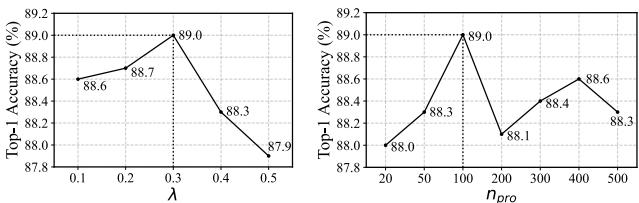
Figure 3 reveals that the model is relatively robust, but peaks when the memory size is around 100 prototypes. This suggests that roughly 100 “atomic motion units” are sufficient to reconstruct the vast complexity of human actions in these datasets.
Visualizing the Difference
To truly understand the impact, we can look at the “accuracy difference” per class. Which specific actions did ProtoGCN improve the most compared to the baseline?
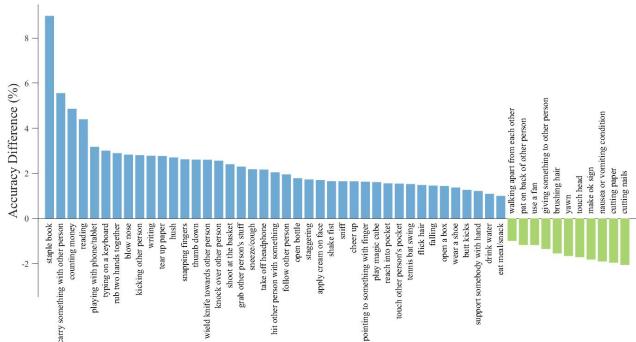
Figure 5 shows the classes with the highest improvement. Notice the types of actions: “saddle book,” “money,” “cutting paper.” These are actions involving object manipulation with fine hand movements—exactly the type of “similar” actions that traditional GCNs fail on.
Finally, let’s look at the learned topologies one more time to see what the network is actually “looking” at.
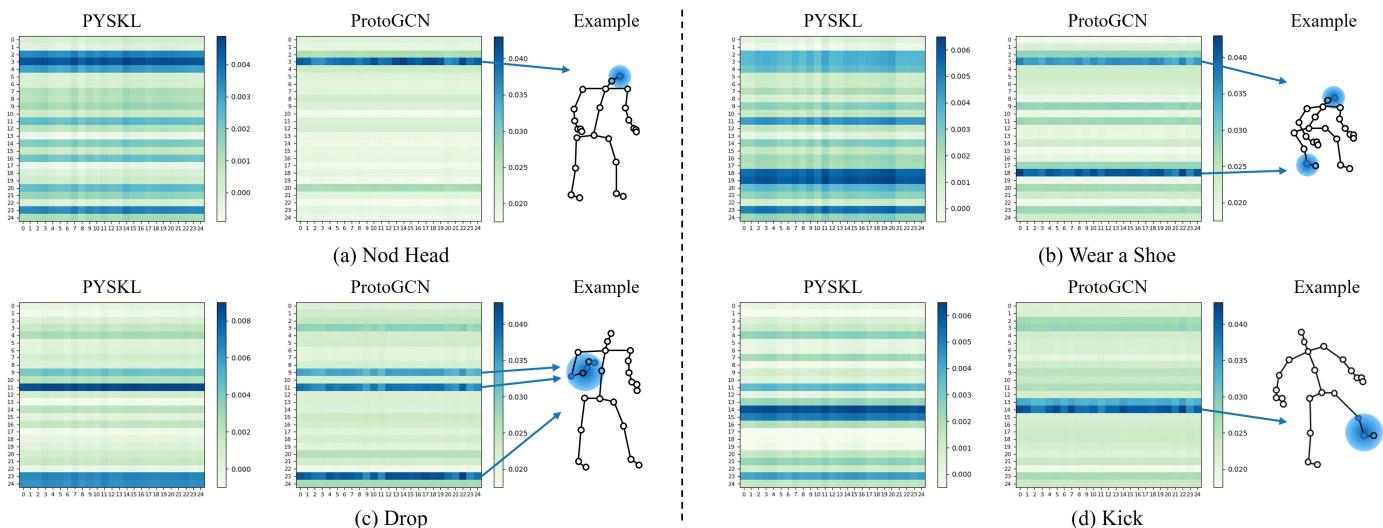
In Figure 4, we see heatmaps of joint attention.
- Row (a) Nod Head: ProtoGCN shows much sharper, darker activation on the specific joints involved in nodding compared to the baseline.
- Row (d) Kick: The attention is concentrated intensely on the leg joints.
The darker colors in the ProtoGCN columns indicate stronger correlations. The model has successfully learned to ignore the static parts of the body and focus intensely on the joints that define the action.
Conclusion
ProtoGCN represents a significant step forward in skeleton-based action recognition. By moving away from simple global feature aggregation and adopting a prototypical perspective, the model learns to “see” the details that matter.
The combination of Motion Topology Enhancement (to find better joint relationships) and the Prototype Reconstruction Network (to filter noise and reconstruct actions from core patterns) allows the system to tease apart highly similar actions like writing and typing.
For students and researchers in this field, ProtoGCN illustrates a powerful concept: sometimes, to understand the whole, you must first perfectly understand the parts. By enforcing a reconstruction constraint based on memory, we can build AI that is not just accurate, but discerning.
The code for ProtoGCN is available publicly, encouraging further exploration into prototype-based learning for graph neural networks.