](https://deep-paper.org/en/paper/2411.19167/images/cover.png)
Introduction
The dexterity of the human hand is a defining trait of our species. Whether we are assembling furniture, typing code, or whisking eggs, we constantly interact with the physical world to manipulate objects. For Artificial Intelligence, understanding these interactions is the holy grail of embodied perception. If an AI can truly understand how hands and objects move together in 3D space, we unlock possibilities ranging from teaching robots manual skills to creating augmented reality (AR) interfaces that turn any surface into a virtual keyboard.
However, there is a significant gap between the aspiration and the reality of computer vision. Current systems struggle to reliably track the 3D motion, shape, and contact of hands and objects simultaneously, especially from the first-person (egocentric) perspective. A major bottleneck has been the lack of data—specifically, data that mirrors the complexity of real-world devices like AR glasses.
This is where the HOT3D dataset comes in. Created by researchers at Meta Reality Labs, HOT3D is a massive, multi-view egocentric dataset designed to push the boundaries of 3D hand and object tracking.
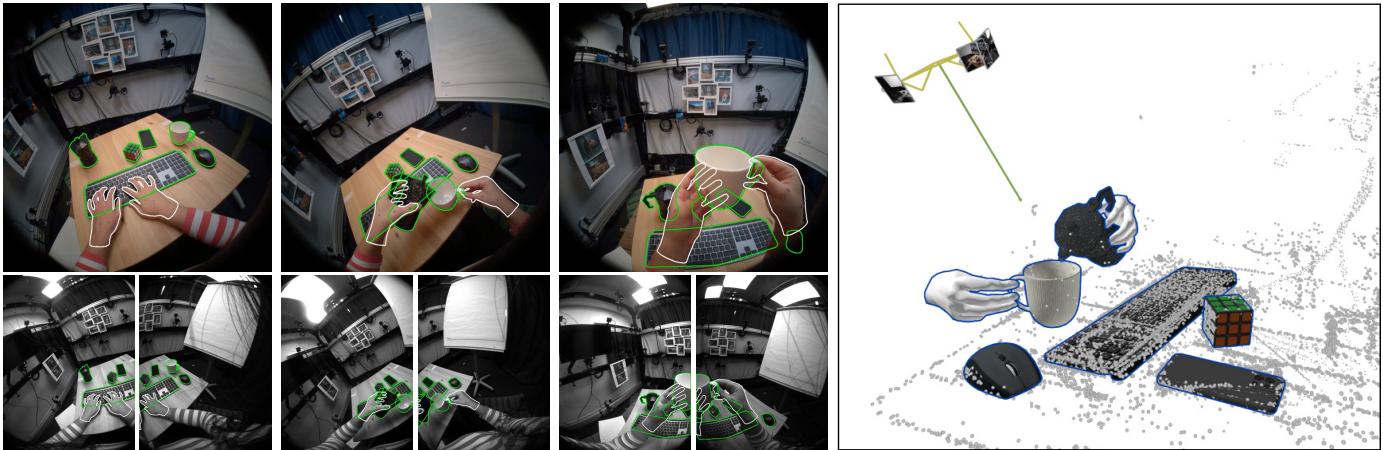
In this post, we will tear down the HOT3D paper, exploring how this dataset was built, why it differs from its predecessors, and the experimental baselines that prove why multi-view systems are the future of egocentric vision.
The Context: Why Do We Need HOT3D?
To understand the significance of HOT3D, we must first look at the history of computer vision datasets in this domain. Historically, research has been divided into two silos: hands-only and objects-only.
- Hands-only datasets focused on pose estimation but ignored the objects being manipulated.
- Objects-only datasets focused on 6-degree-of-freedom (6DoF) pose estimation of rigid items but ignored the hands holding them.
While recent years have seen attempts to combine these (such as HO-3D or DexYCB), they often suffer from limitations. Many rely on “exocentric” (third-person) cameras, which don’t reflect what a user sees through AR glasses. Others use synthetic data, which lacks the noise and lighting nuances of the real world. Furthermore, very few datasets offer multi-view egocentric video—synchronized streams from multiple cameras on a headset—which is a standard feature on modern devices like the Meta Quest 3.
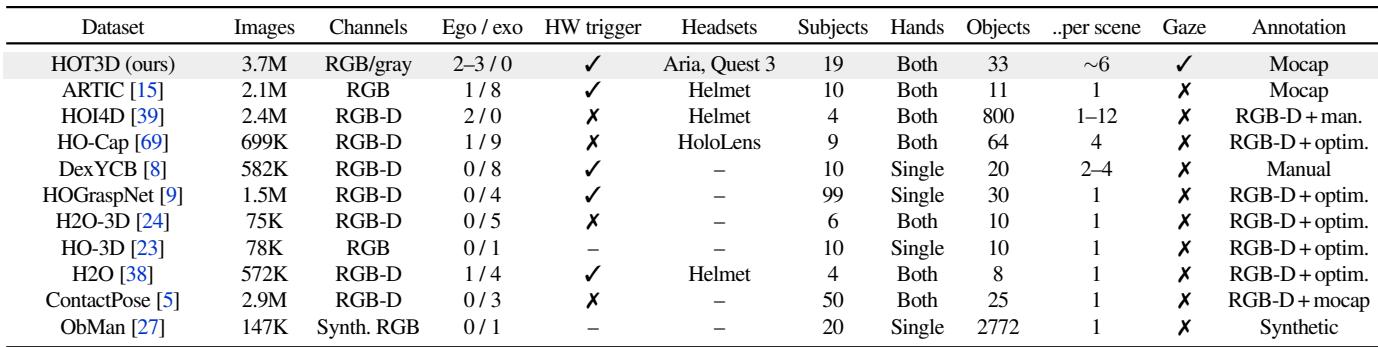
As shown in the table above, HOT3D stands out by offering over 3.7 million images with hardware-synchronized streams from real headsets, annotated with high-quality motion capture (MoCap) data. It is currently the largest dataset in terms of image count that provides this level of egocentric fidelity.
The Core Contribution: Building HOT3D
The researchers built HOT3D to facilitate training and evaluation for a variety of tasks, including 3D hand tracking, object pose estimation, and 3D reconstruction. Let’s break down the components that make this dataset unique.
1. Hardware: Real Devices
Unlike datasets that simulate egocentric views using a camera strapped to a helmet, HOT3D uses actual consumer and research hardware:
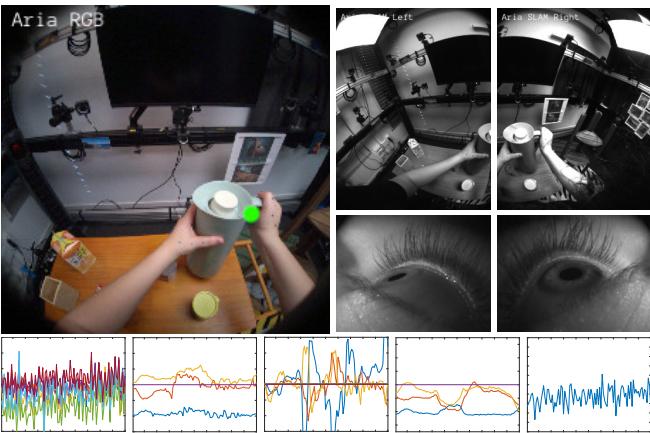
- Project Aria: A research prototype of lightweight AI glasses. It captures RGB, monochrome, and eye-gaze data.
- Meta Quest 3: A widely shipped VR/MR headset.
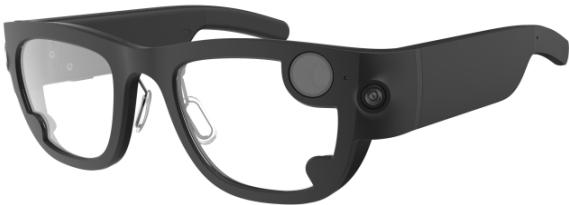
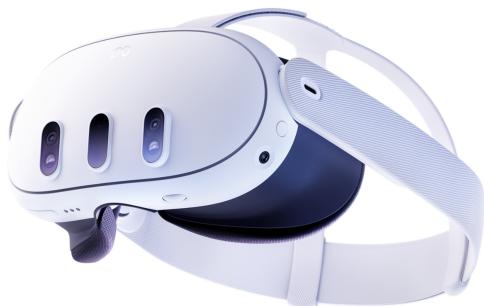
Using these devices ensures that the data contains the specific optical characteristics (like fisheye distortion and specific camera baselines) that algorithms will face in real-world deployment.
2. The Data: Scale and Diversity
The dataset consists of 833 minutes of recordings featuring 19 subjects interacting with 33 diverse rigid objects. The scenarios aren’t just simple “pick up and put down” tasks; they mimic actions in kitchens, offices, and living rooms.
To ensure the visual data is robust, the researchers collected:
- 1.5M+ multi-view frames (totaling 3.7M+ individual images).
- Eye gaze signals (from Aria).
- 3D Point clouds from Simultaneous Localization and Mapping (SLAM).
3. Ground Truth: Precision Motion Capture
The “secret sauce” of any benchmark dataset is the accuracy of its ground truth. If the labels are wrong, the models trained on them will be flawed.
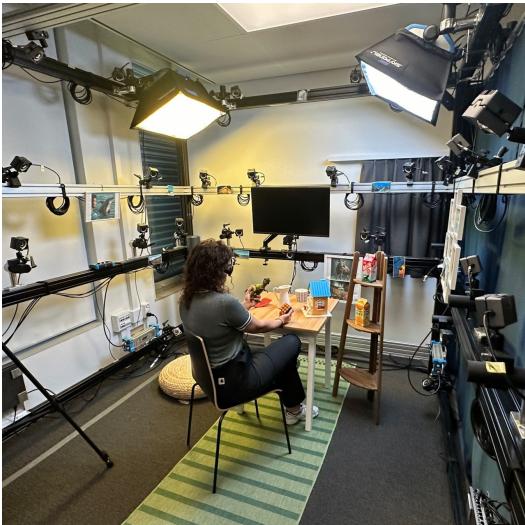
The authors utilized a professional motion-capture lab equipped with dozens of infrared OptiTrack cameras. Small optical markers were attached to the subjects’ hands and the objects. This allowed the team to capture millimeter-accurate 6DoF poses. Importantly, the markers were small enough (3mm) to avoid interfering with natural dexterity.
4. The Objects
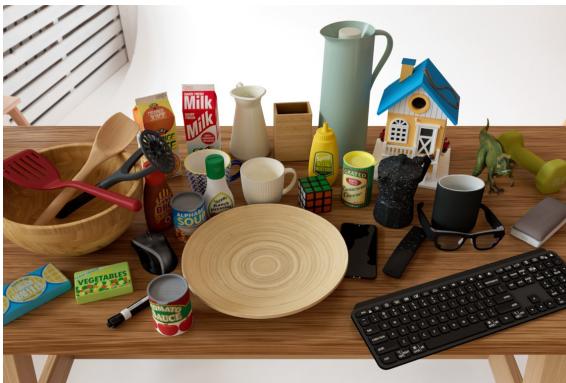
The dataset features 33 objects ranging from kitchenware (mugs, bowls) to office supplies (staplers, toys). These aren’t generic CAD approximations; they are high-resolution scans with Physically Based Rendering (PBR) materials, allowing for photorealistic rendering if needed.
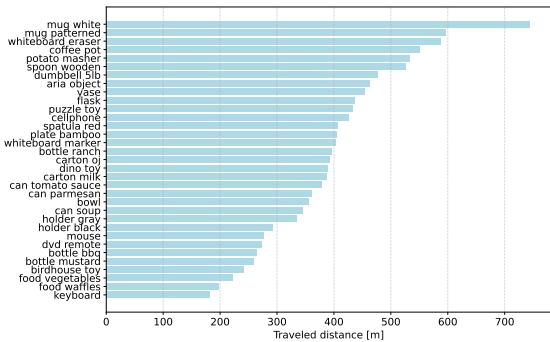
An interesting statistical analysis of the dataset revealed the “life” of these objects during the sessions. As seen below, while items like the keyboard remained mostly stationary, the “white mug” traveled over 700 meters cumulatively across the recordings, making it the “explorer” of the dataset.
Experiments and Baselines
The authors didn’t just release the data; they established strong baselines to demonstrate the value of multi-view information. They evaluated three primary tasks: 3D Hand Pose Tracking, 6DoF Object Pose Estimation, and 3D Lifting of In-Hand Objects.
Task 1: 3D Hand Pose Tracking
The Challenge: Estimate the 3D locations of hand joints in every frame.
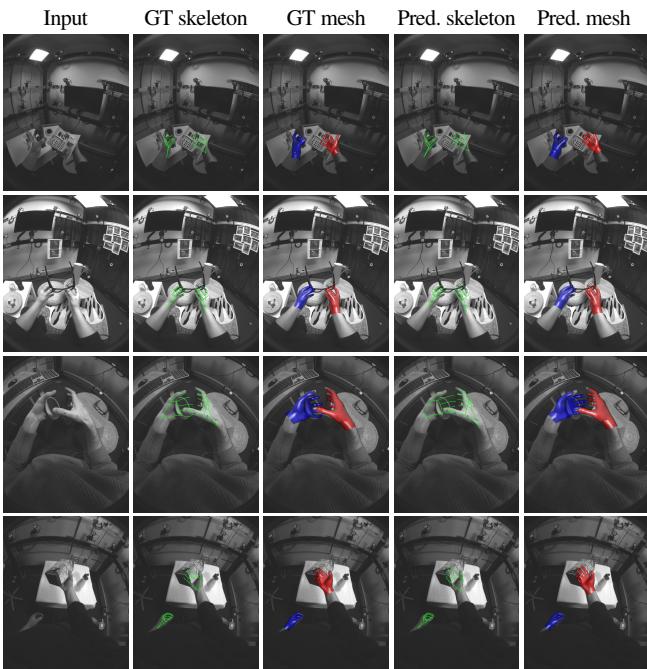
The Method: The researchers utilized UmeTrack, a unified multi-view tracker. They compared a single-view version of the model against a version that utilizes the stereo (two-view) feeds available from the headsets.
The Results: The experiments highlighted a critical “domain gap.” A tracker trained only on previous datasets (like the UmeTrack dataset) failed when tested on HOT3D because it hadn’t seen hand-object interactions, only hand-hand interactions.
However, the most significant finding was the impact of multi-view data. When the tracker was allowed to use two views (stereo), the error rate dropped significantly compared to the single-view approach. The multi-view geometry helps resolve ambiguities—for example, when a finger is occluded in one camera but visible in another.
| Training Dataset | Views | MKPE on HOT3D (mm) |
|---|---|---|
| HOT3D-Quest3 | 1 (Single-view) | 18.0 |
| HOT3D-Quest3 | 2 (Multi-view) | 13.1 |
Note: MKPE stands for Mean Keypoint Position Error. Lower is better.
Task 2: 6DoF Object Pose Estimation
The Challenge: Determine the precise position and rotation (6 Degrees of Freedom) of a known object relative to the camera.
The Method: The authors adapted FoundPose, a method that typically works on single images using DINOv2 features. They extended it to a multi-view framework. The system crops the object in all available views, retrieves templates, and solves the pose by finding correspondences between 2D images and the 3D model across all views simultaneously.
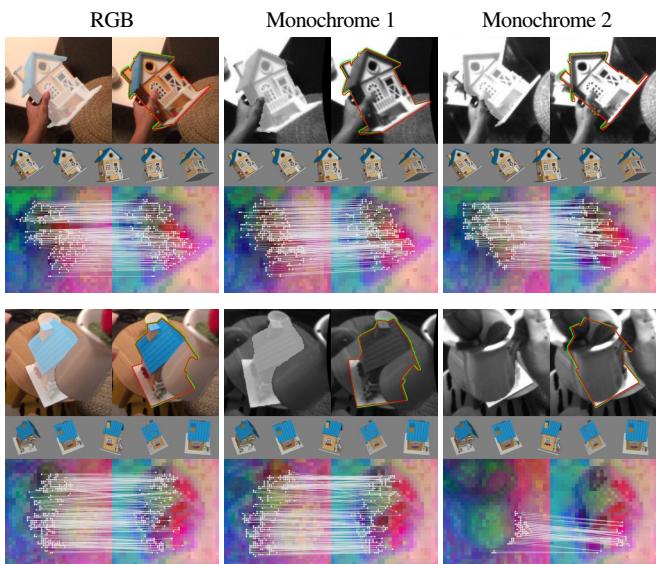
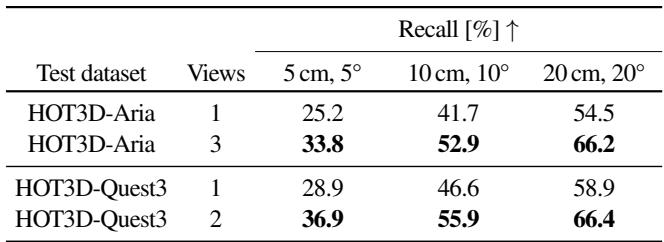
The Results: As hypothesized, the multi-view extension significantly outperformed the single-view baseline. The recall rate (the percentage of correctly estimated poses) increased by 8–12%.
Why? Look at the image above (Figure 7). In the bottom row, the object is heavily occluded by the hand in the RGB view. A single-view method would likely fail here. However, the monochrome side cameras have a clearer line of sight, allowing the multi-view system to lock onto the object’s pose accurately.
Task 3: 3D Lifting of In-Hand Objects
The Challenge: Given a 2D mask of an object (knowing where it is in the image), estimate its depth and 3D location in space. This is crucial for “onboarding” unknown objects into a system.
The Method: The researchers compared three approaches:
- HandProxy: Assuming the object is located at the center of the hand.
- MonoDepth: Using a neural network to predict depth from a single image.
- StereoMatch (New Baseline): A multi-view approach that uses DINOv2 features to find matching points between stereo images and triangulate the object’s depth.
The Results: The StereoMatch method was the clear winner. Monocular depth estimation often struggles with absolute scale—it might know the object is “far,” but not exactly 55cm away. Stereo matching leverages the fixed physical distance between the headset cameras to calculate precise depth via triangulation.
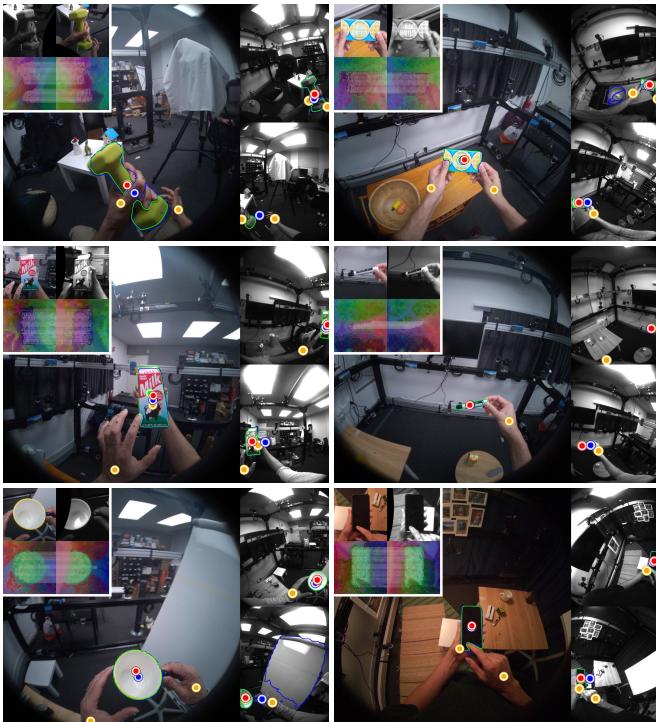
In the visualization above (Figure 9), you can see the results projected into 3D. The Red dots (StereoMatch) consistently align with the Green (Ground Truth), while the Blue (MonoDepth) often drifts along the optical axis (the line of sight), indicating depth errors.
Task 4: 2D Segmentation
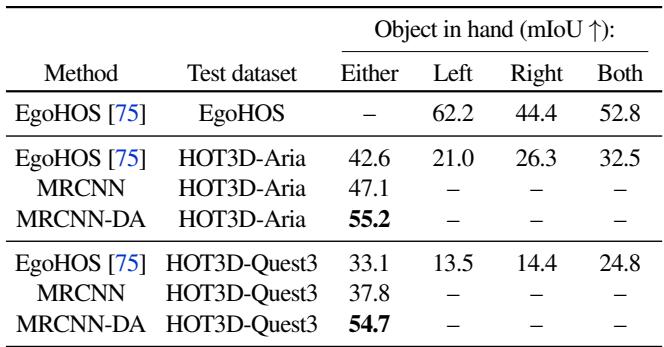
Finally, the paper evaluated how well current models can simply identify pixels belonging to in-hand objects. They compared EgoHOS (a specialized hand-object segmentation model) against a standard Mask R-CNN trained on internal data.
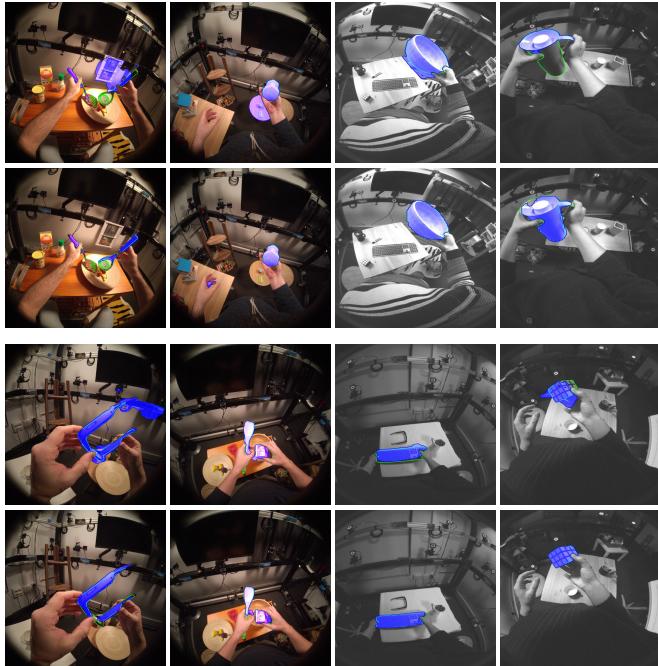
Interestingly, feeding a predicted depth map into Mask R-CNN (denoted as MRCNN-DA in the paper) yielded the best results. This suggests that even for 2D tasks, understanding the 3D geometry (depth) helps the AI separate the foreground object from a cluttered background.
Conclusion and Implications
The release of HOT3D marks a pivotal moment for egocentric computer vision. By providing a dataset that combines the scale of big data with the precision of motion capture—and doing so on the hardware that will define the next generation of computing—the authors have created a new standard for the field.
The experiments conducted in the paper tell a coherent story: Two eyes are better than one. Whether tracking a hand’s subtle finger movements or locating a coffee mug held by a user, multi-view approaches consistently outperform single-view methods.
For students and researchers, the implications are clear:
- Context is Key: Algorithms must account for the unique geometry of wearable headsets.
- Stereo is Essential: Relying solely on monocular cues limits performance; leveraging the multi-camera setups already present on devices like the Quest 3 is the path forward.
- Interaction Matters: Models trained on static objects or isolated hands fail to capture the complexity of dynamic interaction.
HOT3D is not just a dataset; it is a roadmap for building AI that can see the world from our perspective, understanding our actions well enough to help us perform them better.