](https://deep-paper.org/en/paper/2411.19339/images/cover.png)
Generative AI, particularly diffusion models like Stable Diffusion or DALL-E, often feels like magic. You input noise (and perhaps a text prompt), and out pops a coherent, novel image. But from a mathematical perspective, this “novelty” is actually a bit of a puzzle.
Ideally, if a diffusion model is mathematically “perfect,” it shouldn’t generate new images at all—it should simply memorize and reproduce its training data. Yet, in practice, neural networks do generalize. They create images that look like they belong to the training distribution but aren’t exact copies.
Why does this happen? Is it a happy accident of optimization? A specific architectural quirk?
In this post, we dive into the research paper “Towards a Mechanistic Explanation of Diffusion Model Generalization.” The authors propose a fascinating hypothesis: diffusion models generalize because they don’t look at the whole image at once. Instead, they rely on a local inductive bias—essentially acting as “patch-based” denoisers. By reverse-engineering this mechanism, the researchers created a fully training-free algorithm that mimics the creativity of deep neural networks.
The Paradox of the “Optimal” Denoiser
To understand why generalization is strange, we first need to look at how diffusion models work mathematically. The process involves two directions:
- Forward Process: We slowly add Gaussian noise to an image until it becomes pure static.
- Reverse Process: We train a neural network to estimate the noise and remove it, step by step.
The goal of the network is to estimate the posterior mean of the data given the noisy input. Surprisingly, we can write down the closed-form equation for the perfect denoiser. If we have access to the entire training dataset \(\mathcal{D}\), the mathematically optimal output for a denoiser is a weighted average of the training images.

Here, the weights depend on how likely each training image \(\mathbf{x}^{(i)}\) is to have produced the noisy input \(\mathbf{z}\).
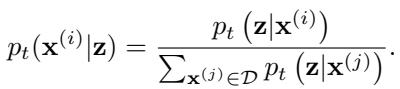
The implications of this are profound. If a neural network perfectly minimized its loss function, it would behave exactly like this equation. And because of the properties of high-dimensional space, this “optimal” denoiser usually assigns almost all its weight to the single nearest neighbor in the training set.
Result? The optimal denoiser just outputs the closest image from the training set. It memorizes. It does not generalize.
Since neural networks do generalize, they must be making “errors” relative to this optimal mathematical solution. The paper sets out to characterize these errors.
Analyzing the “Errors” of Neural Networks
The researchers started by comparing the outputs of state-of-the-art diffusion models (like DDPM++, NCSN++, and Transformers like DiT) against the theoretical “optimal” denoiser on the CIFAR-10 dataset.
They found something striking. All these different architectures, trained in different ways, deviated from the optimal solution in the same way.
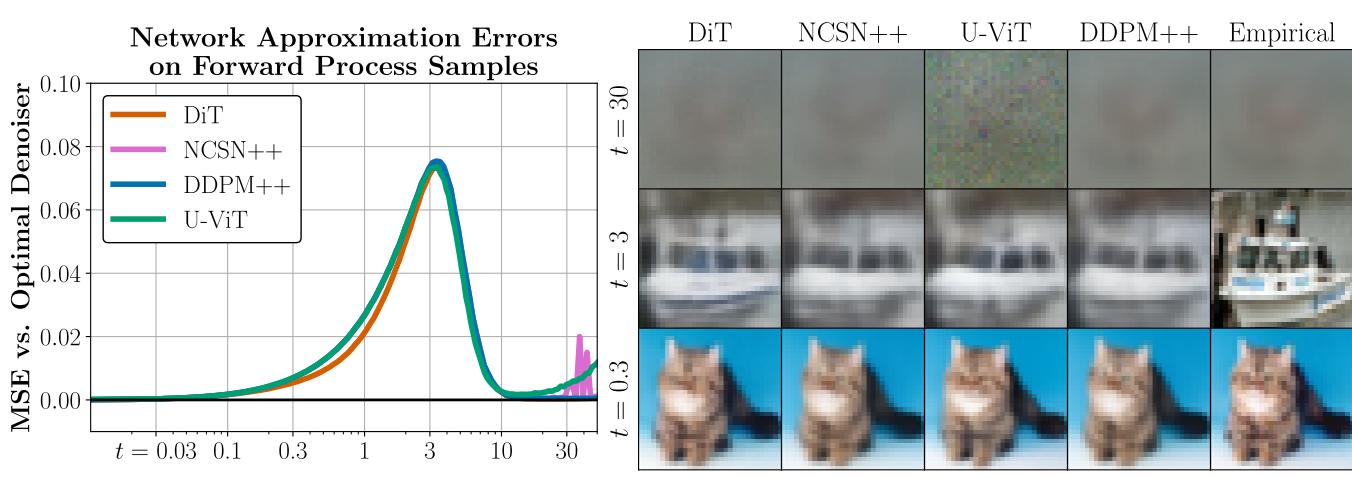
As shown in the graph above (Left), the Mean Squared Error (MSE) between the network and the optimal denoiser spikes in the middle of the diffusion process (around \(t=3\)). At very high noise (early steps) and very low noise (final steps), the networks are nearly optimal. But in that middle regime, they drift away.
The visual comparison (Right) is even more telling. At \(t=3\), the “Empirical” (optimal) denoiser produces a clean, sharp image (a cat). The neural networks, however, produce blurry, distorted versions with distinct artifacts—notice the pinkish hue in the background of the DDPM++ and DiT outputs.
This suggests that generalization isn’t random noise. It is a shared inductive bias across all image diffusion architectures.
The Local Inductive Bias
If the networks aren’t looking at the whole image globally (like the optimal denoiser does), what are they doing? The authors hypothesized that the networks operate locally.
To test this, they analyzed the gradient sensitivity of the networks. Essentially, they asked: “If I change a pixel in the input noise \(\mathbf{z}\), how much does the output pixel at location \((x,y)\) change?”
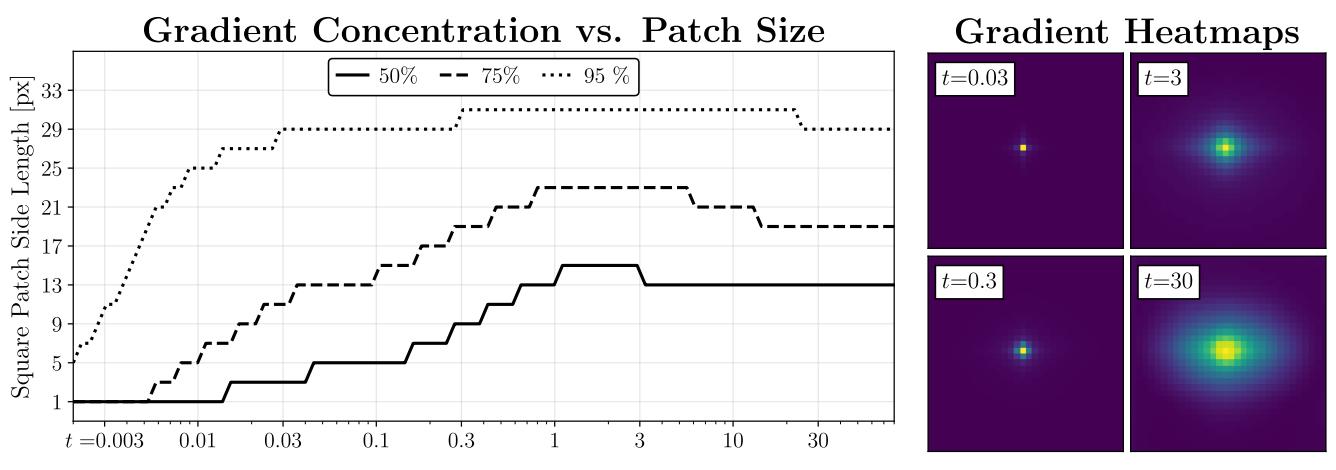
The results (Figure 3, Right) show that for a specific output pixel (marked by the red star), the network only cares about the input pixels in the immediate vicinity.
- At low noise (\(t=0.03\)), the focus is pinpoint sharp.
- As noise increases (\(t=3\) to \(t=30\)), the “receptive field” grows, but it remains localized. It never truly looks at the global context in the way the optimal mathematical formula requires.
This confirms the suspicion: Neural networks generalize because they approximate the global posterior mean using local information.
Introducing PSPC: Reverse-Engineering Generalization
If the “magic” of diffusion models comes from processing images in local patches, can we replicate it without training a neural network?
The authors propose a method called Patch Set Posterior Composites (PSPC). The idea is to explicitly perform the “optimal” denoising operation, but only on small crops (patches) of the image, and then stitch the results back together.
How PSPC Works
- Decompose: Break the noisy input image \(\mathbf{z}\) into many overlapping patches (defined by cropping matrices).
- Retrieve & Denoise: For each noisy patch, compare it to patches from the training set. Calculate the “patch posterior mean”—essentially finding the weighted average of matching training patches.
- Composite: Stitch all these denoised patches back together into a full image, averaging the pixels where patches overlap.
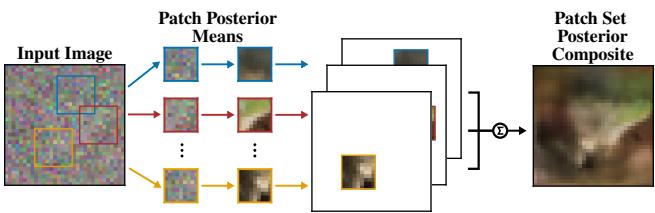
The mathematical formulation for this “Frankenstein” denoiser is elegant. Instead of the global expectation, we compute:

This equation essentially says: sum up the denoised patches (\(\mathbb{E}[\dots]\)) and divide by the number of patches covering each pixel (the normalization term).
Two Variants of PSPC
The authors introduced two ways to define the patches:
- PSPC-Square: Uses standard square sliding windows (e.g., \(8\times8\) or \(16\times16\) pixels). The size of the square changes over time \(t\), matching the gradient sensitivity observed in the neural networks.
- PSPC-Flex: This is the more advanced version. Instead of rigid squares, it uses adaptive, irregular shapes derived directly from the neural network’s gradient heatmaps.
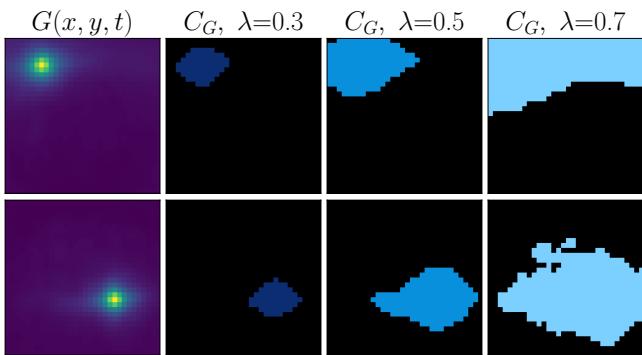
As seen in Figure 6, PSPC-Flex creates organic-looking masks that capture exactly where the network “looks” at any given noise level.
Experimental Results: Does it Work?
The goal of PSPC isn’t to beat state-of-the-art image generators in quality (yet), but to explain them. If PSPC behaves exactly like a neural network, it proves that local patch processing is the mechanism behind generalization.
1. Matching Network Outputs
The researchers fed the same noisy inputs to both a trained neural network (DDPM++) and their training-free PSPC algorithm.
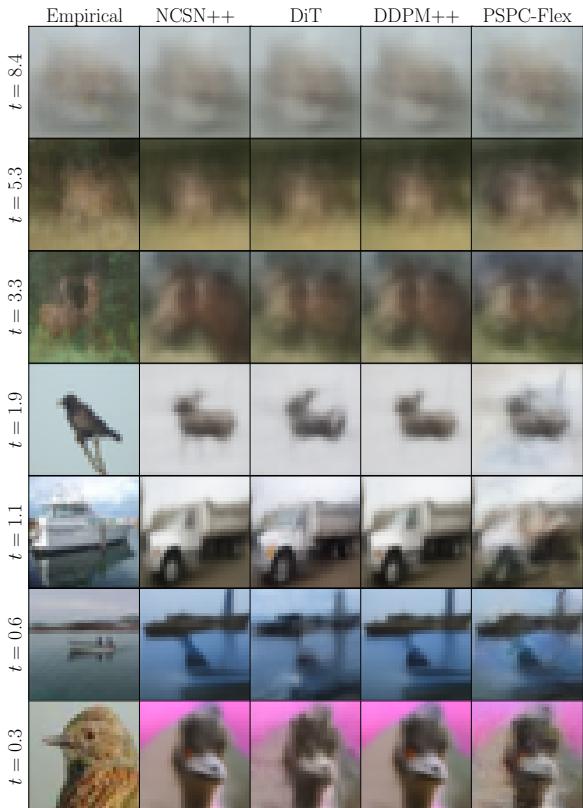
Look at Figure 1.
- Column 1 (Optimal): Returns the exact training data (too sharp, no generalization).
- Columns 2-4 (Networks): Produce specific artifacts, blurring, and color shifts.
- Column 5 (PSPC): The PSPC-Flex output is shockingly similar to the neural networks. It replicates the blur, the structure, and even the color artifacts that the optimal denoiser avoids.
2. Quantitative Error Analysis
When measuring the Mean Squared Error (MSE) against the neural network’s output, PSPC outperforms other baseline methods (like Gaussian approximations or Closed-Form Diffusion Models).
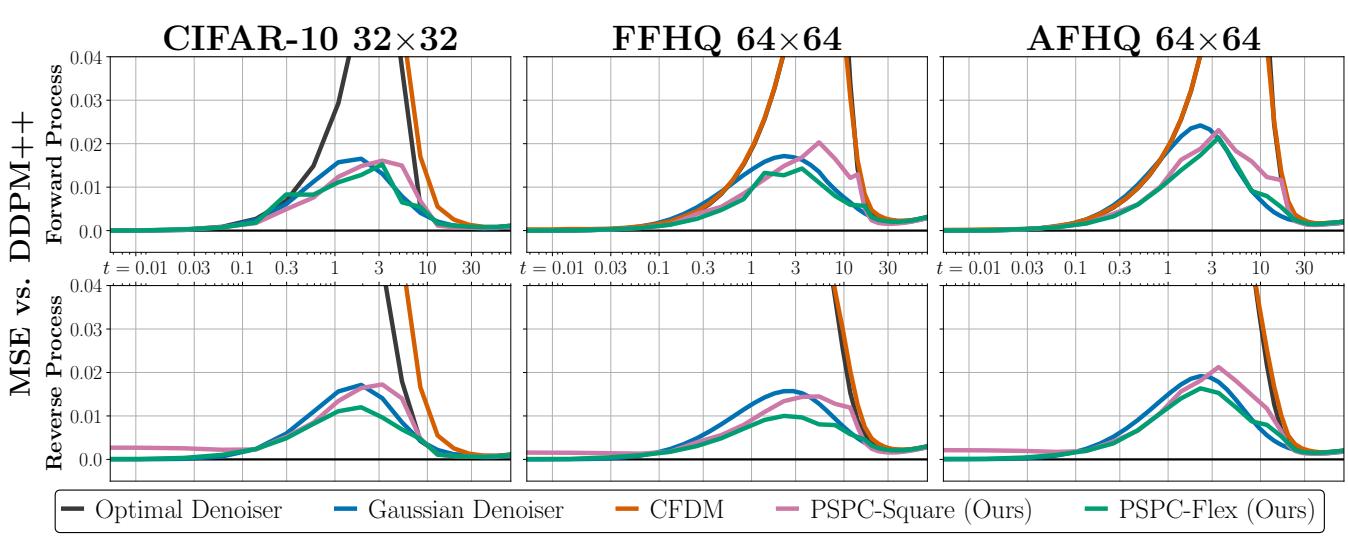
In Figure 7, the pink and green lines (PSPC variants) consistently track lower than the orange (CFDM) and blue (Gaussian) lines, meaning they are much closer to what the neural network is actually doing.
3. Sampling and Similarity
Finally, the authors ran the full diffusion sampling process using PSPC. Can a completely training-free algorithm, which simply stitches together training patches, generate coherent new images?
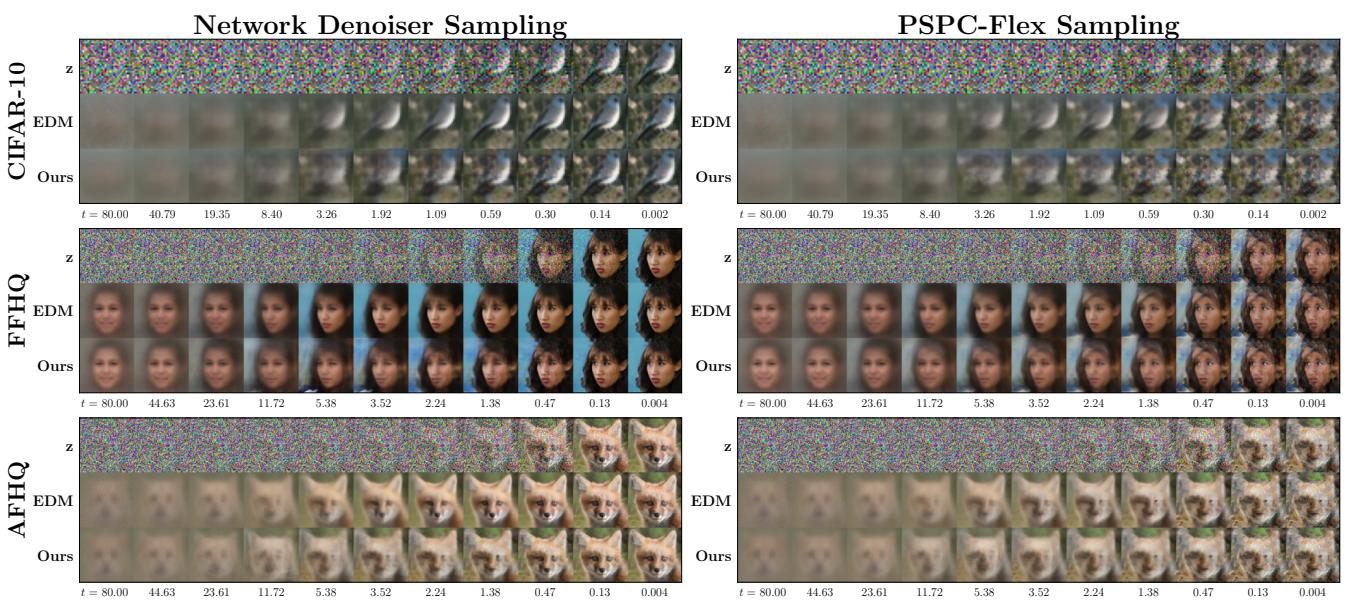
Figure 8 compares the sampling trajectories. While PSPC (Right) accumulates some errors leading to lower fidelity than the neural network (Left), the structure and content are remarkably preserved. If the network generates a face with glasses, PSPC tries to construct a face with glasses using patches.
To quantify this, they used SSCD (a metric for image copy detection/similarity).
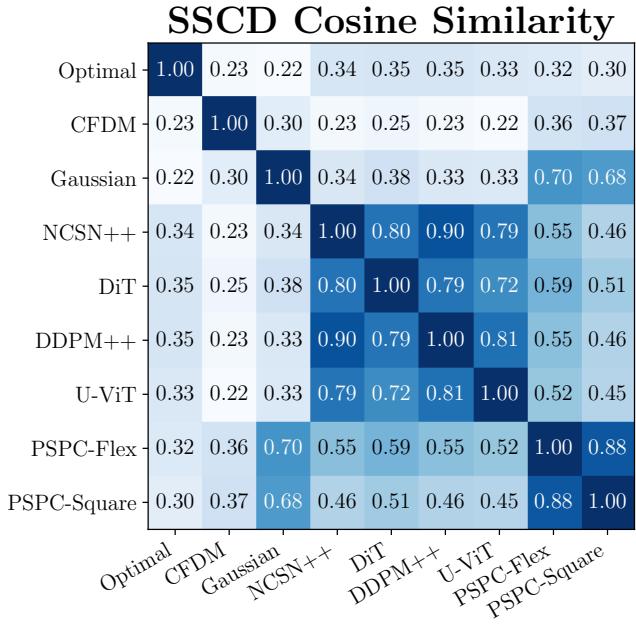
Figure 9 shows that PSPC-Flex samples have a similarity score of 0.55 with neural network samples. This is significantly higher than the Optimal Denoiser (0.34) or other baselines. This high correlation confirms that PSPC captures the essence of the neural network’s generative process.
Conclusion: The “Why” of Generalization
This paper provides a compelling mechanistic explanation for how diffusion models create novel content. They are not simply memorizing data, nor are they doing something ineffably magical.
Diffusion models generalize because they function as local patch denoisers.
By breaking an image into local context windows, the model loses the ability to identify the exact global training image. Instead, it finds the best matching parts of training images—an eye from here, a texture from there—and composes them into a coherent whole.
The PSPC algorithm introduced by the authors serves as a proof-of-concept. It demonstrates that we can mimic the behavior of massive, expensive neural networks using a simple, training-free algorithm based on retrieving and stitching dataset patches.
Why does this matter?
- Interpretability: We now have a clearer understanding of the “black box.” We know that the “creative” gap between memorization and generation lies in the locality of the processing.
- Copyright and Attribution: Since PSPC explicitly uses training patches, it suggests that neural generation is, in a sense, a complex form of collage. This could provide tools for tracking which training images contributed to a specific generated pixel.
- Efficiency: While PSPC is currently slow (due to nearest-neighbor searches), future optimizations could lead to high-quality generative models that don’t require massive training runs—just a good dataset and a smart patch-compositing algorithm.
By demystifying the “magic,” we gain not just better theory, but potentially better, more controllable tools for the future of generative AI.