](https://deep-paper.org/en/paper/2411.19942/images/cover.png)
Introduction
If you have ever played a modern video game or worked with 3D animation, you might have noticed a peculiar trend: characters in tactical gear, tight superhero suits, or jeans look fantastic. But characters wearing long dresses, flowing skirts, or loose robes? They often look… odd. The fabric might stretch unnaturally between their legs, tear apart when they run, or look like a rigid plastic shell rather than flowing cloth.
This isn’t just lazy animation; it is a fundamental limitation in how we traditionally model clothed humans using computers. The industry standard relies on a technique called Linear Blend Skinning (LBS), which assumes that everything on a character moves in sync with their skeleton, like skin. While this works perfectly for a tight t-shirt, it fails miserably for a skirt that shouldn’t move exactly like the legs underneath it.
In this post, we are diving deep into FreeCloth, a new research paper that proposes a clever hybrid solution to this problem. Instead of trying to force existing methods to work for loose clothing, the researchers ask a simple question: Why treat all clothing the same?
By splitting the human model into distinct regions—tight areas that deform with the body and loose areas that are generated freely—FreeCloth achieves state-of-the-art results in modeling complex garments. Let’s explore how it works.
The Problem: The “Pant-Like” Artifact
To understand why FreeCloth is necessary, we first need to understand the current bottleneck in 3D human modeling.
Most learning-based methods for 3D avatars rely on Linear Blend Skinning (LBS). In LBS, every point on a 3D mesh is assigned “weights” corresponding to bones in a skeleton. When a bone moves, the mesh points move with it. This is efficient and effective for skin and tight clothing.
However, these methods usually rely on a “canonical space”—a neutral pose (like a T-pose) where the system learns the shape of the object. To model a posed human, the system tries to map the posed shape back to this neutral T-pose.
Here is the catch: Where do you map the fabric of a skirt in a T-pose?
In a neutral pose, the area between the legs is empty. But in a loose skirt, that area is filled with fabric. When LBS-based methods try to “canonicalize” a skirt, they often map the fabric to the nearest leg. When the character moves, the skirt stretches and splits, following the legs individually rather than draping as a single piece of cloth. This results in the infamous “split” or “pant-like” artifacts, where a beautiful dress ends up looking like a weird pair of baggy trousers.
Previous attempts to fix this have tried to refine the LBS weights or use coarse-to-fine predictions, but they all suffer from the same root cause: they are trying to model loose physics using a system designed for tight skin.
The Solution: Hybrid Modeling
The authors of FreeCloth propose a paradigm shift. Rather than searching for a “one-size-fits-all” algorithm, they acknowledge that different parts of a clothed human behave differently.
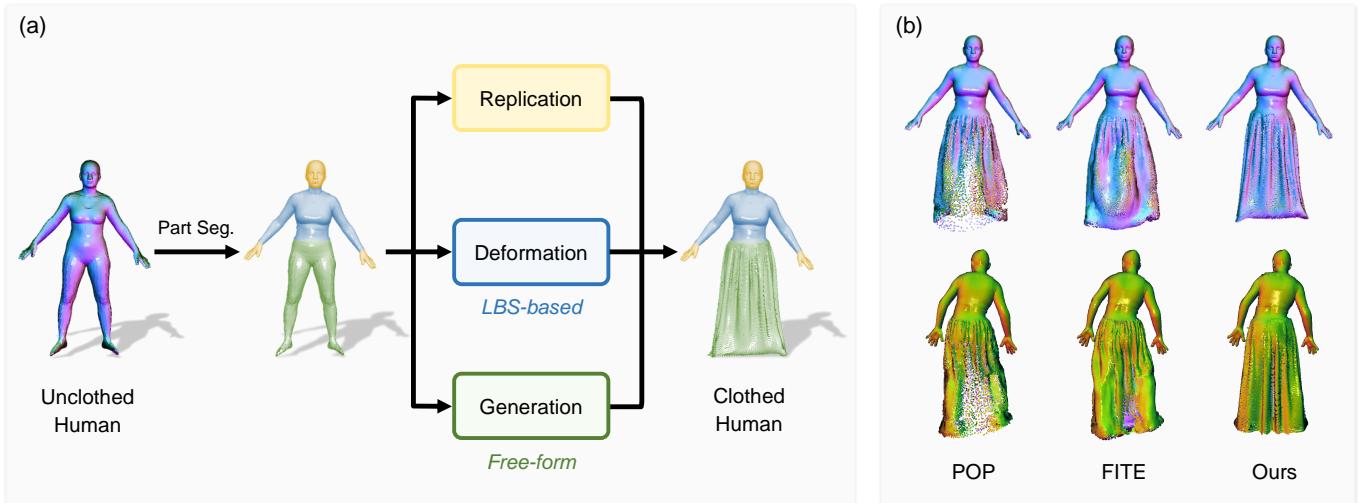
Their framework segments the human body into three distinct categories:
- Unclothed Regions (Yellow): Hands, feet, and head. These don’t need complex clothing deformation; they just need to move with the skeleton.
- Deformed Regions (Blue): Clothing close to the body (e.g., the waist of a dress, tight sleeves). These move closely with the skin, so LBS works well here.
- Generated Regions (Green): Loose clothing (e.g., the hem of a skirt). These regions deviate significantly from the body and shouldn’t be constrained by skinning weights.
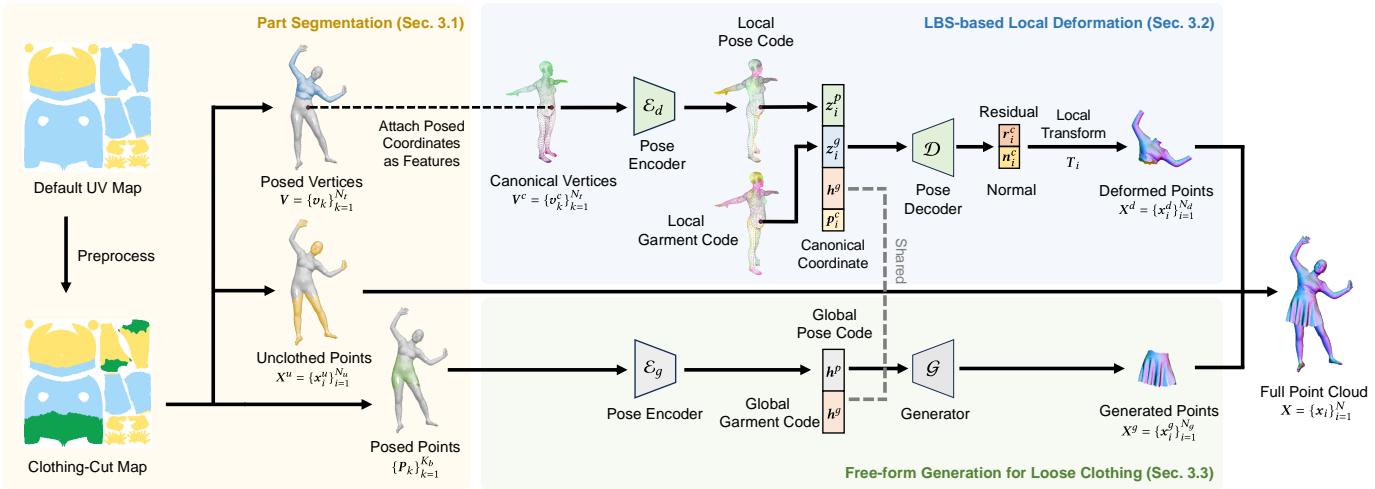
As shown in the architecture diagram above, the system processes these regions in parallel branches that merge at the end to form the final avatar.
Step-by-Step Method Analysis
Let’s break down the FreeCloth pipeline into its three core components: Segmentation, LBS Deformation, and Free-form Generation.
1. Human Part Segmentation
Before the model can process the geometry, it needs to know what it is looking at. The system needs to automatically decide which points should be deformed (LBS) and which should be generated (Free-form).
The researchers utilize the Segment Anything Model (SAM), a powerful foundation model for image segmentation. They render normal maps of the human model in a canonical pose and use SAM to identify loose clothing regions (like skirts).
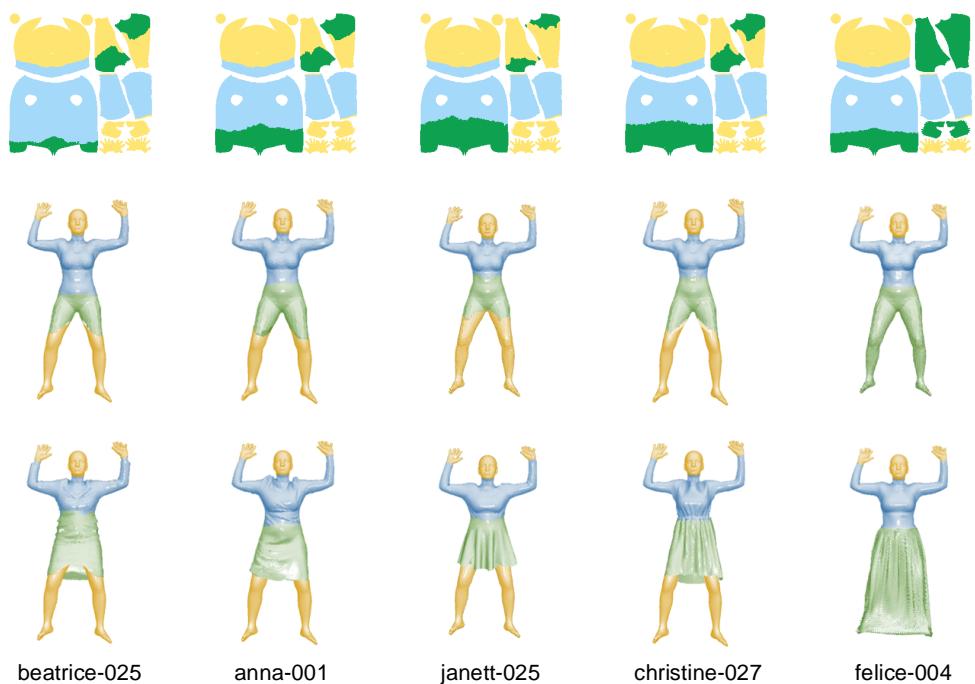
This process creates a Clothing-Cut Map.
- Yellow: Unclothed points (replicated directly).
- Blue: Tight clothing points (sent to the LBS branch).
- Green: Loose clothing points (sent to the Generator branch).
This map is crucial. Without it, the system wouldn’t know when to stop applying LBS and start generating, leading to tearing artifacts where the two methods meet.
2. LBS-based Local Deformation (The Blue Zone)
For the parts of the clothing that stick to the body, the authors stick to what works. They use a standard LBS-based approach.
First, they extract Local Pose Codes (\(z^p_i\)) using a PointNet++ encoder. This captures the specific geometric configuration of the body pose locally. They also use Garment Codes (\(z^g_i\)) to represent the type of clothing (e.g., a t-shirt vs. a tank top).
The core operation here is predicting a displacement (how much the cloth bulges out from the skin) in the canonical space.
\[ [ { \pmb r } _ { i } ^ { c } , { \pmb n } _ { i } ^ { c } ] = \mathcal { D } ( z _ { i } ^ { p } , z _ { i } ^ { g } , { \pmb h } ^ { g } , { \pmb p } _ { i } ^ { c } ) , \]Here, \(\mathcal{D}\) is the decoder network that predicts the residual offset \(r_i^c\) and normal \(n_i^c\). Once this offset is calculated in the neutral T-pose space, it is transformed into the target pose using standard skinning transformations (\(T_i\)):
\[ \pmb { x } _ { i } ^ { d } = \pmb { p } _ { i } + \pmb { T } _ { i } \cdot \pmb { r } _ { i } ^ { c } = \pmb { T } _ { i } \cdot ( \pmb { p } _ { i } ^ { c } + \pmb { r } _ { i } ^ { c } ) . \]This handles the tight parts of the mesh perfectly. But what about the skirt?
3. Free-form Generation (The Green Zone)
This is the novel contribution of the paper. For the “Green” regions identified in the segmentation step, the model abandons LBS entirely. Instead, it treats the skirt as a point cloud generation problem.
The goal is to generate a set of points \(X^g\) that represent the skirt in the current pose, without trying to map it back to a T-pose.
Structure-Aware Pose Encoding
To generate a skirt that flows correctly with the legs, the model needs to understand the pose of the legs specifically. A global pose vector (one vector describing the whole body) is often too vague.
The authors propose Structure-Aware Pose Encoding. They segment the unclothed body into semantic parts (e.g., left thigh, right calf) and use PointNet++ to extract features for each part individually.
\[ \pmb { h } ^ { p } = \mathrm { M a x - P o o l i n g } ( \{ \mathcal { E } _ { g } ( \pmb { P } _ { k } ) \} _ { k = 1 } ^ { K _ { b } } ) . \]This results in a pose code \(h^p\) that is highly sensitive to the specific articulation of the limbs that interact with the skirt.
The Generator
With the pose code (\(h^p\)) and a global garment code (\(h^g\)), a generator network \(\mathcal{G}\) creates the points for the loose clothing directly in the posed space:
\[ X ^ { g } = \{ \pmb { x } _ { i } ^ { g } \} _ { i = 1 } ^ { N _ { g } } = \mathcal { G } ( \pmb { h } ^ { p } , \pmb { h } ^ { g } ) , \]Because this generation is “free-form,” it is not constrained by the topology of the legs. The skirt can drape, fold, and hang in the empty space between the legs without being artificially pulled apart by bone weights.
Collision Loss
One risk of generating clothing freely is that it might clip through the body (e.g., the skirt might accidentally pass through the thigh). To prevent this, the authors implement a collision loss function during training:
\[ \mathcal { L } _ { c } = \frac { 1 } { N _ { g } } \sum _ { j = 1 } ^ { N _ { g } } \operatorname* { m a x } \{ \epsilon - d ( \pmb { x } _ { j } ^ { g } ) , 0 \} , \]This essentially penalizes the model if any generated clothing point \(x^g_j\) is found to be inside the volume of the body (defined by the signed distance function \(d\)).
Experiments and Results
The researchers compared FreeCloth against several state-of-the-art methods: POP, SkiRT, and FITE. They used the ReSynth dataset, which contains high-quality synthetic scans of humans in challenging clothing.
Visual Quality
The visual differences are striking. In the figure below, look closely at the skirts (highlighted in red).
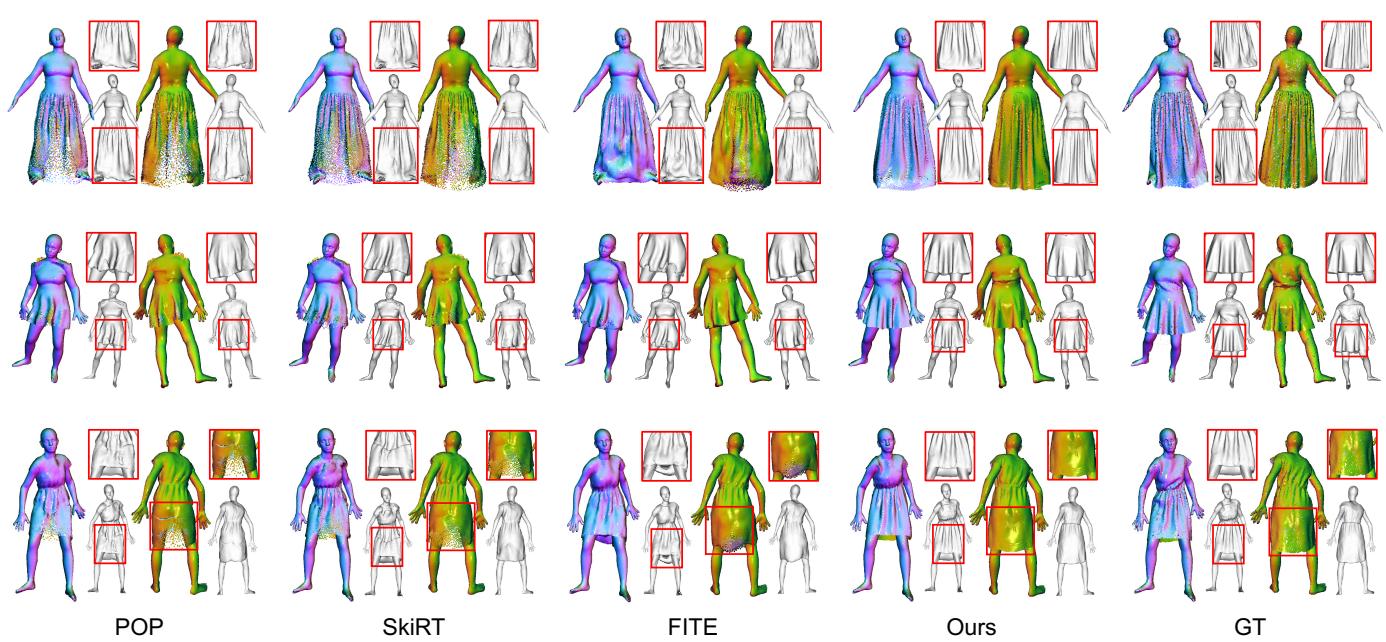
- POP (Top): Suffer heavily from the “pant-leg” artifact. The skirt is torn apart to follow the legs.
- FITE (Middle): Performs better but often creates “open surfaces” or noise where the skirt should be continuous.
- FreeCloth (Bottom): Maintains a continuous, smooth surface with realistic wrinkle details, even in the difficult area between the legs.
The Problem with Traditional Metrics
Interestingly, the authors note that standard metrics like Chamfer Distance (CD)—which measures the average distance between points—are not always reliable for loose clothing. A smooth, featureless blob might have a lower CD error than a highly detailed skirt that is slightly offset from the ground truth.
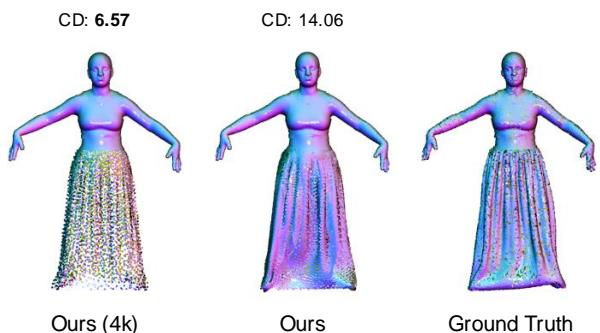
Because clothing simulation is stochastic (the same pose can result in different wrinkle patterns depending on previous motion), exact point-matching isn’t always the best goal. Therefore, they also rely on perceptual metrics like FID (Fréchet Inception Distance) on rendered normal maps, which better captures visual realism.
Quantitative Data
Despite the metric caveats, FreeCloth achieves superior performance across the board, particularly in FID scores which correlate with visual quality.

User Preference
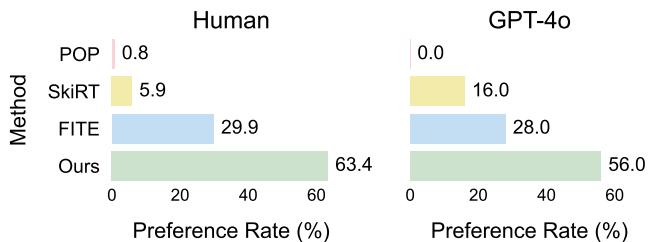
To verify the visual improvements, the researchers conducted a user study (with human voters) and a study using GPT-4o as a judge. The results were overwhelmingly in favor of FreeCloth.
Why the Hybrid Approach Matters (Ablation)
Is the “Hybrid” part really necessary? Could we just use the Generator for the whole body? Or just the LBS?
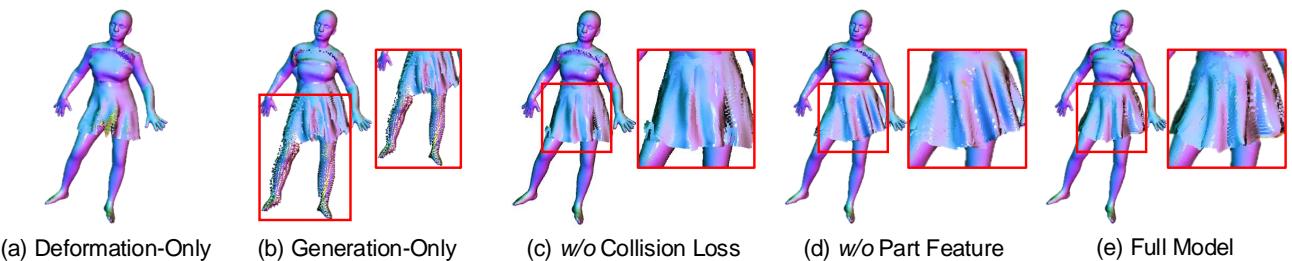
The ablation study below answers this.
- (a) Deformation Only: Results in the pant-leg split.
- (b) Generation Only: The results are noisy and disjointed, especially around articulated joints like knees.
- (e) Full Model: Best of both worlds. Clean joints, clean skirt.
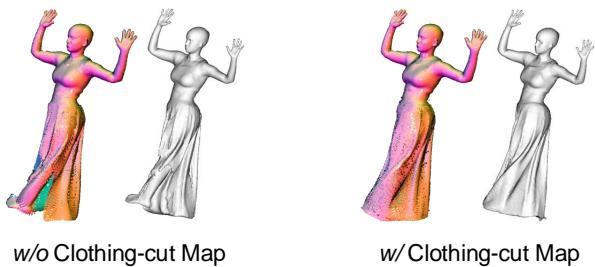
Furthermore, the Clothing-cut map is vital. If you simply try to blend the two methods without explicit segmentation guidance, you get tearing where the LBS mesh fights with the generated mesh.
Conclusion
FreeCloth represents a significant step forward in digital human modeling because it moves away from the idea that a single algorithm must solve every problem. By acknowledging that tight clothing and loose clothing are physically distinct phenomena, the researchers created a pipeline that applies the right tool for the job.
- LBS is used where it shines: articulated, body-hugging deformation.
- Free-form Generation is used where LBS fails: loose, flowing topology.
This hybrid approach effectively solves the “split skirt” artifact that has plagued data-driven avatars for years. For students and researchers in computer graphics, this paper is a great lesson in geometric priors: knowing when to impose structural constraints (like skeletons) and when to let a neural network generate geometry freely is key to achieving high-fidelity results.
While the method currently focuses on single-frame generation (meaning it doesn’t yet account for the physics of the cloth swinging from previous frames), it opens the door for much more realistic avatars in gaming and virtual reality. The authors also suggest future work integrating this with 3D Gaussian Splatting, which could lead to avatars that not only have great geometry but photorealistic textures as well.