](https://deep-paper.org/en/paper/2412.00054/images/cover.png)
In the rapidly evolving landscape of Artificial Intelligence, we have moved from training models from scratch to a new paradigm: taking a massive pre-trained model and fine-tuning it for specific tasks. Whether it’s a vision model trained to recognize satellite imagery or a language model fine-tuned for legal advice, we are surrounded by “specialist” versions of “generalist” models.
But this creates a logistical nightmare. If you want a system that can handle 50 different tasks, do you store 50 copies of a multi-gigabyte neural network? That is computationally expensive and storage-intensive.
Model Merging has emerged as a solution. It involves combining the weights of multiple fine-tuned models into a single entity. However, this technique faces two major hurdles:
- Parameter Conflict: When you mash different models together, they often interfere with each other, degrading performance.
- Storage Costs: Even dynamic merging methods usually require you to keep the heavy, full-precision “task vectors” (the mathematical difference between the fine-tuned model and the base model) on disk.
In a fascinating new paper, Less is More: Efficient Model Merging with Binary Task Switch, researchers propose a radical solution. They discovered that most of the information in these fine-tuned models is actually noise. By stripping away the noise and converting the remaining signal into a simple binary format (just +1s and -1s), they achieved state-of-the-art performance with 1% to 3% of the storage cost.
Let’s dive into how this “T-Switch” method works and why it suggests that, in AI, less really is more.

The Background: Task Vectors and Interference
To understand the innovation, we first need to understand Task Vectors.
Imagine you have a pre-trained model with weights \(\theta_{pre}\). You fine-tune it on a specific task (like classifying cars) to get \(\theta_{ft}\). The “Task Vector” (\(\tau\)) is simply the difference:
\[ \tau = \theta_{ft} - \theta_{pre} \]This vector represents the “knowledge” gained during fine-tuning. Traditional model merging tries to combine multiple task vectors (\(\tau_1, \tau_2, ... \tau_k\)) and add them back to the pre-trained model.
The problem? Interference. One task vector might want to increase a specific neuron’s weight to recognize a wheel, while another task vector might want to decrease that same weight to recognize a cloud. When you add them together, they cancel out or create noise, leading to a model that is mediocre at everything.
The Core Discovery: The “Pulse” Characteristic
The researchers began by asking a fundamental question: Is every parameter in a task vector useful?
Fine-tuning usually updates all the parameters in a network slightly. But are those microscopic updates actual knowledge, or just random noise from the training process (stochastic gradient descent)?
To test this, the authors designed a controlled experiment. They defined a “Pulse Activation” mechanism. They tried discarding parameters based on their magnitude (absolute value):
- Discard Low: Set the smallest parameters to zero.
- Discard High: Set the largest parameters to zero.
- Random: Discard parameters randomly (similar to a technique called DARE).
The results, illustrated below, were striking.
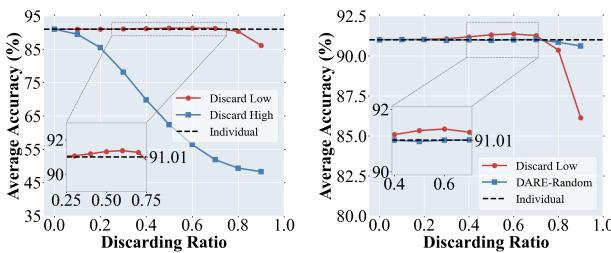
As shown in the left graph, when they discarded the “Low” magnitude parameters (the red line), the model’s accuracy didn’t drop. in fact, it improved. The accuracy remained stable even when 60-80% of the parameters were thrown away. Conversely, discarding the “High” magnitude parameters (the blue line) caused an immediate collapse in performance.
This reveals a Pulse-like Characteristic:
- High-magnitude parameters are the signal. They represent the critical knowledge needed for the task.
- Low-magnitude parameters are the noise. They are redundant and actually interfere with other tasks when merging.
By using a threshold to remove the noise (illustrated in the equation below), we can isolate the “pulse” of the task.

From Cleaning to Compressing: Binarization
Once the researchers realized that only the high-magnitude parameters mattered, they took a bold step. If these parameters are so robust, do we really need their exact 32-bit floating-point values (e.g., 0.54321)? Or do we just need to know their direction (positive or negative)?
They proposed Binary Discard (Bin-Discard). The idea is to:
- Keep only the important parameters (the Pulse).
- Turn them into +1 (if positive) or -1 (if negative).
- Use a single scalar value to scale them back to the approximate range.
The result is a massive compression. Instead of storing complex decimal numbers, you store a sparse map of 1s and -1s.
But does it work?
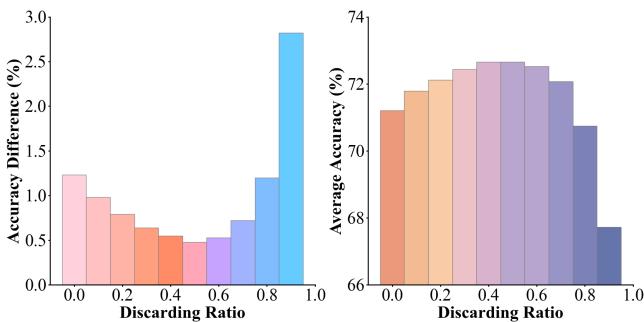
The charts above show something counter-intuitive. The blue bars on the left show the difference in accuracy between the binary method and the original full-precision model. As the discard ratio increases (meaning we throw away more “small” noise), the binary model actually outperforms the original model (indicated by the bars going above 0).
This confirms the “Less is More” hypothesis: Binarizing the task vector not only saves space but acts as a regularizer, stripping away the noise that causes overfitting or merging conflicts.
The Architecture: Introducing T-Switch
Based on these insights, the authors introduced Task Switch (T-Switch). It is a framework that decomposes a task vector into three lightweight components, akin to the controls on an electrical panel.
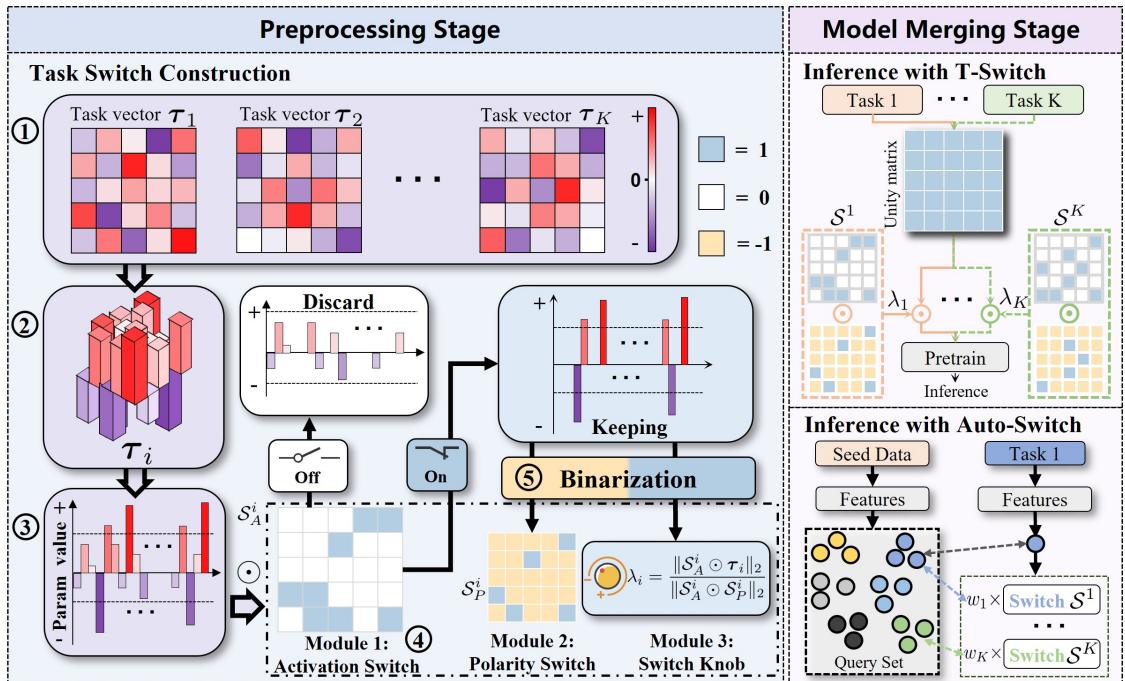
As shown in the diagram above (Module 1, 2, 3), a Task Vector is broken down into:
- Activation Switch (\(S_A\)): A binary mask (0 or 1). This determines where the important parameters are. It “activates” the relevant neurons for a specific task.
- Polarity Switch (\(S_P\)): A binary sign map (+1 or -1). This determines the direction of the update. Does this neuron need to become more positive or more negative?
- Switch Knob (\(\lambda\)): A single scalar value (a floating-point number). This controls the intensity or volume of the task vector.
The Math Behind the Switch
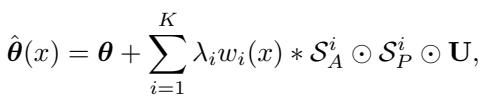
Mathematically, the approximated task vector \(\hat{\tau}_i\) is reconstructed as follows:

When merging multiple tasks during inference, T-Switch dynamically activates these switches applied to a shared “all-ones” vector (\(\mathbf{U}\)). This allows the base model to be modified by multiple lightweight switches simultaneously.

Auto-Switch: Training-Free Automation
In real-world scenarios, we don’t always know which task vector to apply for a given input. If a user uploads an image, is it a satellite photo (Task A) or a traffic sign (Task B)?
Existing methods train complex “routers” to decide this, which is computationally expensive and requires retraining whenever a new task is added.
The authors propose Auto-Switch, a clever, training-free alternative.
- Query Set: For each task, they keep a tiny set of example features (statistically representative embeddings).
- Inference: When a new input arrives, the system compares the input’s features to the Query Sets using a Nearest Neighbor search.
- Weighting: It calculates a similarity score (\(w_i\)) and automatically adjusts the “Switch Knob” for the relevant tasks.
This allows the model to dynamically adapt to the input without any additional parameter training.
Experimental Results
The researchers tested T-Switch and Auto-Switch against standard benchmarks in both Computer Vision (using CLIP models on 8 datasets) and Natural Language Processing (using RoBERTa on the GLUE benchmark).
1. Storage Efficiency vs. Performance
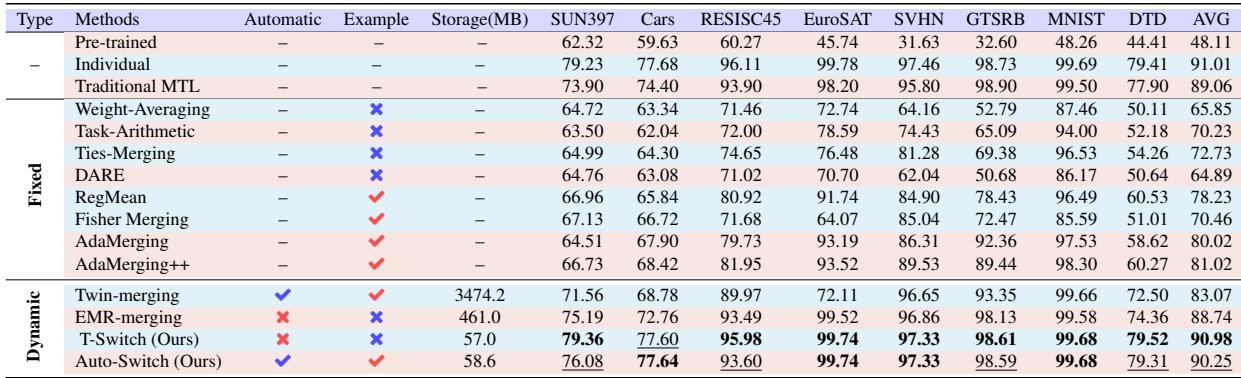
The most impressive result is the storage efficiency. In the table below, look at the “Storage (MB)” column.
- Twin-Merging (Previous SOTA): Requires 3474.2 MB of extra storage.
- T-Switch (Ours): Requires only 57.0 MB.
That is a 98.3% reduction in storage. Yet, look at the “AVG” (Average Accuracy) column. T-Switch achieves 90.98%, beating Twin-Merging (83.07%) and even outperforming the “Traditional Multi-Task Learning” (MTL) baseline.
2. Visual and Language Consistency
The effectiveness wasn’t limited to just vision. The radar charts below compare the methods on Vision (ViT-B/32) and Language (RoBERTa) models.
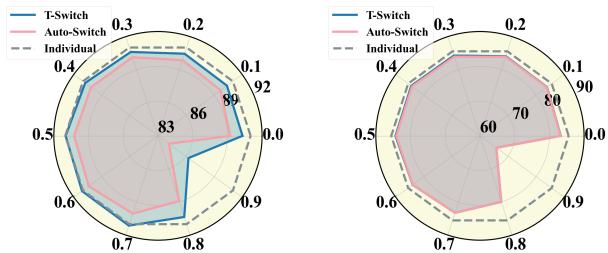
In these charts, the blue line (T-Switch) consistently pushes towards the outer edges (higher performance), closely matching the grey dashed line (Individual Fine-Tuning). This indicates that the merged model, despite being compressed to binary bits, retains almost all the specialized knowledge of the individual models.
Why This Matters
The “Less is More” paper provides a pivotal insight for the future of deployment. As we move towards “Edge AI”—running powerful models on phones, laptops, and IoT devices—storage and memory are the bottlenecks.
Current methods suggest that if you want a model that can do 100 things, you need to store 100 giant files. T-Switch demonstrates that you can store one giant file (the base model) and 100 tiny “Switch” files (the binary masks).
By identifying that the vast majority of fine-tuning updates are redundant noise, T-Switch allows us to:
- Reduce Storage: From Gigabytes to Megabytes.
- Reduce Conflict: By removing noise, tasks play nicer together.
- Maintain Performance: Achieving accuracy comparable to full-precision models.
This research proves that in the world of massive neural networks, we don’t always need more parameters or more precision. Sometimes, we just need to find the “pulse” and switch off the rest.