](https://deep-paper.org/en/paper/2412.00175/images/cover.png)
Introduction
In the cat-and-mouse game of deepfake detection, we often assume that as generative models get better, detection models must simply become more complex to keep up. We rely on massive datasets of real and manipulated videos to train these detectors, trusting that the neural networks are learning to spot subtle artifacts—mismatched lip movements, unnatural blinking, or digital residue on the pixel level.
But what if our models aren’t learning what we think they are learning? What if, instead of analyzing the complex interplay between audio and video, they are cheating?
In a machine learning context, this is known as “shortcut learning” or relying on spurious correlations. A famous example involves an AI trained to detect wolves vs. huskies; instead of looking at the animal, the model learned that “snow in the background” equals “wolf.”
A recent paper titled “Circumventing shortcuts in audio-visual deepfake detection datasets with unsupervised learning” reveals a massive “snow” problem in the world of deepfakes. The researchers discovered that in two of the most popular audio-visual datasets, deepfake videos contain a tiny, almost imperceptible artifact: a brief moment of silence at the very start of the audio track.
This blog post explores how this simple silence broke state-of-the-art supervised models, allowing them to achieve near-perfect scores without actually looking at the fake content. We will then dive deep into the authors’ proposed solution: a shift toward unsupervised learning that aligns audio and visual streams using only real data, effectively blinding the model to these helpful but deceptive shortcuts.
The Hidden Flaw: The Silence Bias
Data is the fuel for modern AI. In the niche of audio-visual (AV) deepfake detection, researchers rely on benchmark datasets to train and evaluate their models. Two heavyweights in this arena are FakeAVCeleb and AV-Deepfake1M.
FakeAVCeleb contains nearly 20,000 fake videos generated using face-swapping and voice-cloning tools. AV-Deepfake1M is even larger, with over a million videos featuring local manipulations (like changing specific words). Both are derived from the VoxCeleb2 dataset of YouTube celebrity interviews.
The researchers of this paper conducted a forensic analysis of these datasets and found a startling anomaly.
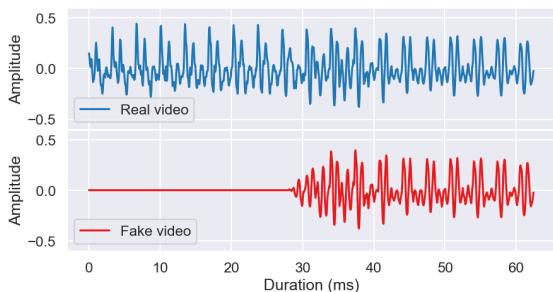
As shown in Figure 1, there is a distinct difference in the audio waveforms of real versus fake videos. The blue line represents a real video; it shows high-frequency oscillations right from the start (\(t=0\)). This is background noise—static, room tone, or breathing—that naturally occurs in real recordings.
The red line, however, represents a fake video. Notice that the amplitude remains at zero for the first 30 milliseconds before the signal kicks in. This is the leading silence. It is likely an artifact introduced during the generation process, perhaps when the synthetic audio stream is stitched together with the video.
Quantifying the Bias
Is this just a fluke in a few samples? The researchers analyzed the distribution of silence duration across the entire test sets of both datasets.

Figure 2 paints a clear picture. The blue distributions (Real) cluster heavily near 0 ms, meaning the audio starts immediately. The orange distributions (Fake) have distinct peaks between 25ms and 30ms.
This separation is so distinct that you don’t need a complex neural network to tell real from fake. You just need a simple rule: “If the audio is silent for more than 10ms, it’s a deepfake.”
Using a basic classifier based solely on this “leading silence duration,” the researchers achieved an Area Under the Receiver Operating Characteristic Curve (AUC) of over 98% on both datasets. This implies that many state-of-the-art models, which claim to detect sophisticated manipulation, might actually just be detecting silence.
Sensitivity Analysis
To further prove how robust this “shortcut” is, the researchers tested different thresholds.
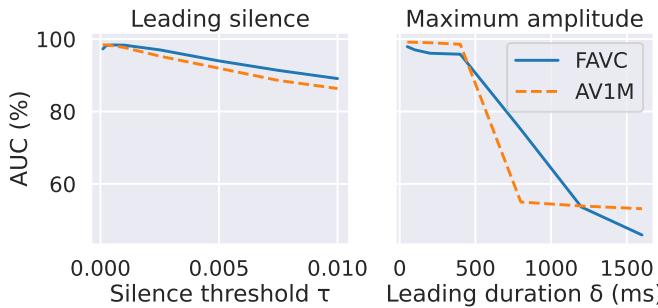
Figure 3 (Left) shows the performance of the silence classifier as the threshold for what counts as “silence” changes. The performance remains near 100% AUC for low amplitude thresholds (\(\tau\)), meaning the silence is truly silent (digital zeros or near-zeros).
Figure 3 (Right) approaches it differently: looking at the maximum amplitude within the first \(\delta\) milliseconds. If you only look at the first 30ms, the classifier is perfect. As you look further into the video (beyond 500ms), real audio and fake audio become indistinguishable by amplitude alone, and performance drops to random chance (50%).
This confirms the bias is concentrated entirely at the very beginning of the file.
The Impact on Existing Models
The discovery of the silence bias casts a shadow over previous research. If a complex deep learning model is fed data where class A (Fake) always has silence and class B (Real) does not, the model will lazily learn to detect the silence. It is the path of least resistance.
To test this hypothesis, the authors evaluated three existing methods:
- RawNet2: An audio-only model analyzing raw waveforms.
- MDS (Modality Dissonance Score): An audio-visual method measuring the distance between audio and video features.
- AVAD: An unsupervised anomaly detection method.
They tested these models in two scenarios:
- Original: The full videos (including the silence).
- Trimmed: The videos with the leading silence cut off (forcing the model to look at the actual content).
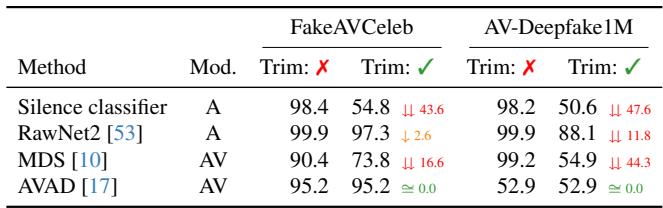
Table 1 reveals the extent of the damage.
- The Silence Classifier: As expected, it drops from ~98% to random chance (~50%) when the silence is trimmed.
- RawNet2 (Audio-only): On the AV-Deepfake1M dataset, its performance drops significantly from 99.9% to 88.1%. This suggests the model was heavily relying on the silence cue.
- MDS: This model essentially collapses on AV-Deepfake1M, dropping from 99.2% to 54.9% (near random).
- AVAD: Interestingly, this model is unaffected. Why? Because it is an unsupervised method trained only on real data. It never saw a fake video during training, so it never learned that “silence = fake.”
This result is the pivot point of the paper. It suggests that supervised learning (training on labeled Real vs. Fake data) is dangerous when datasets have hidden biases. The model overfits to the artifacts of the specific dataset generator rather than learning generalizable features of manipulation.
The Solution: AVH-Align
To solve the shortcut problem, the authors propose abandoning supervised learning in favor of an unsupervised approach trained exclusively on real data. If a model never sees a deepfake during training, it cannot learn the “silence shortcut.”
Their proposed method is called AVH-Align (AV-HuBERT Aligned).
The core idea is Audio-Visual Synchronization. In real videos, the movement of the lips and facial muscles is perfectly synchronized with the audio speech. In deepfakes, even high-quality ones, there are often subtle temporal mismatches or semantic inconsistencies between what is seen and what is heard.
AVH-Align learns what “perfect alignment” looks like from real data. During inference, if a video exhibits poor alignment, it is flagged as a deepfake.
System Architecture
The architecture leverages a powerful pre-trained model called AV-HuBERT.
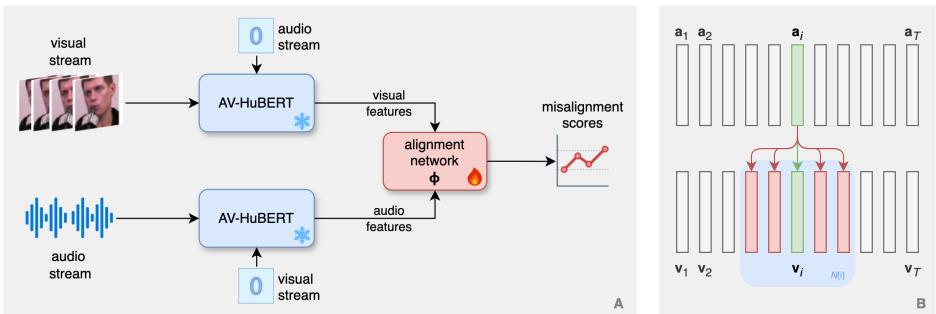
As illustrated in Figure 4, the pipeline consists of two stages: Feature Extraction and Alignment Learning.
1. Self-Supervised Feature Extraction
The system uses AV-HuBERT, a Transformer-based model pre-trained on massive amounts of audio-visual data (like Lip Reading tasks).
- Visual Features (\(v_i\)): The model processes the video frames while the audio input is masked.
- Audio Features (\(a_i\)): The model processes the audio waveform while the visual input is masked.
This results in two streams of high-dimensional feature vectors (1024 dimensions) representing the audio and video content at each time step \(i\).
2. The Alignment Network (\(\Phi\))
Once the features are extracted, they are normalized and passed to a lightweight network called \(\Phi\). This is a Multi-Layer Perceptron (MLP) that takes the concatenated audio and visual features and outputs a single score representing their compatibility.

The MLP consists of four layers that progressively compress the data (1024 \(\to\) 512 \(\to\) 256 \(\to\) 128 \(\to\) 1 output).
3. The Objective: Contrastive Learning
How does the network learn alignment? The authors use a probabilistic contrastive approach.
For a specific time step \(i\), the audio feature \(a_i\) should match the visual feature \(v_i\). This is the “positive pair.” However, \(a_i\) should not match visual features from different time steps (e.g., \(v_k\) where \(k\) is a few seconds away).
The model calculates the probability that visual frame \(v_i\) matches audio frame \(a_i\) using the Softmax function over a neighborhood of frames:
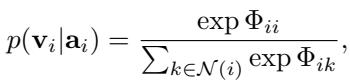
Here, \(\mathcal{N}(i)\) represents the temporal neighborhood (30 frames around the target). The goal is to maximize the score \(\Phi_{ii}\) (correct match) relative to the scores of neighbors \(\Phi_{ik}\) (incorrect matches).
The final loss function is the negative log-likelihood of these probabilities, averaged over the video duration \(T\):
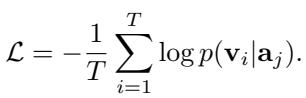
By minimizing this loss on real videos only, the network becomes an expert at recognizing natural audio-visual synchronization.
Inference: Detecting the Fake
When a new video is presented to AVH-Align:
- The model computes the alignment score \(-\Phi_{ii}\) for every frame.
- If the video is real, the alignment is strong (score is low).
- If the video is fake, the audio and video will be out of sync (score is high).
The video-level score is computed by pooling these frame-level scores. Crucially, because the model was never told “silence = fake,” it treats the leading silence just like any other audio segment. If the silence doesn’t match the video (which it likely doesn’t), it contributes to the score, but it doesn’t dominate the decision-making process like it does in supervised models.
Experiments and Results
The researchers compared their unsupervised AVH-Align against a supervised version of the same architecture (AVH-Align/sup). The supervised version was trained using a standard Binary Cross-Entropy loss on labeled real and fake data.

The comparison aimed to answer one main question: Is the unsupervised method more robust to dataset biases?
Robustness to Trimming
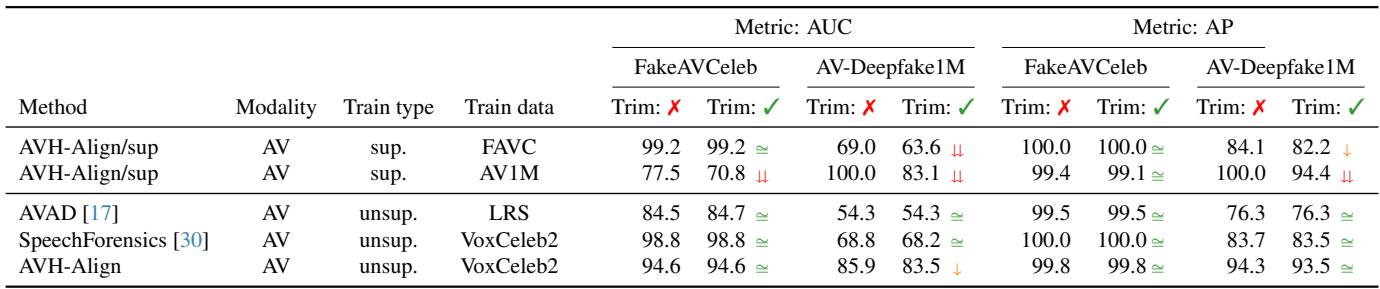
Table 2 presents the critical results. Let’s look at the AV-Deepfake1M (AV1M) columns:
- AVH-Align/sup (Supervised):
- On the original dataset (Trim: ✖️), it scores a massive 100.0% AUC when trained on AV1M. It looks perfect.
- But when the silence is trimmed (Trim: ✔️), performance drops significantly (e.g., from 85.9% to 66.6% or 100% to 83.1% depending on training data). This confirms the supervised model was cheating.
- AVH-Align (Unsupervised):
- The performance is identical on trimmed and untrimmed data (e.g., 85.9% vs 83.5% or 94.6% vs 94.6%).
- Trimming the silence generally leads to better or stable performance because the model isn’t relying on the artifact.
While the supervised model (cheating with silence) technically gets higher numbers on the flawed dataset, the unsupervised model is the only one actually solving the problem of deepfake detection rather than silence detection.
Visualizing the “Cheat”
To visualize exactly what the models are looking at, the authors plotted the “fakeness score” for every frame of a video.

Figure 5 is revealing.
- Red shaded areas: The parts of the video that were actually manipulated.
- Orange line (Supervised): Notice how it spikes aggressively at the very beginning (Time 0). The supervised model is screaming “Fake!” based purely on the first millisecond of silence. It often ignores the actual manipulated regions (red areas) later in the video because it has already made up its mind.
- Blue line (Unsupervised): This line stays low at the start. It spikes during or after the red manipulation zones. This indicates the unsupervised model is detecting the actual dissonance caused by the deepfake generation.
Official Test Set Evaluation
Finally, the authors submitted their model to the official AV-Deepfake1M test server. This is a blind test where the labels are withheld, and the speakers are different from those in the training set.

Table 3 shows that AVH-Align achieved 85.24% AUC, beating all other frame-level and segment-level methods that don’t exploit the silence bias.
The methods marked in red (AVH-Align/sup and Silence Classifier) achieve near-perfect scores (~99%), confirming that the official test set also contains the silence flaw. This implies that the leaderboard for this dataset is currently dominated by models that are likely just detecting silence.
Ablation Studies
The researchers also stripped down their model to understand which components mattered most.

Table 4 highlights a few key architectural insights:
- Feature Normalization is crucial.
- Training Set Size matters (more real data is better).
- Pooling: “Mean” pooling works better for fully generated videos (where the whole video is fake), while “Log-Sum-Exp” works better for local manipulations.
They also tested the complexity of the alignment network.
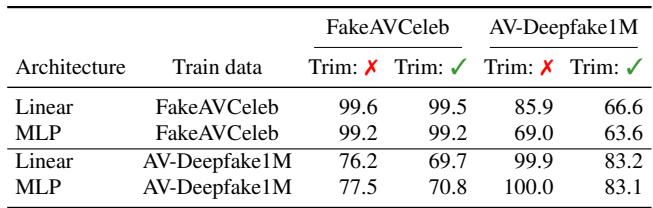
Table 5 shows that while a simple Linear layer can work for supervised learning (because learning “silence vs. noise” is easy), the MLP is necessary for the unsupervised task to capture the complex non-linear relationship between audio and visual features.
Conclusion: The Case for Unsupervised Learning
This paper serves as a wake-up call for the deepfake detection community. It highlights a critical vulnerability in how we build and benchmark AI systems: good performance metrics on bad data result in bad models.
The authors demonstrated that two major datasets, FakeAVCeleb and AV-Deepfake1M, are compromised by a simple silence artifact. Supervised models, designed to maximize accuracy at all costs, exploit this artifact as a shortcut, leading to inflated performance estimates that wouldn’t hold up in the real world.
The proposed solution, AVH-Align, offers a robust alternative. By training exclusively on real data, the model is forced to learn the intrinsic properties of natural human speech—specifically, the precise synchronization between face and voice.
Key Takeaways:
- Audit your Data: Always inspect your data for spurious correlations (like leading silence).
- Beware of 99% Accuracy: If a task is complex (like deepfake detection) but the results are perfect, the model might be cheating.
- Unsupervised Stability: Training on real data (Anomaly Detection) is often more robust to unseen generator artifacts than training on specific fake data (Binary Classification).
As deepfake generation evolves, the artifacts will change. The “silence” bug will eventually be fixed by generators. Supervised models trained on today’s fakes will fail on tomorrow’s. But the fundamental alignment of human speech will remain constant, making unsupervised methods like AVH-Align a promising direction for future-proof forensics.