](https://deep-paper.org/en/paper/2412.01027/images/cover.png)
Introduction: The Limits of Language in Image Editing
We are currently living through a golden age of text-to-image generation. Models like Midjourney, DALL-E, and Stable Diffusion have made it incredibly easy to conjure detailed worlds from a simple sentence. However, a significant gap remains between generating an image from scratch and editing an existing one precisely.
Consider a specific scenario: You have a photo of a standard sedan, and you want to transform it into a Lamborghini. You type the instruction: “Make it a Lamborghini.”
If the AI model has seen thousands of Lamborghinis during its training, it might succeed. But what if the concept is rare, or the specific visual attributes you want are difficult to describe in words? Describing the exact aerodynamic curves, the specific “look” of a texture, or a complex artistic style purely through text is often frustratingly imprecise. Language suffers from ambiguity.
This is where Few-Shot Image Manipulation comes in. Instead of just telling the model what to do, you show it. You provide a “before” image and an “after” image (an exemplar pair) and say, “Do this kind of change to that new image.”
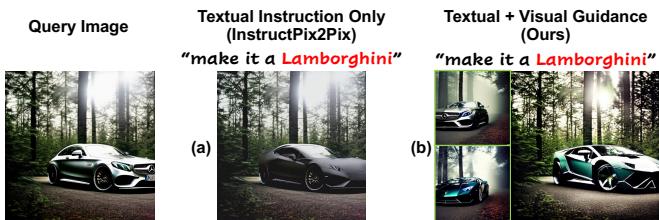
As seen in the figure above, standard text-guided models (like InstructPix2Pix) often fail when the concept (e.g., “Lamborghini”) is excluded from their training data. They might just change the color or do nothing at all. However, by providing a visual example, we can guide the model to understand exactly what we mean.
In this post, we will deep dive into InstaManip, a new research paper that proposes a novel way to solve this problem. Unlike previous methods that rely heavily on diffusion models, InstaManip leverages the reasoning power of Autoregressive Models (the architecture behind Large Language Models) to “learn” an editing operation instantly from examples and apply it to new images.
Background: The Reasoning Gap in Diffusion Models
To understand why InstaManip is significant, we first need to look at the current landscape of AI image editing.
Most state-of-the-art image editing tools today are built on Diffusion Models. These models are excellent at generating high-quality pixels. Approaches like ControlNet or InstructPix2Pix tweak the internal states of a diffusion model to guide the generation.
However, learning from a visual example requires more than just generation; it requires reasoning. The model needs to look at Pair A (Source \(\rightarrow\) Target), figure out the relationship (e.g., “the object became made of clay” or “the weather changed to snowy”), and then apply that abstract relationship to a completely different Image B.
Diffusion models are generally weaker at this type of abstract reasoning compared to Autoregressive (AR) Models. AR models, which predict the next token in a sequence, are the foundation of GPT-4 and LLaMA. They have demonstrated massive success in “In-Context Learning”—the ability to learn a new task simply by reading a prompt with examples, without any weight updates.
The researchers behind InstaManip asked a crucial question: Can we unleash the in-context reasoning capability of Large Language Models to solve the problem of few-shot image manipulation?
The InstaManip Method
The core philosophy of InstaManip is inspired by cognitive science. Research suggests that humans learn in two distinct stages:
- Learning/Abstraction: We look at examples and abstract a high-level concept or rule.
- Applying: We apply that learned concept to a new situation.
Existing autoregressive vision models often mash these two steps together, trying to attend to everything at once. InstaManip explicitly separates them.
The Mathematical Formulation
Let’s formalize the problem. We have:
- An instruction \(\mathcal{T}\) (text).
- Exemplar images: Source \(\mathcal{X}'\) and Target \(\mathcal{Y}'\).
- A query image \(\mathcal{X}\) (the one we want to edit).
- The goal: Generate the output \(\mathcal{Y}\).
Standard approaches try to model the probability of \(\mathcal{Y}\) given all inputs simultaneously. InstaManip introduces a latent variable \(\mathcal{Z}\)—representing the manipulation features (the “rule” of the edit).

As shown in the equation above, the process is broken down. Part 1 (encircled 1) is the probability of the manipulation features \(\mathcal{Z}\) given the instruction and examples. Part 2 (encircled 2) is the probability of the output image \(\mathcal{Y}\) given the query image \(\mathcal{X}\) and those learned features \(\mathcal{Z}\).
Architecture Overview
InstaManip implements this two-stage logic using a specific architecture based on the LLaMA backbone.
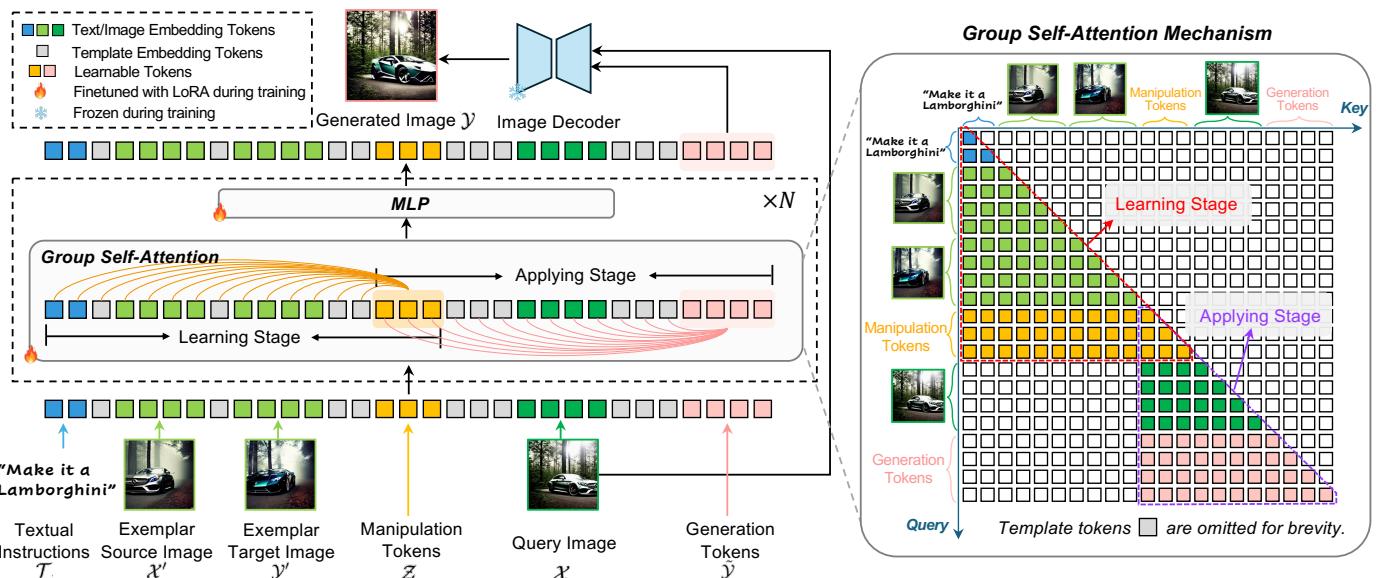
The workflow, illustrated above, proceeds as follows:
- Tokenization: The text and images are converted into tokens (embeddings).
- Prompt Construction: The inputs are arranged in a specific template: Instruction \(\rightarrow\) Exemplar Source \(\rightarrow\) Exemplar Target \(\rightarrow\) Manipulation Tokens \(\rightarrow\) Query Image.
- Processing: The model processes these tokens through several layers.
- Generation: Finally, “Generation Tokens” are produced, which are fed into an image decoder (like SDXL) to create the final image.
The magic lies in how the model handles the “Manipulation Tokens” (the yellow squares in the figure). These tokens act as a bridge. They are the only bottleneck through which information flows from the examples to the new query image.
The Core Innovation: Group Self-Attention (GSA)
In a standard Transformer, “Self-Attention” allows every token to look at every other previous token. While powerful, this can be noisy. The model might get distracted by irrelevant details in the exemplar images (like the background scenery) when it should only be focusing on the transformation rule (like “change the style to Van Gogh”).
To solve this, the authors propose Group Self-Attention. They artificially split the attention mechanism into two isolated groups within a single forward pass.
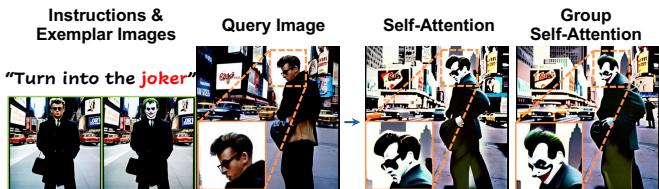
As the figure above illustrates, Group Self-Attention produces significantly cleaner edits. In the standard approach (left), the model struggles to apply the full “Joker” makeup, perhaps attending too much to the specific face shape of the example. In the Group Self-Attention approach (right), the transformation is applied comprehensively.
How GSA Works
The mechanism divides the prompt into two groups:
- Group 1 (The Learning Stage): Contains the Textual Instruction, Exemplar Source, Exemplar Target, and the Manipulation Tokens.
- Here, the Manipulation Tokens “read” the examples and the text to learn what to do. They condense this knowledge into the vector \(\mathcal{Z}\).
- Crucially, this group cannot see the Query Image. This forces \(\mathcal{Z}\) to be a general representation of the edit, not specific to the new image.
- Group 2 (The Applying Stage): Contains the Manipulation Tokens, the Query Image, and the Generation Tokens.
- Here, the Generation Tokens look at the Query Image to know the content, and look at the Manipulation Tokens (\(\mathcal{Z}\)) to know the style/edit.
- They cannot see the original exemplar images directly. They must rely on the “summary” provided by \(\mathcal{Z}\).
This separation simplifies the problem. Group 1 focuses solely on “What changed?” Group 2 focuses solely on “How do I apply that change here?”
The mathematical implementation of this split attention is defined as:


In these equations, \(\mathcal{S}_1\) and \(\mathcal{S}_2\) represent masks that enforce the visibility constraints described above.
Relation Regularization
There is one more risk: What if the Manipulation Tokens learn the wrong thing? For example, if you provide an example of turning a red car into a blue car, the model might learn “turn it blue.” But it might also accidentally learn “make the background a city street” if the example image happened to have that background.
To prevent this, the authors introduce Relation Regularization.
The intuition is that if two different instructions are semantically similar (e.g., “Make it a tiger” and “Turn into a tiger”), their corresponding Manipulation Tokens (\(\mathcal{Z}\)) should also be similar. Conversely, different instructions should yield different tokens.
The authors use a pre-trained CLIP text encoder to measure the similarity between instructions. They then force the dot product of the learned Manipulation Tokens to match the dot product of the CLIP text embeddings.

This loss function (\(\mathcal{L}_{relation}\)) ensures that the learned features \(\mathcal{Z}\) are actually related to the semantics of the instruction, disentangling the transformation from the content of the example images.
The final training objective combines the standard reconstruction loss (can we generate the right pixels?) with this new regularization term:

Experiments and Results
The authors trained InstaManip using the LLaMA-13B architecture and tested it against several strong baselines: InstructPix2Pix (text-only), ImageBrush, VISII, and PromptDiffusion.
Qualitative Performance
The visual results are striking. InstaManip demonstrates a strong ability to handle diverse and complex instructions that require understanding both texture and high-level semantics.
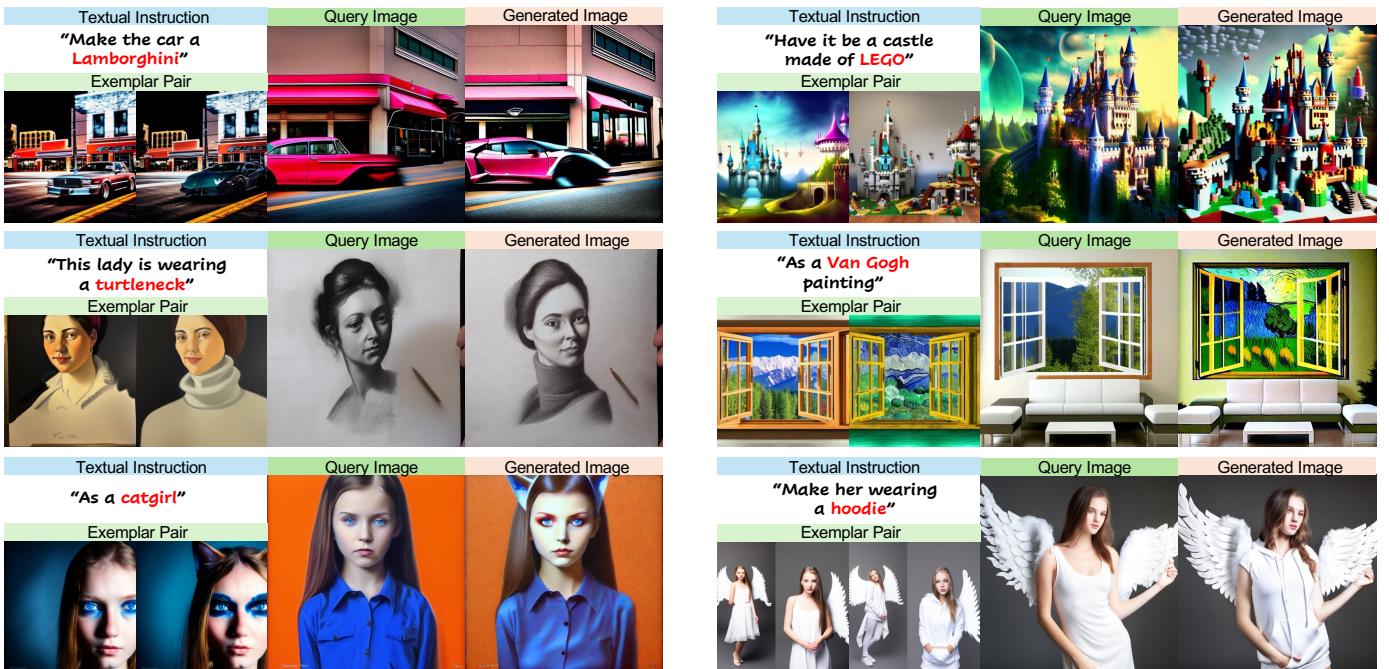
In Figure 1 above, we see the model handling instructions like “Make it a castle made of Lego” or “As a painting by Van Gogh.” These are non-trivial because the model has to understand the structural properties of Lego bricks or the brushstroke style of Van Gogh from the examples and apply them to completely different structures (like a house or a window).
Let’s look at a direct comparison with competitors:
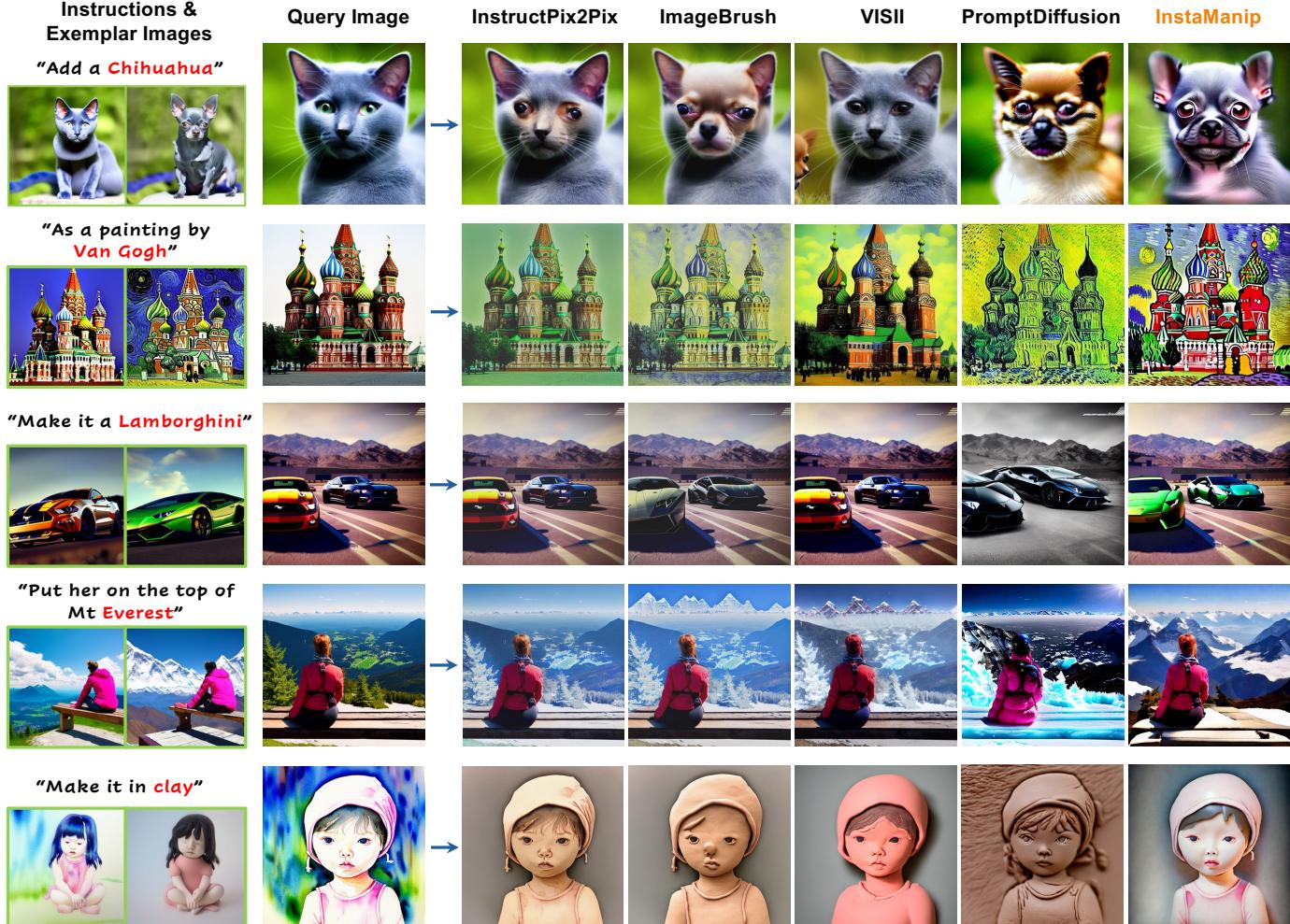
In the row “Make it a Lamborghini” (Figure 5), notice how InstructPix2Pix creates a car that looks somewhat sporty but generic. ImageBrush and PromptDiffusion make changes, but often struggle with the specific identity of the car or the perspective. InstaManip (far right) creates a vehicle that distinctly carries the visual signature of the Lamborghini from the examples while respecting the pose of the query image.
Similarly, in the “Make it in clay” row, InstaManip captures the smooth, plasticine texture much better than the competitors, which simply apply a filter or distort the face.
Quantitative Analysis
The researchers used CLIP-based metrics to evaluate performance:
- CLIP-Dir: Measures if the direction of change (Text \(\rightarrow\) Edit) matches the image change.
- CLIP-Vis: Measures if the visual change in the examples matches the visual change in the output.
- CLIP-T: Similarity between output image and text.
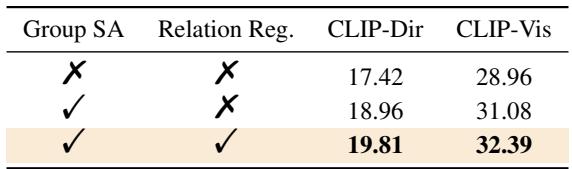
The ablation study (Table 2) proves the architecture choices were correct.
- Base Model: Starting point.
- + Group SA: Adding Group Self-Attention significantly boosts performance (CLIP-Vis jumps from 28.96 to 31.08). This confirms that separating the “Learn” and “Apply” stages helps.
- + Relation Reg: Adding the regularization further improves consistency (CLIP-Vis to 32.39).
Human Evaluation
Metrics like CLIP are useful, but human judgment is the gold standard for image editing.
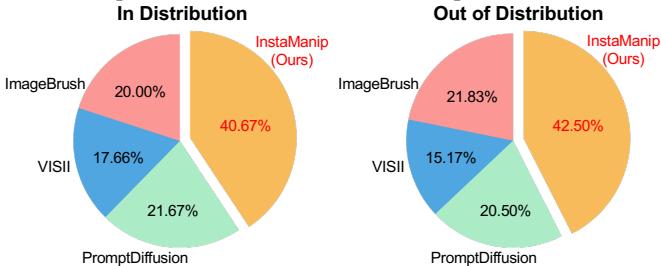
In a blind user study (Figure 6), human raters preferred InstaManip over 40% of the time, with the next best competitor (PromptDiffusion) lagging at around 20%. This is a massive margin in generative AI research, indicating a distinct qualitative leap.
The Power of Examples
One of the most interesting findings is how the model scales with the number of examples provided.
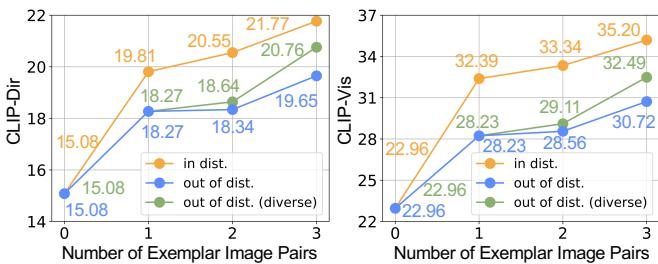
As shown in Figure 9, the performance (CLIP-Vis) climbs steadily as you add more example pairs (1, 2, up to 3). This behavior is characteristic of “In-Context Learning”—the model genuinely gets smarter about the task as it sees more data points, without any retraining.
Furthermore, the model is sensitive to the content of the examples. If you change the visual example, the output changes, even if the text stays the same.
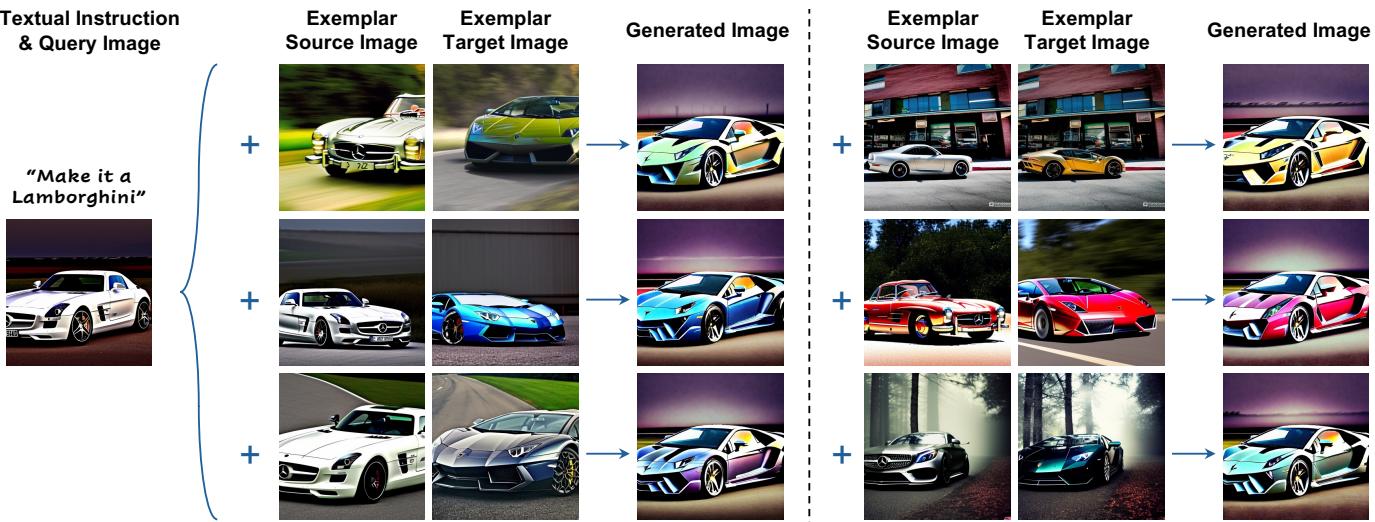
In Figure 12, the text instruction is always “Make it a Lamborghini.” However, when the example target shows a green Lamborghini, the output is green. When the example is yellow, the output is yellow. This proves the model isn’t just relying on its internal knowledge of the word “Lamborghini”; it is actively looking at the visual prompt to determine attributes like color and style.
Versatility
Finally, let’s look at how the model handles different instructions on the same image.
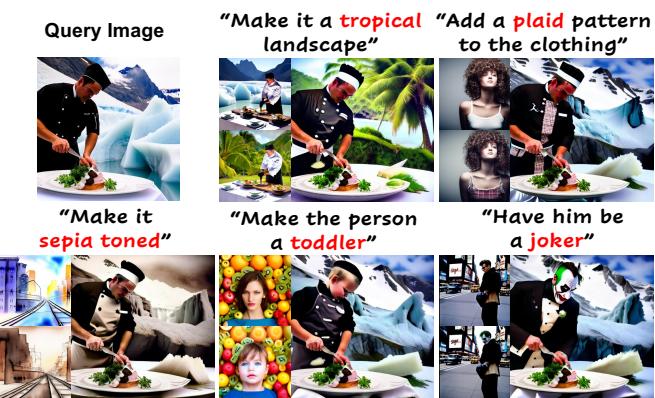
In Figure 10, a single image of a chef is transformed into a tropical scene, a toddler, a joker, or a sepia-toned photo. The model maintains the semantic layout (a person standing in the center) while radically altering the content based on the combined text and visual guidance.
Conclusion and Implications
InstaManip represents a significant step forward in making AI image editing more controllable and robust. By moving away from purely diffusion-based reasoning and adopting an Autoregressive architecture with Group Self-Attention, the authors have created a system that “thinks” before it “paints.”
Key Takeaways:
- Two-Stage Learning: Explicitly separating the “learning” of the edit from the “application” of the edit yields better results.
- Visual Prompts Matter: Text is often insufficient. Visual examples provide the local details (texture, exact color, shape) that words miss.
- Regularization is Key: Forcing the model to align its internal manipulation features with semantic text embeddings prevents it from overfitting to irrelevant visual details in the examples.
This work paves the way for “Generalist” vision models—systems that don’t just perform a fixed set of tasks (like “remove background” or “upscale”), but can learn any new visual operation instantly, just by looking at a couple of examples. As Autoregressive Multimodal Models continue to scale, we can expect this “in-context” capability to become the new standard for creative AI tools.