](https://deep-paper.org/en/paper/2412.01821/images/cover.png)
The recent explosion in generative AI has given us models capable of dreaming up distinctive images and surreal videos from simple text prompts. We have seen tremendous progress with diffusion models, which have evolved from generating static portraits to synthesizing dynamic short films. However, if you look closely at AI-generated videos, you will often notice a subtle, nagging problem: the world doesn’t always stay “solid.”
Objects might slightly warp as the camera moves; the geometry of a room might shift impossibly; or the background might hallucinate new details that contradict previous frames. This happens because most video diffusion models are learning pixel consistency over time, but they don’t inherently understand the 3D structure of the world they are rendering. They are excellent 2D artists, but poor 3D architects.
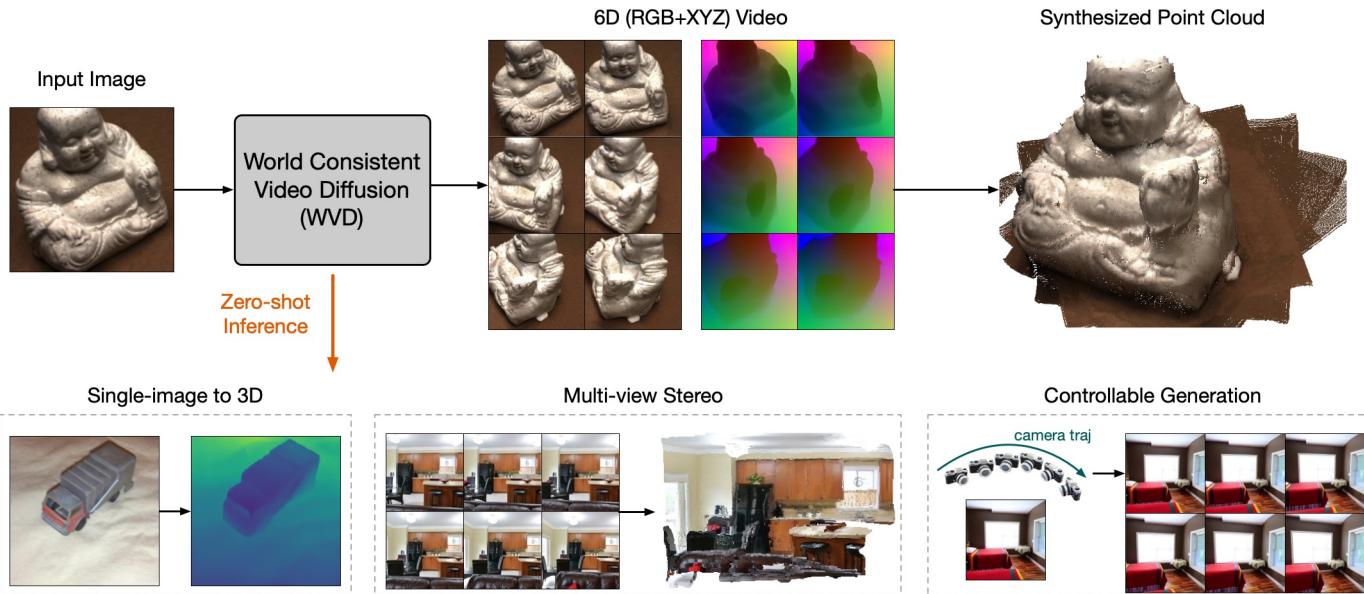
In this deep dive, we are exploring a new framework called World-consistent Video Diffusion (WVD). This research proposes a fascinating solution: instead of just teaching a model to paint pixels (RGB), we should teach it to simultaneously build the world’s geometry (XYZ). By explicitly modeling 3D coordinates alongside color, WVD unifies tasks like single-image 3D reconstruction, video generation, and camera control into one powerful model.
The Problem: The Gap Between Video and Geometry
To understand why WVD is necessary, we first need to look at how current “3D-aware” generation works. Broadly, there have been two approaches:
- Implicit Multi-view Diffusion: You take a massive dataset of videos and train a model to predict the next frame. The model uses attention mechanisms to look at previous frames and “guess” what the new perspective should look like. While effective, this is implicit. The model doesn’t know the chair has a back; it just knows that when pixels move left, chair-like patterns usually appear. This lacks mathematical guarantees of 3D consistency.
- Explicit 3D Biases: Some researchers try to force 3D consistency by embedding volume rendering (like NeRFs) directly into the generation pipeline. While this ensures geometry is respected, it is computationally heavy and imposes strict constraints that make it hard to scale to diverse, real-world data.
The researchers behind WVD identified a middle ground. They wanted the scalability of standard diffusion models (like Stable Diffusion or Sora) but with the explicit geometric grounding of 3D engines.
Their solution? 6D Video.
Standard video is 3D in terms of data channels (Red, Green, Blue). WVD operates on 6 channels: RGB + XYZ. The XYZ channels don’t contain color; they contain the exact global 3D coordinate of the surface visible at that pixel. By training a model to generate both simultaneously, the visual appearance becomes locked to the physical geometry.
The Core Method: RGB-XYZ Diffusion
The heart of WVD is a Diffusion Transformer (DiT) that learns the joint distribution of color and geometry. Let’s break down the architecture and the data representation that makes this possible.
1. The XYZ Image Representation
Point clouds are the standard way we represent 3D data in computer vision—lists of points with X, Y, and Z coordinates. However, point clouds are unstructured lists (\(N \times 3\)), which makes them terrible inputs for image-based neural networks that expect structured grids of pixels.
To bridge this gap, the authors convert 3D point clouds into XYZ images.

In this equation:
- \(\pmb{X}\) is the raw point cloud.
- \(\mathcal{N}\) is a normalization function that scales the scene to a manageable range (e.g., \([-1, 1]\)).
- \(\mathcal{R}\) is a rasterizer. It takes the normalized points and “takes a picture” of them using camera parameters \(C\).
Instead of capturing light (color), this virtual camera captures coordinates. If you look at pixel \((u, v)\) in an XYZ image, the “color” value at that pixel actually tells you exactly where that point sits in the 3D world.
Why is this better than a depth map? A depth map only tells you how far away a pixel is from the camera relative to that specific view. If you move the camera, the depth values change completely. An XYZ image, however, encodes global coordinates. If two different cameras look at the corner of a table, the XYZ values for that corner will be identical in both views (assuming perfect calibration). This provides a strong, explicit supervision signal for consistency that depth maps lack.
2. The Architecture: Diffusion Transformer (DiT)
Now that the data is prepared as “6D” frames (3 RGB channels + 3 XYZ channels), how does the model learn?
The researchers utilize a Diffusion Transformer (DiT). Unlike the older U-Net architectures common in early diffusion models, DiTs use self-attention mechanisms that are excellent at modeling long-range dependencies—crucial for understanding how the front of an object relates to its back.
The input to the model isn’t raw pixels. To make training efficient, the images are first compressed into a latent space using a Variational Autoencoder (VAE).

As shown in the equation above, the model takes the latent embedding of the RGB frame (\(\mathcal{E}(\pmb{x}^{\mathrm{RGB}})\)) and the latent embedding of the XYZ frame (\(\mathcal{E}(\pmb{x}^{\mathrm{XYZ}})\)) and simply concatenates them.
If the latent dimension is \(D\), the input to the Transformer is a vector of size \(2D\). This simple design choice is powerful because it allows WVD to use pre-trained video diffusion weights. The model treats the geometry just like additional channels of information, denoising the color and the shape of the world simultaneously.
3. The WVD Pipeline
The training process involves adding noise to these 6D latent vectors and teaching the model to reverse the process—recovering the clean RGB and XYZ data.
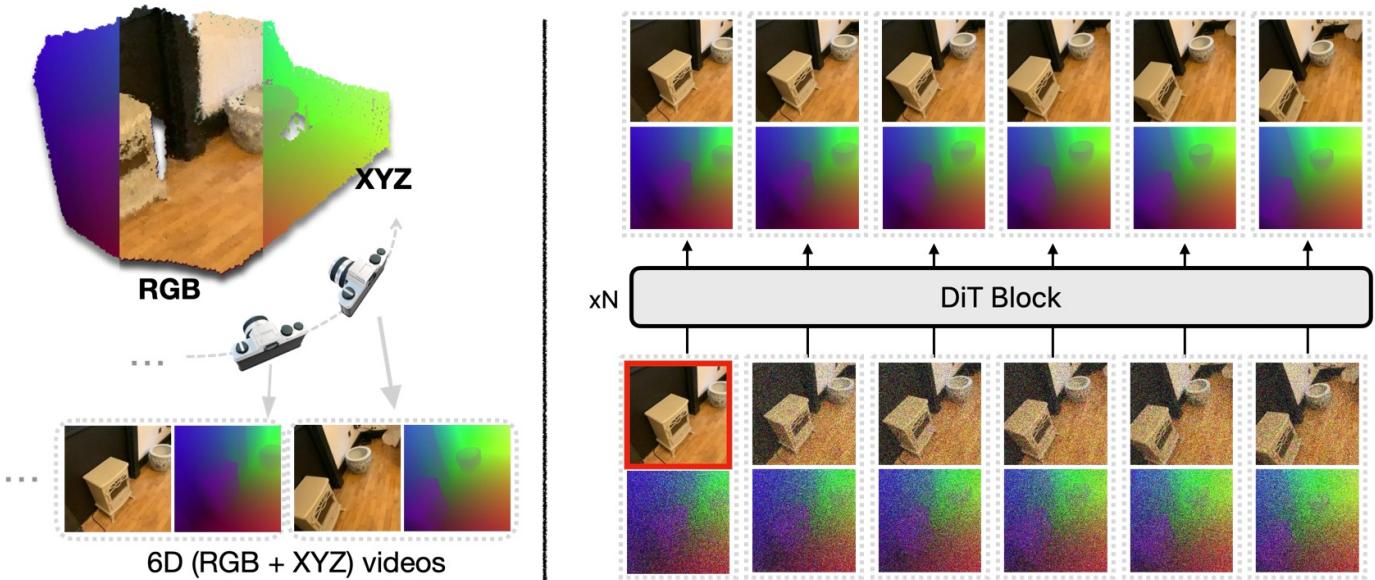
As illustrated in Figure 2:
- Input: A single RGB image (highlighted in red) acts as the condition.
- Process: The model iteratively denoises a sequence of frames.
- Output: It produces a video sequence where every frame has both visual texture (RGB) and geometric coordinates (XYZ).
Because the XYZ frames are generated alongside the RGB, the “hallucinations” of the generative model are constrained. It cannot easily generate a pixel that doesn’t have a corresponding location in 3D space, forcing the video to be physically consistent.
WVD as a “Everything” Model
One of the most compelling aspects of WVD is that it isn’t just a video generator. Because it models the joint probability of \(P(\text{RGB}, \text{XYZ})\), it can be adapted for various tasks during inference using inpainting strategies.
In diffusion models, inpainting allows you to fix certain known parts of the data and ask the model to generate the rest. WVD exploits this property to unify three distinct computer vision tasks.
Task 1: Single-Image to 3D
If you provide a single RGB image, the model can generate the XYZ map for that image (monocular depth estimation) and then generate subsequent frames (novel view synthesis). Because the output includes XYZ coordinates, you can lift the pixels directly into a 3D point cloud.
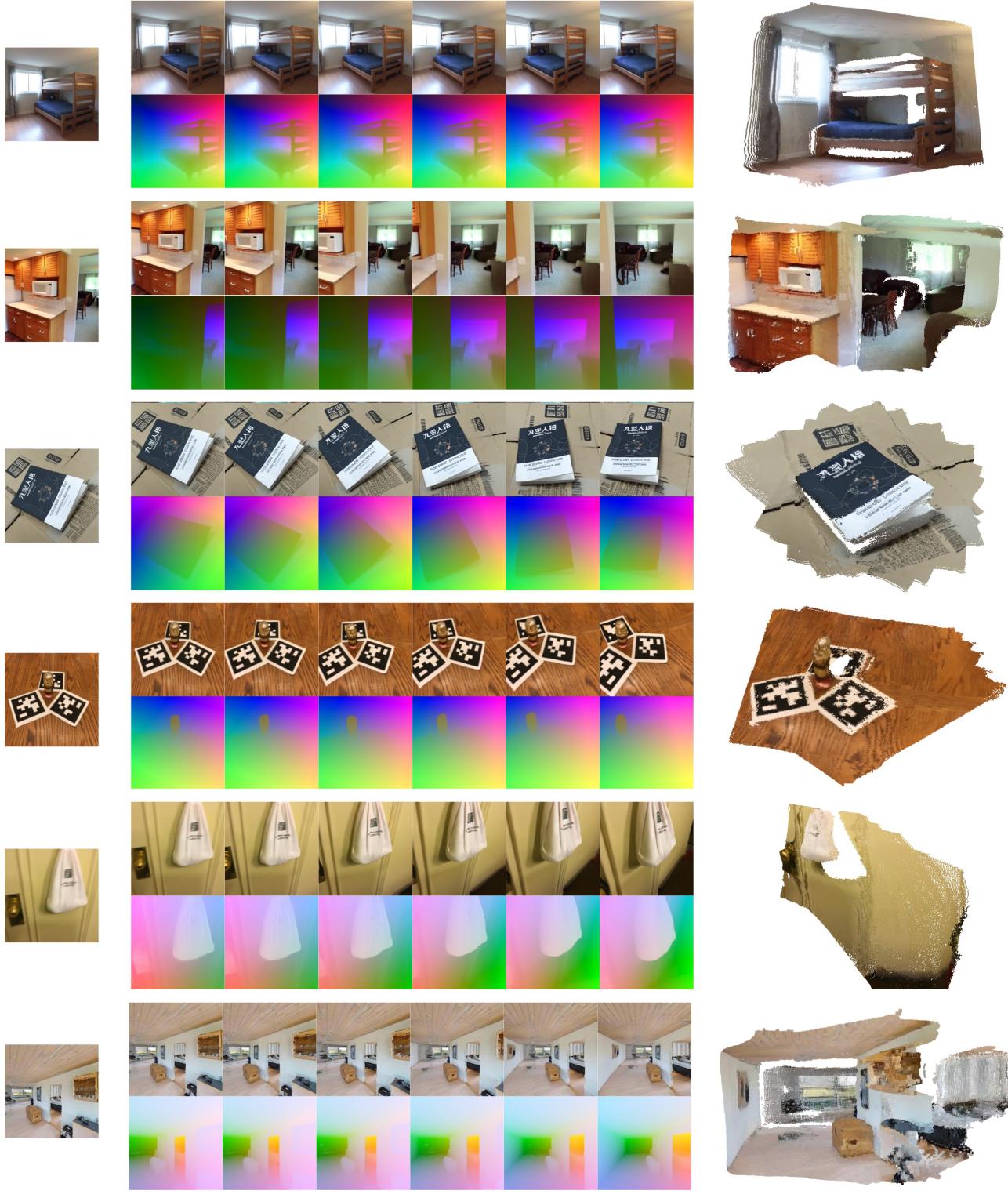
Figure 4 shows this capability in action. From a single photo of a bedroom or a kitchen (left column), the model imagines the lighting changes and perspectives of a moving video (center column) and reconstructs a 3D point cloud (right column) that retains the structure of the furniture and walls.
Task 2: Multi-view Stereo (Video Depth Estimation)
What if you already have a video (RGB frames) but no depth info? You can feed the RGB frames into the model as “known” data and ask WVD to “inpaint” the missing XYZ channels.
This effectively turns the generative model into a discriminative depth estimator. But unlike traditional depth estimators that look at one frame at a time, WVD looks at the whole sequence, ensuring the predicted geometry is consistent over time.
Once the XYZ maps are predicted, the system performs a post-optimization step to refine the camera parameters and depth maps using the Perspective-n-Point (PnP) algorithm.

This equation minimizes the difference between the predicted global coordinates and the coordinates derived from the optimized camera parameters (\(P, K\)) and depth (\(d\)). This step ensures mathematical rigor in the final 3D reconstruction.
Task 3: Camera-Controlled Generation
Perhaps the most exciting application for creative professionals is controllable generation. Standard video diffusion models are notoriously hard to direct; you prompt for a “pan left,” but the model might zoom instead.
WVD solves this by using geometry as a handle.

The process, shown in Figure 3, works like this:
- Estimate Geometry: Use WVD to get the 3D points of the first frame.
- Reproject: Physically move the “virtual camera” to where you want it to be. Project the known 3D points onto this new view. This gives you a “partial” XYZ image (sparse points).
- Inpaint: Feed this partial geometry into WVD. The model sees the geometric constraints (“this table corner must be here”) and fills in the rest of the geometry and the corresponding RGB pixels.
This allows for precise camera trajectories that strictly adhere to the laws of physics.
Experimental Results
The researchers trained WVD on a massive mixture of datasets, including RealEstate10K (indoor scenes), ScanNet, and MVImgNet (objects). Training this 2-billion parameter model took roughly two weeks on 64 A100 GPUs—a significant compute investment that paid off in versatility.
Quantitative Performance
The team compared WVD against state-of-the-art models like CameraCtrl and MotionCtrl.
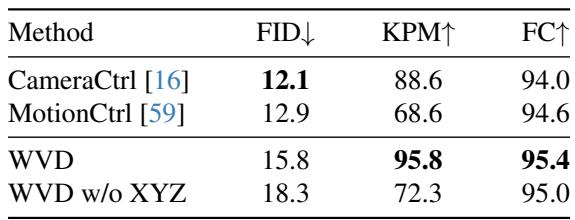
In Table 1, we see the importance of the XYZ component:
- WVD w/o XYZ: When the model is trained only on RGB (standard video diffusion), the Frame Consistency (FC) and Key Point Matching (KPM) scores are lower.
- WVD (Full): Adding XYZ supervision drastically improves KPM (from 72.3 to 95.8). This metric measures how well feature points match across frames, proving that explicit 3D modeling leads to far more stable videos.
Monocular Depth Estimation
Even though WVD is a generative video model, it turns out to be an exceptional depth estimator. By asking it to predict the XYZ map for a single image, it outperforms dedicated depth estimation models.

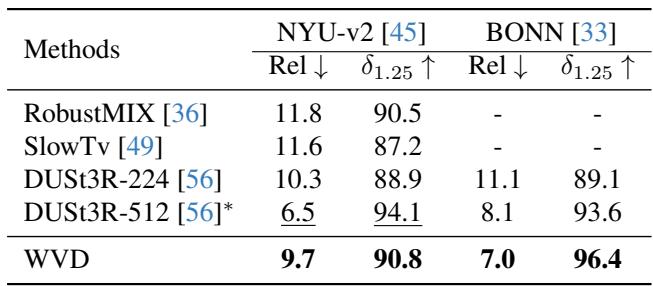
Figure 5 and Table 2 highlight comparisons with DUSt3R, a leading 3D reconstruction model. On the NYU-v2 and BONN benchmarks, WVD produces sharper depth boundaries and achieves lower relative error rates. Note that on BONN, WVD (trained at 256 resolution) beats DUSt3R (trained at 512 resolution), suggesting that the generative prior—the model’s “understanding” of what scenes look like—helps it infer geometry more accurately than pure regression methods.
Controlling the Camera
Finally, the capability to control camera movement was tested against ground-truth videos.

In Figure 6, the “Re-projected XYZ Images” column shows the sparse guidance the model receives. The “In-painted RGB” column shows the result. The model successfully hallucinates the dis-occluded areas (parts of the room that were hidden in the first frame) while keeping the known geometry perfectly locked in place.

Additional results in Figure A1 further demonstrate this consistency. The synthesized frames (bottom rows) follow the exact trajectory of the ground truth (top rows), maintaining coherent structures like hallways, windows, and furniture layouts.
Conclusion and Future Implications
World-consistent Video Diffusion (WVD) represents a significant step forward in bridging the gap between 2D generative AI and 3D computer vision. By treating 3D coordinates (XYZ) as just another set of channels to be generated alongside color (RGB), the researchers have created a unified framework that enforces physical consistency without the need for complex, heavy rendering engines during the generation process.
The implications are broad:
- Unified Workflow: A single model can now handle depth estimation, 3D reconstruction, and video generation.
- Scalability: Because it uses XYZ images (compatible with 2D Transformers) rather than voxels or ray-marching, it scales efficiently to high resolutions and large datasets.
- Controllability: It solves the “wild camera” problem in video generation, offering creators precise control over viewpoint.
While the current model is trained on static scenes (camera moving through a frozen world), the authors suggest that future work could incorporate optical flow or 4D datasets to handle dynamic scenes—people walking, trees blowing in the wind—while maintaining that same rigorous 3D consistency. WVD suggests that the future of video generation isn’t just about painting prettier pixels, but about explicitly modeling the world those pixels represent.