](https://deep-paper.org/en/paper/2412.02168/images/cover.png)
Introduction
We are living in the golden age of AI image generation. Tools like Stable Diffusion and FLUX allow us to conjure detailed worlds from a single sentence. Yet, for all their magic, these models often fail at a task that is fundamental to professional photography: understanding the physical camera.
Imagine you are a photographer. You take a photo of a mountain trail with a 24mm wide-angle lens. Then, without moving your feet, you switch to a 70mm zoom lens. What happens? The perspective compresses, the field of view narrows, but the scene—the specific rocks, the shape of the trees, the lighting—remains exactly the same.
Now, try asking a standard text-to-image model to do this. Prompt it for a “mountain trail, 24mm,” and then “mountain trail, 70mm.” You won’t just get a zoomed-in view; you will likely get a completely different mountain, different trees, and different rocks. The model treats “70mm” as a style or a vibe, not a physical geometric constraint.
This inconsistency prevents generative AI from being a true “virtual camera” for professionals. Today, we are diving into a research paper titled “Generative Photography: Scene-Consistent Camera Control for Realistic Text-to-Image Synthesis.” This work proposes a fascinating solution: teaching AI models the actual physics of photography to achieve precise, scene-consistent control over focal length, shutter speed, aperture, and color temperature.
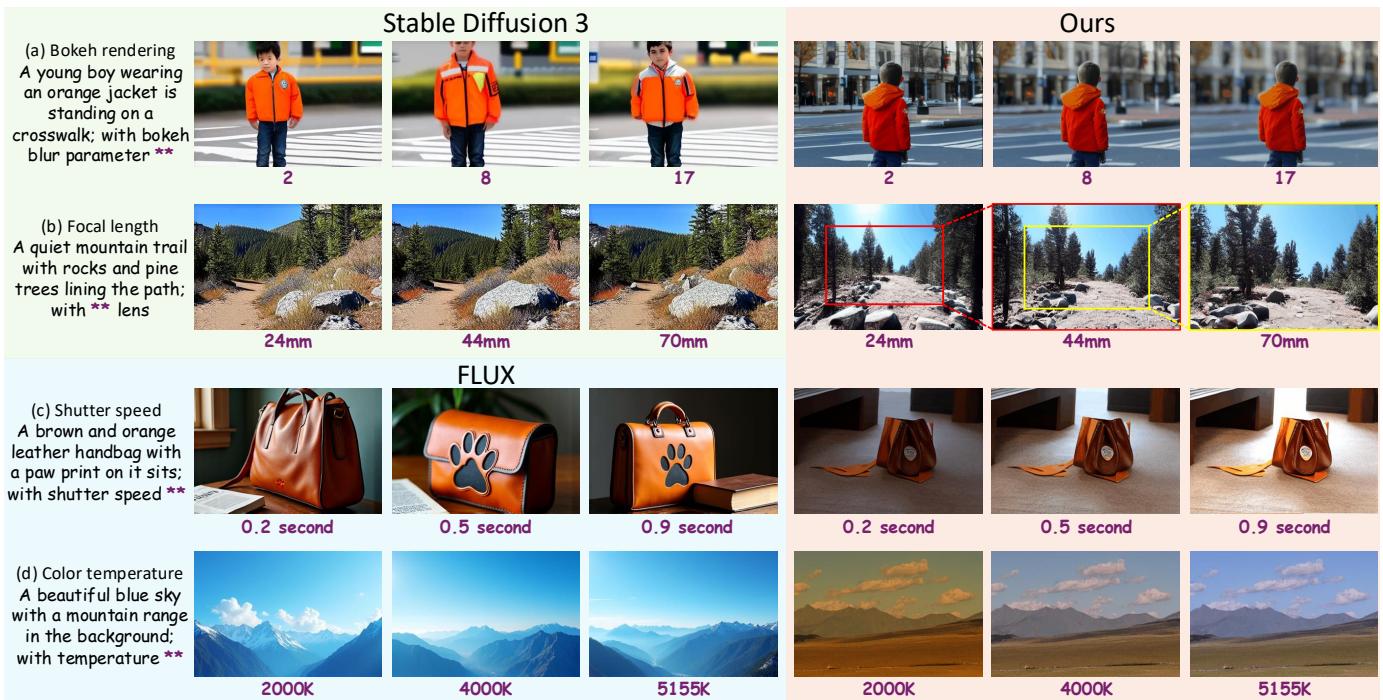
As shown in Figure 1 above, while state-of-the-art models like Stable Diffusion 3 struggle to maintain the subject identity when camera settings change (notice the boy’s jacket or the mountain shape changing), the proposed method maintains a consistent scene while applying realistic optical effects.
The Problem: Why Can’t AI “See” Like a Camera?
To understand the solution, we first need to understand why current models fail.
Standard diffusion models are trained on massive datasets of image-text pairs. They learn correlations. They know that images labeled “bokeh” usually have blurry backgrounds, and images labeled “telephoto” usually look compressed. However, they lack a fundamental understanding of the underlying physical laws that cause these effects.
There are two main hurdles:
- Data Scarcity: To teach a model physics, you need paired data. You would need millions of examples of the exact same scene captured with different shutter speeds, apertures, and focal lengths. Gathering this data in the real world is incredibly tedious and impractical.
- Entangled Embeddings: In current models, the “scene” (the objects and layout) and the “camera” (how the scene is captured) are hopelessly entangled. When you change the text prompt to modify the camera, the model inadvertently changes the scene embedding, morphing the content itself.
The Solution: Generative Photography
The researchers introduce a framework called Generative Photography. The core philosophy is to disentangle the scene content from the camera intrinsics. To achieve this, they utilize two clever techniques: Dimensionality Lifting and Differential Camera Intrinsics Learning.
1. Dimensionality Lifting: Turning Images into Videos
This is the most “lightbulb moment” concept in the paper. The researchers realized that trying to generate independent images for different camera settings leads to inconsistency.
However, there is a class of generative models designed specifically to keep scenes consistent over time: Video Generation Models (Text-to-Video or T2V). A video model ensures that a person walking down the street doesn’t turn into a different person in the next frame.
The researchers propose “lifting” the problem from spatial (image) generation to spatiotemporal (video) generation.
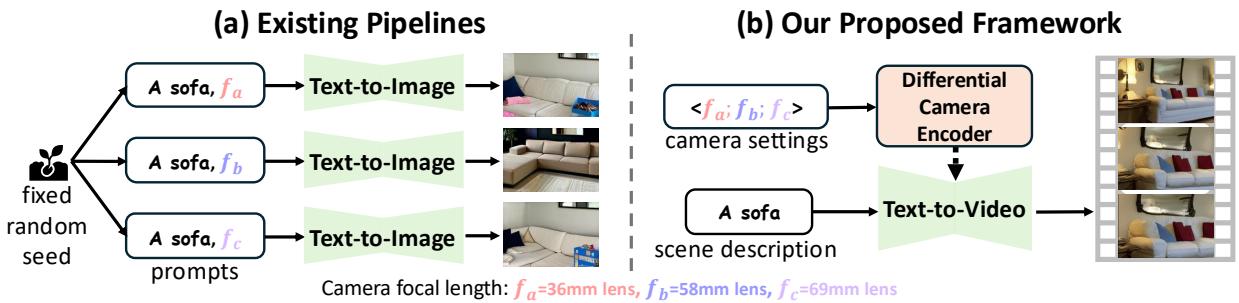
As illustrated in Figure 2, instead of generating unconnected images (Method “a”), they feed the prompt into a video model (Method “b”). But here is the trick: Time is replaced by Camera Settings.
Frame 1 might represent a 24mm lens, Frame 2 a 35mm lens, and Frame 3 a 50mm lens. By forcing the model to generate these as a coherent “video” sequence, the model’s internal attention mechanisms work to keep the scene consistent, effectively locking the subject in place while the “camera” changes.
2. Differential Camera Intrinsics Learning
Simply using a video model isn’t enough; the model still needs to understand what a “shutter speed of 0.5s” actually looks like compared to “0.2s.” Since real-world training data is scarce, the researchers create their own Differential Data using physical simulation.
The Data Pipeline
The team constructs synthetic datasets where a single base image is mathematically manipulated to simulate different camera effects.
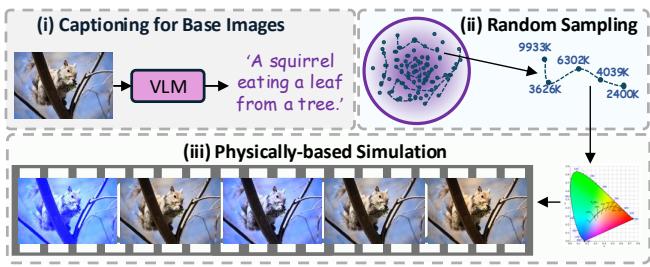
The process, shown in Figure 3, works as follows:
- Base Image: Take a high-quality image.
- Captioning: Use a Vision Language Model (VLM) to describe the scene textually.
- Physical Simulation: Apply mathematical transformations to the base image to create variations.
Let’s look at how they simulate these specific physical properties.
Focal Length (Field of View)
To simulate zooming, they use high-resolution base images and apply center cropping based on Field of View (FoV) calculations. The relationship between FoV, sensor size (\(w, h\)), and focal length (\(f\)) is governed by these equations:
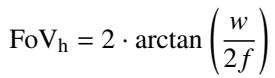
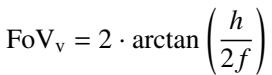
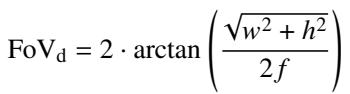
By cropping the image according to these ratios, they create a sequence of images that perfectly mimics optical zooming.
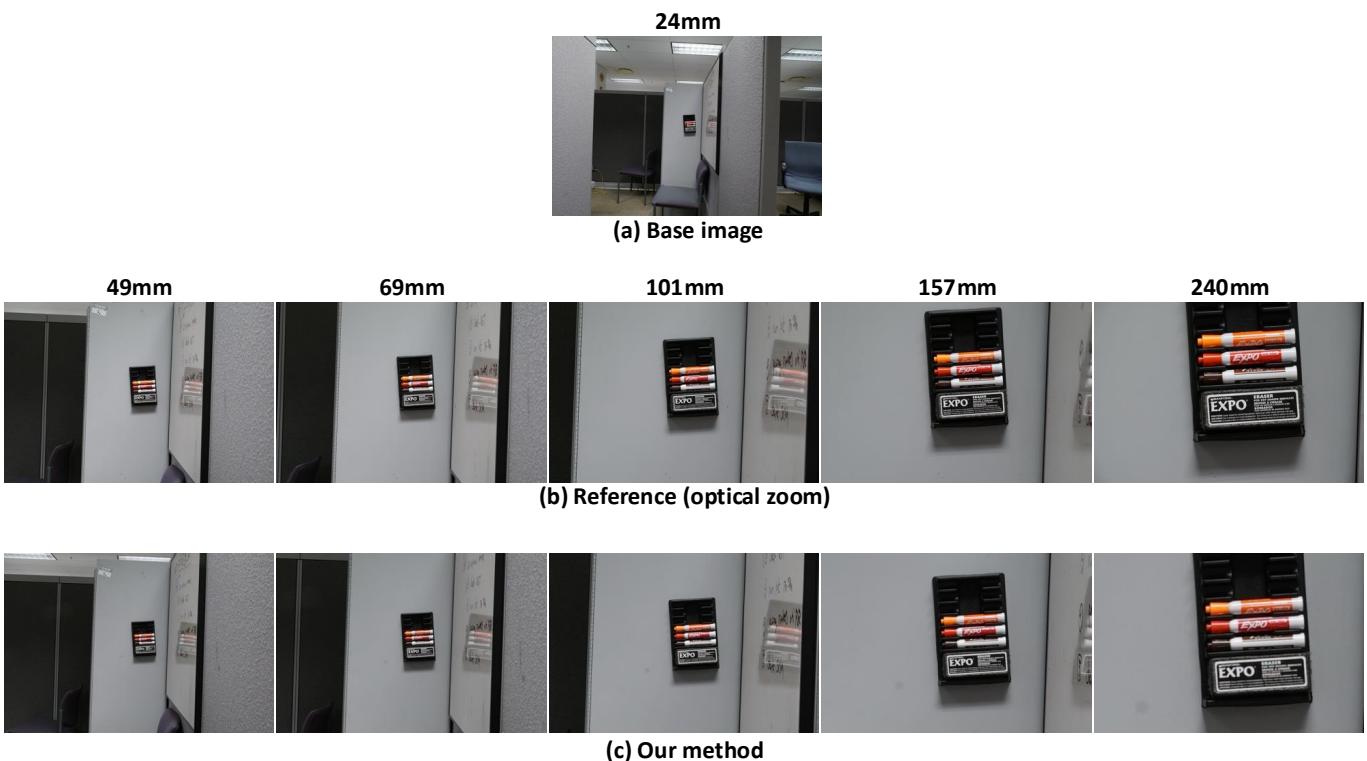
Figure 8 demonstrates that this cropping method (bottom row) aligns almost perfectly with real-world optical zoom references (middle row), provided the base image resolution is high enough.
Shutter Speed (Motion Blur & Exposure)
Shutter speed affects exposure (brightness) and motion blur. The researchers simulate this by adjusting the irradiance equation, which models how photons hit the sensor over time (\(t\)):
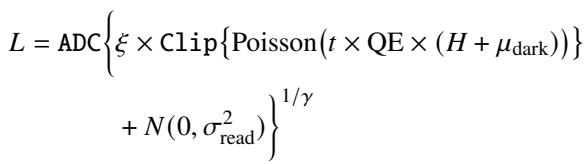
This formula accounts for quantum efficiency (\(QE\)), dark current (\(\mu_{dark}\)), and sensor readout noise (\(\sigma_{read}\)), ensuring the simulated exposure changes look physically authentic rather than just “brightening” the pixels linearly.
Color Temperature (White Balance)
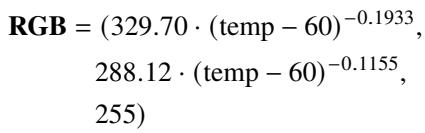
To simulate different Kelvin temperatures (e.g., warm 3000K vs. cool 8000K), they map temperatures to RGB values using empirical approximations. This allows the model to learn the precise color shifts associated with blackbody radiation.
Bokeh (Aperture)
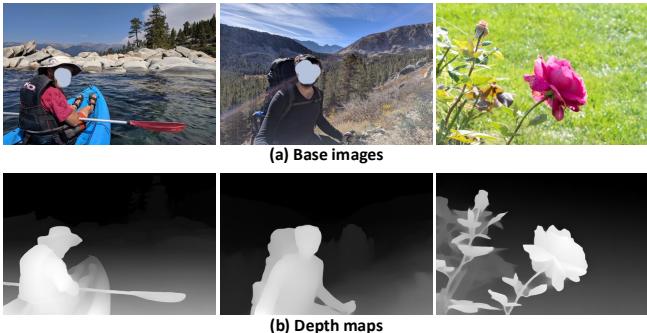
For depth-of-field effects, they use a depth estimation model (“Depth Anything”) to create a depth map of the base image. They then apply a “BokehMe” rendering algorithm. This keeps the foreground sharp while blurring the background based on a simulated aperture size.
The Architecture: Differential Camera Encoder
Once this differential data is created, it is fed into the network. The researchers introduce a Differential Camera Encoder.
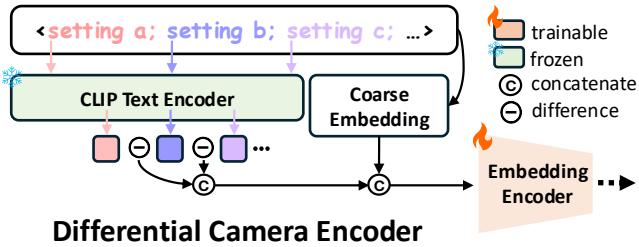
As shown in Figure 4, this module does not just look at the raw camera parameters. It encodes the differences between frames.
- Coarse Embedding: It takes a physical prior (like a mask for focal length or a blur map for bokeh).
- Differential Features: It uses CLIP to extract features and computes the difference between adjacent settings (e.g., the difference between 35mm and 50mm).
This teaches the network to focus on the change in the camera setting relative to the previous frame, rather than trying to memorize absolute values in a vacuum.
For focal length specifically, the coarse embedding is a simple mask, indicating which parts of the sensor would be “cropped out” at a higher zoom level:

Experiments and Results
Does it actually work? The researchers compared their method against industry giants: Stable Diffusion 3 (SD3), FLUX, and generic video models (AnimateDiff) and camera control models (CameraCtrl).
Visual Consistency
The visual results are striking. Let’s look at the overall comparison.
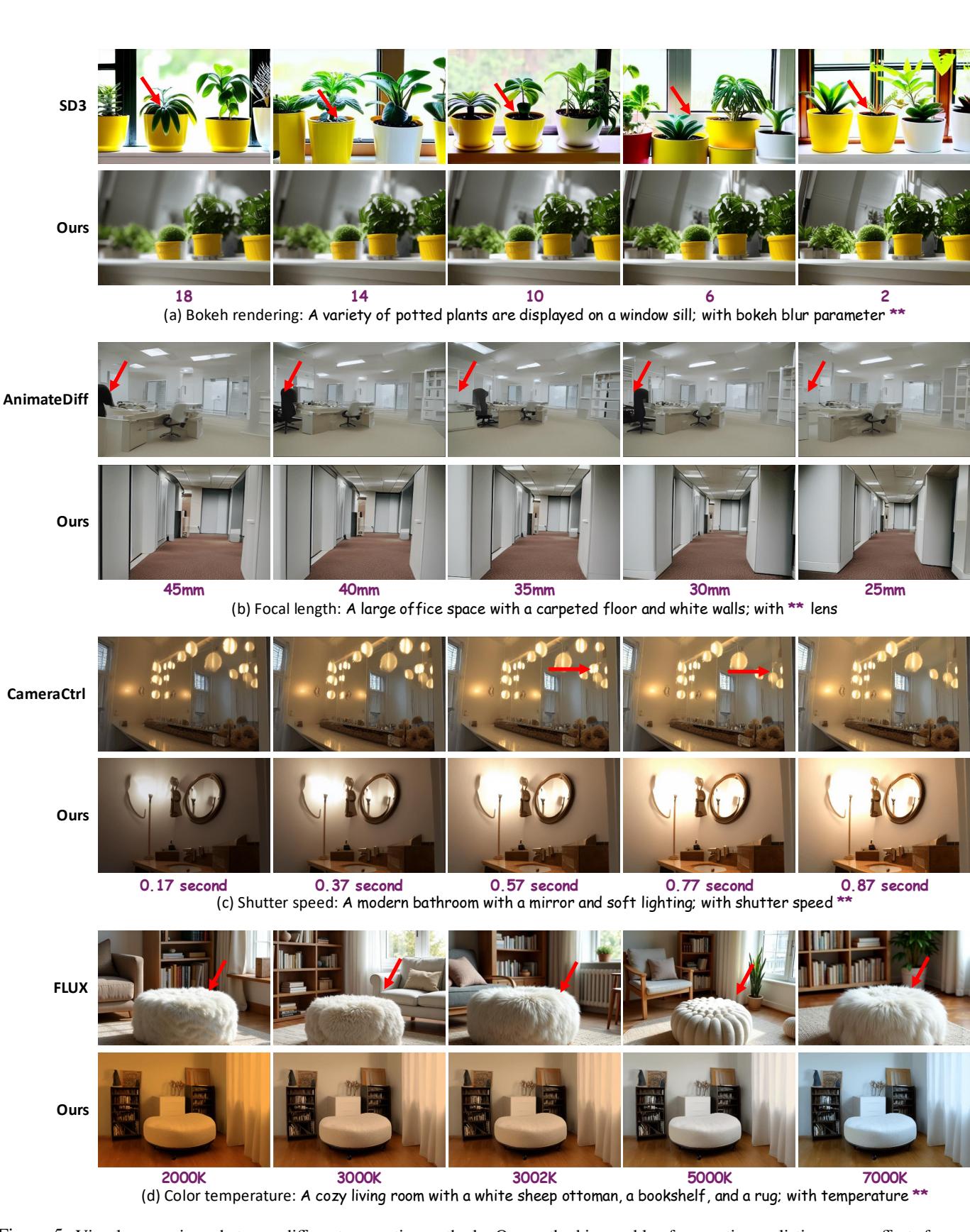
In Figure 5, look at the Focal Length row (b).
- SD3: The layout of the room changes completely as it “zooms.”
- Ours: The chair and the room geometry remain consistent; only the perspective changes.
In the Bokeh row (a), the proposed method smoothly increases background blur while keeping the plants identical. SD3 tends to hallucinate different plants or pots as the blur changes.
Quantitative Analysis
The researchers didn’t just rely on the “eye test.” They used strict metrics:
- Accuracy: Does the image mathematically match the physics? (e.g., is the brightness change correct for the shutter speed?)
- Consistency: Do the frames look like the same scene? (measured using LPIPS).
- Following: Does the image still match the text prompt? (measured using CLIP).

Table 1 confirms the visual results. The proposed method (bottom row) achieves the highest scores in Accuracy and Consistency (lower LPIPS is better for consistency, but here it must be balanced against the necessary changes from the camera effect). Notably, it achieves these physical constraints without sacrificing prompt adherence (Following).
Deep Dive: Specific Effects
Let’s look closer at specific capabilities.
Bokeh Rendering: Even without depth information provided during inference (testing), the model learned to infer depth and blur the background correctly.
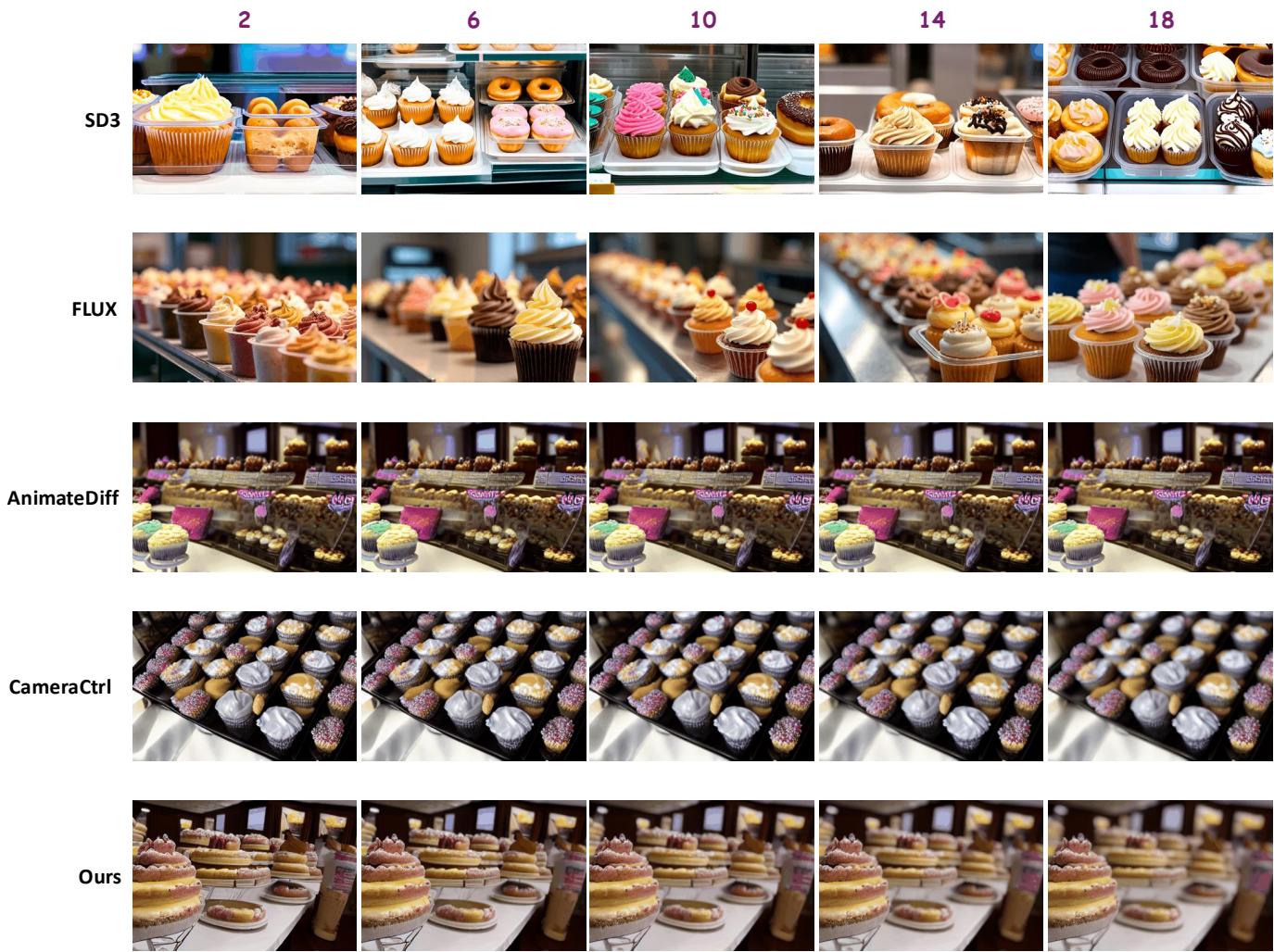
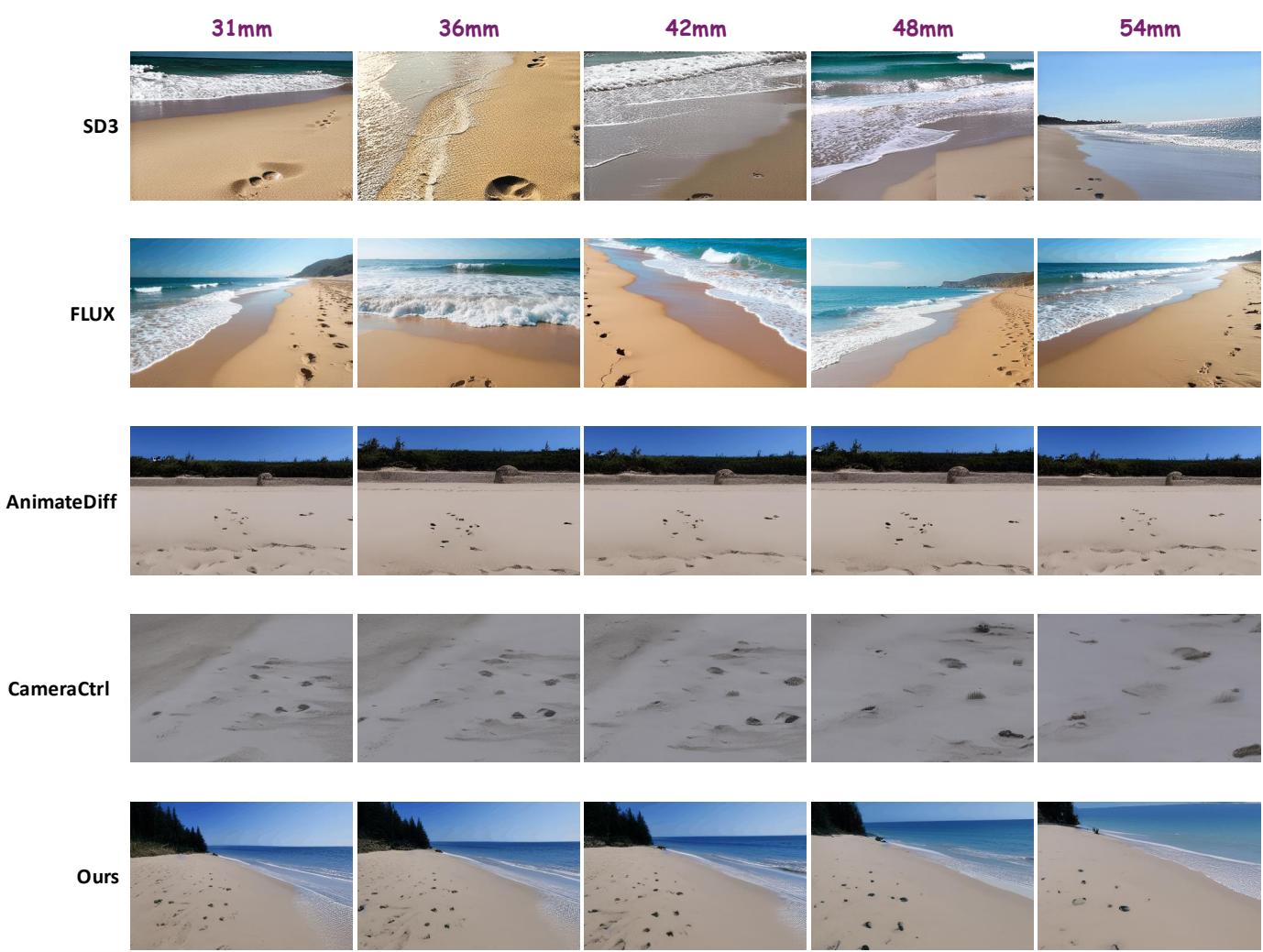
Focal Length: The smooth transition in the “Ours” row (Figure 11 below) mimics a real optical zoom, whereas models like AnimateDiff (without fine-tuning) struggle to maintain the horizon line or object placement.
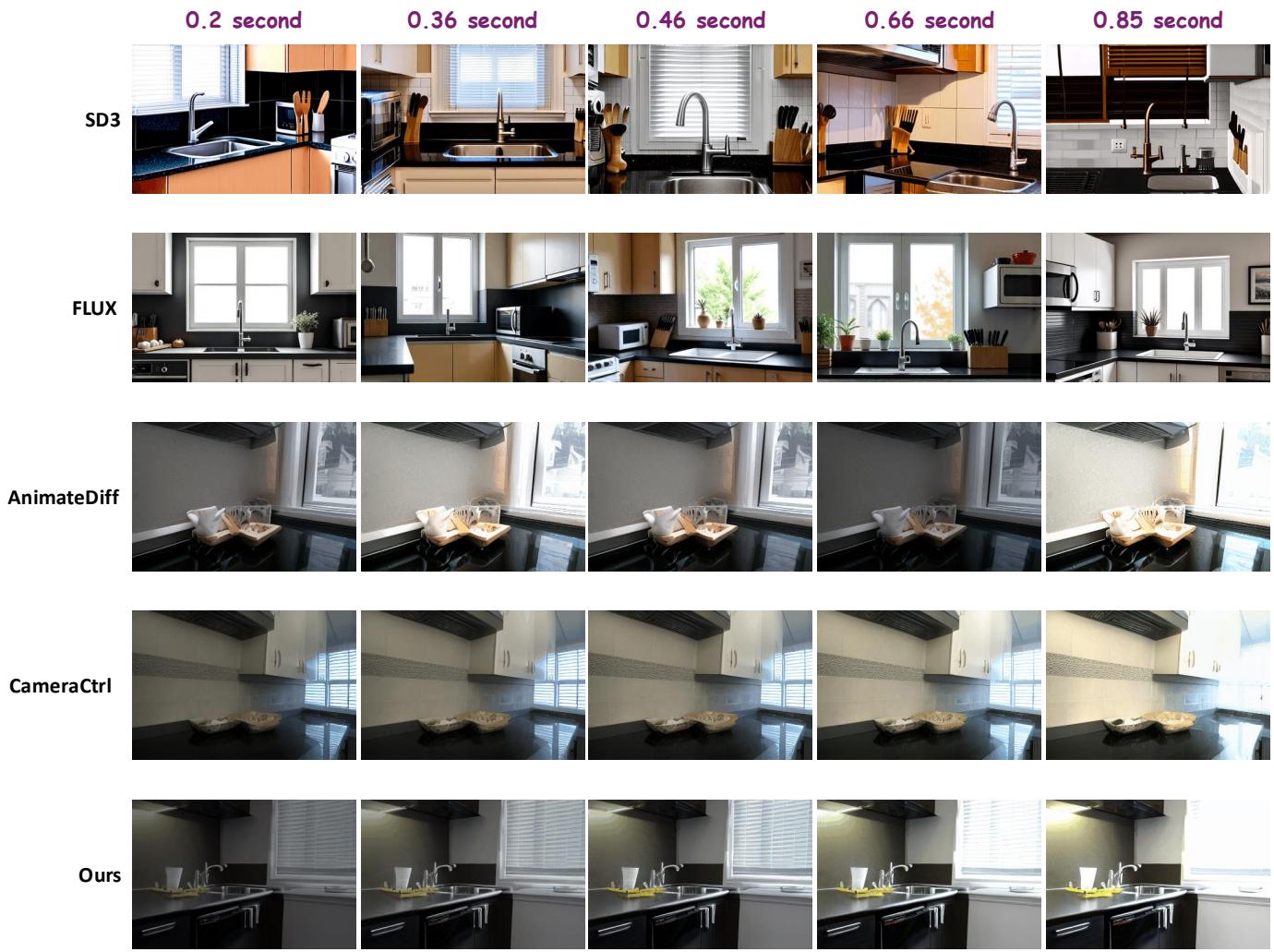
Shutter Speed: Notice in Figure 12 how the “Ours” method handles the exposure change in the kitchen. The highlights blow out naturally as the shutter speed slows down (increases in duration).
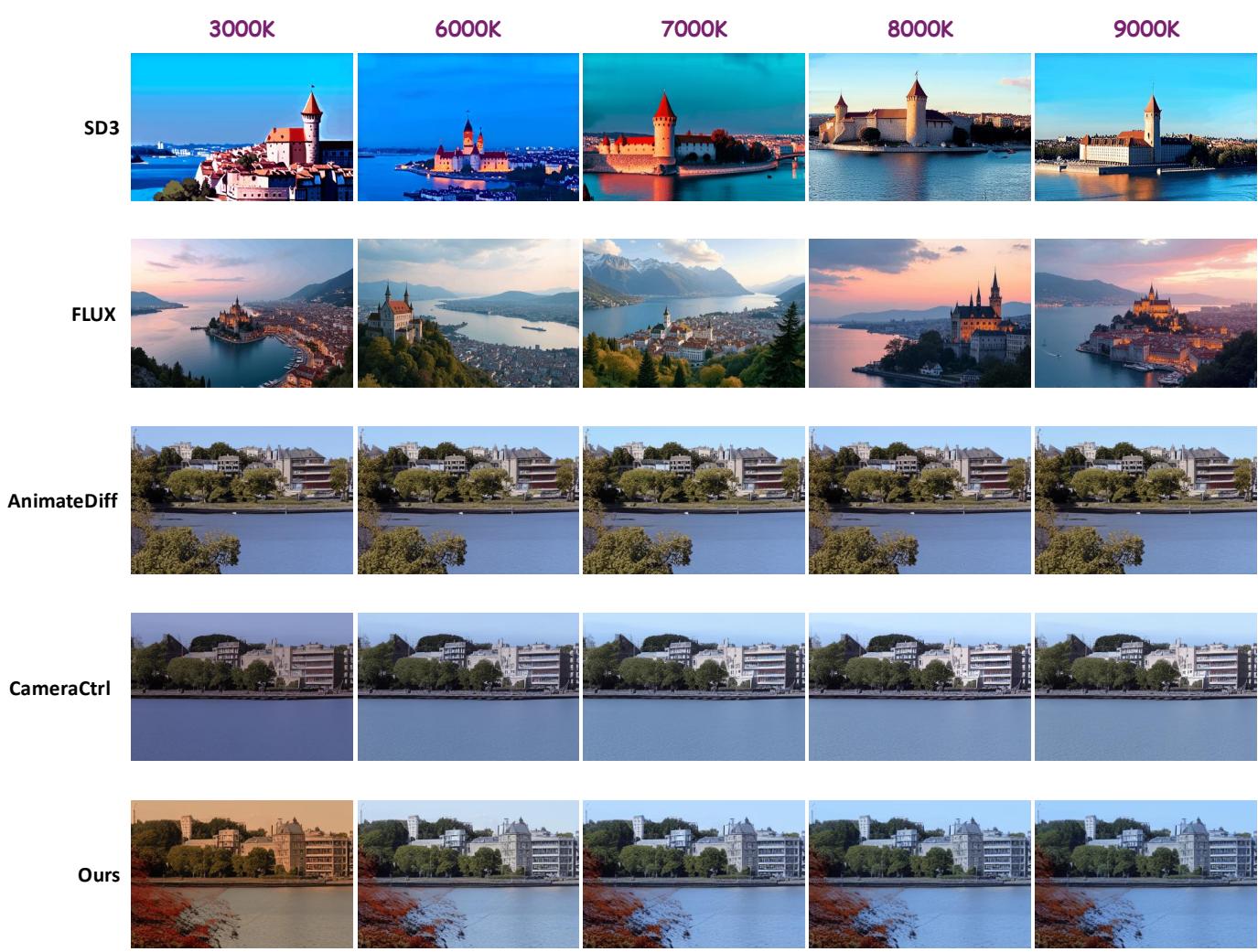
Color Temperature: The model successfully navigates from warm (low Kelvin) to cool (high Kelvin) tones without altering the city architecture.
Why the “Differential” Approach Matters
You might wonder, “Do we really need the complex differential encoder? Can’t we just feed the data into the video model?”
The researchers tested this in an Ablation Study.

Table 2 shows that removing the differential aspect (“w/o differential”) causes a significant drop in accuracy. The network needs to explicitly know the difference between the settings to learn the physical law effectively.
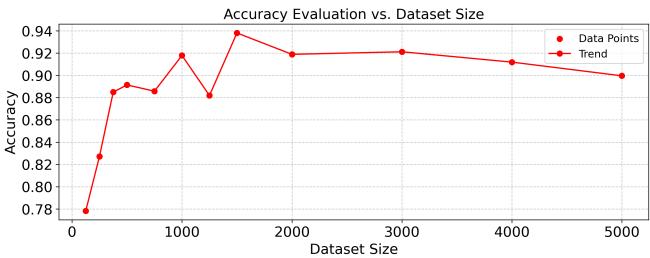
Furthermore, they found that dataset size matters, but you don’t need infinite data. As shown in Figure 6, performance plateaus after about 1,000 data points, suggesting that the model learns the underlying physical rules efficiently rather than just memorizing examples.
Conclusion
The paper “Generative Photography” marks a significant step forward in aligning AI generation with physical reality. By creatively reframing image generation as a video generation problem (Dimensionality Lifting), the authors solved the scene consistency issue. By simulating physical camera data and teaching the network to learn the differences (Differential Camera Intrinsics Learning), they bridged the gap between text prompts and optical physics.
For students and researchers, this paper highlights a crucial lesson: Structure matters. Simply throwing more data at a generic model often yields diminishing returns. By designing the architecture to reflect the physical nature of the problem (in this case, the continuity of camera settings), we can achieve results that are not just artistically pleasing, but physically accurate.
This technology has the potential to transform generative AI from a novelty into a serious tool for photographers and cinematographers, allowing for virtual photo shoots where the laws of optics actually apply.