](https://deep-paper.org/en/paper/2412.02317/images/cover.png)
Introduction
We are currently witnessing a “Cambrian Explosion” in the world of 3D content generation. With the advent of text-to-image and image-to-3D models, creating a detailed 3D humanoid character used to take an artist days; now, it takes seconds. But there is a massive bottleneck that sits between a static 3D model and a playable video game character: Rigging.
Rigging is the digital equivalent of putting a skeleton inside a statue. It involves defining bones (skeleton construction) and telling the computer which parts of the “skin” (the mesh) should move with which bone (skinning). Without rigging, a 3D model is just a statue—it cannot walk, wave, or dance.
Traditionally, rigging is a highly technical, labor-intensive process performed by skilled technical artists. While there have been attempts to automate this using machine learning, existing methods often fail when faced with the chaotic, irregular geometry produced by modern AI 3D generators.
In this deep dive, we are exploring a new paper, HumanRig, which proposes a solution to this deadlock. The researchers introduce two major contributions: a massive dataset specifically designed for AI-generated characters, and a novel deep learning framework that uses “mutual attention” to robustly rig characters ranging from realistic humans to stylized cartoons.
If you are a student of computer graphics or deep learning, understanding how HumanRig solves the “topology problem” offers a fascinating look into the future of automated animation pipelines.
The Problem: Artist vs. AI Topology
To understand why automatic rigging is so hard, we first need to look at the data.
In the past, 3D models were manually crafted by artists. Artists create “clean topology”—the wireframe of the model follows the flow of muscles. There are more vertices (points) near joints like elbows and knees to allow for bending, and the layout is logical.
AI-generated models, however, are different. They look great on the surface (the texture and shape are correct), but the underlying wireframe is often chaotic. The triangles are uneven, edge loops don’t exist, and the vertex density is inconsistent.
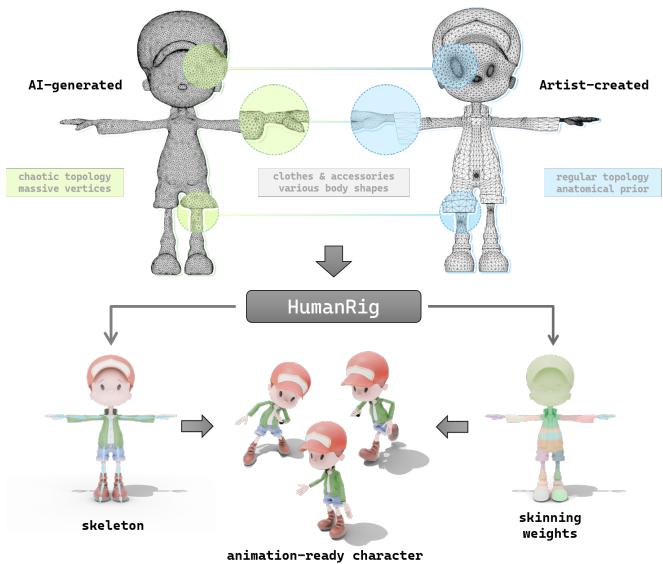
As shown in Figure 1, the difference is stark. The mesh on the right (Artist-created) has a structured, clean grid. The mesh on the left (AI-generated) looks like a crumpled web.
Previous automated rigging methods, such as those based on Graph Neural Networks (GNNs), rely heavily on the connectivity (edges) of the mesh. When they try to process the chaotic “spaghetti” of an AI mesh, they fail to identify where the joints should be.
The Data Gap
The second major hurdle is data. Deep learning requires massive amounts of training data. However, high-quality rigged character datasets are scarce.
- Mixamo: High quality, but very small (about 100 characters).
- RigNetv1: Larger (~2,703 models), but inconsistent. The skeletons don’t share a standard topology (some have tails, some don’t, bone names vary), making it hard to train a universal model.
- SMPL: Uses a consistent skeleton, but focuses on realistic human body shapes without clothing or hair, limiting its use for stylized characters.
This is where the HumanRig Dataset comes in.
Building the Foundation: The HumanRig Dataset
The researchers recognized that to train a model that works on AI meshes, they needed a dataset of AI meshes. They constructed HumanRig, the first large-scale dataset tailored for this specific problem.
The dataset creation pipeline is a clever combination of generative AI and manual refinement.
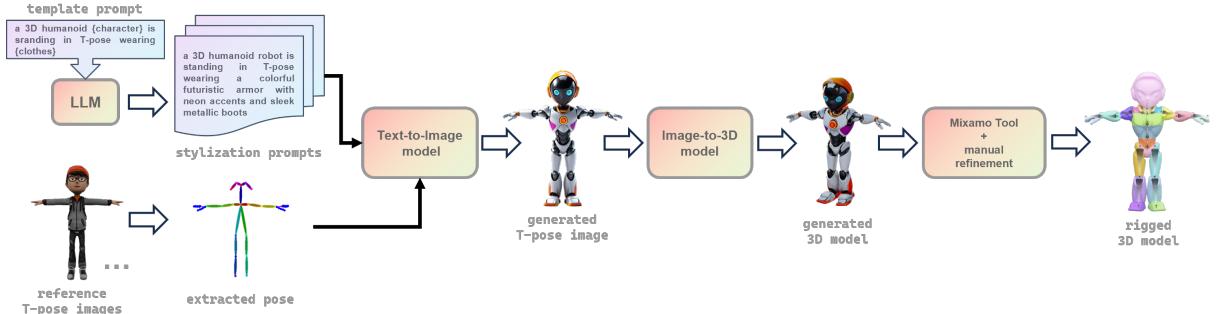
As illustrated in Figure 2, the process works as follows:
- Prompt Engineering: An LLM generates detailed text prompts for diverse characters (robots, anime girls, futuristic soldiers).
- T-Pose Generation: They use ControlNet and Stable Diffusion to generate images of these characters in a strict T-pose (arms out, legs straight). This is the standard “binding pose” for rigging.
- 3D Synthesis: Image-to-3D models (like InstantMesh or TripoSR) convert these 2D images into 3D meshes.
- Rigging & Refinement: The meshes are auto-rigged using Mixamo’s tool and then manually refined by artists to ensure high quality.
Dataset Statistics
The resulting dataset is a game-changer for the field. It contains 11,434 rigged humanoid models. Crucially, all of them share a uniform skeleton topology (the standard Mixamo skeleton). This means a model trained on this dataset learns a consistent skeletal structure, regardless of whether the input is a goblin or an astronaut.

Table 1 highlights the scale difference. HumanRig is nearly 10x larger than previous T-pose datasets and, unlike RigNet, strictly adheres to a uniform skeleton.
Furthermore, the dataset is incredibly diverse in terms of body proportions. In animation, we often talk about “head-to-body ratios” (e.g., a realistic human is 7-8 heads tall, while a “chibi” character might be 2-3 heads tall).
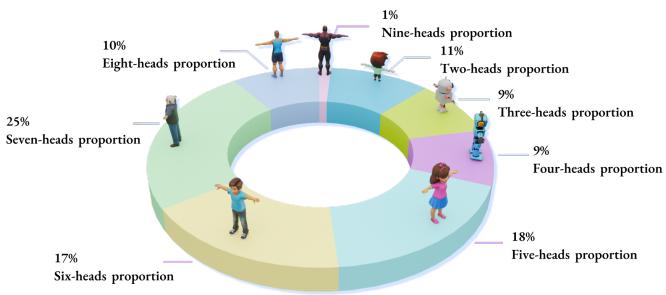
Figure 3 shows that HumanRig covers everything from 2-head proportions (cartoon style) to 9-head proportions (heroic/idealized style). This diversity is essential for training a network that generalizes well to any character style.
The Method: Automatic Rigging Architecture
Now that we have the data, how do we build the model? The researchers propose a framework that treats rigging as two coupled tasks: Skeleton Construction (predicting joint positions) and Skinning (predicting vertex weights).
The framework, called HumanRig (sharing the name with the dataset), is designed to overcome the “chaotic topology” issue of AI meshes.
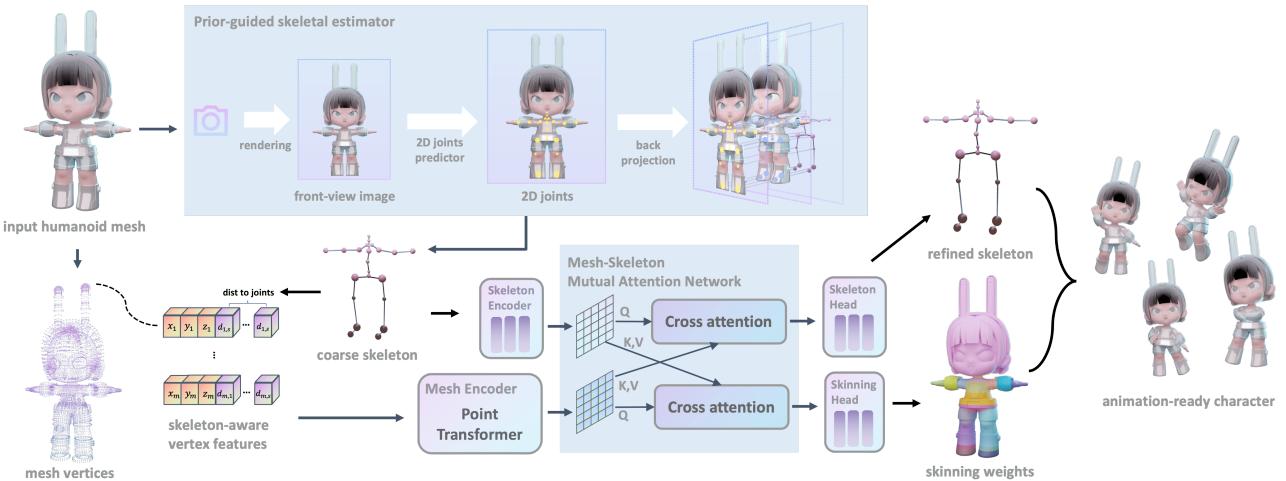
Figure 4 provides a roadmap of the architecture. Let’s break it down into its three core components:
- Prior-Guided Skeleton Estimator (PGSE)
- Point Transformer Encoders
- Mesh-Skeleton Mutual Attention Network (MSMAN)
1. Prior-Guided Skeleton Estimator (PGSE)
Predicting 3D skeleton joints directly from a raw 3D mesh is incredibly difficult because the internal volume of the mesh is empty; the computer only sees the surface skin.
To solve this, the authors utilize a “2D Prior.” Since they have a front-view rendering of every character, they first run a 2D pose estimator (based on RTM-Pose) on that image. This is much easier for AI, as 2D pose estimation is a mature field.
Once they have the 2D joint positions (\(J_{2D}\)), they project them back into 3D space.

In this equation:
- \(\mathbf{P}_c\) is the pseudo-inverse of the camera projection matrix.
- \(\ddot{\mathbf{X}}_c\) is the camera center.
- \(\mu\) represents the depth along the ray.
Essentially, they shoot a ray from the camera through the 2D joint pixel and find where it enters and exits the 3D mesh. The midpoint between the entry and exit points provides a robust initial guess for the Coarse 3D Skeleton. This gives the network a strong starting point rather than guessing from zero.
2. Feature Encoding: Moving Beyond GNNs
Most previous methods used Graph Neural Networks (GNNs) to understand the 3D body. GNNs pass information along the edges of the mesh. But remember Figure 1? AI meshes have terrible, messy edges. Passing information along broken edges leads to broken features.
The HumanRig authors ditch GNNs in favor of a Point Transformer.
A Point Transformer treats the mesh vertices as a cloud of points in space, ignoring the specific edge connections. It groups points based on spatial proximity (how close they are in 3D) rather than topological connectivity (how they are wired). This makes the model robust to the chaotic topology of AI-generated assets.
- Skeleton Encoder: A simple Multi-Layer Perceptron (MLP) encodes the coarse skeleton joints.
- Mesh Encoder: The U-shaped Point Transformer processes the mesh vertices to extract deep geometric features.
3. Mesh-Skeleton Mutual Attention Network (MSMAN)
This is the “brain” of the operation. Rigging is a symbiotic relationship: to place joints correctly, you need to understand the mesh shape (is this a fat leg or skinny leg?). To weight the skin correctly, you need to know where the joints are.
The MSMAN fuses information between the mesh features (\(f_m\)) and the skeleton features (\(f_s\)) using a mechanism called Cross-Attention.
For the students reading this, attention mechanisms (popularized by Transformers/ChatGPT) allow the model to dynamically “focus” on relevant parts of the input.
The authors define the attention operation as:

Here, they prepare Queries (\(Q\)), Keys (\(K\)), and Values (\(V\)). If we want to update the skeleton features with information from the mesh, we set \(Q\) as the skeleton, and \(K, V\) as the mesh.
The attention formula is the standard scaled dot-product attention:
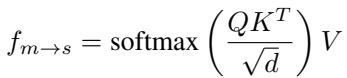
This results in updated features where every skeleton joint has “looked at” every mesh vertex and gathered relevant context, and vice versa. This mutual exchange allows the network to refine the coarse skeleton into a precise final skeleton and generate accurate skinning weights simultaneously.
Training the Beast
The network outputs two things: the final joint positions and the skinning weights. These are trained using specific loss functions.
Skeleton Loss: This is a standard Mean Squared Error (MSE) loss, minimizing the distance between the predicted joints (\(P_{ske}\)) and the ground truth joints (\(G_{ske}\)).
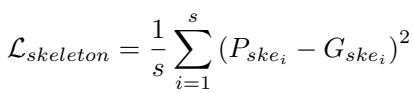
Skinning Loss: Skinning weights are probabilities (e.g., a vertex on the elbow might be 50% upper arm, 50% lower arm). The authors use Kullback-Leibler (KL) divergence, which measures how different two probability distributions are.

The total loss is simply the sum of the two:

Experiments and Results
Does this complex architecture actually work better than existing methods? The authors conducted extensive comparisons against RigNet (the previous state-of-the-art) and NBS (Neural Blend Shapes).
Quantitative Comparison
First, let’s look at the numbers. The researchers compared the models using metrics like CD-J2J (Chamfer Distance Joint-to-Joint), which measures how far off the predicted bones are from the real ones. Lower is better.

Table 2 reveals a significant victory. Even when trained on a smaller subset of data, HumanRig outperforms RigNet. When trained on the full dataset, the error rates drop dramatically.
They also performed an Ablation Study to prove that their specific architectural choices (PGSE and MSMAN) were necessary.

Table 3 shows that removing the Prior-Guided Skeleton Estimator (w/o PGSE) causes a massive spike in error (0.0110 vs 0.0027). This proves that the “initial guess” from the 2D image is crucial. Similarly, removing the Mutual Attention module (w/o MSMAN) degrades the skinning precision.
Furthermore, they validated the choice of the Point Transformer over GNNs.
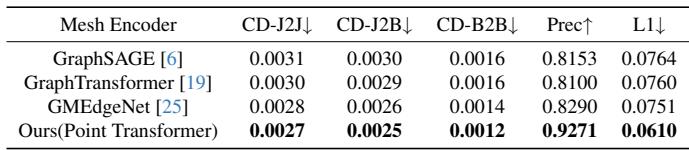
As shown in Table 4, the Point Transformer yields the lowest error and highest precision compared to GraphSAGE or GraphTransformer, confirming that spatial-based learning is superior to edge-based learning for these types of meshes.
Robustness to Body Shapes
One of the coolest experiments involved testing the model on different “Head-to-Body Ratios.”
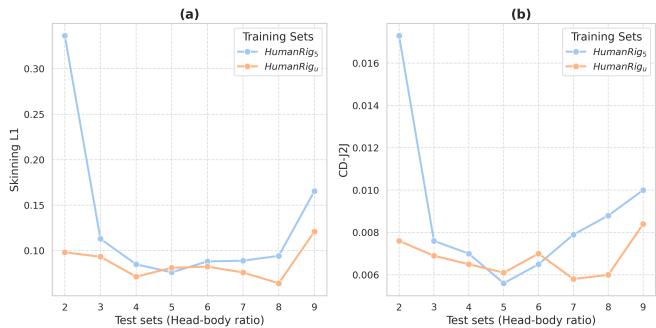
In Figure 5, the blue line represents a model trained only on “5-head” tall characters (standard cartoon proportions). Notice how the error shoots up when it tries to rig a 2-head or 9-head character. The orange line represents the model trained on the diverse HumanRig dataset—the error remains flat and low across all body types. This proves the value of the diverse dataset.
Visual Quality
Numbers are great, but animation is visual. Let’s look at the skeleton construction.
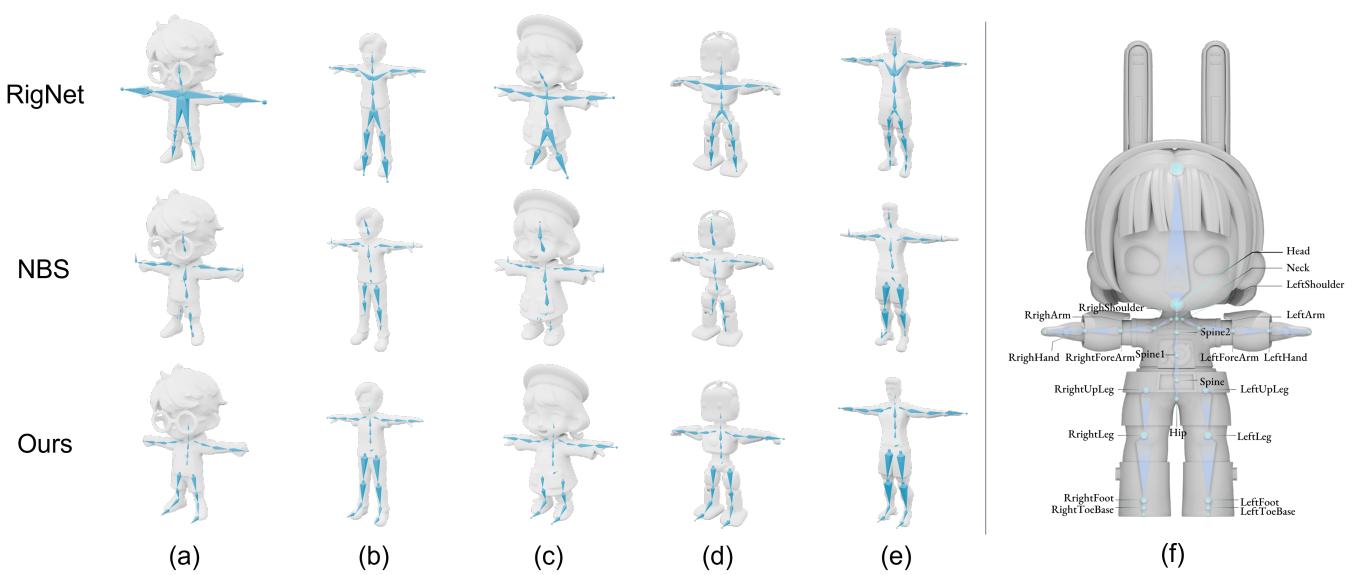
In Figure 6, look at the blue skeleton lines.
- RigNet (top): The skeletons are messy; joints are missing or floating outside the body.
- NBS (middle): The legs are often misaligned.
- HumanRig (bottom): The skeletons are anatomically plausible and align perfectly with the Mixamo standard (f), regardless of whether the character is a tall slender woman (c) or a squat cartoon boy (e).
Finally, the deformation (skinning) quality.

Table 5 confirms that HumanRig produces the lowest deformation error. Visually, this translates to smoother bending.
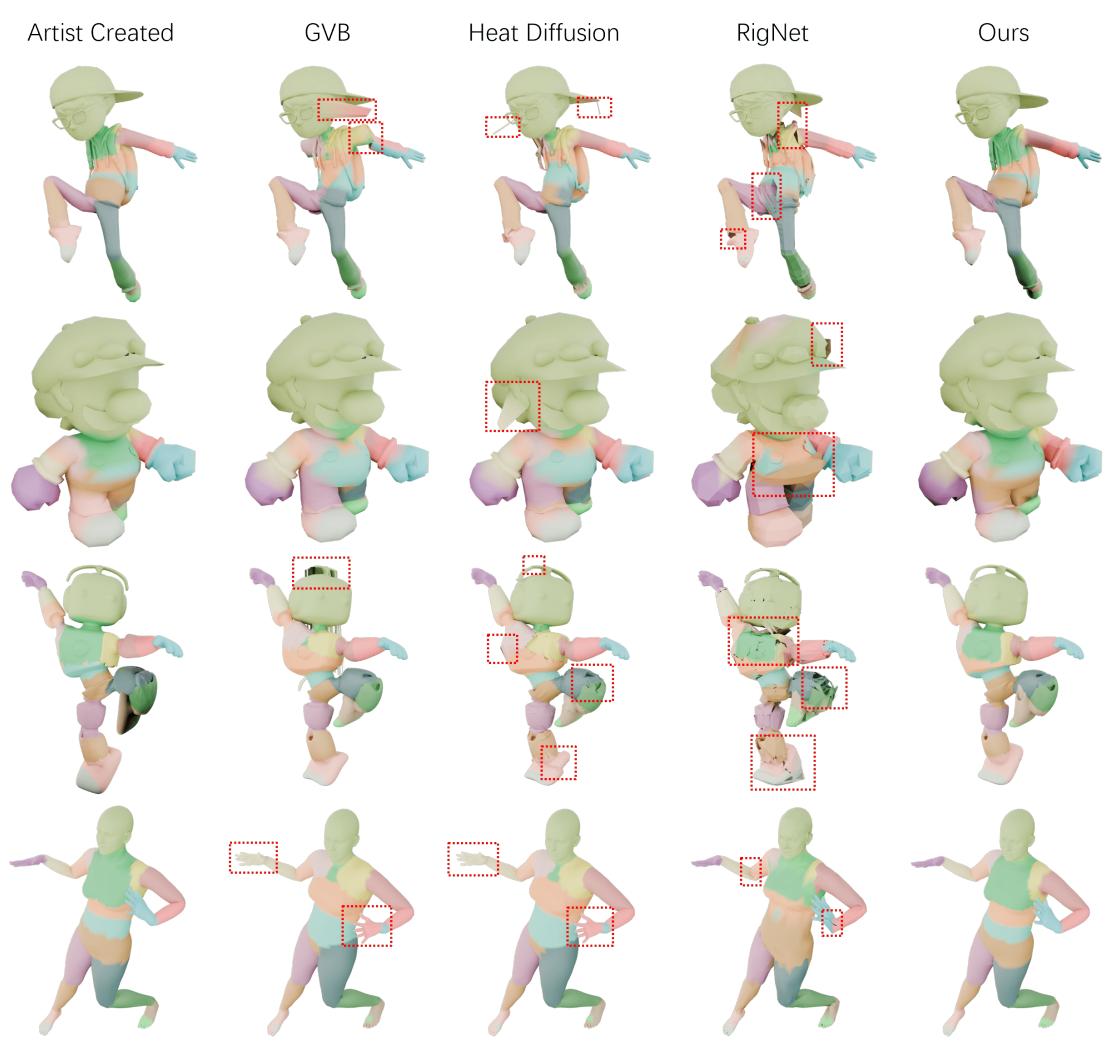
In Figure 7, the red boxes highlight artifacts in competitor methods—collapsed meshes or “candy wrapper” twisting effects. The HumanRig column shows smooth deformations that closely mimic the ground truth artist-created rigs.
Conclusion and Implications
The HumanRig paper represents a significant step forward in the democratization of 3D content creation. By combining a massive, diverse, high-quality dataset with a neural architecture designed specifically for the messy reality of AI-generated meshes, the authors have solved a major bottleneck.
Key Takeaways:
- Topology Matters: Traditional GNNs fail on chaotic AI meshes; Point Transformers that ignore edges are the solution.
- Priors are Powerful: Don’t ask the AI to guess 3D positions from scratch. Using a 2D projection as a “cheat sheet” (PGSE) drastically improves accuracy.
- Mutual Attention: Skeleton placement and skinning weights are deeply intertwined; solving them simultaneously via cross-attention yields better results than solving them sequentially.
For the animation industry, this implies a future where a concept artist can type a prompt, generate a 3D model, and have it running around in a game engine within minutes, with no manual rigging required. While the current method doesn’t yet handle fingers or facial expressions perfectly, it lays the groundwork for fully automated, high-fidelity character animation pipelines.