](https://deep-paper.org/en/paper/2412.03240/images/cover.png)
Introduction
In the world of computer vision, more data usually leads to better decisions. This is particularly true when dealing with multi-modal sensors. Consider an autonomous vehicle driving at night: a visible light camera captures the rich textures of the road but might miss a pedestrian in the shadows. Conversely, an infrared sensor picks up the pedestrian’s thermal signature clearly but loses the texture of the lane markings.
The solution to this has long been Image Fusion: mathematically combining these two inputs into a single, comprehensive image. Traditionally, the goal of image fusion was to create an image that looks “good” to a human observer—balanced brightness, clear details, and high contrast.
However, machines don’t “see” like humans do. When we feed fused images into downstream tasks like semantic segmentation or object detection, the features that make an image pleasing to the human eye aren’t necessarily the ones a neural network needs to classify an object correctly.
This disconnect brings us to a significant research gap: How do we fuse images not for human aesthetics, but for maximum performance on specific downstream tasks?
This brings us to the research paper “Task-driven Image Fusion with Learnable Fusion Loss”, which proposes a novel framework called TDFusion. Instead of using fixed, hand-crafted equations to fuse images, TDFusion learns how to fuse images by looking at the requirements of the task at hand. It employs a fascinating meta-learning approach where the loss function itself is learnable and evolves during training.
In this deep dive, we will explore how TDFusion bridges the gap between image fusion and high-level vision tasks, essentially “teaching the fusion network how to learn.”
Background: The Limitations of Predefined Objectives
Before understanding the solution, we must define the problem with current methods.
The Traditional Approach
Conventional deep learning-based image fusion generally falls into two categories:
- Unsupervised Methods: These treat fusion as an image restoration problem. They use fixed loss functions (like \(L_1\) norm or perceptual loss) to force the fused image to retain pixel intensity or texture from source images.
- Task-Aware Methods: Recent works have tried cascading fusion networks with task networks (e.g., placing a fusion net before an object detector). The detector’s loss backpropagates to the fusion net.
The Problem
While task-aware methods are a step in the right direction, they often still rely on predefined fusion loss terms. Researchers manually design these losses (e.g., “preserve 50% of infrared intensity and 50% of visible gradient”).
This manual design acts as a rigid prior. It assumes we know exactly what mixture of features is best for a neural network to detect a car or segment a road. But we don’t. A segmentation network might need distinct texture boundaries from the visible image, while a detection network might prioritize the high-contrast “blobs” from the infrared image. A fixed loss function cannot adapt to these varying needs.
The TDFusion Solution
TDFusion proposes a paradigm shift: Don’t define the fusion loss; learn it.
The authors introduce a Loss Generation Module. This is a neural network whose sole job is to output the parameters of the loss function. This module is trained via meta-learning, specifically inspired by Model-Agnostic Meta-Learning (MAML). The goal is to generate a fusion loss such that, when the fusion network is trained on it, the resulting image minimizes the error on the downstream task.
Core Method: The TDFusion Framework
The TDFusion framework is complex because it involves three distinct networks interacting in a nested optimization loop. Let’s break down the architecture and the training process.
1. The Architecture Overview
As illustrated in the workflow diagram below, the system consists of three main modules:
- Fusion Network (\(\mathcal{F}\)): Takes source images (\(I_a, I_b\)) and generates a fused image (\(I_f\)).
- Task Network (\(\mathcal{T}\)): Takes the fused image and performs a task (e.g., object detection).
- Loss Generation Module (\(\mathcal{G}\)): Takes source images and outputs weights (\(w_a, w_b\)) that define the fusion loss function.
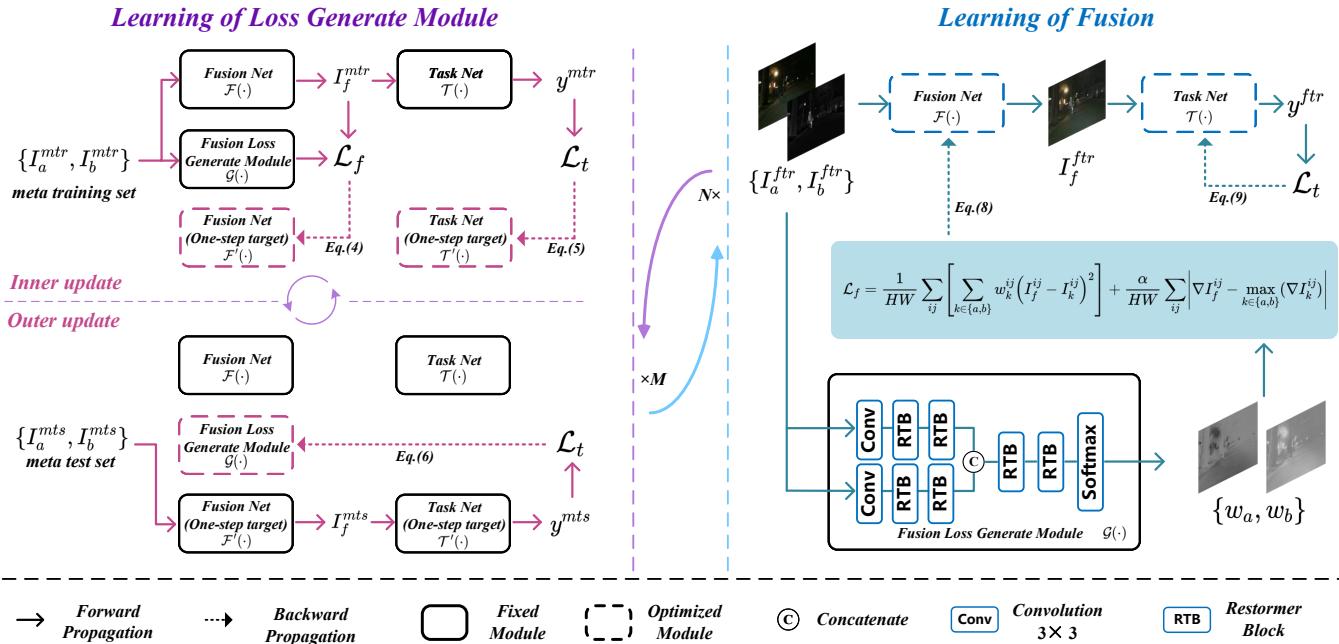
The training process alternates between two phases:
- Purple Section (Left): Learning the Loss Generation Module via meta-learning.
- Blue Section (Right): Learning the Fusion Network using the generated loss.
2. The Learnable Fusion Loss
At the heart of this method is the loss function itself. Instead of a static equation, the loss is dynamic.
The fusion loss (\(\mathcal{L}_f\)) is composed of an Intensity Term and a Gradient Term.

Let’s dissect this equation:
- Intensity Term (\(\mathcal{L}_f^{int}\)): This measures how well the fused image retains pixel values from source images \(a\) and \(b\). However, notice the weights \(w_k^{ij}\). These are not fixed constants like 0.5. They are pixel-wise weights predicted by the Loss Generation Module. This allows the network to say, “For this specific pixel, the Infrared data is important, but for that pixel, ignore it.”
- Gradient Term (\(\mathcal{L}_f^{grad}\)): This forces the fused image to have gradients (edges/textures) similar to the maximum gradient found in either source image. This is a standard technique to preserve sharp details.
The weights \(w_a\) and \(w_b\) are the “learnable” part. They are the output of the Loss Generation Module \(\mathcal{G}\).
3. Training via Meta-Learning
The most innovative part of TDFusion is how it trains the Loss Generation Module. Since we don’t have “ground truth” weights for the loss function, we cannot train \(\mathcal{G}\) directly. instead, we use a bi-level optimization strategy (meta-learning).
The logic is: “Update the fusion network using the current loss. Then, check if that update improved the downstream task performance. If not, change how the loss is generated.”
This involves Inner Updates and Outer Updates.
Step A: The Inner Update (Simulation)
First, we take a “clone” of the Fusion Network (\(\mathcal{F}'\)) and update it once using the current fusion loss. This simulates a training step.

Here, \(\mathcal{F}\) is updated to \(\mathcal{F}'\) using the loss generated by \(\mathcal{G}\). Simultaneously, the task network is also updated temporarily:
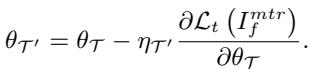
Step B: The Outer Update (Optimization)
Now that we have the updated clone \(\mathcal{F}'\), we feed a Meta-Test Set of images through it. We then calculate the Task Loss (e.g., segmentation error) on these fused images.
Crucially, we compute the gradient of this Task Loss with respect to the parameters of the Loss Generation Module (\(\theta_{\mathcal{G}}\)). This tells us: “How should we change the loss generation parameters so that the fusion network—after being trained on that loss—produces better results for the task?”
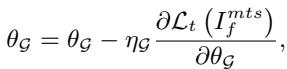
To compute this gradient, we use the chain rule through the inner update step. This requires calculating second-order derivatives (Hessian-vector products), a standard technique in meta-learning:

This equation mathematically connects the downstream task performance (\(\mathcal{L}_t\)) back to the fusion loss parameters (\(\theta_{\mathcal{G}}\)).
Step C: Updating the Fusion Network
Once the Loss Generation Module (\(\mathcal{G}\)) has been updated to be “smarter,” we proceed to actually train the real Fusion Network (\(\mathcal{F}\)). We use the improved loss function generated by \(\mathcal{G}\) on the training set.

And simultaneously update the task network:

4. Theoretical Analysis
To understand exactly how the task loss influences the fusion weights, the authors provide a theoretical breakdown. They rewrite the intensity loss term to explicitly show the dependency on the Loss Generation Module’s output:

The derivation of gradients becomes quite complex, involving the interaction between the meta-testing task loss and the meta-training fusion loss. The equation below represents the gradient decomposition, highlighting that the optimization of \(\mathcal{G}\) is driven by the inner product between gradients derived from the task loss and the fusion loss.
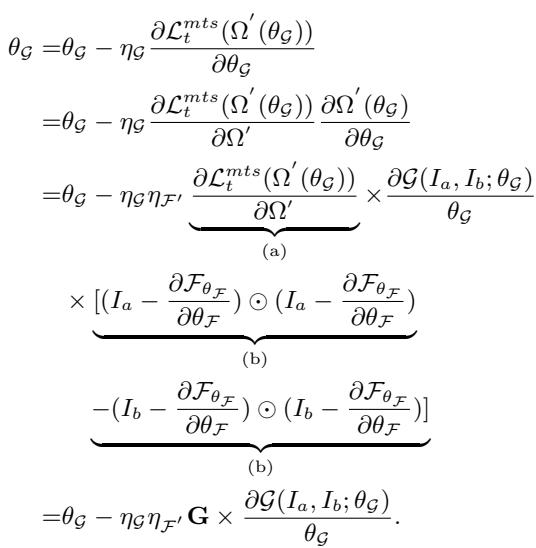
In simpler terms: The network looks at the difference between the source image and the fused image. It then scales this difference based on how much that specific difference contributed to the success or failure of the downstream task.
Experiments and Results
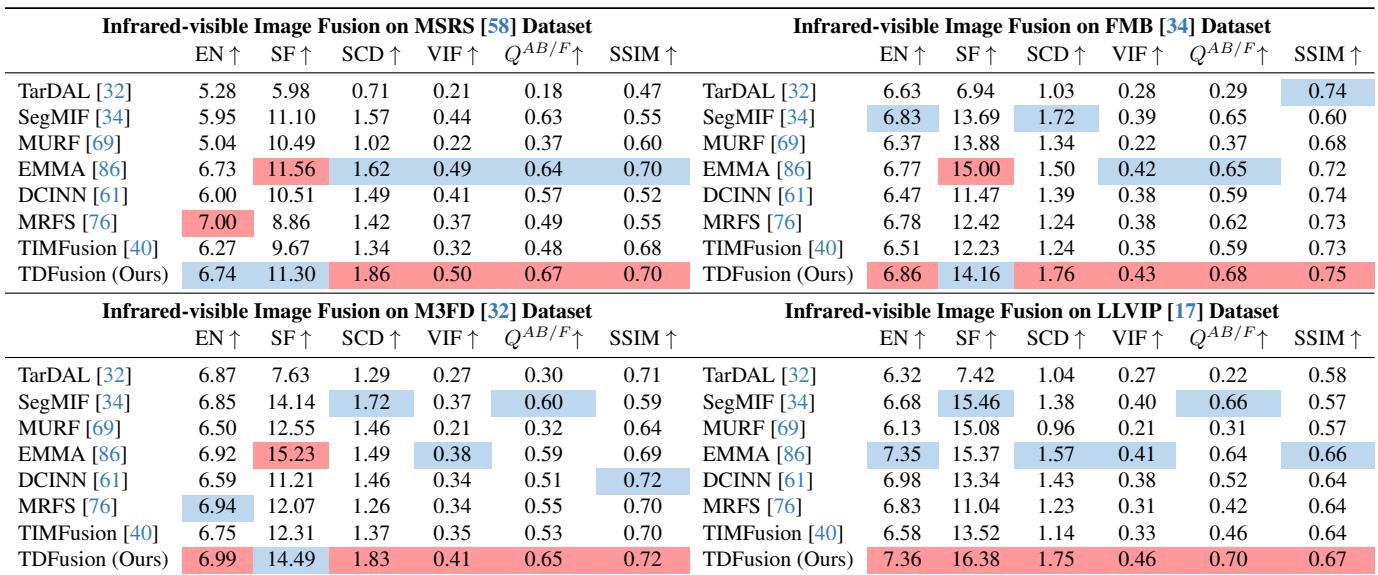
The authors validated TDFusion on four major datasets (MSRS, FMB, M3FD, LLVIP), focusing on both visual quality and downstream task performance (Semantic Segmentation and Object Detection).
Visual Quality of Fusion
While the goal is task performance, visual quality acts as a sanity check. If the image is unintelligible, the task network likely won’t work either.
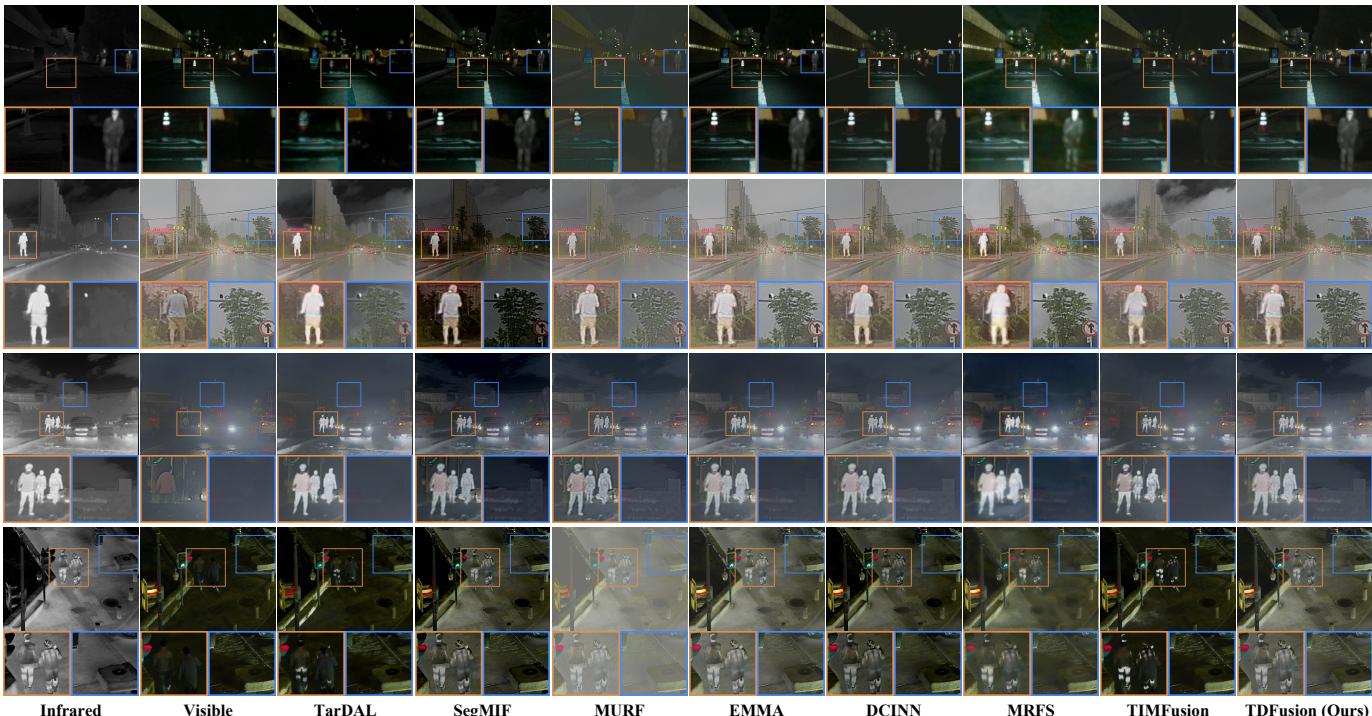
In Figure 2, we see TDFusion (bottom row) compared to state-of-the-art methods like TarDAL, SegMIF, and TIMFusion.
- Detail Preservation: Look at the pedestrian in the last column (“LLVIP”). TDFusion maintains a very sharp, high-contrast silhouette from the infrared, while still keeping background context.
- Artifact Reduction: Some competitors (like EMMA or TarDAL) introduce noise or “ghosting” artifacts. TDFusion produces cleaner, more natural-looking images.
Quantitative Analysis: The table below confirms the visual impressions. TDFusion (highlighted in red) achieves the best performance across most metrics, including SSIM (Structural Similarity) and VIF (Visual Information Fidelity).
Downstream Task Performance
This is the most critical evaluation. Does the learnable loss actually help the machine “see” better?
Semantic Segmentation
The authors retrained a SegFormer network using the fused images from various methods.

In Figure 3, looking at the bottom row (TDFusion):
- Notice the Person segmentation (orange/yellow mask). TDFusion provides a much cleaner boundary than TarDAL or SegMIF, which often fragment the person or miss limbs.
- The Car segmentation is also more complete, likely because the fusion network learned to prioritize infrared intensity for warm objects (car engines/bodies) and visible texture for boundaries.
Object Detection
Using a YOLOv8 backbone, the authors tested detection accuracy.
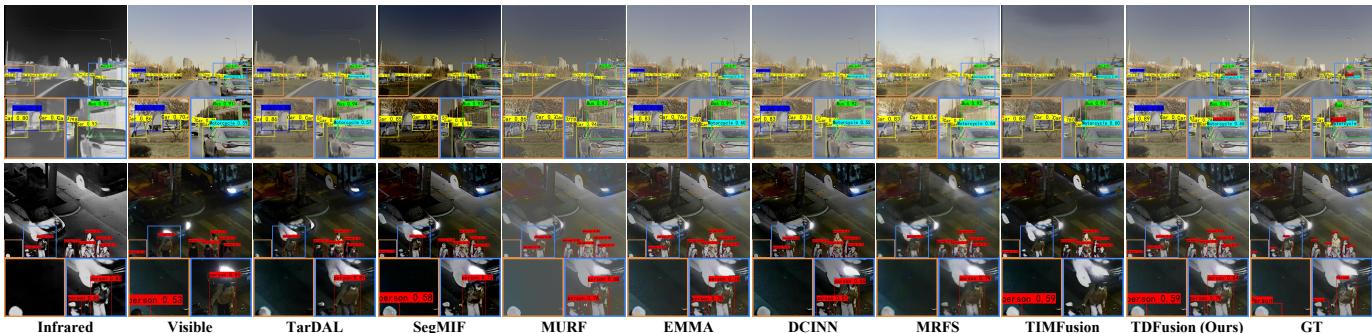
In Figure 4, compare the confidence scores and bounding boxes.
- In the LLVIP example (far right), TDFusion successfully detects the pedestrians with high accuracy.
- Crucially, in difficult lighting conditions where visible cameras fail (the “Infrared” column shows the pedestrians clearly, but “Visible” does not), TDFusion effectively leverages the infrared data to ensure detection, whereas other fusion methods might dilute this signal with the dark visible pixels.
Task Metrics: The quantitative results for these tasks are compelling:

TDFusion achieves the highest mIoU (mean Intersection over Union) for segmentation and mAP (mean Average Precision) for detection. This statistically proves that the learnable loss guides the fusion network to preserve features that are mathematically more useful for the task network.
Why Does It Work? A Visualization of the Loss
One of the most insightful parts of the paper is the visualization of the learned weights. Since the loss is learnable, we can actually see what the network thinks is important for different tasks.
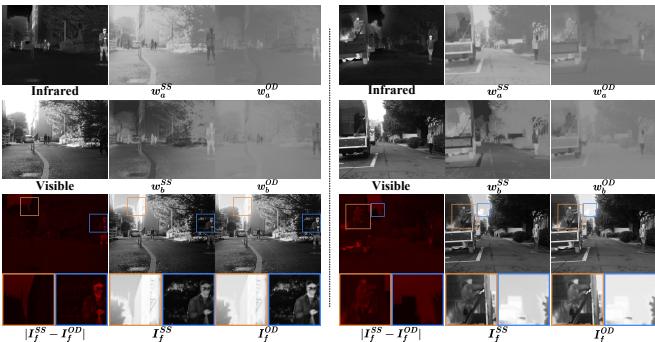
In Figure 5, the authors compare the learned weights for Semantic Segmentation (SS) vs. Object Detection (OD).
- \(w^{SS}\) (Segmentation Weights): Notice that for segmentation, the network emphasizes boundaries and textures (trees, road markings). It needs to know where one object ends and another begins.
- \(w^{OD}\) (Detection Weights): For object detection, the network places much higher weight on salient objects (people, cars). The weight maps are “brighter” around the pedestrians.
This confirms the hypothesis: Different tasks require different information from the source images. TDFusion automatically learns these preferences.
Ablation Studies
Finally, to prove that the learnable loss and the meta-learning strategy are necessary, the authors performed ablation studies.
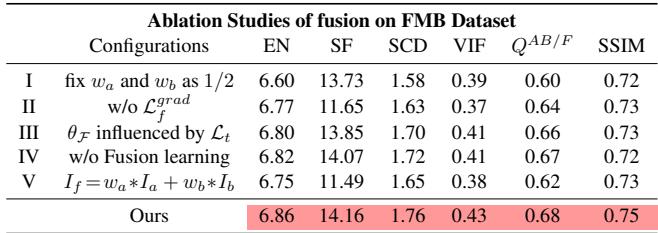
- Config I: Fixing weights to 0.5 (Standard fusion). Performance drops significantly.
- Config II: Removing gradient loss. Performance drops, showing texture is important.
- Config IV: Removing the fusion learning phase.
- Ours: The full framework performs best across the board.
Conclusion and Implications
The TDFusion paper presents a compelling argument against “one-size-fits-all” image fusion. By accepting that machine vision tasks have different requirements than human vision, and even different requirements between tasks, the authors developed a framework that is highly adaptive.
Key Takeaways:
- Meta-Learning for Fusion: TDFusion successfully applies meta-learning to optimize a loss function, effectively automating the design of the fusion objective.
- Task-Specific Adaptation: The visualizations prove that the model learns to prioritize different image features (texture vs. contrast) depending on whether the goal is segmentation or detection.
- Superior Performance: The method yields state-of-the-art results not just in fusion metrics, but in the actual utility of the images for downstream applications.
This work paves the way for “Application-Centric” image processing, where the preprocessing steps (like fusion, denoising, or enhancement) are no longer static, but are dynamic components of the entire AI pipeline, trained end-to-end to maximize the final objective.