](https://deep-paper.org/en/paper/2412.03378/images/cover.png)
Introduction
In the fast-moving world of neural rendering, we are often forced to choose between two paths: physical accuracy or rendering speed.
On one side, we have ray-tracing methods like NeRF (Neural Radiance Fields). They meticulously simulate light passing through a volume, integrating density along rays. They are physically grounded and produce stunningly realistic images, but they can be painfully slow to train and render.
On the other side, we have the recent superstar: 3D Gaussian Splatting (3DGS). It is blazingly fast because it treats the scene as a collection of 3D ellipsoids and “splats” them onto the screen using rasterization. However, this speed comes with a hidden cost. To make the math work for real-time rasterization, 3DGS makes several mathematical approximations. It essentially flattens 3D shapes into 2D stains on your screen, breaking the laws of volume rendering physics.
But what if we didn’t have to choose? What if we could keep the speed of rasterization but restore the physical accuracy of ray tracing?
This is exactly what the researchers behind Volumetrically Consistent 3D Gaussian Rasterization have achieved. In this post, we will dive deep into how they identified the flaws in standard Gaussian Splatting and derived a closed-form analytical solution to fix them. The result is a rendering engine that produces sharper edges, better opaque surfaces, and can even be used for scientific tasks like computed tomography (CT scans)—all while maintaining high inference speeds.
Background: The Volume Rendering Equation
To understand why standard 3D Gaussian Splatting is an approximation, we first need to look at the “ground truth”: the volume rendering equation. This is the gold standard used by NeRFs.
When we render a pixel, we are essentially casting a ray \(\boldsymbol{r}(t)\) from the camera into the scene. The color of that pixel \(C(\boldsymbol{r})\) is determined by accumulating the color and density of the fog-like volume the ray passes through.

Here, \(\sigma(\boldsymbol{r}(t))\) is the density at a point \(t\) along the ray, and \(c(\boldsymbol{r}(t), \boldsymbol{d})\) is the color. The term \(T(0,t)\) represents transmittance—the probability that light travels from the start of the ray to point \(t\) without being blocked.
Transmittance is crucial. It is calculated as the exponential decay of the accumulated density:
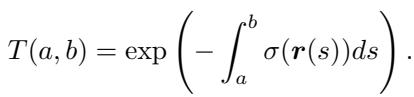
In a point-based scene representation, like 3DGS, the density \(\sigma(\boldsymbol{x})\) is defined as the sum of many 3D Gaussian kernels \(G_i\), each weighted by an opacity coefficient \(\kappa_i\):
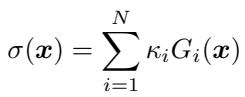
And each Gaussian is defined by its mean \(\boldsymbol{\mu}\) (position) and covariance \(\boldsymbol{\Sigma}\) (shape/scale):

How Standard 3DGS “Cheats”
Strictly evaluating the integrals above requires sampling hundreds of points along every ray (ray marching), which is slow. 3DGS gets around this by using Splatting.
Instead of integrating the 3D Gaussian along the ray, 3DGS projects the 3D ellipsoid onto the 2D image plane. It approximates the total contribution of a Gaussian using a 2D formula. The standard alpha blending formula used in rasterization looks like this:
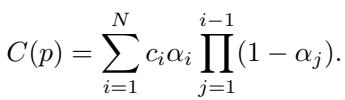
In standard 3DGS, the alpha value \(\alpha_i\) (how opaque a specific Gaussian looks at a specific pixel) is computed by evaluating a 2D Gaussian at the pixel coordinate \(p\):
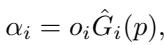
Here, \(\hat{G}_i\) is a 2D Gaussian obtained by approximating the camera projection \(J\) (Jacobian) to squash the 3D covariance \(\Sigma\) into a 2D covariance \(\Sigma'\):

The Problem: This projection relies on affine approximations and ignores the depth integration. It assumes that the “heaviness” of the fog along the ray can be represented by a flat 2D stamp. As we will see, this prevents Gaussians from looking truly “solid” and introduces artifacts at edges.
The Core Method: Volumetric Integration
The key insight of this paper is that we do not need to splat. We can keep the rasterization pipeline (sorting Gaussians and drawing them front-to-back), but we can replace the approximate 2D projection with the exact analytic integration of the 3D Gaussian along the ray.
1. Re-deriving Alpha Blending
First, the authors prove that the volume rendering equation can indeed be expressed as alpha blending, provided we assume the Gaussians are sorted and don’t overlap significantly.
If we substitute the sum of Gaussians into the volume rendering integral, we get:
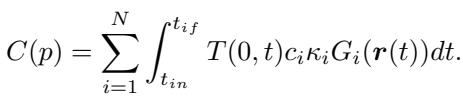
By assuming the Gaussians are sorted front-to-back, we can split this integral into discrete contributions. The color contribution of the \(i\)-th Gaussian is weighted by the transmittance of all previous Gaussians (\(\prod \overline{T}_j\)) and its own internal absorption:

Here, \(\overline{T}_j\) is the total transmittance across the \(j\)-th Gaussian.

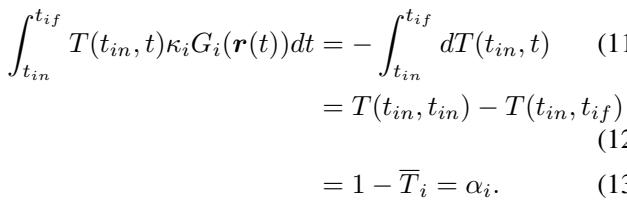
The authors then perform a clever mathematical substitution. They realize that the integral of density multiplied by transmittance is actually just the change in transmittance. This simplifies beautifully to show that the alpha value \(\alpha_i\) is exactly equal to \(1 - \overline{T}_i\):
This leads us back to the familiar alpha blending equation:
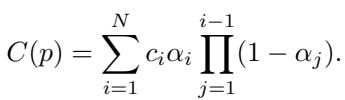
Why does this matter? It confirms that we can use the fast alpha-blending engine of a rasterizer to solve the volume rendering equation. We just need to calculate \(\alpha_i\) correctly. Standard 3DGS calculates \(\alpha_i\) using a 2D projection approximation. This paper calculates \(\alpha_i\) by actually solving the integral \(\int \kappa_i G_i(\boldsymbol{r}(t)) dt\).
2. The Analytic Solution
So, how do we integrate a 3D Gaussian along a ray without expensive sampling?
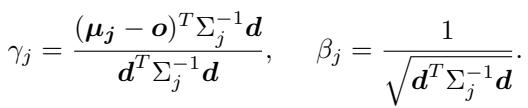
A 3D Gaussian, when restricted to a single line (the ray), becomes a 1D Gaussian. The authors derive the parameters for this 1D Gaussian \(g_j(t)\) along the ray direction \(\boldsymbol{d}\):
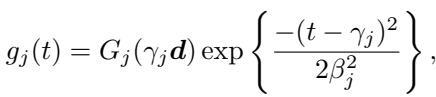
The mean \(\gamma_j\) (where the Gaussian is centered along the ray) and the standard deviation \(\beta_j\) (how spread out it is along the ray) can be computed in closed form using the ray origin \(\boldsymbol{o}\) and direction \(\boldsymbol{d}\):
Now, we simply need to integrate this 1D Gaussian from the point it enters the ray to the point it leaves.
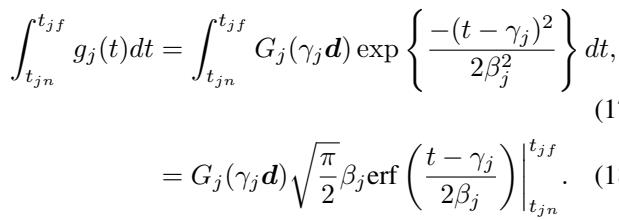
Conveniently, the integral of a Gaussian function is known: it is the Error Function (erf). Since Gaussians decay quickly, we can integrate from \(-\infty\) to \(+\infty\) to get the total optical depth. This gives us a closed-form solution for the transmittance through a Gaussian:

This is the “magic formula.” By computing this value, we know exactly how much light is blocked by a 3D Gaussian, accounting for its full 3D shape, without any ray marching samples.
3. Visualizing the Difference
The difference between the standard 3DGS approach and this new volumetric approach is visualized below.
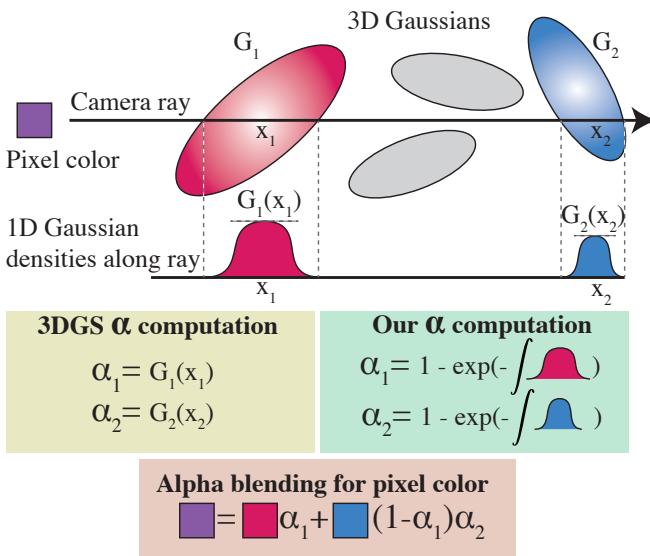
In the top row (3DGS), the alpha is just the maximum density value at the peak. In the bottom row (Ours), the alpha is derived from the area under the curve.
This distinction has massive implications for rendering solid objects.
- 3DGS (Splatting): A Gaussian is projected as a 2D blob. It is only fully opaque (\(\alpha=1\)) at its very center. As you move away from the center of the pixel, opacity drops off like a bell curve. This makes it hard to represent a flat, solid wall.
- Ours (Volumetric): If you increase the density or the length of the Gaussian along the ray, the area under the curve grows. The integration results in a “flat top” opacity profile. This means the Gaussian can look like a solid, opaque disc with sharp edges, not just a fuzzy blob.
The figure below demonstrates this behavior perfectly:
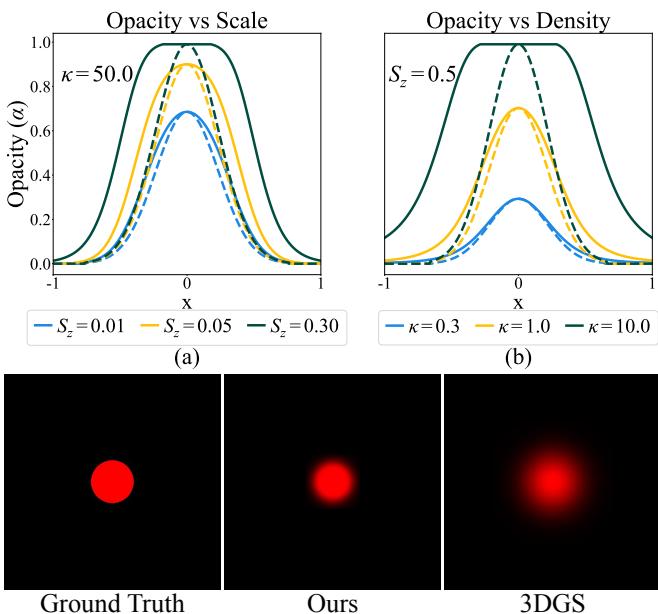
- Graph (a): In the proposed method (solid lines), extending the Gaussian along the ray (increasing \(S_z\)) makes it more opaque. In 3DGS (dotted lines), stretching the Gaussian along the view direction does nothing to the 2D projection.
- Graph (b): Increasing density in the proposed method creates a wide, flat plateau of perfect opacity. 3DGS just makes the peak higher, but the shape remains a narrow spike.
Experiments & Results
Does this better math actually lead to better pictures? The authors integrated their analytic alpha calculation into the standard 3DGS CUDA rasterizer and tested it.
View Synthesis Performance
The method was tested on standard benchmarks like Mip-NeRF 360, Tanks & Temples, and DeepBlending.
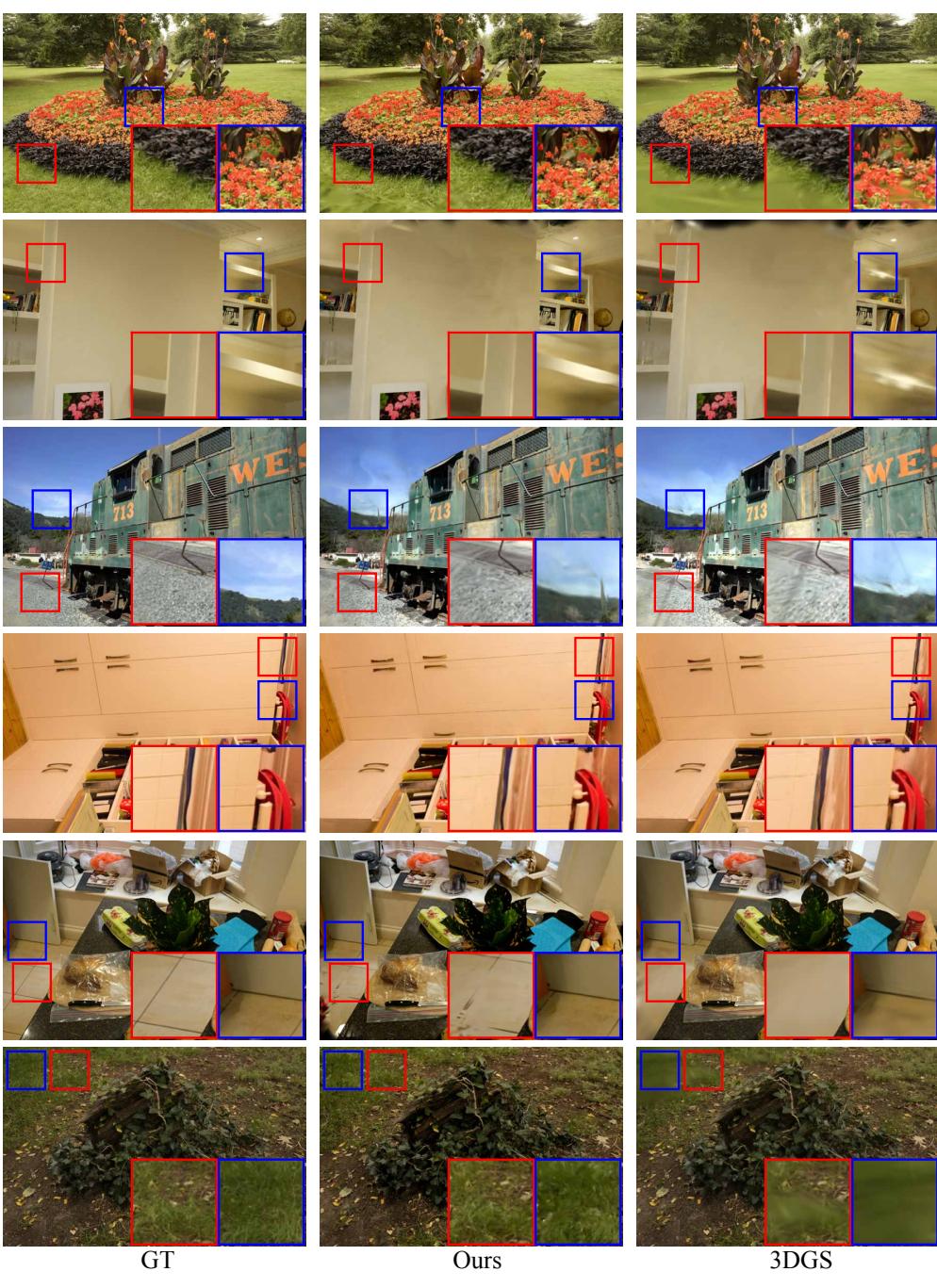
In the qualitative results above, notice the Room scene. The 3DGS version (right) struggles to create a solid opaque surface, leading to a somewhat “cloudy” look. The proposed method (center) renders a solid, consistent surface that matches the ground truth (left) much better. In the Flowers and Stump scenes, the new method captures finer high-frequency details that are blurred out by the approximations in 3DGS.
One of the most striking demonstrations is the “Square Fit” test. The researchers tried to optimize a set of Gaussians to represent a simple flat square.
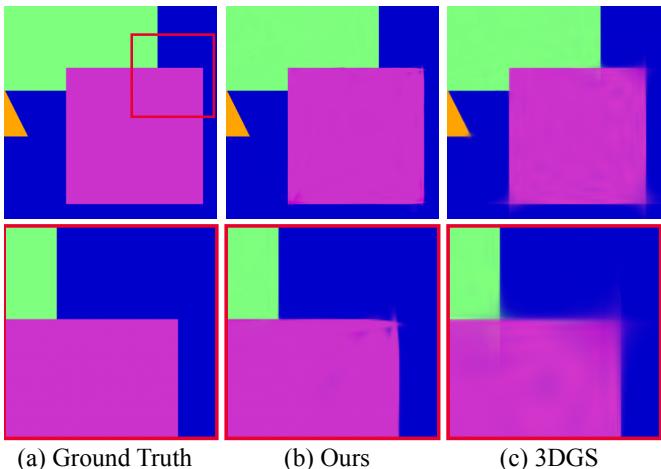
Standard 3DGS (c) fails to make a sharp square. Because every primitive creates a soft 2D Gaussian splat, the edges are blurry and the center isn’t perfectly uniform. The Volumetric method (b) creates a nearly perfect square because the integration allows the Gaussians to act as opaque “bricks.”
Quantitatively, the method outperforms standard 3DGS and other rasterization-based approaches in perceptual metrics like LPIPS (which measures how “natural” an image looks) and SSIM (structural similarity).
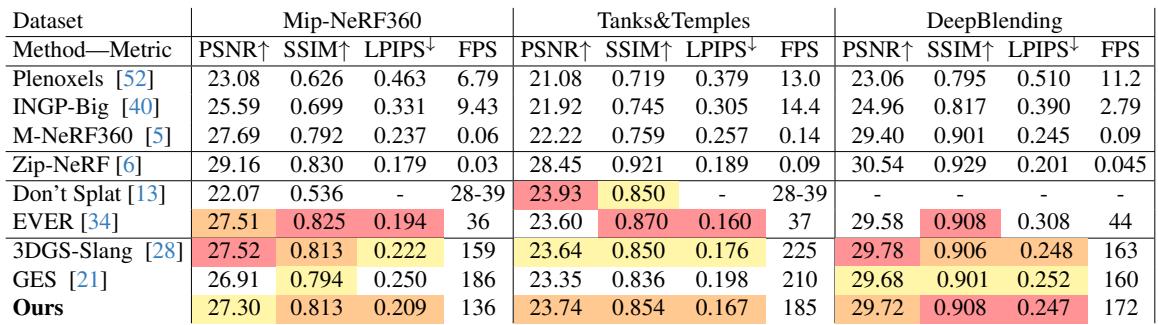
While the FPS (Frames Per Second) is slightly lower than the original 3DGS (136 vs 159 on Mip-NeRF360), it remains in the real-time territory, significantly faster than ray-tracing methods.
Application: Tomography
Perhaps the most exciting application of this physical consistency is in Computed Tomography (CT).
In X-ray CT, the goal is to reconstruct internal 3D density from 2D projections. This relies strictly on the physics of light attenuation (Beer-Lambert law).

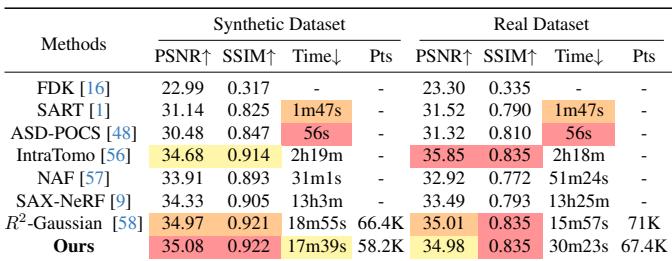
Because standard 3DGS is an approximation that doesn’t strictly follow the integral of density, it performs poorly “out of the box” for scientific reconstruction. Previously, researchers had to invent specialized normalizations (\(R^2\)-Gaussian) to fix this.
However, because the proposed method is the analytic solution to the volume integral, it works for tomography without any modifications.
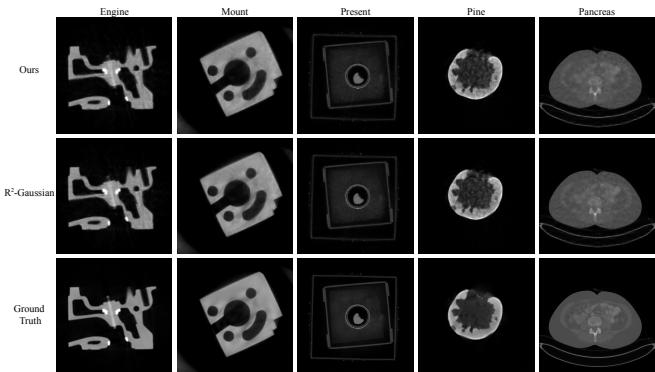
As shown in the table below, the method matches the state-of-the-art specialized tomography solvers (like \(R^2\)-Gaussian) while using fewer points.
Limitations
No method is perfect. While this approach fixes the integration physics, it still relies on the rasterization framework, which assumes that primitives are sorted and do not overlap.
In reality, soft Gaussian clouds do overlap. The authors compared their method against a rigorous (but slow) ray-marching reference to see where the rasterization assumption breaks.
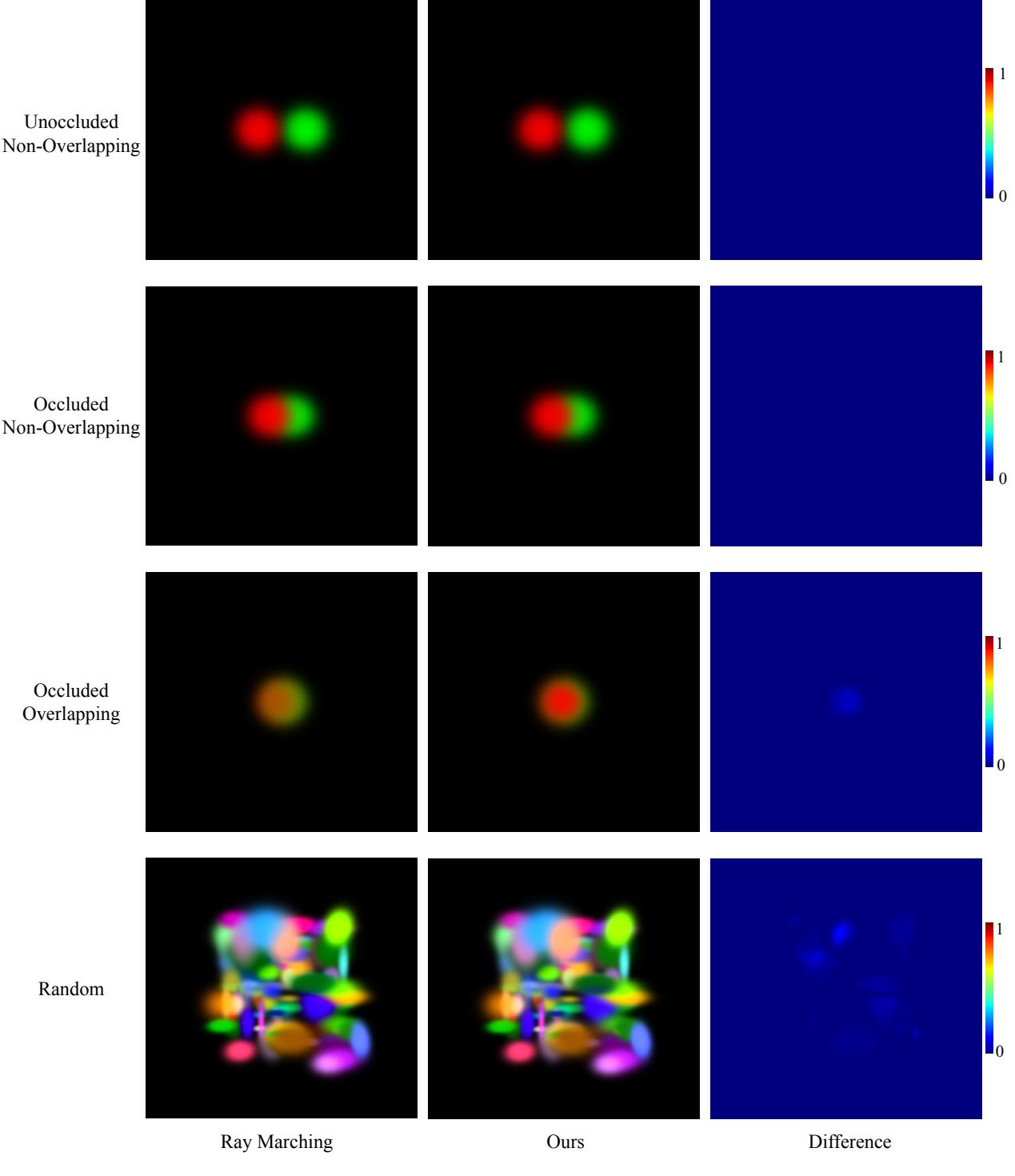
As seen in Row 3, when primitives heavily overlap, the rasterization assumption (calculating alpha sequentially) diverges slightly from the true volumetric sum. However, in Row 4 (Random clouds), we see that for general scenes, the error is minimal.
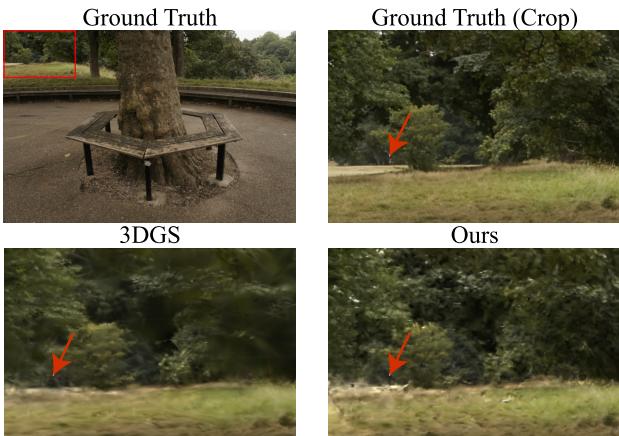
Additionally, because the method is better at rendering opaque solids, it can sometimes be too good. If the camera calibration is slightly off (the poses are wrong), standard 3DGS blurs the image to hide the error. The proposed method tries to render a hard opaque surface, resulting in “floating” artifacts when the geometry doesn’t perfectly align.
Conclusion
“Volumetrically Consistent 3D Gaussian Rasterization” bridges a significant gap in the field of neural rendering. It proves that we don’t need to sacrifice physical accuracy for the speed of rasterization. By swapping the approximate 2D splatting math for exact 3D integration, the authors have created a rendering engine that is:
- More accurate: Producing sharper edges and better solid surfaces.
- More versatile: capable of scientific tasks like Tomography out-of-the-box.
- Still fast: Maintaining real-time frame rates.
This work lays a mathematical foundation that could allow Gaussian Splatting to expand beyond pretty pictures into rigorous scientific visualization and reconstruction tasks.