](https://deep-paper.org/en/paper/2412.03572/images/cover.png)
Introduction
How do you navigate a crowded room to reach the exit? You likely don’t just stare at your feet and react to obstacles the moment they touch your toes. Instead, you project a mental simulation. You imagine a path, predict that a person might step in your way, and adjust your trajectory before you even take a step. You possess an internal model of the world that allows you to simulate the future.
In the field of robotics, however, navigation has traditionally been much more reactive or “hard-coded.” Most state-of-the-art navigation policies are trained via supervised learning to map current observations directly to actions. While effective, these policies lack flexibility. Once trained, they cannot easily adapt to new constraints (like “don’t turn left”) or reason about the long-term consequences of an action in a novel environment.
This brings us to a fascinating development in Embodied AI: the Navigation World Model (NWM).
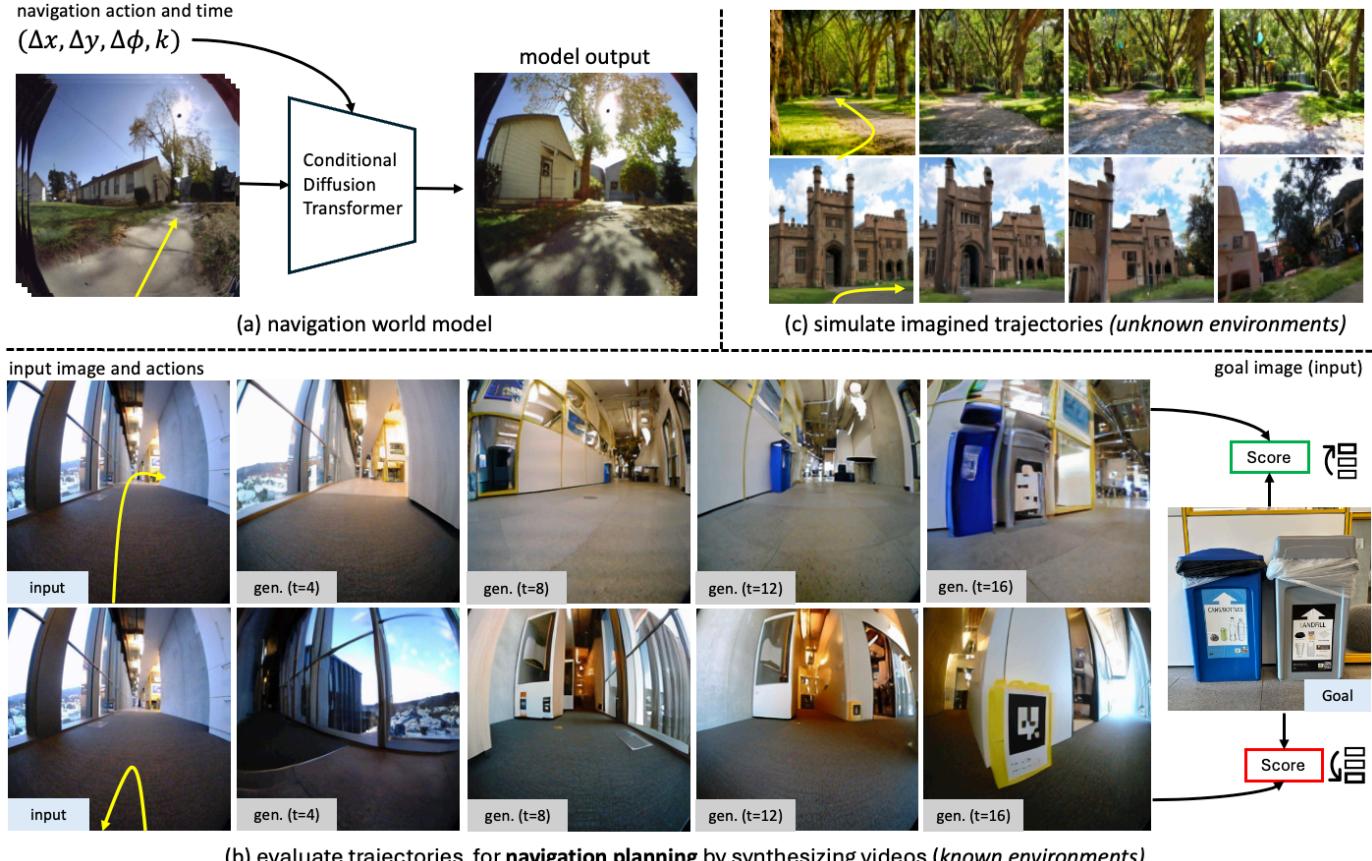
As illustrated in Figure 1, the NWM treats navigation as a video generation problem. By training a generative model to predict future video frames based on past observations and specific actions, researchers have created a system that allows robots to “imagine” the consequences of their movements. This enables a robot to simulate thousands of potential futures, evaluate which one gets it closest to the goal, and then execute that plan—effectively bringing the human capability of mental simulation to autonomous agents.
In this deep dive, we will explore how NWM works, the novel architecture that makes it efficient, and how it outperforms traditional navigation policies.
Background: World Models and Generative AI
To understand NWM, we need to bridge two concepts: World Models from reinforcement learning and Diffusion Models from computer vision.
What is a World Model?
In robotics and reinforcement learning, a “world model” is an internal representation of the environment. Formally, if an agent is in state \(s_t\) and takes action \(a_t\), a world model predicts the next state \(s_{t+1}\). If a robot has a good world model, it doesn’t need to try dangerous actions in the real world to see what happens; it can query its internal model.
The Rise of Generative Video
Recently, we have seen an explosion in text-to-video models (like Sora). These models understand the physics of light, motion, and object permanence well enough to generate realistic clips. The researchers behind NWM asked a critical question: Can we repurpose this video generation capability for robotic control?
Instead of generating video from text prompts, NWM generates video conditioned on navigation actions. If the model understands that “moving forward” causes the hallway in the image to expand and objects to get closer, it has effectively learned the physics of navigation.
Core Method: The Navigation World Model
The core of the NWM is a conditional generative model. Let’s break down the mathematical formulation, the handling of time, and the specific architecture designed to make this computationally feasible.
1. Formulation: Predicting the Future
The goal is to learn a function that takes past visual observations and a sequence of actions, and outputs the future visual observation.
Because working directly with raw pixels is computationally expensive, the system first encodes images into a compressed latent space using a Variational Autoencoder (VAE). Let \(x_i\) be an image and \(s_i\) be its latent representation. The world model \(F_\theta\) is a stochastic mapping defined as:

Here, \(\mathbf{s}_\tau\) represents the history of past frames (context), and \(a_\tau\) is the action. The model effectively asks: “Given what I’ve seen in the last few seconds, and assuming I move this way, what will the world look like next?”
2. Action and Time Conditioning
A standard robot action usually consists of linear velocity (moving forward/backward) and angular velocity (turning). However, prediction requires knowing how much time has passed.
The NWM inputs a tuple \((u, \phi, k)\) where:
- \(u\): Translation parameters (movement).
- \(\phi\): Rotation parameters (yaw).
- \(k\): Time shift (how far into the future to predict).
This explicit time shift is a powerful addition. It allows the model to act as a simulator where you can ask, “Show me the state 1 second from now” or “Show me the state 4 seconds from now.”
The actions are aggregated over the time window:

To feed these conditions into the neural network, the scalar values for action, time shift, and the diffusion timestep are embedded into vectors and summed:

This vector \(\xi\) modulates the neural network, ensuring the generated video frame respects the specific movements the robot intends to make.
3. The Architecture: Conditional Diffusion Transformer (CDiT)
This is perhaps the most significant technical contribution of the paper. Standard Diffusion Transformers (DiTs) are powerful but computationally heavy. In a standard Transformer, attention complexity is quadratic with respect to the input sequence length (\(O(N^2)\)). If you want to condition on a long history of past frames, the model becomes too slow for real-time robotics.
To solve this, the authors propose the Conditional Diffusion Transformer (CDiT).
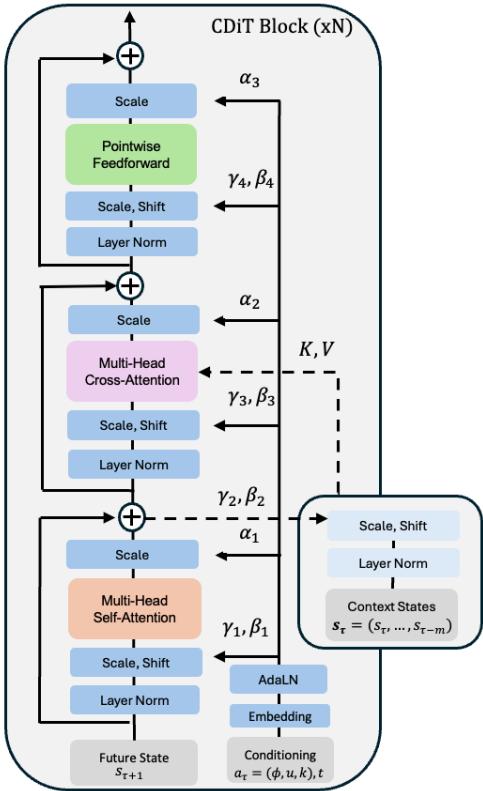
As shown in Figure 2, the CDiT block separates the processing of the current frame being generated from the past context frames:
- Multi-Head Self-Attention: Applied only to the tokens of the future frame (the target being denoised).
- Multi-Head Cross-Attention: The target frame attends to the past context frames.
By treating past frames as a fixed context accessed via cross-attention (similar to how text-to-image models treat the text prompt), the complexity becomes linear with respect to the number of context frames. This allows the NWM to scale up to 1 billion parameters and use longer context histories without becoming prohibitively slow.
4. Training Objective
The model is trained as a standard diffusion model. It takes a clean future latent state \(s_{\tau+1}\), adds noise to it, and attempts to predict the clean state (denoise it) given the context and actions.

5. From Prediction to Planning
Having a model that predicts the future is useful, but how does it actually navigate? The researchers use a Model Predictive Control (MPC) framework.
The robot wants to reach a goal image \(s^*\). It needs to find a sequence of actions that results in a predicted future state \(s_T\) that looks similar to \(s^*\).
They define an Energy Function (cost function) that the robot tries to minimize:
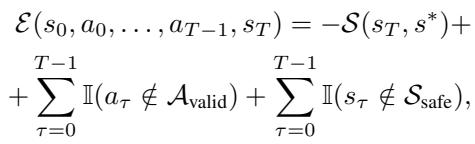
This equation has three parts:
- Similarity: How close is the predicted future frame \(s_T\) to the goal frame \(s^*\)?
- Action Validity: Are the proposed actions feasible?
- Safety: Does the predicted future state involve falling off a cliff or hitting a wall?
The planning process reduces to finding the sequence of actions that minimizes this energy:

The system samples many random action sequences, simulates them using the NWM, scores them using the equation above, and picks the best one.
Experiments and Results
The NWM was trained on a massive collection of robotic datasets (SCAND, TartanDrive, RECON, HuRoN) and unlabeled video data from Ego4D. The experiments tested the model’s ability to synthesize video, plan paths, and generalize to new environments.
1. Video Prediction Quality
First, does the model actually understand the world? The researchers compared NWM against a baseline called DIAMOND (a UNet-based diffusion world model).
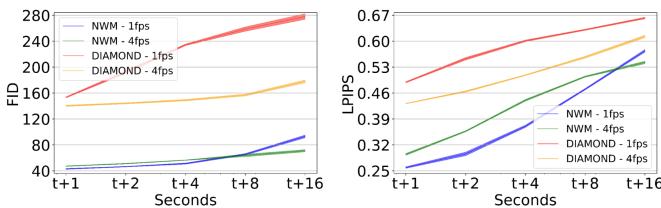
Figure 4 shows that NWM produces more realistic video (lower FID) and accurate predictions over longer time horizons (up to 16 seconds).

As seen in the table above, the Fréchet Video Distance (FVD)—a metric for video quality—is significantly lower for NWM, indicating much sharper and more temporally consistent video generation.
2. Efficiency: CDiT vs. DiT
Is the novel architecture actually better?
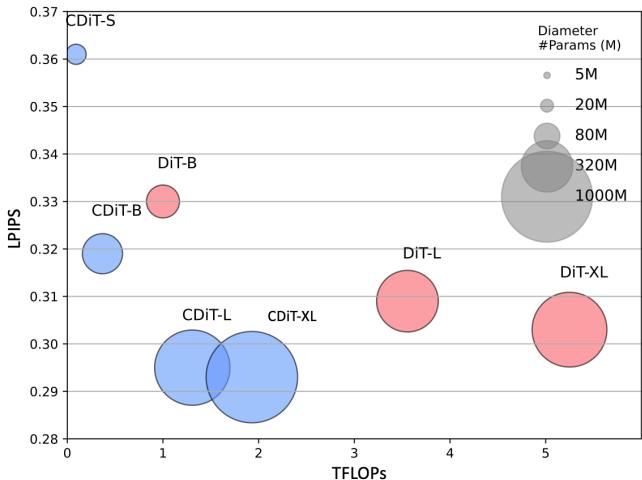
The chart in Figure 5 confirms the architectural hypothesis. The CDiT models (blue bubbles) cluster in the bottom-left, meaning they achieve low error (low LPIPS) with very low computational cost. The standard DiT models (red bubbles) require massive amounts of compute to achieve similar performance.
3. Navigation Planning Performance
The ultimate test is whether a robot can use this “dreaming” capability to navigate.
Ranking Trajectories: One powerful use case is using NWM to double-check another policy. Imagine a standard navigation policy suggests 16 different paths. The NWM can simulate the video for all 16 paths and rank them based on which one actually reaches the visual goal.
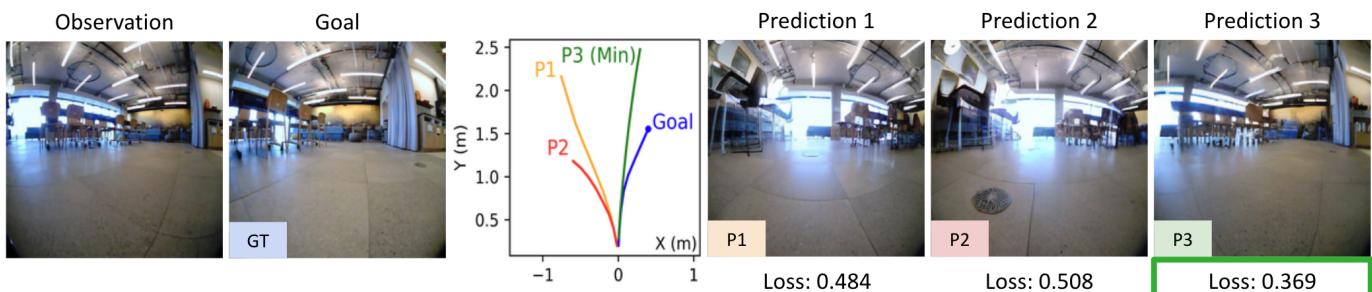
Quantitative Results:
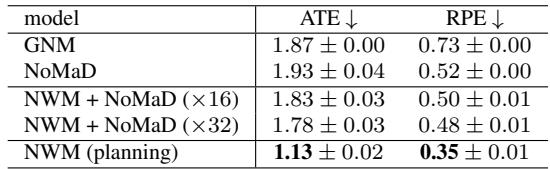
Table 2 shows that NWM achieves the lowest Absolute Trajectory Error (ATE) compared to state-of-the-art policies like NoMaD and GNM. This proves that “imagining” the path leads to more accurate navigation than simply reacting to the current view.
4. Planning with Constraints
One of the biggest advantages of a world model over a hard-coded policy is controllability. If you tell a standard policy “reach the goal,” it takes the optimal path. But what if you say “reach the goal, but go straight for 3 meters first”? A standard policy breaks.
With NWM, you simply filter out any imagined trajectories that don’t meet the constraint.
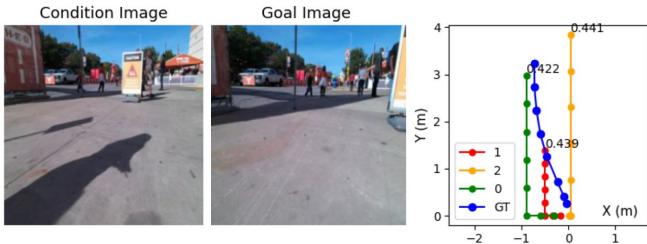
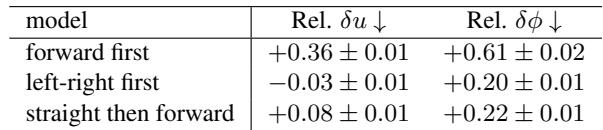
Table 3 demonstrates that NWM can handle complex instructions like “forward first” or “left-right first” while still successfully reaching the destination.
5. Generalizing to Unknown Environments
Finally, can the model hallucinate paths in environments it has never seen, using only a single image?

Figure 8 shows the model generating plausible video sequences for unseen outdoor environments. Crucially, the researchers found that adding unlabeled video data (like Ego4D footage, which has no robot action labels) significantly improved this capability.
By watching thousands of hours of human video (Ego4D), the model learned general visual priors about how the world moves, which helped it generalize to new robotic contexts.
Conclusion and Implications
The Navigation World Model represents a shift in how we think about robot autonomy. Instead of hard-coding behavior or relying solely on trial-and-error reinforcement learning, NWM gives robots a visual cortex capable of imagination.
Key Takeaways:
- Linear Complexity: The Conditional Diffusion Transformer (CDiT) makes it computationally feasible to condition high-quality video generation on long context histories.
- Flexibility: Unlike supervised policies, NWM allows for plug-and-play constraints and “test-time” planning.
- Data Scalability: The model benefits from diverse data, including unlabeled videos of humans, to build a robust understanding of physics and geometry.
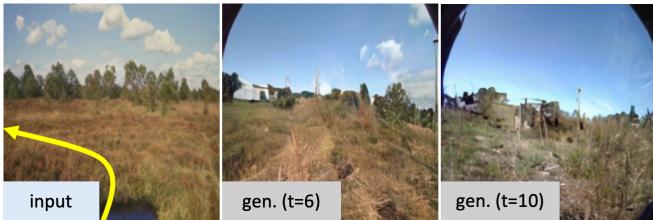
Limitations: The system isn’t perfect. As shown in Figure 10 below, “mode collapse” can occur in very unfamiliar environments, where the model slowly forgets the current context and starts generating generic scenery that looks like its training data.
Despite these limitations, NWM paves the way for “General Purpose Robots”—machines that don’t just follow instructions, but simulate the outcome of their actions to make safer, smarter decisions in the real world. Just as humans mentally rehearse a difficult task before performing it, the robots of the future will likely spend a lot of time dreaming.