](https://deep-paper.org/en/paper/2412.04244/images/cover.png)
Introduction
The human hand is an evolutionary masterpiece. Whether you are threading a needle, typing a blog post, or kneading dough, your hands perform a complex symphony of movements. For Artificial Intelligence and robotics, however, replicating this dexterity is one of the “grand challenges” of the field.
We have seen Large Language Models (LLMs) revolutionize text by training on trillions of words. We have seen vision models master image recognition by looking at billions of pictures. But when it comes to bimanual (two-handed) object interaction, we hit a wall. The data just isn’t there.
Existing datasets are either captured “in the wild” (where data is messy and 3D reconstruction is inaccurate) or in small studios (where actions are staged and limited). To build models that truly understand and replicate human hand activity, we need a dataset that combines the precision of studio capture with the scale and diversity of the real world.
Enter GigaHands.
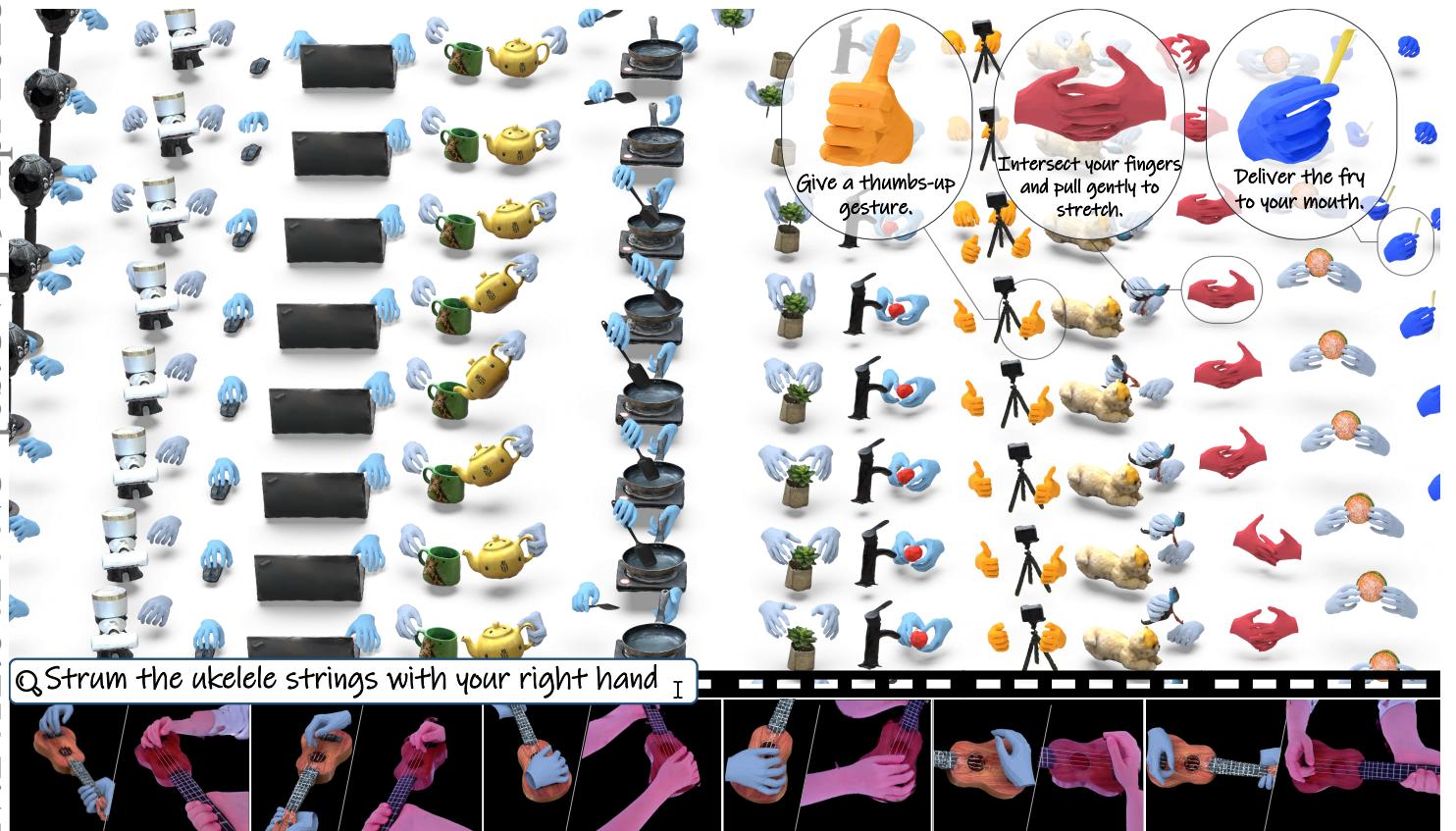
In this post, we will deep-dive into a new research paper that introduces a massive, diverse, and fully annotated dataset of bimanual hand activities. We will explore how the researchers captured 183 million frames of data, the novel “Instruct-to-Annotate” pipeline they developed, and how this data powers the next generation of AI in motion synthesis and 3D reconstruction.
The Data Bottleneck
Before understanding the solution, we must understand the problem. Why is it so hard to get good data on hands?
- Occlusion: When you hold a cup, your hand blocks the camera’s view of the cup, and the cup blocks the view of your palm. When two hands interact, they occlude each other.
- Lack of Texture: Hands are relatively uniform in color, making it hard for computer vision algorithms to track rotation and depth without markers.
- Complex Articulation: The hand has many joints and degrees of freedom.
Researchers usually choose between two evils:
- In-the-wild video: Footage from YouTube or wearable cameras. It’s natural and diverse, but extracting accurate 3D position data is a nightmare due to noise and lack of calibration.
- Studio Motion Capture (MoCap): Accurate, but requires sticking markers on skin (which changes how people move) and is usually limited to a few distinct actions.
How GigaHands Compares
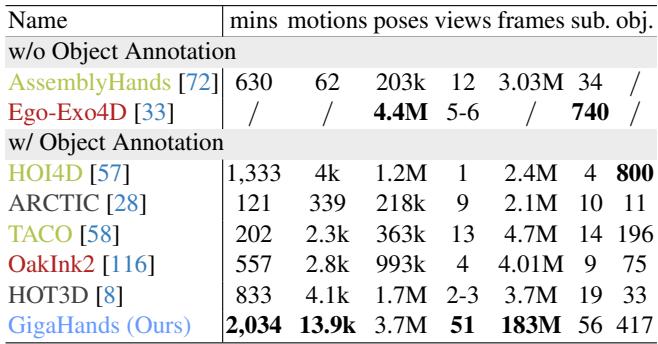
The GigaHands researchers took the studio approach but scaled it up massively to solve the diversity issue. They built a custom markerless capture system with 51 cameras surrounding a transparent tabletop.
As shown in the comparison table below, GigaHands dwarfs existing datasets in almost every metric—total duration (minutes), number of clips, number of distinct camera views, and the sheer volume of frames.
Notable distinctions include:
- 183 Million Frames: This is orders of magnitude larger than typical datasets.
- Bimanual Focus: It specifically targets the complex interaction between two hands.
- Text Annotations: Unlike datasets that just label a class (e.g., “drinking”), GigaHands includes 84k detailed textual descriptions, enabling vision-language tasks.
Diversity: The Key to Generalization
Size isn’t everything; diversity matters. If a dataset only contains 100 hours of someone pouring tea, an AI trained on it will fail to understand how to peel a banana.
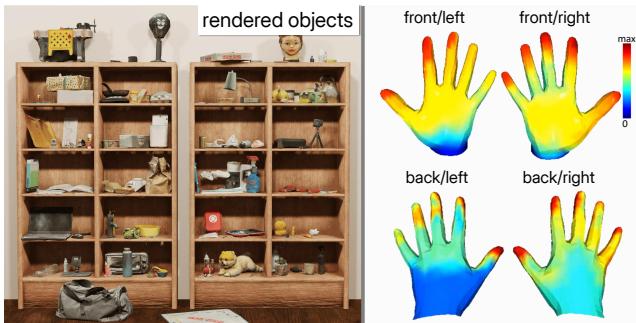
GigaHands captures 56 subjects interacting with 417 objects. The researchers ensured the actions weren’t just simple pick-and-place tasks. They included complex interactions, gestures, and self-contact (hands touching each other).
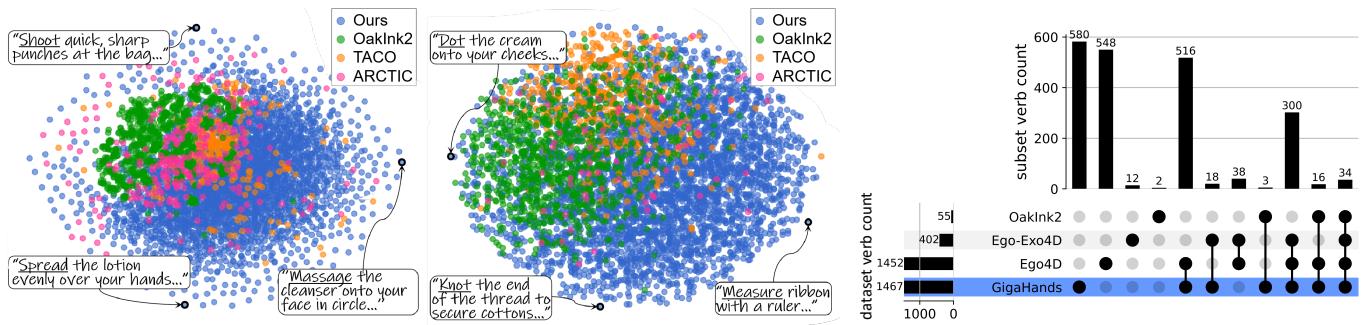
The t-SNE plot below visualizes this diversity. t-SNE is a technique that reduces complex data into 2D points; points that are far apart represent very different types of data. The blue region (GigaHands) covers a much broader area than previous datasets like ARCTIC or TACO, indicating a wider variety of hand poses and motions.
Furthermore, the dataset includes a wide variety of objects—from rigid items like mugs and drills to deformable objects like cloth. This diversity leads to diverse contact maps. A contact map shows which parts of the hand touch objects. In many datasets, interaction is limited to fingertips. In GigaHands, we see contact across the entire hand surface, including the back of the hand (e.g., during specific gestures or martial arts moves).
The Core Method: “Instruct-to-Annotate”
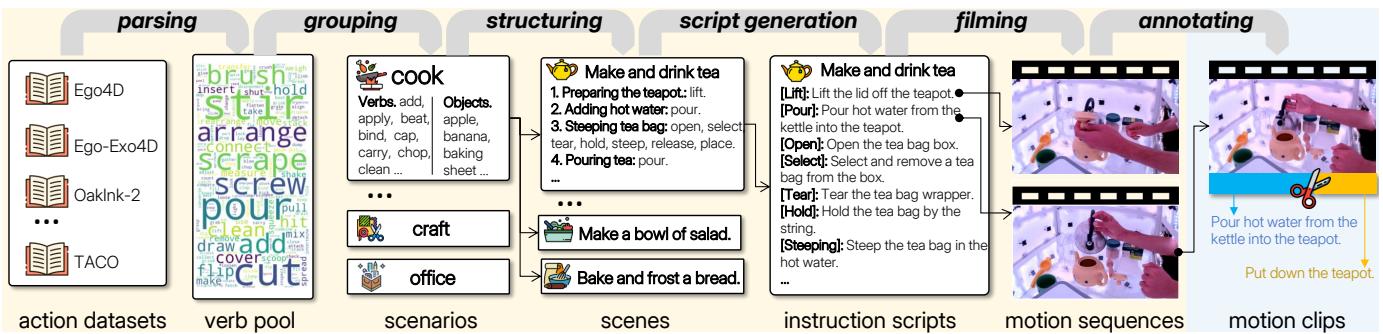
Collecting 14,000 motion clips is a logistical nightmare. If you simply ask people to “do random stuff,” you get repetitive data. If you script everything manually, it takes forever. The researchers introduced a procedural pipeline called Instruct-to-Annotate to solve this.
This pipeline is a clever loop involving Large Language Models (LLMs) and human annotators:
- Procedural Instruction Generation: They used an LLM to generate scenarios (e.g., “Cooking,” “Office Work”). The LLM broke these down into scenes and specific atomic actions (verbs) involving available objects.
- Filming: Actors in the capture rig listened to these audio instructions and performed the actions.
- Annotation & Refinement: Because actors sometimes deviate from instructions (or the LLM hallucinates a weird instruction), human annotators reviewed the footage. They adjusted the text descriptions to match what actually happened.
- Augmentation: Finally, the LLM rephrased the descriptions to provide linguistic diversity (e.g., “Grab the cup” vs. “Pick up the mug”).
Automated 3D Tracking Pipelines
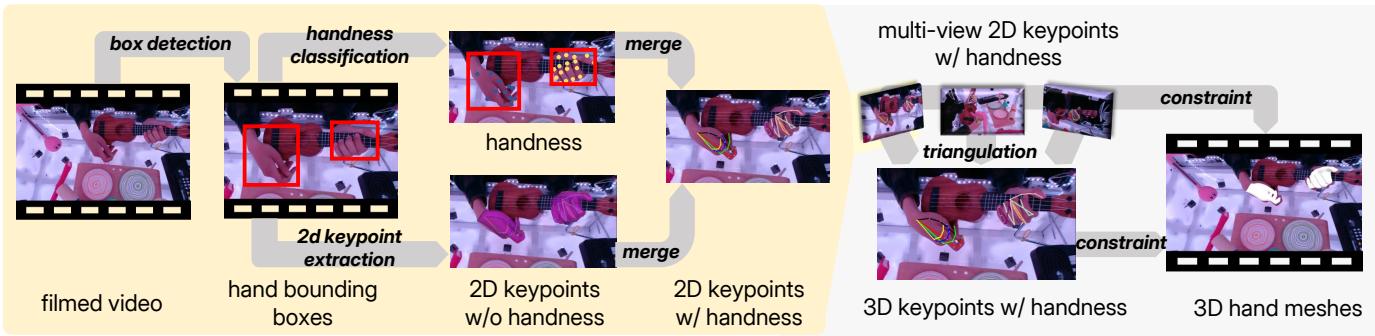
Capturing video is one thing; turning it into 3D mathematical representations (meshes) is another. The researchers couldn’t manually annotate 3D poses for 183 million frames. They built two automated tracking pipelines: one for hands and one for objects.
1. Hand Motion Tracking
The team developed a hybrid method because existing single-shot estimators weren’t accurate enough for their high standards.
- Detection: They use YOLOv8 to find hands in the images.
- 2D Keypoints: They use ViTPose and HaMeR to estimate where the joints are in the 2D image. HaMeR is particularly good at recovering the shape of the hand.
- Triangulation: Since they have 51 cameras, they can triangulate these 2D points into a precise 3D position.
- Fitting: Finally, they fit the MANO model (a standard parametric model of the human hand) to these 3D points to get a smooth, realistic mesh.
2. Object Motion Tracking
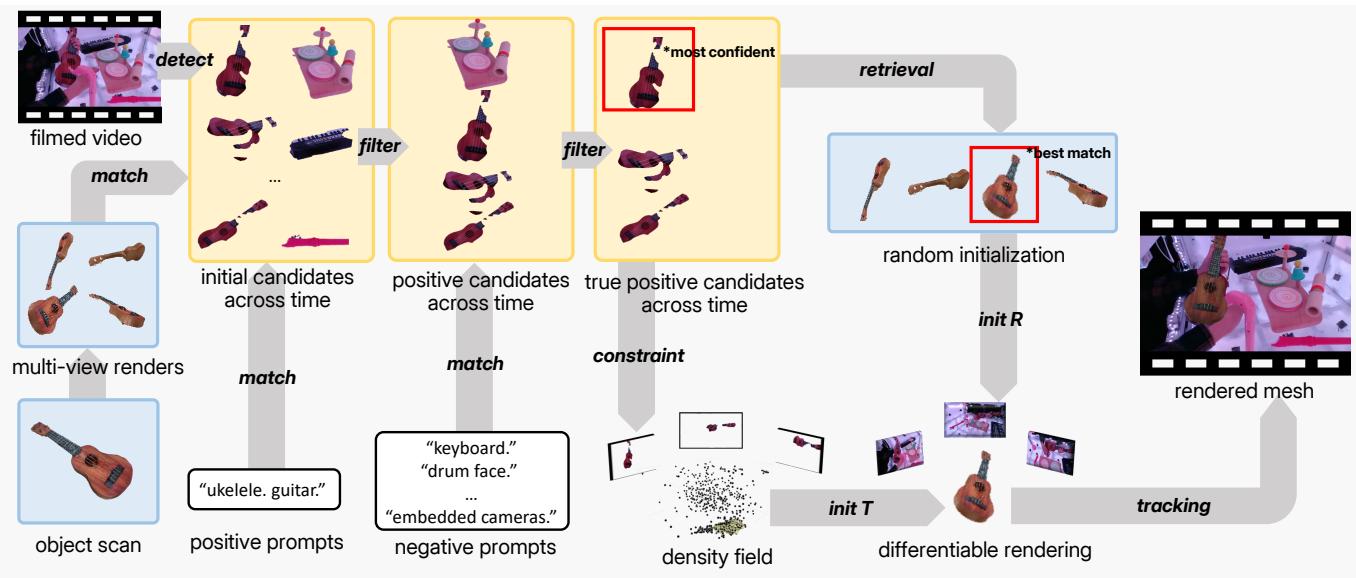
Tracking objects is notoriously difficult because hands constantly cover them up. The researchers used a method that combines modern segmentation AI with classic 3D optimization.
- Segmentation: They used DINOv2 (a vision transformer) to find objects and SAM2 (Segment Anything Model 2) to cut them out from the background accurately.
- Initialization: They estimated the rough position of the object using a density field (similar to a low-res 3D scan).
- Refinement: They used differentiable rendering. This is a technique where the computer renders the 3D object, compares it to the actual video frame, calculates the error, and adjusts the object’s position to minimize that error. This results in highly accurate 6-DoF (6 Degrees of Freedom) pose estimation.
Experiments & Applications
The sheer scale of GigaHands unlocks capabilities that weren’t possible before. The researchers demonstrated this across three main applications.
1. Text-Driven Motion Synthesis
Can an AI imagine how hands should move based on a text prompt?
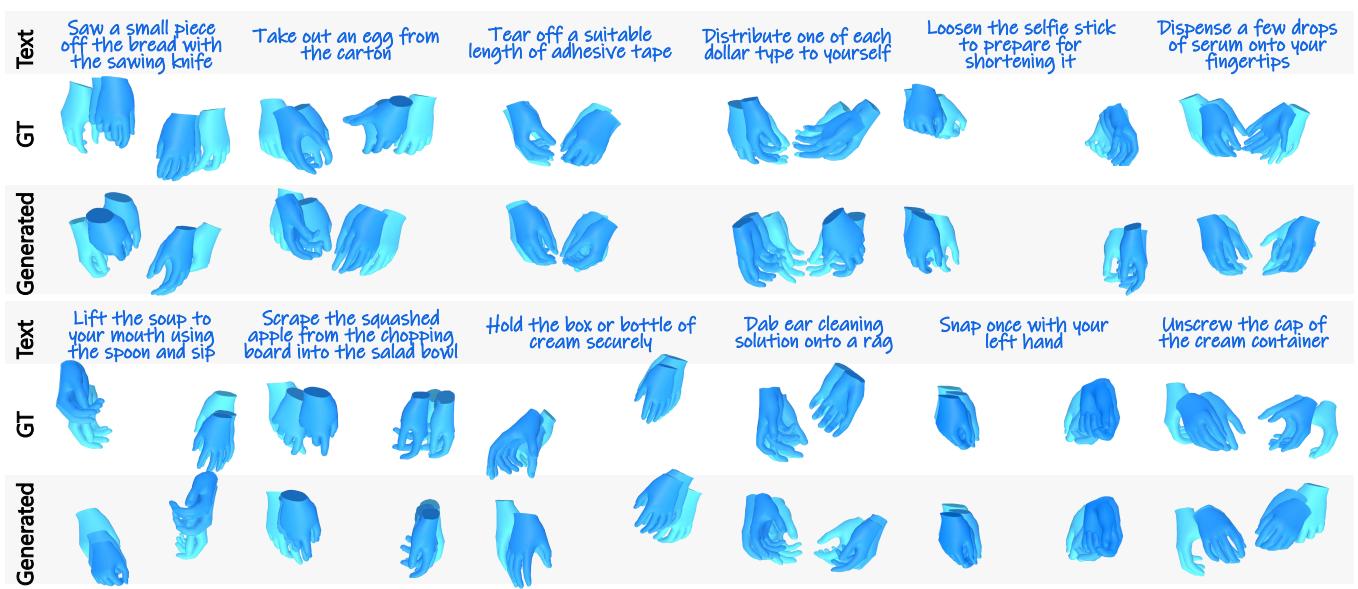
The researchers trained a T2M-GPT (Text-to-Motion Generative Pre-trained Transformer) model using GigaHands. The goal: input a sentence like “Zip up the pants,” and output a 3D animation of hands performing that action.
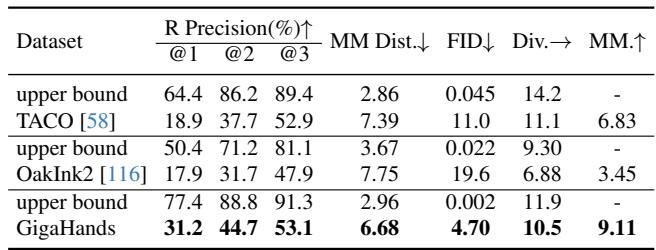
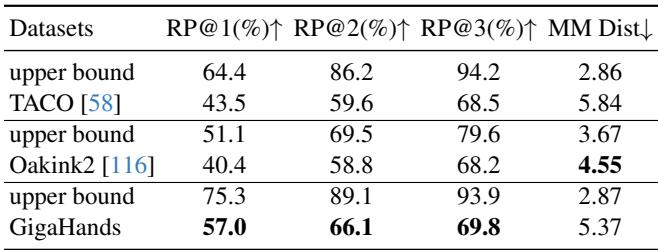
The Results: As shown in Table 2, the model trained on GigaHands achieved the best performance across almost all metrics compared to models trained on smaller datasets like TACO or OakInk2.
- FID (Fréchet Inception Distance): Lower is better. It measures how realistic the motion looks. GigaHands achieved a score of 4.70, significantly better than TACO (11.0).
- Diversity: GigaHands models produced more varied motions, avoiding the “mode collapse” problem where AI generates the exact same movement every time.
Visually, the difference is striking. In the figure below, the blue hands (GigaHands model) perform complex actions like “Unscrew the cap” or “Pour the cream” with realistic finger articulation. Models trained on other datasets often struggle with the subtle interactions between fingers and objects.
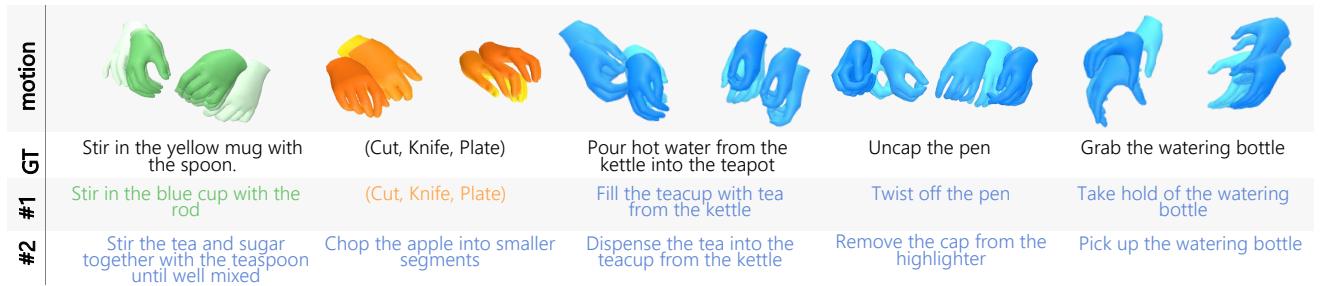
(Note: The image above visualizes captioning, but serves to illustrate the complexity of motions handled by the dataset. Below, we see the specific synthesis quality.)
2. Hand Motion Captioning
This is the reverse task: The AI watches a 3D hand motion and tries to describe it in text. This is crucial for robotic understanding—a robot needs to know what a human is doing to assist them.
The model trained on GigaHands showed superior ability to generate diverse and accurate descriptions. Interestingly, even though the model only sees hand motion (not the object itself), it can often infer the object based on the grip type (e.g., inferring a “pen” from a writing grip).
3. Dynamic Radiance Field Reconstruction (Novel View Synthesis)
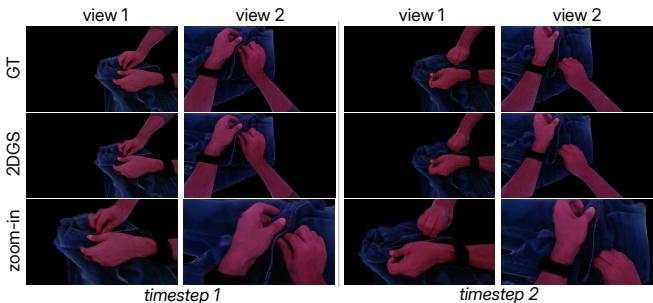
Because GigaHands captures scenes from 51 angles, it is perfect for training NeRFs (Neural Radiance Fields) or 3D Gaussian Splatting. These technologies allow you to view a recorded scene from any angle, effectively creating a “holographic” video.
The researchers used 2D Gaussian Splatting (2DGS) to reconstruct dynamic scenes. In the example below, look at the “zip up the pants” action. The synthesized views preserve the fine details of the fabric and the hand interaction, even though the fabric is a deformable object that is incredibly hard to track with traditional mesh fitting.
The Power of Scale
One of the most important findings of the paper is the confirmation of “scaling laws” for hand data. In AI, we often ask: “Will adding more data actually help?”
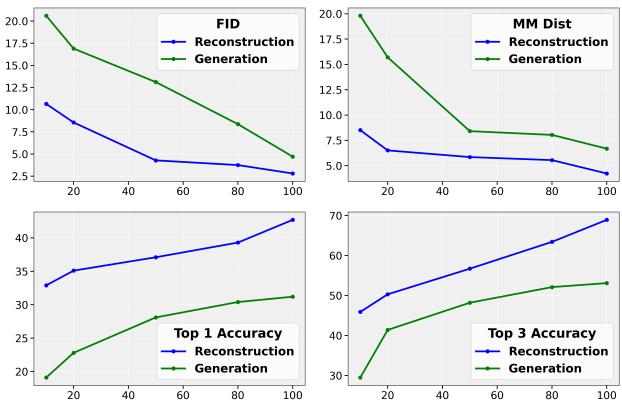
The researchers trained their models on 10%, 20%, 50%, and 100% of the data. The graphs below show a clear trend: as the dataset size grows (X-axis), the error rates (FID, MM Dist) drop and accuracy increases. This suggests that GigaHands isn’t just big for the sake of being big—the size is directly contributing to smarter AI.
Conclusion
GigaHands represents a significant leap forward in 3D computer vision. By combining a massive capture volume (183M frames) with a smart, procedural annotation pipeline, the researchers have created a dataset that is both vast and precise.
For students and researchers in the field, this dataset opens new doors. It allows for the training of “foundation models” for hands—models that understand general hand behavior rather than just specific, memorized tasks. Whether for generating realistic avatars in VR, teaching robots to manipulate household objects, or captioning human behavior, GigaHands provides the fuel needed to power the next generation of algorithms.
The limitations? It’s still a studio dataset. The challenge for the future will be combining the precision of GigaHands with the chaos of the real world. But for now, we have a new gold standard for bimanual activity understanding.