](https://deep-paper.org/en/paper/2412.04462/images/cover.png)
Imagine you are watching a video of a cat playing with a toy. In a standard video, you are a passive observer, locked into the camera angle the videographer chose. Now, imagine you could pause that video at any second, grab the screen, and rotate the camera around the frozen cat to see the toy from the back. Then, you press play, and the video continues from that new angle.
This concept—a dynamic scene that can be viewed from arbitrary viewpoints over time—is the “Holy Grail” of 4D Video Generation.
While 3D generation (creating a static object you can rotate) and Video generation (creating a moving 2D clip) have seen massive leaps recently, combining them into 4D has remained notoriously difficult. Existing methods often require hours of computation per video or produce results where the object “hallucinates” (changes shape or identity) as the camera moves.
In this post, we are diving deep into 4Real-Video, a new research paper that proposes a solution to this problem. The researchers introduce a novel architecture that can generate consistent, photorealistic 4D videos in about one minute. We will unpack how they treat video as a “grid,” their clever use of parallel diffusion streams, and the synchronization mechanism that keeps everything glued together.
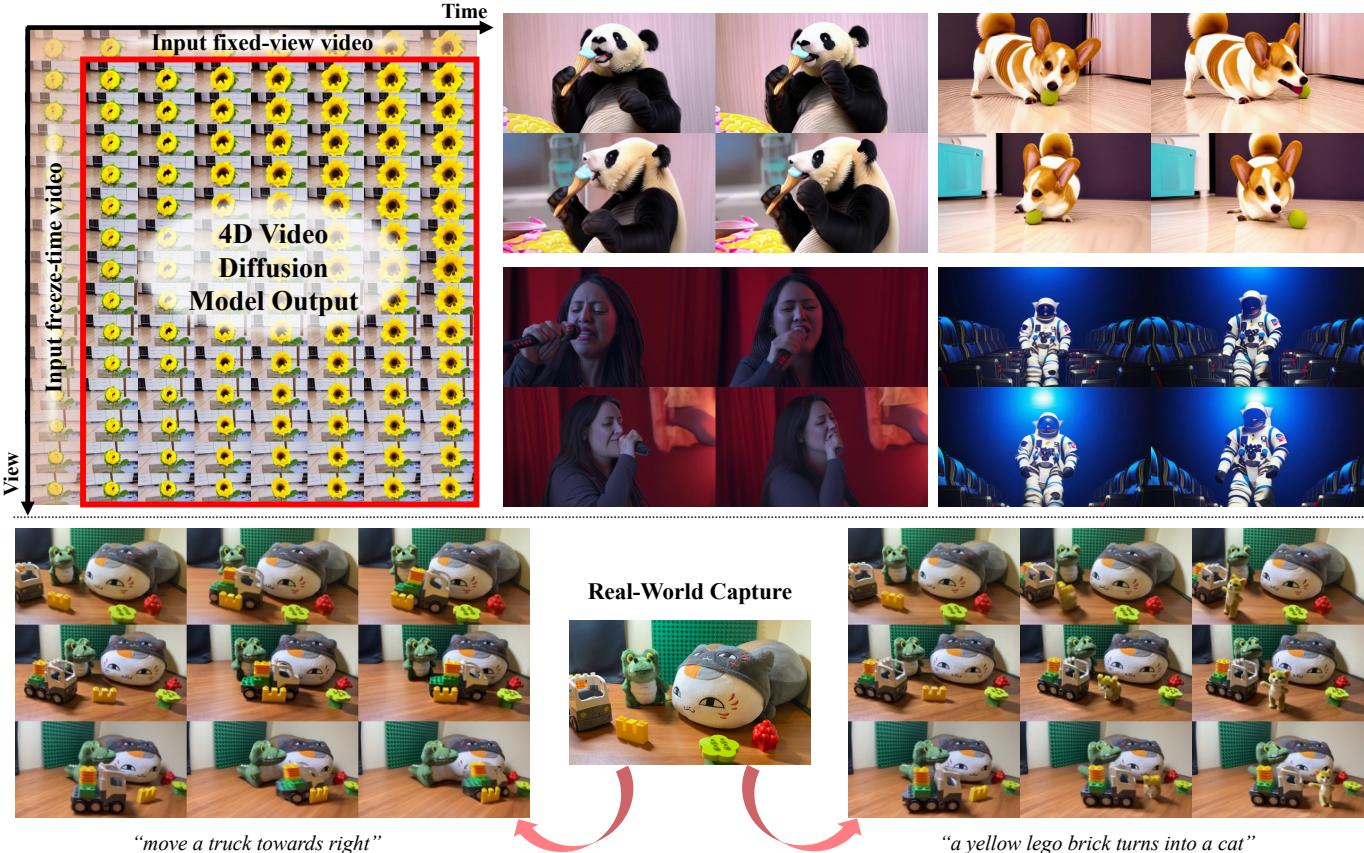
The Problem: What is a 4D Video?
To understand the solution, we first need to rigorously define the problem. The authors define a 4D Video not just as a 3D object moving, but as a structured grid of frames.
Imagine a grid where:
- The X-axis (Columns) represents Time.
- The Y-axis (Rows) represents Viewpoint.
If you look across a single row, you see a Fixed-View Video: the camera is locked in place, and time moves forward. If you look down a single column, you see a Freeze-Time Video: time is stopped, and the camera moves around the frozen scene.
Most previous approaches, often called “camera-aware video generation,” try to generate a single video path through this space. While useful, they struggle to create a full, consistent world. Other methods use optimization techniques (like Score Distillation Sampling) which act like 3D scanners, slowly carving out the 4D scene. These are computationally heavy and often result in “cartoonish” or blurry outputs.
The goal of 4Real-Video is to take a sparse input—specifically, just the first row (one standard video) and the first column (one static multi-view rotation)—and fill in the rest of the grid.
The Core Method: A Two-Stream Architecture
The heart of 4Real-Video is a feedforward diffusion model. If you are familiar with models like Sora or Stable Video Diffusion, you know they typically use a DiT (Diffusion Transformer) architecture. A standard DiT processes tokens (chunks of the video) to denoise them and generate an image sequence.
To generate a 4D grid, we have two competing needs:
- Temporal Consistency: Frame \(t\) must look like it follows Frame \(t-1\).
- Multi-View Consistency: View \(v\) must look like the same object as View \(v-1\).
If you simply train a model to do both at once, or alternate between them sequentially, the model often gets confused. It might prioritize smooth motion but forget what the back of the object looks like, or vice versa.
The researchers propose a Two-Stream Architecture. Instead of one set of tokens trying to do everything, they split the tokens into two parallel streams that run simultaneously through the network.
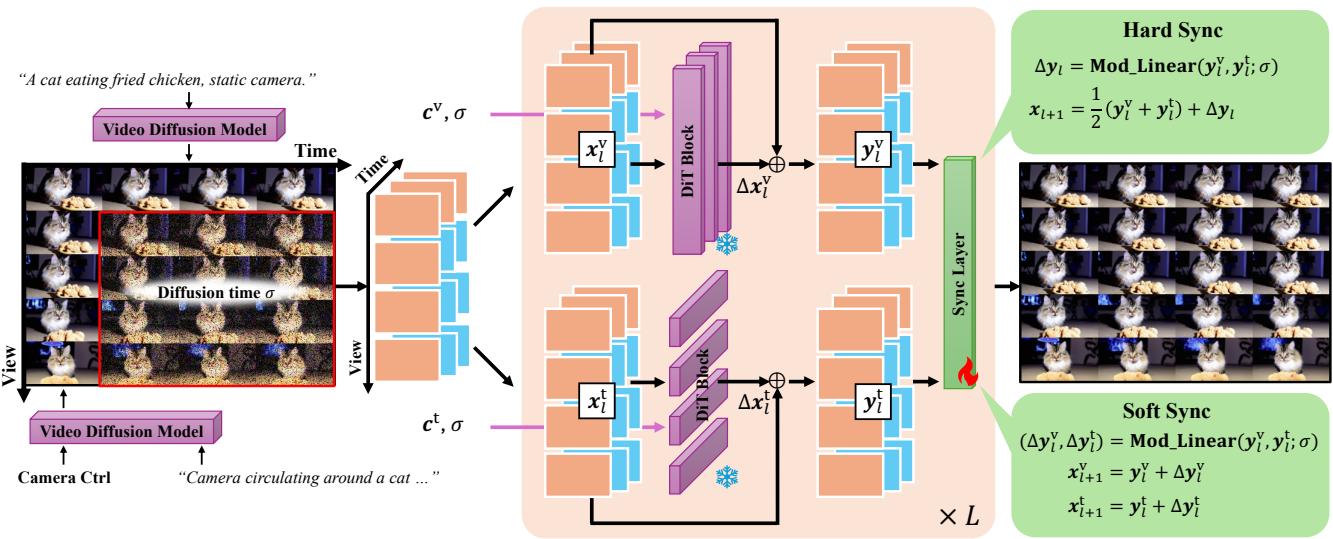
As shown in the architecture diagram above, the process works as follows:
- Stream 1 (View Stream - Top): This stream processes tokens \(\mathbf{x}^v\). It focuses purely on the columns of our grid. It uses a transformer block designed to understand how viewpoints change (\(\varphi^v\)).
- Stream 2 (Time Stream - Bottom): This stream processes tokens \(\mathbf{x}^t\). It focuses purely on the rows. It uses a transformer block designed to understand how time evolves (\(\varphi^t\)).
Mathematical representations of these updates look like this:

Here, \(\mathbf{y}_l\) represents the intermediate output after the \(l\)-th layer of the transformer.
The Challenge of Parallelism
If we just ran these two streams separately, we would end up with two completely different videos. The “View Stream” would generate a perfect static rotation, and the “Time Stream” would generate a perfect 2D video, but they wouldn’t match. The cat in the rotation might be black, while the cat in the video is white.
We need a way to force these two streams to agree on the reality they are generating. This is where the paper’s main contribution comes in: the Synchronization Layer.
The Secret Sauce: Synchronization Layers
After every transformer block, the model pauses and exchanges information between the View Stream and the Time Stream. This ensures that the 3D structure and the temporal motion remain consistent.
The authors propose two ways to achieve this synchronization: Hard Sync and Soft Sync.
1. Hard Synchronization
Hard synchronization is the brute-force approach. It assumes that ideally, the tokens for the view stream and the time stream should be identical (\(\mathbf{x}^v = \mathbf{x}^t\)).
Inspired by projection methods in optimization, this layer takes the output from both streams and forces them together, usually by averaging them (often with learned weights).

In this equation, \(\mathbf{W}\) represents learned weights that combine the streams. While this conceptually makes sense—merging the “best of both worlds”—it has practical downsides. The distribution of data in a “freeze-time” video is different from a “fixed-view” video. Smashing them together can confuse the pre-trained video model, leading to artifacts like objects stretching or “ghosting.”
2. Soft Synchronization (The Winner)
The authors found that a gentler approach works better. Instead of forcing the tokens to be identical at every step, Soft Synchronization treats the streams as separate but linked entities. It uses a “modulated linear layer” to predict an update (or correction) term.

Here, the function Mod_Linear looks at both streams and decides how much they need to adjust to align with each other. It calculates a delta (\(\Delta\)) for each stream. These deltas are then added to the original streams:

This allows the model to maintain the distinct statistical properties of “time” and “view” while still sharing information. The view stream learns about the motion, and the time stream learns about the 3D geometry, but they aren’t forced into a single, potentially corrupted representation.
Dynamics of Soft Sync
An interesting analysis in the paper visualizes how this Soft Sync behaves across the layers of the neural network.
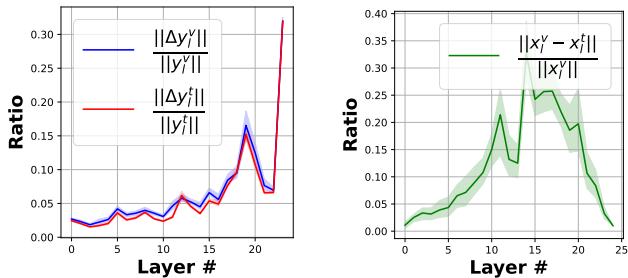
Looking at the graphs above:
- Left (a): The “Update Magnitude” (how much the sync layer changes the tokens) stays relatively low for the first 15 layers and then spikes in the later layers. This suggests the model first establishes the independent structure of motion and geometry, and then heavily synchronizes them towards the end of the generation process to ensure they match.
- Right (b): The “Similarity” graph shows that the tokens in the two streams are actually quite different in the middle layers (high ratio), but as the sync layers do their work, the difference drops to near zero by the final layer.
Experiments and Results
The researchers trained 4Real-Video using a clever mix of data. Since real 4D data is scarce, they used:
- Pseudo-4D Data: Applying 2D affine transformations (scaling, rotating) to standard videos to mimic camera movement.
- Objaverse: A dataset of synthetic 3D objects, animated to create ground-truth 4D clips.
Visual Quality
The results are visually impressive when compared to existing baselines like MotionCtrl (a camera-control method) and SV4D (a prior 4D method).
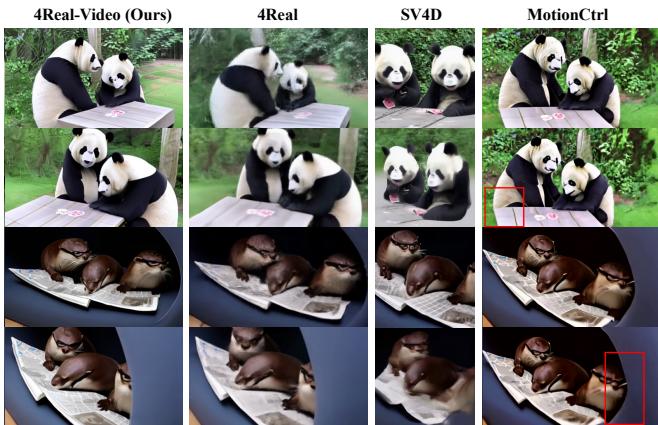
In Figure 4 above, look at the bottom row (the otter).
- MotionCtrl struggles with the complex texture and lighting, producing inconsistent frames (highlighted in red boxes).
- SV4D (middle columns) tends to blur the object significantly.
- 4Real-Video (left) maintains sharp fur textures and consistent lighting across different viewpoints.
Ablation: Why Soft Sync Matters
The authors performed an “ablation study”—stripping away parts of the model to see what breaks. They compared a Sequential architecture (alternating Time/View blocks), a Hard Sync parallel architecture, and their Soft Sync approach.
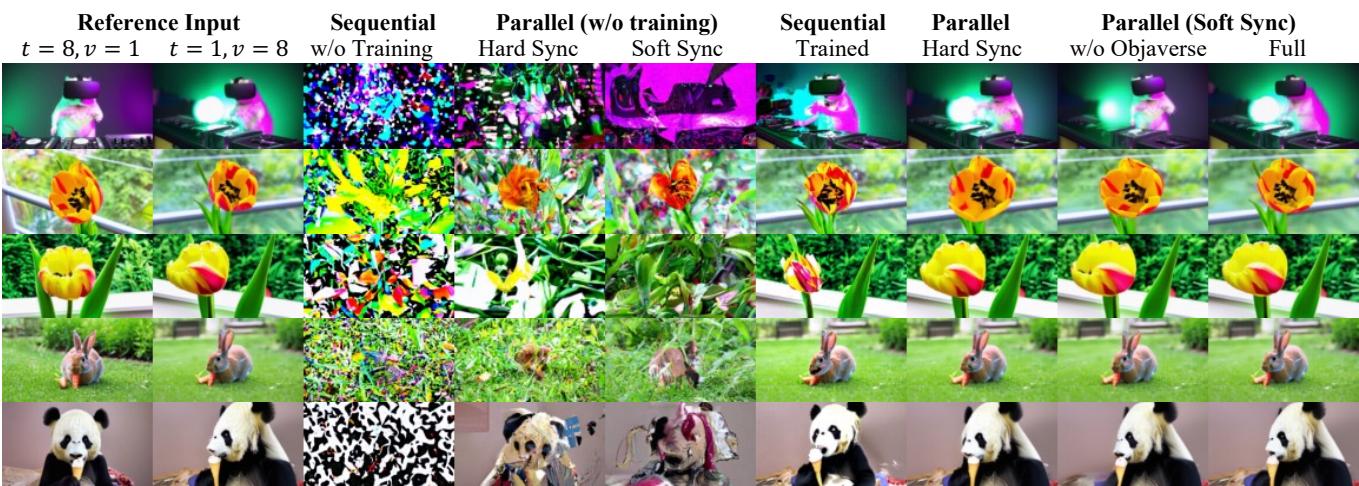
In the figure above:
- Sequential w/o Training: Produces complete noise or broken images.
- Hard Sync: Generates a recognizable image but notice the distortion—the object often looks stretched or doubled.
- Soft Sync: Produces the cleanest, most coherent panda.
The quantitative data backs this up. In the table below, notice how Soft Sync achieves better scores in VideoScore (visual quality) and Dust3R-Confidence (geometric consistency).
| Method | VideoScore (Quality) | Dust3R-Conf (Consistency) |
|---|---|---|
| Sequential | 2.28 | 24.6 |
| Hard Sync | 2.42 | 31.5 |
| Soft Sync | 2.43 | 33.4 |
(Selected data from the paper’s tables)
3D Reconstruction
A true test of a 4D video is whether you can reconstruct the 3D geometry from it. The researchers applied Deformable 3D Gaussian Splatting to their generated output.
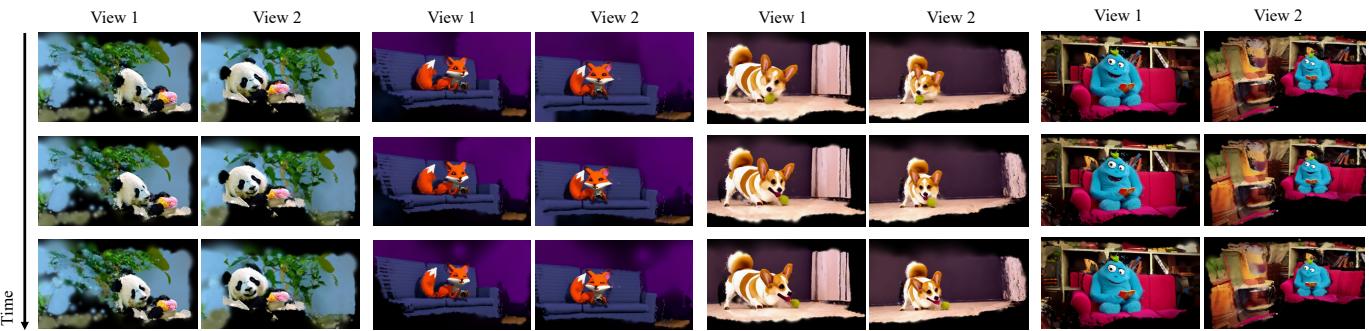
The ability to reconstruct plausible 3D shapes (as seen in Figure 6) proves that the model isn’t just hallucinating pixels that look good from one angle; it’s generating a geometrically consistent world.
User Study
Finally, because automated metrics don’t always capture human perception, they asked real people to rate the videos.
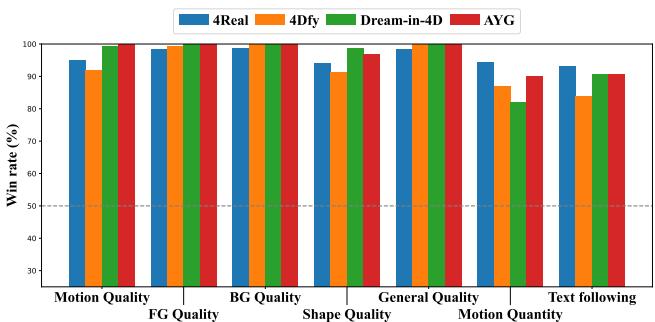
The results were a landslide. On criteria ranging from “Motion Realism” to “Shape Quality,” 4Real-Video (the blue bars) consistently outperformed optimization-based methods like 4Real and 4Dfy.
Conclusion
4Real-Video represents a significant step forward in generative media. By framing 4D generation as a grid completion problem and solving it with a synchronized two-stream architecture, the authors have bypassed the slow, computationally expensive optimization loops of the past.
Key Takeaways:
- Decomposition: Splitting the problem into “Time” (rows) and “View” (columns) makes the complex 4D task manageable.
- Parallelism: Processing both dimensions simultaneously preserves the integrity of both motion and geometry.
- Soft Synchronization: Allowing streams to loosely exchange information is more effective than forcing them to be identical, preventing distribution shifts and artifacts.
While the model still relies on the quality of the base video generator and doesn’t yet support full 360-degree environments, it opens the door to rapid creation of dynamic 3D assets. Future iterations could power everything from VR experiences to instant movie-quality special effects, all generated in seconds on a standard GPU.