](https://deep-paper.org/en/paper/2412.04616/images/cover.png)
For the last few years, the recipe for building a Vision-Language Model (VLM) has been relatively static. If you wanted a model that understood how images and text relate—like OpenAI’s CLIP—you needed to collect a massive dataset of hundreds of millions of image-text pairs and train two neural networks (one for vision, one for text) from scratch.
This process is computationally expensive, data-hungry, and often results in models that are “jacks of all trades, masters of none.” The vision encoder might be decent, and the text encoder might be passable, but neither is state-of-the-art compared to models dedicated to a single modality.
But what if we flipped the script? We already have incredible vision models (like DINOv2) and incredible language models (like modern LLMs). What if, instead of training from scratch, we just introduced them to each other?
In the paper “Assessing and Learning Alignment of Unimodal Vision and Language Models,” researchers from Mila and Université de Montréal propose exactly this. They introduce a method to measure how well these pre-trained models align naturally, and they present a framework called SAIL (Swift Alignment of Image and Language). The result? A model that outperforms CLIP while using only ~6% of the data and training on a single GPU in just 5 hours.
The Core Problem: Do We Really Need to Train from Scratch?
The dominant paradigm in vision-language learning is Contrastive Learning. Models like CLIP are trained to pull representations of an image and its corresponding text caption closer together in a shared vector space, while pushing mismatched pairs apart.
However, training these models from scratch ignores the fact that we already have powerful “unimodal” models:
- Vision: Self-Supervised Learning (SSL) models like DINOv2 understand object geometry and fine-grained details better than CLIP’s vision encoder.
- Language: Models like BERT or modern LLMs have a much deeper grasp of syntax and complex reasoning than CLIP’s text encoder.
The researchers posed a fundamental question: “To what extent are these unimodal models already aligned?” If they effectively represent the same underlying reality, maybe we don’t need to retrain them. Maybe we just need a lightweight translator to align their outputs.
Part I: The Investigation (Alignment Probing)
To answer this, the authors introduced a new evaluation method called Alignment Probing.
In standard Self-Supervised Learning (SSL), researchers use “Linear Probing” to test a model. They freeze the model and train a single linear layer on top of it to see if it can classify images. The authors adapted this idea for multimodal alignment.
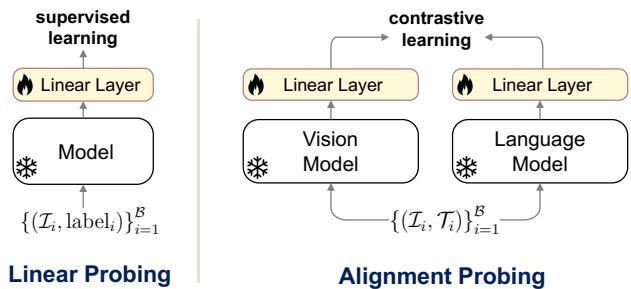
As shown in Figure 1, Alignment Probing works by freezing both the pre-trained Vision Model and the Language Model. The researchers then train only a lightweight linear alignment layer to map their representations into a shared space. If the models align well, this simple linear layer should be enough to achieve high performance on retrieval tasks (finding the right image for a text query).
Key Finding 1: Clustering Quality Matters More Than Linear Separability
For years, the gold standard for evaluating vision models has been Linear Separability (how easily a linear classifier can separate classes). However, the researchers found something surprising when they tested various SSL models (like MAE, DINO, iBOT, and DINOv2).
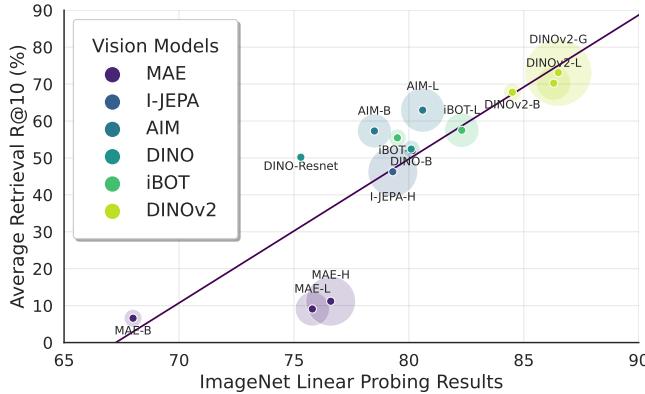
As Figure 8 illustrates, linear separability (x-axis) doesn’t perfectly predict how well a vision model will align with language (y-axis). The Masked Autoencoder (MAE) model, for example, is an outlier—it has decent classification scores but terrible alignment performance.
Instead, the authors found that Clustering Quality (measured by k-NN performance) is a much better predictor of alignment success.
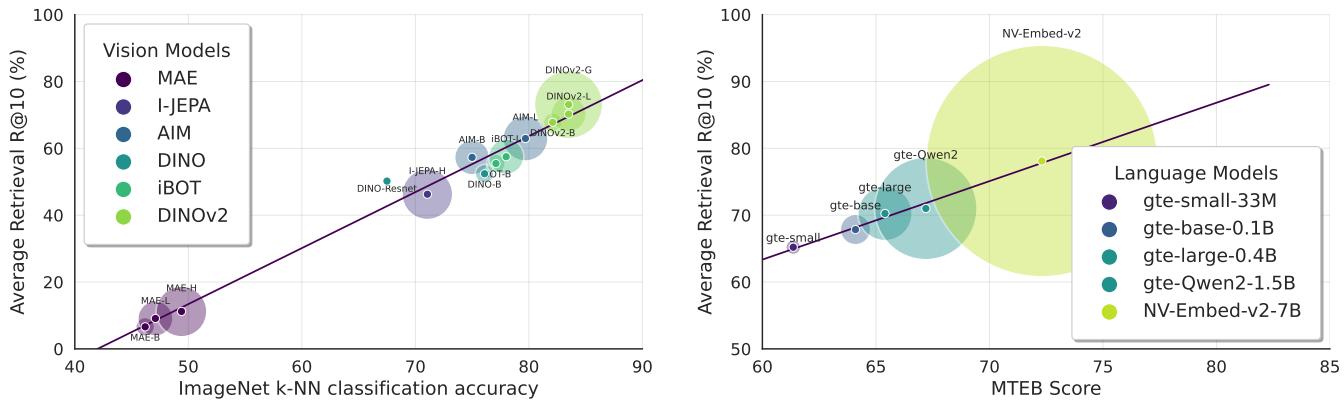
On the left side of Figure 2, you can see a tight correlation between k-NN performance and alignment. This suggests that for a vision model to “speak the same language” as a text model, it needs to group semantically similar images together in its feature space, not just separate class boundaries.
Key Finding 2: CLIP’s Text Encoder is a Bottleneck
The researchers also investigated the language side. They found that standard CLIP models struggle with complex reasoning. Because CLIP is trained on short, noisy alt-text from the web, its text encoder learns to spot keywords rather than understand complex sentence structures.
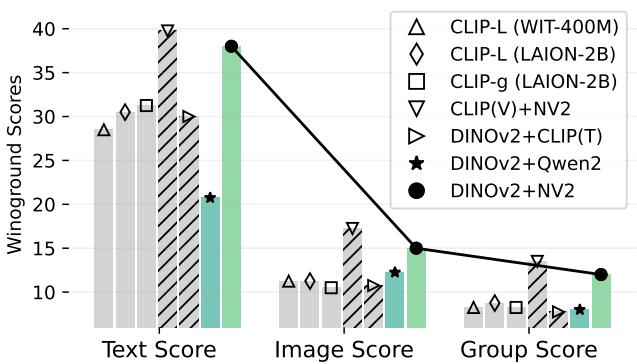
Figure 3 shows results on the Winoground benchmark, which tests whether a model can distinguish between sentences like “the child is biting the dog” vs. “the dog is biting the child.” Standard CLIP models (the first three bars) perform poorly here. However, when the researchers paired a vision model (DINOv2) with a strong pre-trained language model (like NV2), performance skyrocketed.
The conclusion? Unimodal models are inherently well-aligned. We don’t need to retrain the backbones; we just need a better way to connect them.
Part II: The Solution (SAIL)
Based on these insights, the authors introduced SAIL: Swift Alignment of Image and Language.
SAIL is an efficient transfer learning framework. Instead of training a massive model for weeks on hundreds of GPUs, SAIL freezes the heavy lifters (the vision and text backbones) and focuses solely on training a highly optimized connection between them.
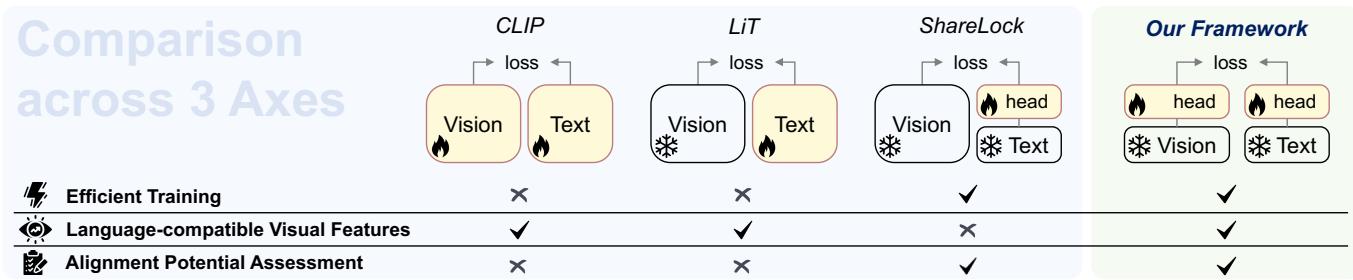
As Figure 7 highlights, unlike previous methods like LiT (Locked-image Text tuning) or ShareLock, SAIL optimizes for three things simultaneously: efficient training, creating language-compatible features, and assessing alignment potential.
The SAIL Pipeline
The architecture is elegantly simple. Because the backbones are frozen, the image and text data can be pre-encoded. You run the dataset through DINOv2 and the Language Model once, save the embeddings, and then train the alignment layer using only those embeddings.
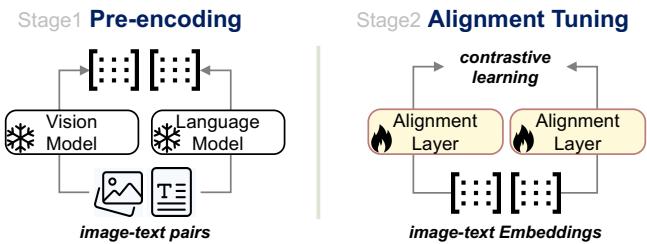
This trick, illustrated in Figure 4, allows SAIL to support massive batch sizes (up to 32,768) on a single A100 GPU.
The “Secret Sauce”: Three Optimizations
The authors didn’t just use a standard linear layer. They conducted ablation studies to find the perfect recipe for alignment.
1. The Alignment Layer: GLU Instead of a simple linear projection or a standard MLP (Multi-Layer Perceptron), SAIL uses a Gated Linear Unit (GLU).
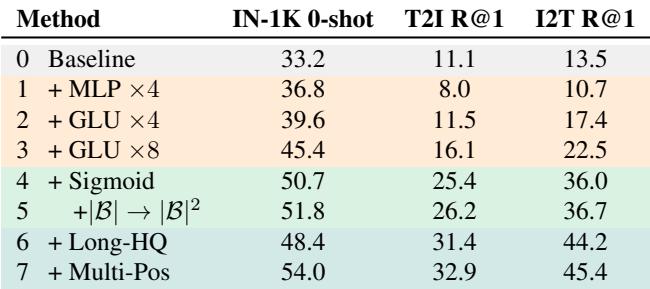
Table 1 shows the impact of this choice. Moving from a linear baseline (row 0) to a GLU architecture (rows 2-3) significantly boosts retrieval performance. The non-linearity helps map the complex manifolds of vision and language into a shared space more effectively than a rigid linear transformation.
2. The Loss Function: Sigmoid vs. InfoNCE Most contrastive models use InfoNCE (Softmax) loss. SAIL swaps this for Sigmoid Loss.
\[ \mathcal { L } ( \mathcal { I } , \mathcal { T } ) = - \frac { 1 } { | \mathcal { B } | } \sum _ { i = 1 } ^ { | \mathcal { B } | } \sum _ { j = 1 } ^ { | \mathcal { B } | } \log \frac { 1 } { 1 + e ^ { z _ { i j } ( - t \hat { \mathbf { x } } _ { i } \cdot \hat { \mathbf { y } } _ { j } + b ) } } , \]
Why Sigmoid? It treats every image-text pair as an independent binary classification problem (“Do these match? Yes/No”). This removes the need for global normalization across the batch, reducing computational overhead and making the model more sensitive to “hard negatives.”
3. High-Quality Data & Multi-Positive Loss Finally, the authors addressed data quality. Web data is noisy. Synthetic captions generated by modern Multimodal LLMs are detailed and accurate but can lack diversity. SAIL combines both.
They utilized a Multi-Positive Loss function:
\[ \mathcal { L } _ { \mathrm { M u l t i - P o s } } = \mathcal { L } ( \mathcal { I } , \mathcal { T } ) + \mathcal { L } ( \mathcal { I } , \mathcal { T } ^ { \mathrm { H Q } } ) , \]
For every image, the model learns to align with both the raw web caption (\(\mathcal{T}\)) and a high-quality synthetic caption (\(\mathcal{T}^{HQ}\)). This gives the model the best of both worlds: the breadth of web concepts and the precision of synthetic descriptions.
Experimental Results: David vs. Goliath
The results of SAIL are impressive, especially considering the resource disparity. The authors trained SAIL on a merged dataset of roughly 23 million pairs. For comparison, standard CLIP models are often trained on 400 million pairs.
1. Beating State-of-the-Art Efficient Methods
First, let’s look at how SAIL stacks up against other “efficient” training methods like ShareLock.
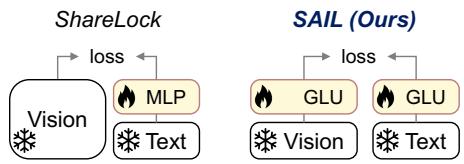
Figure 9 visualizes the architecture difference. While ShareLock uses a shared MLP, SAIL uses independent GLUs for each modality. The result is consistently higher performance across benchmarks.
2. Retrieval and Complex Reasoning
Retrieval tasks (searching for an image using text) are the ultimate test of alignment.
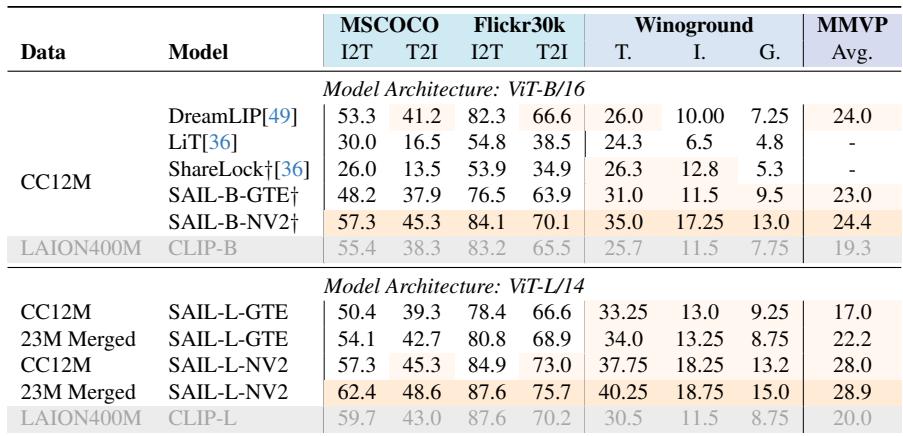
In Table 3, look at the comparison between SAIL-L-NV2 (trained on 23M samples) and CLIP-L (trained on 400M samples).
- MSCOCO Text-to-Image (T2I): SAIL achieves 48.6% vs. CLIP’s 43.0%.
- Winoground (Complex Reasoning): SAIL dominates with a group score of 15.0 compared to CLIP’s 8.75.
This confirms that using a pre-trained Large Language Model (NV2) as the text encoder provides superior reasoning capabilities compared to CLIP’s “bag-of-words” style understanding.
3. Visual Nuance and Granularity
One criticism of CLIP is that it often ignores fine details. It might recognize a “dog,” but miss the specific breed or the texture of its fur. Because SAIL uses DINOv2 (which is excellent at pixel-level understanding), it retains this granularity.
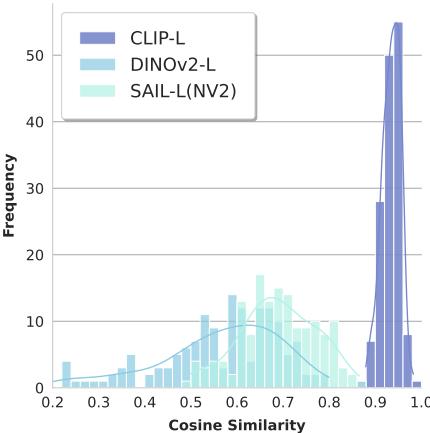
Figure 5 shows the distribution of similarity scores on the MMVP benchmark (which contains pairs of images with subtle differences). CLIP (orange) tends to rate distinct images as highly similar—it’s “blind” to the nuances. SAIL (green), mirroring the behavior of DINOv2 (blue), spreads the scores out, indicating it can successfully distinguish between visually similar but semantically distinct images.
4. Open-Vocabulary Segmentation
This fine-grained visual understanding translates directly to dense prediction tasks like segmentation (identifying pixels belonging to specific objects).
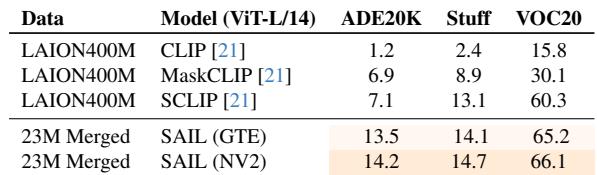
As shown in Table 4, SAIL outperforms CLIP and specific adaptations like MaskCLIP on segmentation benchmarks (ADE20K, VOC20). By aligning DINOv2’s patch-level features with text, SAIL allows for precise “zero-shot” segmentation without any specific training for that task.
Implications for Multimodal LLMs
Finally, the authors showed that SAIL isn’t just a standalone model; it can serve as a better “eye” for Multimodal Large Language Models (MLLMs) like LLaVA.
Usually, MLLMs use CLIP as their vision encoder. The authors replaced CLIP with the SAIL vision encoder (DINOv2 + Alignment Layer) inside LLaVA-1.5.
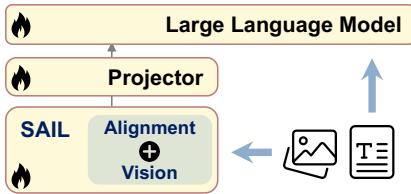
Table 5 reveals that the SAIL-L vision encoder (Row 2) boosts performance over the standard DINOv2 (Row 0/1) and beats the CLIP-L baseline (Row 3) on 5 out of 7 tasks. This proves that SAIL transforms the “raw” visual features of DINOv2 into “language-compatible” features that LLMs can easily understand.
Conclusion
The findings from this paper represent a significant shift in how we think about building Vision-Language Models.
- Don’t Reinvent the Wheel: We don’t need to train vision and language backbones from scratch. Strong unimodal models are already “platonic friends”—they just need a small nudge (alignment) to become a couple.
- Quality > Quantity: By leveraging pre-trained reasoning capabilities and high-quality synthetic captions, we can achieve SOTA performance with 94% less data than CLIP.
- Democratization: You no longer need a supercomputer to train a foundational VLM. With SAIL, a single A100 GPU and a few hours are enough.
As we move forward, frameworks like SAIL suggest a modular future for AI, where we continuously swap in the best vision and language components to build increasingly powerful multimodal systems with a fraction of the energy and data previously required.