](https://deep-paper.org/en/paper/2412.05826/images/cover.png)
Introduction
Imagine you are trying to build a 3D model of a cathedral using hundreds of photographs taken by tourists. You feed these images into a computer, and the software begins matching features: the curve of a window here, the texture of a brick there. But there is a problem. The cathedral is symmetrical. The north face looks almost identical to the south face.
To a human, context clues reveal that these are two different sides of the building. To an algorithm, they look like the same surface. The software, confused by this “visual aliasing,” stitches the north and south faces together. The resulting 3D model collapses in on itself, creating a distorted, impossible geometry.
In computer vision, these visually similar but distinct structures are called doppelgangers.
For years, Structure-from-Motion (SfM) pipelines—the technology used to reconstruct 3D scenes from 2D images—have struggled to distinguish between true matches and these illusory doppelgangers. Previous attempts to solve this used Convolutional Neural Networks (CNNs) trained on famous landmarks, but they often failed when applied to everyday scenes like office parks or residential streets.
In a recent paper, researchers from Cornell University and Visym Labs introduced Doppelgangers++, a new approach that significantly advances the state of the art in visual disambiguation. By abandoning traditional 2D CNNs in favor of 3D-aware features from a Transformer model, and by training on a vastly more diverse dataset, they have created a system that can tell the difference between a building’s “evil twins” with remarkable accuracy.
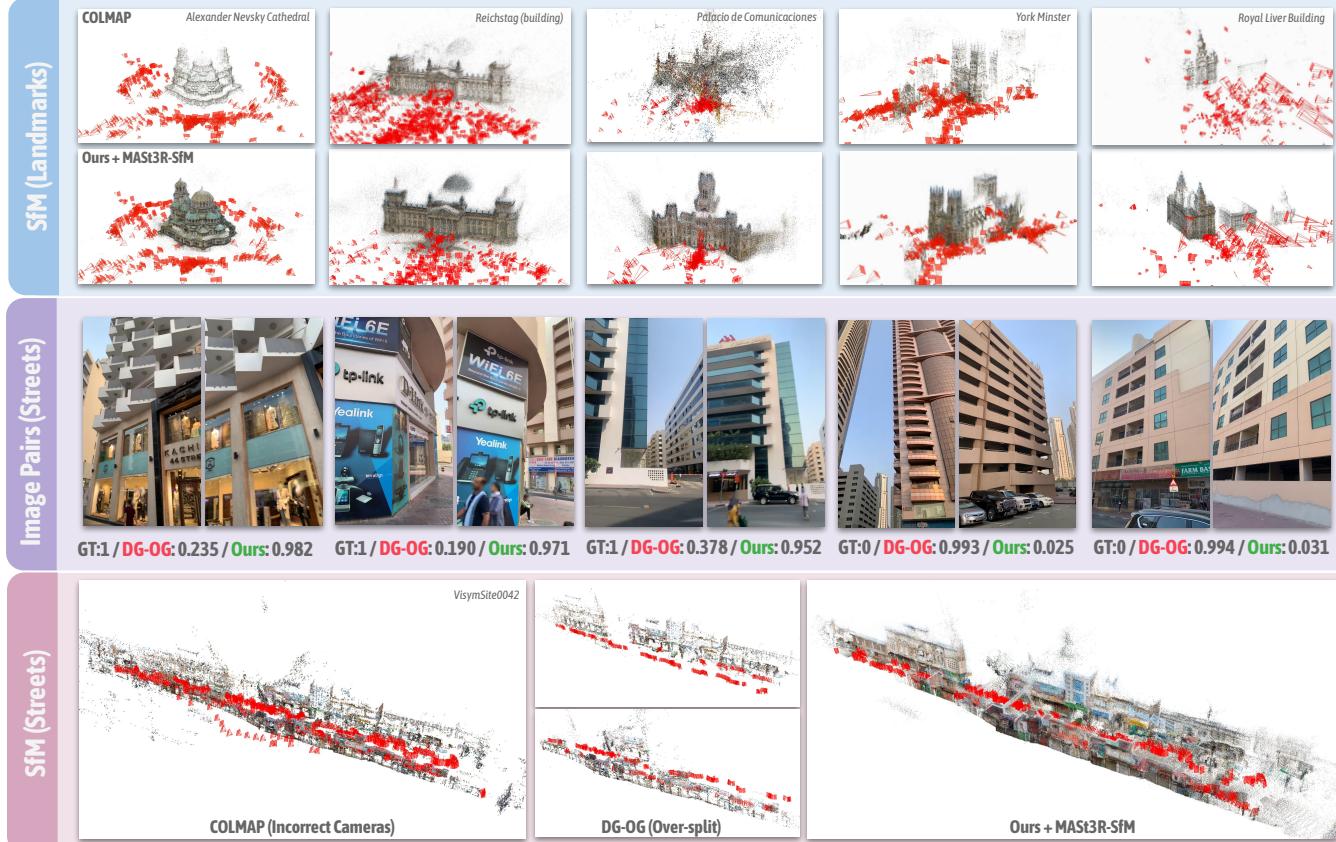
The Core Problem: Visual Aliasing in SfM
To understand why Doppelgangers++ is necessary, we first need to understand the vulnerability of standard 3D reconstruction pipelines.
Classic pipelines like COLMAP work by detecting local features (like corners or blobs) in images and describing them using algorithms like SIFT. They then search for matching descriptors across different images. If enough matches are found, the system assumes the images depict the same physical space and calculates the camera geometry.
However, modern architecture and urban environments are full of repetitive patterns. Symmetrical buildings, repeated window designs, and identical street lamps create visual aliasing. A feature matcher might confidently link a window on the left side of a building to an identical window on the right side. These spurious matches create “wormholes” in the scene graph, pulling distinct parts of the geometry together.
While previous work, specifically a method known as “Doppelgangers” (referred to here as DG-OG), attempted to solve this using a binary classifier to prune these bad edges, it had significant limitations:
- Brittleness: It required careful tuning of thresholds.
- Limited Scope: It was trained mostly on Internet photos of famous landmarks (like Big Ben or the Trevi Fountain), meaning it failed to generalize to “boring” everyday scenes.
- 2D Limitation: It relied on 2D image patterns, ignoring the rich geometric context that might help distinguish similar surfaces.
The Solution: Doppelgangers++
The researchers proposed a three-pronged strategy to overcome these limitations: better data, a better architecture, and a better way to measure success.
1. VisymScenes: Data Beyond Landmarks
One of the primary reasons AI models fail in the real world is domain shift. If a model is trained only on distinct, high-contrast historical monuments, it will struggle with the glass-and-steel repetition of a modern business district.
To fix this, the authors introduced the VisymScenes dataset. This dataset moves away from curated internet photo collections and utilizes data captured specifically for this task using the Visym Collector platform. It includes 258,000 images from 149 sites across 42 cities.
Crucially, these images come with GPS and IMU (compass) metadata. This metadata allows the researchers to mine for “hard negatives”—pairs of images that look visually identical but are geographically distant.
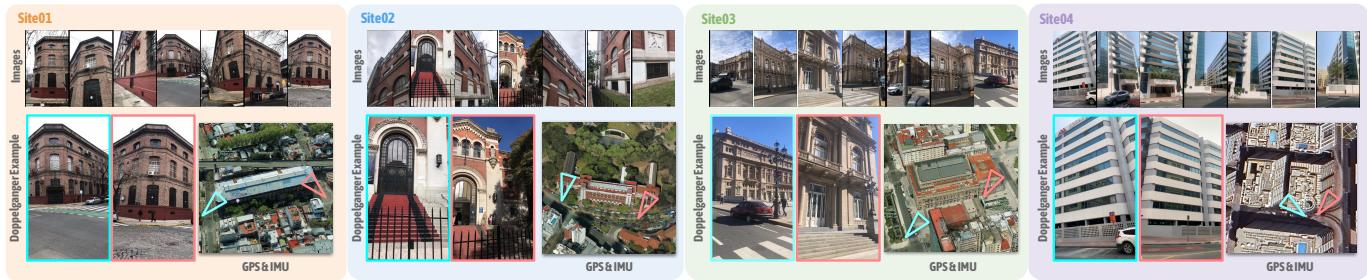
As shown in the figure above, the dataset captures mundane but challenging environments: brick residential blocks, endless rows of office windows, and repetitive street structures. By training on this data, the model learns that visual similarity does not always equal physical identity.
2. The Architecture: Leveraging MASt3R
The most significant technical leap in Doppelgangers++ is the move from standard CNNs to a Transformer-based architecture that leverages MASt3R.
MASt3R is a recent “foundation model” for 3D geometry. It is a Transformer trained to take image pairs and output dense 3D point clouds and matching maps. Because MASt3R is trained to understand 3D structure, its internal features contain deep geometric understanding—information that is critical for distinguishing doppelgangers.
Instead of training a model from scratch, Doppelgangers++ freezes a pre-trained MASt3R model and extracts features from its internal decoder layers.
The Pipeline
The process works as follows:
- Symmetrization: Transformers are sensitive to input order. The relationship between Image A and Image B might look slightly different to the network than B to A. To handle this, the system creates a symmetrized pair (feeding both A-B and B-A).
- Feature Extraction: The image pair is passed through the frozen MASt3R backbone. The system extracts multi-level features from the decoder blocks. These features encode how pixels in one image relate to pixels in the other in a 3D context.

The decoder features are mathematically represented as a sequence of operations where two branches (one for each image) exchange information:

- Classification Heads: These complex 3D features are then fed into lightweight, trainable Transformer heads. These heads are responsible for the final binary decision: Is this a true match, or is it a doppelganger?

Voting Mechanism
Because the system analyzes the image pair in both directions (A-to-B and B-to-A) using two different internal heads, it ends up with four different scores. To make a final robust decision, Doppelgangers++ uses a voting mechanism.
If the majority of the heads signal “Positive Match,” the system takes the maximum confidence score. If the majority signal “Negative” (Doppelganger), it takes the minimum score. This effectively pushes the decision toward the consensus, filtering out weak or uncertain predictions.

3. A New Benchmarking Standard
In the past, evaluating visual disambiguation was surprisingly unscientific. Researchers would run the reconstruction and manually inspect the 3D point cloud to see if it looked “broken.” This is subjective and hard to scale.
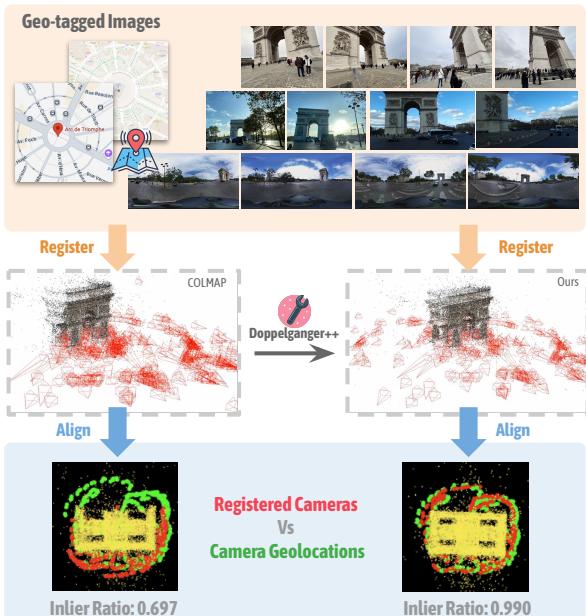
Doppelgangers++ introduces a quantitative metric using Geo-alignment.
The method uses third-party geo-tagged images (from Mapillary) as “probes.”
- The system reconstructs the scene using the Doppelgangers++ pipeline.
- It registers the Mapillary images to this reconstruction.
- It then compares the calculated camera positions of those images against their real-world GPS coordinates.
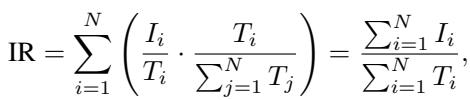
If the model is correct, the calculated positions will align perfectly with the GPS data via a rigid transformation. If the model is folded or distorted by doppelgangers, the points will not align. The researchers calculate an Inlier Ratio (IR) to quantify this alignment.
Experimental Results
The researchers subjected Doppelgangers++ to a rigorous battery of tests, comparing it against the previous state-of-the-art (DG-OG) and standard COLMAP.
Pairwise Disambiguation
The first test was simple classification: given a pair of images, can the model correctly identify if they are a true match?
The results showed that Doppelgangers++ significantly outperforms the baseline, especially on out-of-domain data. When tested on the Mapillary dataset (which neither model had seen during training), Doppelgangers++ maintained high precision and recall, whereas the CNN-based DG-OG model’s performance degraded severely.
SfM Reconstruction Quality
The ultimate test, however, is the quality of the 3D models. The researchers integrated their classifier into the SfM pipeline to prune false matches before the geometry was calculated.
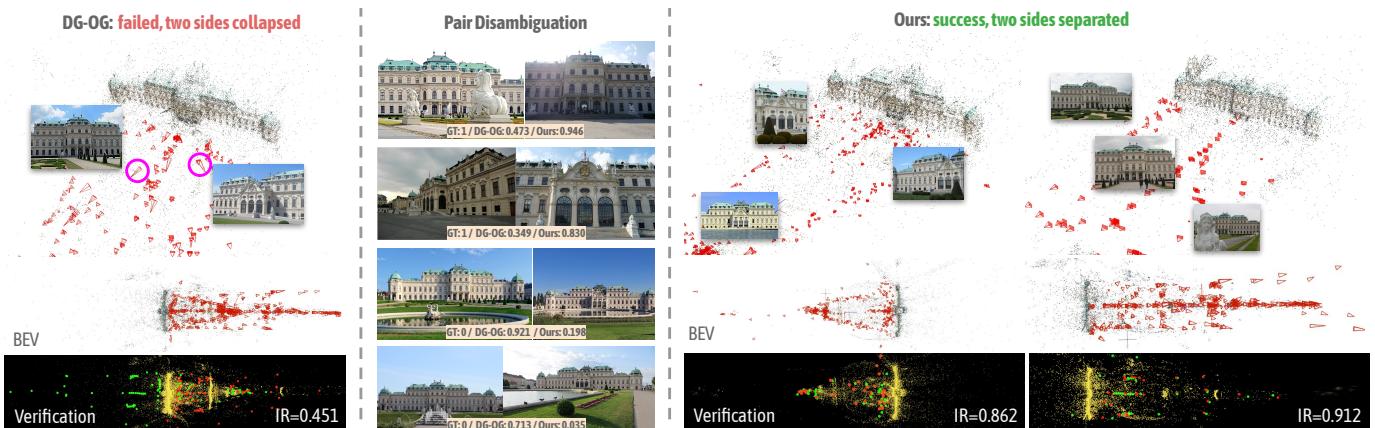
The visual results are striking. In the example below from the MegaScenes dataset, the baseline method (DG-OG) fails to separate the two sides of a building, causing the blue and green camera paths to collapse on top of each other. Doppelgangers++ correctly splits the model into two clean components.
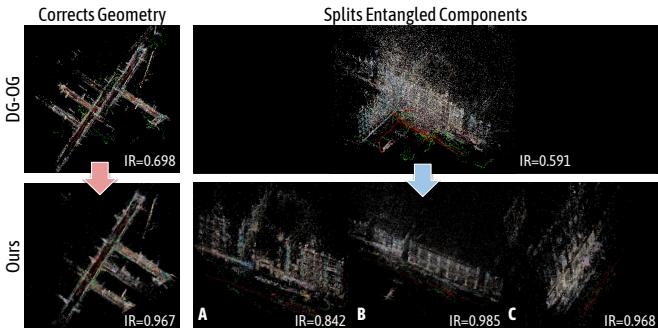
The robustness of the method shines even brighter on the challenging VisymScenes data. These everyday street scenes often lack the distinctive features of famous cathedrals, making them a nightmare for traditional algorithms.
Integration with MASt3R-SfM
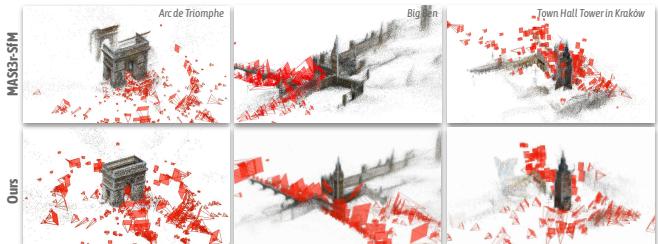
Interestingly, even the MASt3R model itself—which provided the features for this new method—is not immune to doppelgangers when used in its own native SfM pipeline (MASt3R-SfM). Because MASt3R is trained to find correspondences, it can sometimes be “too eager,” matching similar-looking windows that shouldn’t be matched.
The researchers showed that Doppelgangers++ can be plugged into the MASt3R-SfM pipeline to prune these matches, proving that the classifier has learned specific disambiguation logic that isn’t present in the raw foundation model.
Why does it work? (Ablation Studies)
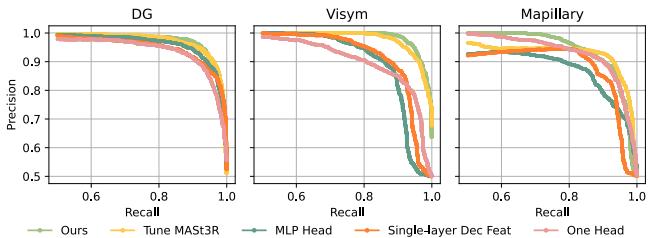
To ensure that the improvements weren’t just due to the new dataset or random chance, the authors performed ablation studies. They compared their Transformer head against a simple MLP (Multi-Layer Perceptron) and tested using only the final layer of features vs. multi-layer features.
The Precision-Recall curves below tell the story clearly. The proposed method (dark red line) consistently hugs the top-right corner, indicating high precision at high recall. The study confirmed that:
- Multi-layer features matter: The classifier needs deep and shallow information from the decoder.
- Transformers beat MLPs: The attention mechanism in the head is necessary to process the complex geometric relationships.
- Specialized Heads: Training a lightweight head on frozen features works as well as, or better than, fine-tuning the massive foundation model, while being much more efficient.
Conclusion
Visual aliasing has long been a thorn in the side of 3D reconstruction. As we move toward larger-scale digital twins and autonomous navigation in complex urban environments, the ability to distinguish “similar” from “identical” becomes critical.
Doppelgangers++ provides a robust solution by combining three key insights:
- Context is King: 3D geometric features (from MASt3R) are far superior to 2D patterns for detecting aliasing.
- Diversity Data: Training on messy, everyday scenes with GPS validation creates a model that works in the real world, not just on postcards.
- Objective Verification: Using geo-alignment for evaluation moves the field away from subjective “eyeballing” toward hard metrics.
By seamlessly integrating into existing pipelines like COLMAP and MASt3R-SfM, Doppelgangers++ paves the way for more reliable, accurate, and scalable 3D reconstruction of the world around us.